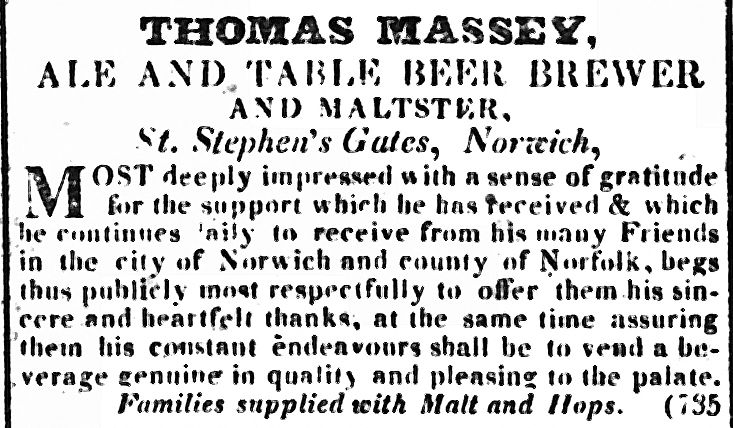
Back to my series of posts from 200 years ago, I think it might be useful to touch upon the brewery arrangement run by Thomas Massey. He advertised in the Norwich Mercury in March 1825 with this text:
“Thomas Massey, Ale and Table Beer Brewer and Maltster, St. Stephen’s Gates, Norwich. Most deeply impressed with a sense of gratitude for the support which he has received & which he continues daily to receive from his many Friends in the city of Norwich and county of Norfolk, begs thus publicly most respectfully to offer them his sincere and heartfelt thanks, at the same time assuring them his constant endeavours shall be to vend a beverage genuine in quality and pleasing to the palate. Families supplied with Malt and Hops.”
This was the St. Stephen’s Brewery which Massey operated and it was trading from the 1820s. He was still going into the early 1840s and by then he was brewing from the newly opened Champion pub (which is still there and I visited last year), which he appeared to own. In 1844, he decided that he would sell his entire operation off and that included the brewery, malting house, surrounding buildings and some land as well.
In 1899, following the death of Charles Crawshay, there was an interesting article in the local press which touched upon this brewery.
“It is with deep regret that we record the death of Mr Charles Crawshay, of Hingham, who passed away on Wednesday evening, after a very brief illness. The deceased was in his usual health on Tuesday, and enjoyed a long drive in his carriage in the forenoon, but shortly after his return he was suddenly seized with paralysis, which terminated fatally. Mr Crawshay was in his 85th year. Born at Rowfant, Surrey, the deceased gentleman, at the age of 18, went to the London firm of Messrs Charrington, Head, and Co., to undergo a three years training in all that pertains to a brewer’s business. In 1845 he took charge of his father’s St Stephen’s Brewery, Norwich, and in 1850 entered into partnership with Mr John Youngs (Youngs, Crawshay, and Youngs).
In 1876 by a maiden bid of £30,000 at auction he secured the Diss Brewery, which has since proved a valuable adjunct to the Norwich Crown Brewery, which latter has been recently converted in a limited liability company. For the greater part of the century Mr Crawshay has been a familiar figure in the county, and the older inhabitants of Norwich well remember his style and dash. He was one of the best “whips” in the neighbourhood, and the manner in which he handled his four-in-hand team was indeed a sight to witness. He subsequently turned his attention to yachting, and in 1852 his boat, the Kestral, won prizes at Cantley and Coldham Hall regattas and at Yarmouth water frolics. In 1856 he married Miss Cubitt, a relative of Sir William Cubitt, who constructed Lowestoft Harbour. The following year he served the office of Sheriff of Norwich, and received the thanks of the city for his services and hospitality.
On removing to Hingham in 1858 Mr Crawshay went in for farming, and gained considerable fame as a breeder of Southdown and cross-bred sheep. A keen sportsman, he was a big preserver of game. His love of sport is inherited by members of his family. His connection with politics was but slight, but he held that a parson should under no circumstances take part in magisterial affairs. By his death the poor of the district have lost a generous friend.”
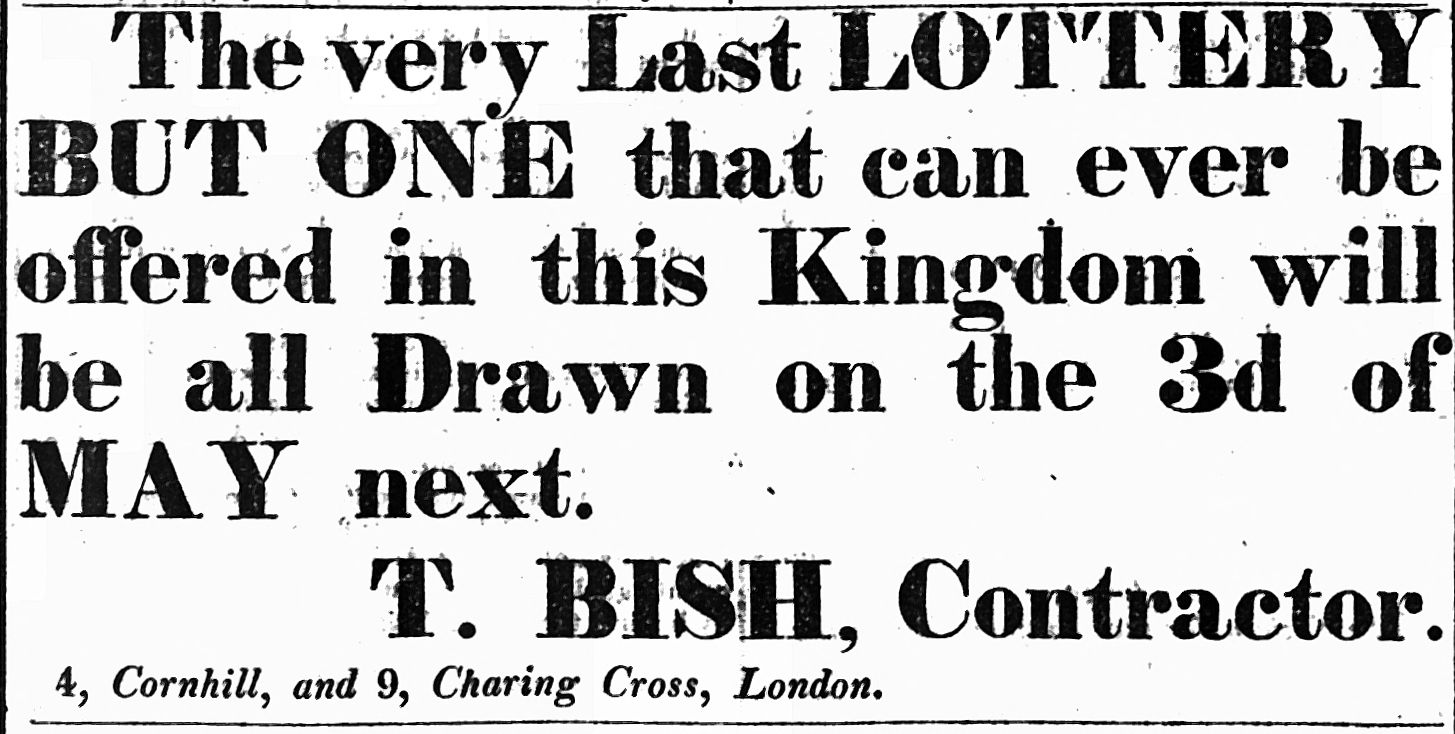
In the early 1820s, the British public was gripped by a peculiar form of gambling fever orchestrated by Thomas Bish, someone who seemed quite a character to say the least. The advert above was in the Norwich Mercury from 200 years ago, although the lottery arrangement was a national one.
Bish was the most prominent lottery contractor of his day and he turned the sale of state lottery tickets into a massive marketing spectacle. Operating out of offices at 4 Cornhill and 9 Charing Cross in London he managed to get his whole lottery system sanctioned by the state. He put bold ads in newspapers, such as the Norwich Mercury, he created eye-catching handbills and used humour in his adverts. He was ahead of his time.
The era of these grand lotteries came to a close in 1826 when the Government finally abolished the state lottery as it didn’t suit their needs. Bish did not go quietly as he campaigned vigorously against the ban and even managed to get himself elected as an MP for Leominster twice although his first win was unseated because of his Government lottery contracts. Bish advertised that it would be the last ever lottery conducted in the Kingdom, but then in the 1990s, John Major came along and introduced the National Lottery once again.
This is a court case from 21 July 1886, when John Gayford, a 19-year old labourer, was tried in the Guildhall in Norwich with the judge being Baron Pollock.
The crime was sexually assaulting a six year old girl for which he was found guilty and sentenced to six months hard labour for his offences. This seems unduly lenient to me from today’s standards, but one substantial change is that they were merrily naming the poor girl who had been assaulted. To give some context, and although it was a repeat offender, the court the same week gave a criminal twelve months hard labour for stealing 14lbs of plums.
The victim was Nellie Baldwin and in an earlier hearing it was decided that although the only witness to the crime was a five year old boy, the courts accepted that they would take his evidence into account. Nellie, aged six, her five year old friend and a baby in a pram all went out together for the day. When the group returned home, Nellie explained what had happened and a police doctor was called. Some of the case relied upon it must have happened as she was physically hurt and how else would a little girl be able to describe what had happened.
John Gayford went on to become a self-employed gardener, he married Rosanna and they had two children, Rosa and Florence. Someone guilty of his crime today would have likely left the area after they were released, but at the 1921 census he was living at 20 Northumberland Street in Norwich, just a short walk from where the crime took place. He lived there until his death in 1942 and I imagine that just about everyone not directly impacted by the crime had forgotten about it, in those days when searching for information was somewhat harder.
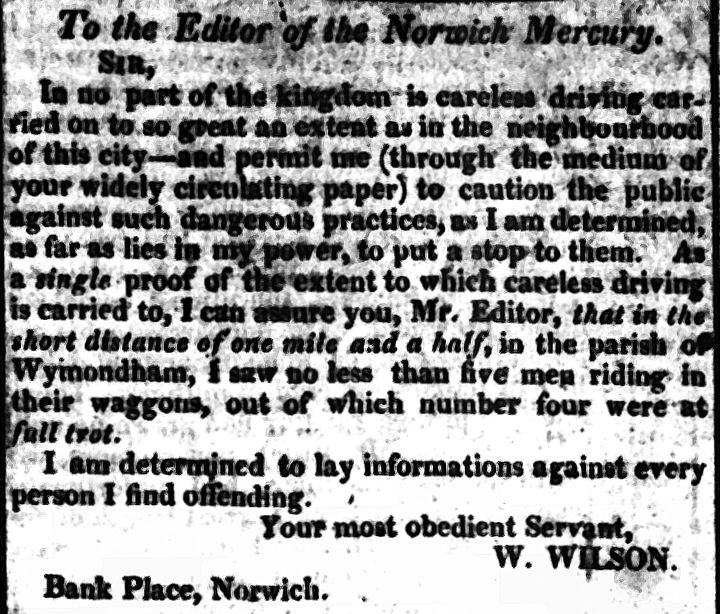
Another another article from 200 years ago this week in the Norwich Mercury from 1826.
“Sir, In no part of the kingdom is careless driving carried on to so great an extent as in the neighbourhood of this city—and permit me (through the medium of your widely circulating paper) to caution the public against such dangerous practices, as I am determined, as far as lies in my power, to put a stop to them. As a single proof of the extent to which careless driving is carried to, I can assure you, Mr. Editor, that in the short distance of one mile and a half, in the parish of Wymondham, I saw no less than five men riding in their waggons, out of which number four were at full trot. I am determined to lay informations against every person I find offending.
Your most obedient Servant, W. WILSON.
Bank Place, Norwich.”
Some things never change, whether men have access to carts or cars, some will speed…..
200 years ago there was a lot of crime in Norfolk and until 1823, there were 200 different crimes that could lead to execution if found guilty. The policy didn’t work and so was scrapped in 1823 to start to allow more prison sentences rather than executions. This wave of liberalism didn’t please everyone.
The newspaper reported this serious crime:
“On Saturday evening as Mr. Caddiwold, of Kimberley, was returning home from our market, he was stopped and robbed near the Forehoe Wood by three men, who to accomplish their diabolical object, fixed a rope across the road, and as soon as Mr. C. came in contact with it, one of the villains jumped up behind his gig and passed over Mr. C.’s head a piece of wood, with a joint in the middle, so as to form a gripe, in the shape of a pair of compasses; between which the robber held his head so fast that he was unable to stir, and at the same time demanded his money. Mr. C. alarmed at being thus suddenly placed in a situation where it was impossible for him either to escape or resist, begged to be let at liberty, and said he would give them what money he had. Upon which, another of the fellows who was standing at the horse’s head, called out “let a little looser,” which being done, Mr. C. gave them his pocket book, containing five pounds, and was then suffered to proceed home.—These daring villains made an attempt the same evening to stop Mr. J. Smith, of Kimberley, in the same way, but the rope fortunately was placed rather too high, and caught his hat, which flew off, and he escaped.—A man has been taken into custody, in whose possession this new invented apparatus was found, and has since been discharged.”
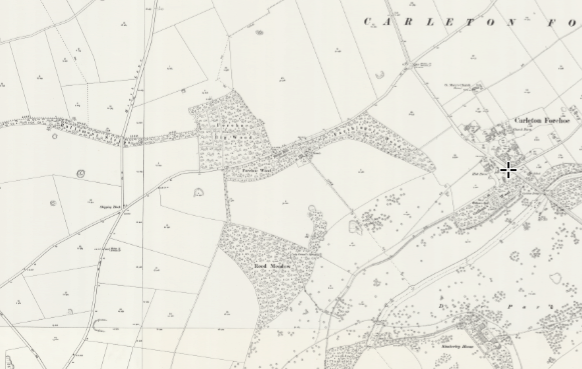
The incident took place at Forehoe Wood which is on the Norwich Road towards Kimberley, near to Carleton Forehoe. This area had seen incidents similar to this from the 1780s and so there must have been some terror for those travelling in this area.
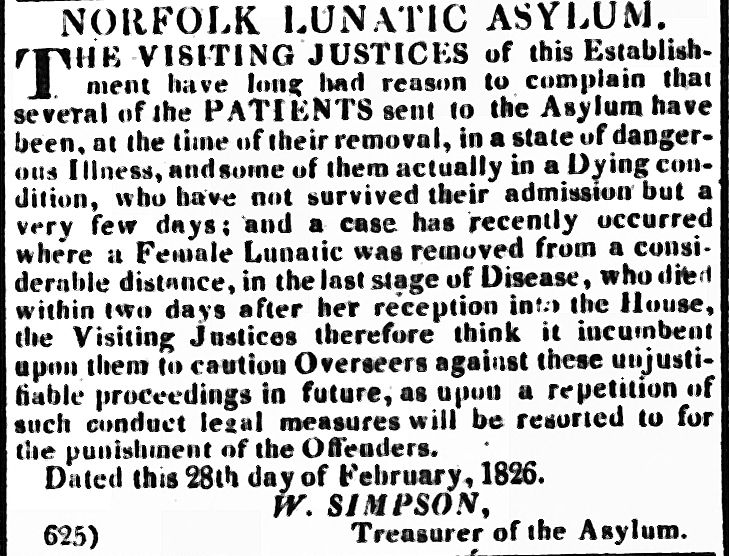
“NORFOLK LUNATIC ASYLUM : The Visiting Justices of this Establishment have long had reason to complain that several of the PATIENTS sent to the Asylum have been, at the time of their removal, in a state of dangerous Illness, and some of them actually in a Dying condition, who have not survived their admission but a very few days; and a case has recently occurred where a Female Lunatic was removed from a considerable distance, in the last stage of Disease, who died within two days after her reception into the House, the Visiting Justices therefore think it incumbent upon them to caution Overseers against these unjustifiable proceedings in future, as upon a repetition of such conduct legal measures will be resorted to for the punishment of the Offenders.
Dated this 28th day of February, 1826.
W. SIMPSON, Treasurer of the Asylum.”
And here’s the early welfare state system in action, where money has been raised to look after those with mental health issues at an asylum, but local parishes have been sending whoever they can to stop them being a problem to them.
The overseers in these parishes were tasked with managing the poor laws, although there wasn’t a great deal of money around and there was already some tension about who should be funding this. And there were extreme financial pressures as unemployment was rising, populations were rising and suffering was increasing. The joining together of parishes to provide workhouses was a handy way of hiding poverty, but I can imagine the keenness of the overseers to use the county asylum as a way of removing people from their parish.
I’ve posted numerous times before about just how bad mental health must have been at this time, they were very regular articles in the press in the 1820s about suicide and self-harm, but in the main, there must have been a lot of people struggling that had nowhere to go for help.
As an aside, the building is what became known as St. Andrew’s Hospital, although it opened in May 1814 as the Norfolk County Asylum. It remained in use as a mental health facility, later becoming part of the NHS in the 1940s, but closed in the 1990s following a move towards care in the community.
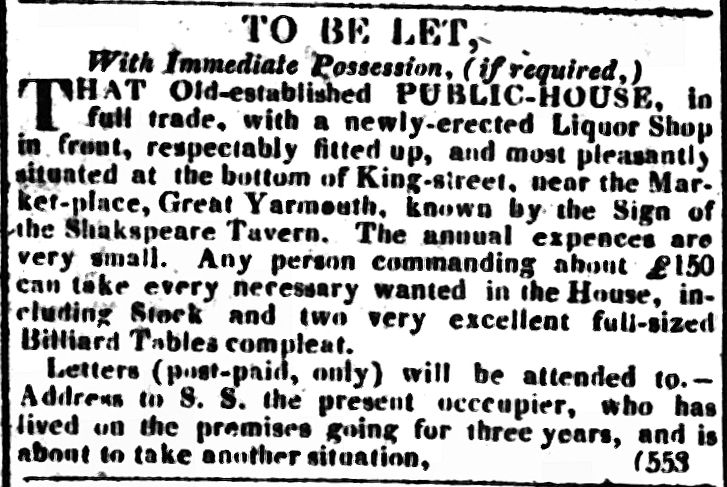
In the Norwich Mercury 200 years ago this week, it was advertised that the Shakespeare Tavern in Great Yarmouth was for let.
The advert read:
“THAT Old-established PUBLIC-HOUSE, in full trade, with a newly-erected Liquor Shop in front, respectably fitted up, and most pleasantly situated at the bottom of King-street, near the Market-place, Great Yarmouth, known by the Sign of the Shakspeare Tavern. The annual expences are very small. Any person commanding about £150 can take every necessary wanted in the House, including Stock and two very excellent full-sized Billiard Tables complete.
Letters (post-paid, only) will be attended to.— Address to S. S. the present occupier, who has lived on the premises going for three years, and is about to take another situation”
The SS referred to here was Samuel Smith, although I don’t know where he went from here. The pub had opened in around 1800, but it closed in the mid 1860s and was turned into a shop.
And another in my meanderings into newspapers from 200 years ago…. In February 1826, the Anchor Inn on Surrey Street was for sale at a public auction held at the Swan Inn in the city.
The auction listing said:
“An excellent freehold public house called the Anchor, with a cottage adjoining, in the parish of St. Stephen in Norwich with a frontage of thirty feet on the best side of Surrey Street. At the back of the house is a wash-house and a large yard and garden, well adapted for building.
This is now in the occupation of Messrs. Finch, Brewers and their under-tenant Robert Ramsey, and the Widow Tee. Land tax £2 2s. 0d.”
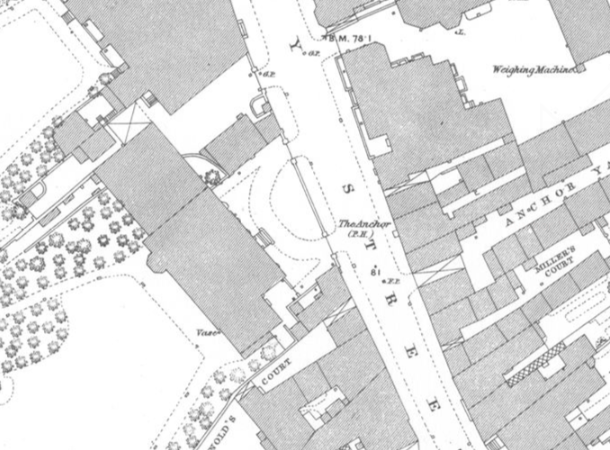
There’s the Anchor, although all of this on the north of Surrey Street has been trashed by the generic buildings (this one now known as Rosso) put up by Norwich Union and so nothing remains. It was located pretty much opposite the current entrance to the bus station.
The pub itself continued trading until 1913, having later been taken over by Steward & Patteson Brewery, although the building itself survived until after the Second World War. I think there’s only one photo surviving of the entrance to Anchor Yard, named after the pub, which is at http://georgeplunkett.co.uk/Norwich/S/Surrey%20St%2018%20to%2020%20[1027]%201936-06-14.jpg. I assume that’s the former pub building in the photo, although this photo is from 1936, so twenty years after the pub closed.
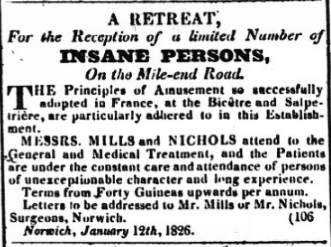
On my series of articles from Norwich newspapers of 200 years ago, there was an advertisement posted by two surgeons, Mills and Nichols, in the Norwich Mercury in February 1825. They were planning to open an asylum for “insane people” on Mile End Road, which is just off Newmarket Road in the city. They were intending to charge 40 guineas a year for treatment based on that from the Pitié-Salpêtrière Hospital in France.
What interests me about this pair, and this is another rabbit hole I’ll likely get lost in at some point, is that later in 1826 they opened their dissecting rooms in what I assume were premises nearby. This is in the period before bodies could legally be acquired in any number, so until the 1832 Anatomy Act, they were mainly sourced by body-snatchers. And on this, I can only suspect that Mills and Nichols were sourcing bodies in such a fashion. I will endeavour to find out more…..
Back to 200 years ago, as I’ve been neglecting this series of posts….
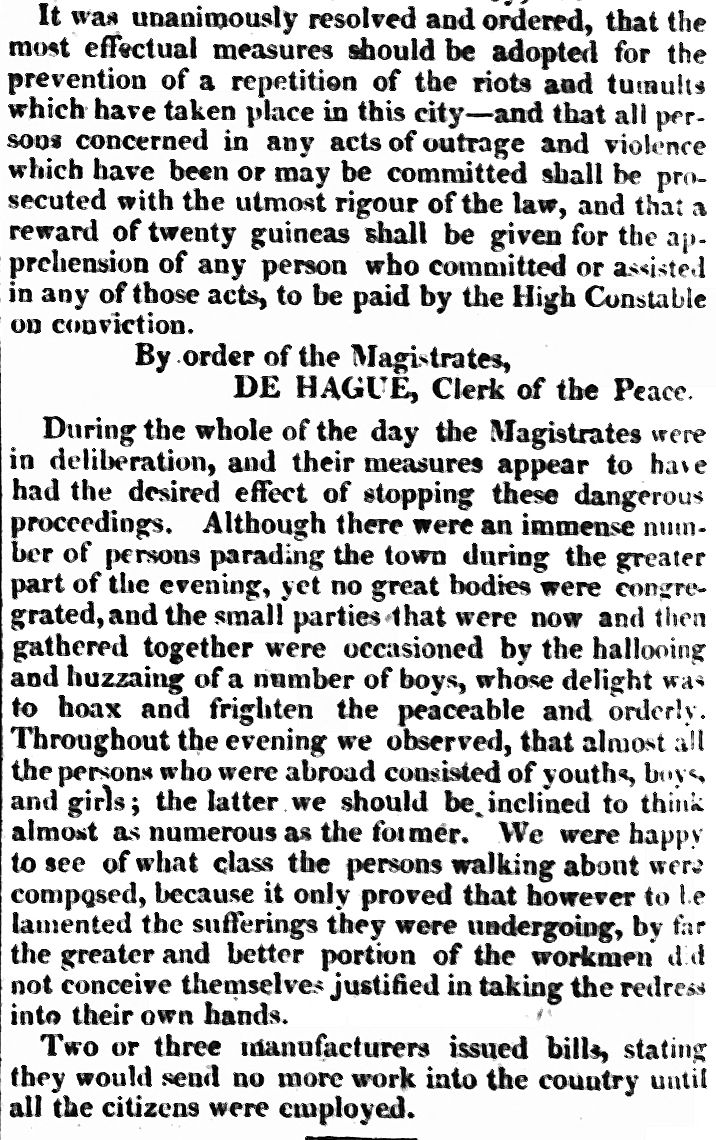
This is an article about the “State of the City” from the Norwich Mercury from February 1825, which I’ve pasted below. It shows just how tense matters were in the city, as the weavers in Norwich were upset by work being sent out to countryside where they suspected it was being completed for lower wages.
The manufacturer on Elm Hill found that their stock was destroyed, their premises smashed up and the rioters then ran amok damaging other locations in the city. The authorities acted in a robust manner to try and take back control, but manufacturers also decided to make a promise not to send any more work outside the city to try and calm the situation.
The magistrates took action anyway, they didn’t want a repeat of such occurrences in the city and they promised to take the firmest action possible against the rioters. And they were right to be concerned, the weaving trade was in a state of continued decline in Norwich and ultimately much work ended up being shipped out to Yorkshire in the 1830s. The 12,000 or so looms in Norwich in 1800 fell to under half that level by 1830, it was the beginning of the end of the trade that had led to so much wealth in the city.
“During the last few years, while the manufactures of the city have been in great and constantly increasing demand, the masters have been necessitated, notwithstanding the vast emigrations that have taken place from the country to the city, to send a large quantity of work into the country, where it has been manufactured. Great jealousy has existed for some time past between the city and country weavers, not only on this account, but because it was generally reported and as generally believed, that the wages were much less. The almost entire want of employment pervading the weaving population has turned the attention of the weavers to this point. The consequence has been, that on Tuesday evening about seven o’clock, having some suspicion, from seeing the Forncett carrier’s cart standing against the warehouse of Mr. Wright, a manufacturer, on Elm-hill, that he was about to send some work off to the country, the carrier was watched and seen to enter the warehouse with goods, but on his coming out, it was discovered that he was about to carry away a quantity of work. The weavers, who were assembled in a large body near the spot, drove away the cart, and after taking out the horse, completely destroyed it. They then as directly broke the windows in Mr. Wright’s factory.
Almost at the termination of these proceedings, Mr. Ald. Francis (the Deputy Mayor), Sheriff Brooks, J. J. Gurney, Esq. and several other gentlemen, came down to the spot, when Mr. Francis addressed the persons assembled, saying that every thing should be done for the purpose of relieving them, and requested their immediate and peaceable return to their homes. This address was received by them with loud shouts, and they quietly dispersed. On Wednesday morning a large body of weavers proceeded to almost all the public-houses from whence the carriers set out, and searched the carts. Some materials for work were found, and directly deposited in the Sword-bearer’s office, in the Hall—but we have not heard of any damage having been sustained either by carriers or innkeepers. The principal part of the day was thus passed, until between six and seven o’clock, when a large body of men came from Eaton, near this city, where they had seized some yarn. This they carried to the Hall, from whence they proceeded to Messrs. Willett’s factory, in Pottergate-street, where (these gentlemen being suspected of sending work out of the city) they demolished not only the windows, but the frames of the lower rooms.
Messrs. Bullamore and Hawkins’ warehouse, in Magdalen-street, Messrs. Bolingbroke’s, Brownfield’s, Willement’s, Herring’s, and several other houses, were visited, at each of which the proprietors were called for and questioned, both as to the quantity of work each had in the country, and as to whether they intended to send any more into the country while the citizens were unemployed. Answers to these questions having been satisfactorily given, no violence was offered. Mr. Purdy’s warehouse, in Peacock-street, was also very seriously damaged.
After the populace had been to the warehouses of the gentlemen we have mentioned, they proceeded to Mr. A. Beloe’s factory, St. John’s Timberhill, where, unfortunately Mr. Beloe being absent in London, and no person being present to address them, they immediately broke nearly all the windows of this extensive building, which is four stories high. The Deputy Mayor came about this time to the scene of tumult, where he immediately read the Riot Act. The market place then became thronged with people, where the Riot Act was again read by Mr. Francis, and a number of special constables sworn on. It was then deemed necessary to send to the barracks for the Scots Greys. Col. J. Harvey addressed the persons assembled upon the impropriety of their conduct, both at Mr. Beloe’s, in the Market, and on the Castle Ditches, and recommended their immediate return to their homes. At the Hall great discussion among the Magistrates took place upon the propriety of the Dragoons being sent for; fortunately there was no necessity to employ them. A party of special constables were sent to each of the manufactories, and the rest of the night was passed in quietude.
In the early part of the day, while very many weavers were assembled in the Market-place, they were addressed by Mr. Alderman Francis, who promised that he would call a meeting of the manufacturers, and urge the necessity of their not sending any more work out of the city while it was in its present state. Pursuant to this promise, many of the principal manufacturers met at the Hall—J. Harvey, Esq. the High Sheriff, (the chairman of the committee of manufacturers in this city) in the chair, and it was unanimously agreed that they would send no more work out of the city, and a paper was sent round for the signature of such manufacturers as were not present. After this was agreed upon, a deputation of the weavers were called in and acquainted with the fact.
The city on Thursday morning exhibited an unsettled and stormy appearance, and in the streets during the whole day were to be seen numbers of idle hands. In the morning the magistrates sent officers to summon every respectable inhabitant to the Hall for the purpose of swearing them on as special constables. A very large number were sworn in during the afternoon, and at half-past five they assembled, in case any fresh disturbance should take place. About four o’clock a part of Colonel Harvey’s Yeomanry Cavalry marched up to the Hall, where they received orders to proceed to Mulbarton, and put themselves under the direction of Dr. Beevor, the magistrate at that place, as it was surmised by the magistrates that Mr. Beloe’s factory there might be attempted. Shortly afterwards the Mayor issued the following bill:
Twenty Guineas Reward.—At a meeting of the Magistrates for the city and county of Norwich, held at the Guildhall on the 2d of February, 1826— It was unanimously resolved and ordered, that the most effectual measures should be adopted for the prevention of a repetition of the riots and tumults which have taken place in this city—and that all persons concerned in any acts of outrage and violence which have been or may be committed shall be prosecuted with the utmost rigour of the law, and that a reward of twenty guineas shall be given for the apprehension of any person who committed or assisted in any of those acts, to be paid by the High Constable on conviction.
By order of the Magistrates, DE HAGUE, Clerk of the Peace.
During the whole of the day the Magistrates were in deliberation, and their measures appear to have had the desired effect of stopping these dangerous proceedings. Although there were an immense number of persons parading the town during the greater part of the evening, yet no great bodies were congregated, and the small parties that were now and then gathered together were occasioned by the hallooing and huzzaing of a number of boys, whose delight was to hoax and frighten the peaceable and orderly. Throughout the evening we observed, that almost all the persons who were abroad consisted of youths, boys, and girls; the latter we should be inclined to think almost as numerous as the former. We were happy to see of what class the persons walking about were composed, because it only proved that however to be lamented the sufferings they were undergoing, by far the greater and better portion of the workmen did not conceive themselves justified in taking the redress into their own hands.
Two or three manufacturers issued bills, stating they would send no more work into the country until all the citizens were employed.”






![http://georgeplunkett.co.uk/Norwich/S/Surrey%20St%2018%20to%2020%20[1027]%201936-06-14.jpg](http://georgeplunkett.co.uk/Norwich/S/Surrey%20St%2018%20to%2020%20[1027]%201936-06-14.jpg)