
Category: Birmingham

  • GeoGuessr 2 – Birmingham (Primark)

    GeoGuessr 2 – Birmingham (Primark)

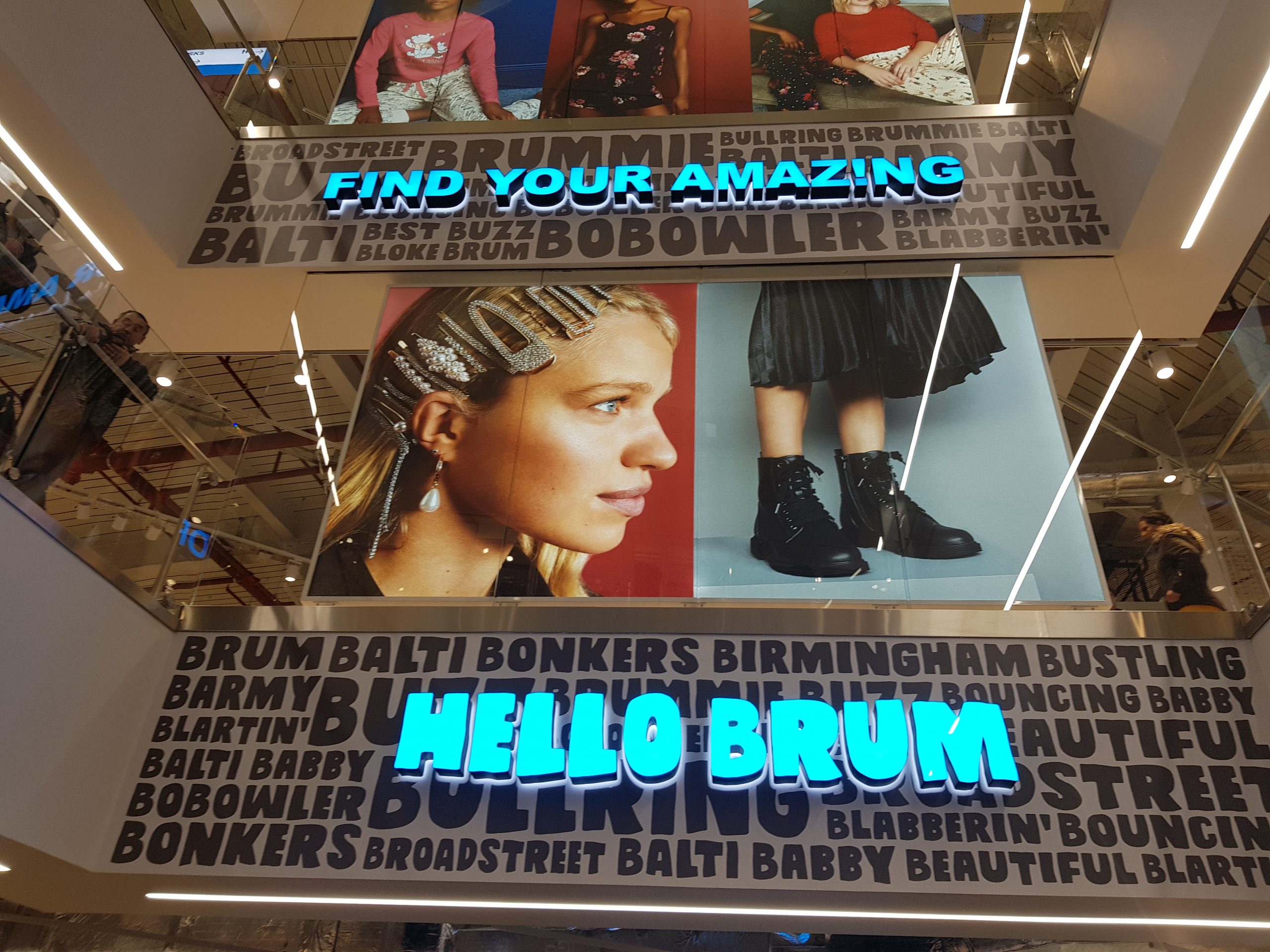
    I’ve now posted about Primark twice in a week, which is enough shopping blogging to last me for the next two years. This is an amazing shop though, it’s the largest Primark in the world and proof that the high street hasn’t entirely been buried by on-line shopping. Five floors, over 160,000 square feet, a barber’s shop, beauty studio and three dining options, that’s some shop.

    I won’t mention in too much detail about Nathan’s sliding down a mud bank in Birmingham the previous evening, but it did result in him needing new shoes and jeans. So, hence why we were in Primark, although I was also intrigued about seeing this vast piece of retail estate.

    I also won’t embarrass anyone, so I won’t name who it was, but when this person was buying his new shoes and jeans, he also gave his hat to the member of staff at the till. This confused the staff member as the hat didn’t have a barcode on it to scan, until Nathan, I mean, the person who I won’t name, remembered that was the hat he actually already owned and had come into the shop with.

    The coffee shop within Primark and there was also a restaurant next to it which specialised in pizzas, with its own impressive pizza oven visible on the counter. The prices in Primark are certainly bordering on the ridiculous in terms of how low they are, but the store is well managed, accessible and there were plenty of staff around the shop. So, all very lovely.

  • Birmingham – Barber Institute of Fine Arts (An Old Woman by Bernardo Strozzi)

    This artwork was painted by Bernardo Strozzi in Genoa in the 1620s and it’s not actually of anyone in particular. Instead it’s a study of old age and so wasn’t funded by some wealthy trader or influential politician from the period. The artist was also called il Cappuccino, likely derived from the Capuchin monks, as the coffee didn’t receive its name until much more recently.

    There doesn’t seem to be much provenance listed for this work, although the Barber Institute purchased it for £2,000 from the Hazlitt Gallery in 1966. I’m not very well placed to be an art critic, since I don’t know anything about art, but I thought that it was quite an eye-catching and powerful portrayal of the individual.

  • Birmingham – Birmingham Museum and Art Gallery (HP Sign)

    One of the HP signs which used to be on the company’s Aston Cross factory in Birmingham. The factory originally opened in 1875 and the iconic HP sauce first went on sale in 1903. This all went marvellously until 2007 when HP was bought out and production was moved to the Netherlands to save money, with the last production line closing on 16 March 2007. The factory was demolished and this sign is one of the few reminders of the site.

  • Birmingham – Barber Institute of Fine Arts (A Portrait of a Boy by Giovanni Bellini)

    This artwork was originally used as part of a lid of an inheritance chest and was painted in Venice in around 1475. I’m not entirely sure what an inheritance chest is (as opposed to any other chest) and an on-line search for the term just finds the description that the gallery have for this artwork. The information provided by the gallery does though add that the chest was constructed to hold the marble bust of Angelo Probi who died in 1474.

    Bellini was a Venetian artist who lived from 1430 until 1516 and I assume that he was quite prolific given how many of his artworks that still exist. The artwork was owned by the Holford family from at least the mid-eighteenth century and it was acquired by the Barber Institute in 1946 for £9,500.

  • Birmingham – Barber Institute of Fine Arts (Joseph Distributing Corn in Egypt by Bartholomeus Breenbergh)

    This artwork was painted by the Dutch artist Bartholomeus Breenbergh in 1655 and was purchased by the gallery in 1963. It shows Joseph distributing corn and it’s known that the location is in Egypt because of the obelisk. There’s another very similar painting to this which the artist painted in the previous year, although that artwork is now in private hands.

    There’s some provenance to this artwork, likely sold at an auction in Amsterdam during 1702 when works owned by the merchant and art collector Jan Agges were sold following his death. It was later purchased by P. Laendert de Neufville in 1756 who at the time was a wealthy merchant in Amsterdam, but he suffered severe financial difficulty in 1763 and after trying to pay his debts for some years the whole house of cards fell down in 1770. This explains the sale of the painting in 1771 to Fouquet and was later sold again in 1844.

    I still find the whole provenance of artworks such as this fascinating, as the route for this painting to end up in Birmingham is a long and complex one determined by some many different factors.

  • Birmingham – Barber Institute of Fine Arts (The Loggetta, Venice by Canaletto)

    I thought that this was a bemusing painting by Canaletto as he’s one of my favourite artists and this looks ridiculous. However, the information panel by the painting revealed the truth, which is that the top of the artwork was at some stage cut off. Bloody vandals…. It’s thought that it was to fit the painting above a door, with the top section of the Loggetta being painted out. The information panel doesn’t say, but I assume that it was cut down on the left hand side as well, as it looking irritatingly uncentred.

    The artwork was purchased by the Barber Institute in 1954 and it was during cleaning of the painting in 1964 that the painted out section at the top was revealed and then restored. The Loggetta, or bell tower, was constructed between 1537 and 1540 and the artwork was painted in the mid 1730s.

    I like paintings with provenance, and this is fortunately available for this one from throughout some of its history. It was purchased by the gallery from the art dealer Mr Edward Speelman in 1954 for £3,000 and it had been purchased at Sotheby’s in May the year before by a Mr. Murray for £2,300. Before that it had been owned by Sir Robert Mond who was an archaeologist and then before that it was owned by G. A. F. Cavendish-Bentinck MP, a prominent Conservative politician, who had sourced the painting from the art dealer Martin Colnaghi. Before that the artwork was owned by James Whatman who was the Liberal MP for Maidstone and West Kent and before that it was owned by George Gee.

  • Birmingham – Birmingham Library

    Birmingham Library replaced the former Central Library which was on a nearby site and which closed in 2013. I actually quite liked the old library and it’s a shame that it was only in use between 1974 and 2013, but the brutalist architecture never really appealed to many. Inside the library I remember that it was quiet, calm and peaceful, so at the time I had hoped that the new library wouldn’t be built when there were campaigns to save the old one.

    The escalators in the new building sweep visitors through the book stacks and it is an impressive sight. However, this library cost nearly £200 million and that seems a huge investment given that the previous building was still functional. I recall the fiasco that Birmingham City Council got into when they realised they didn’t have enough money to open their lovely flagship building, with proposed opening hours slashed nearly in half, although the situation seems to have improved a little since then.

    Books neatly shelved, although some of them are deliberately decorative and can’t be reached by visitors or staff.

    Another view of the escalator.

    The tower area of the building. I’ve visited this library before shortly after it opened and I visited again because I wanted to go on the terraces to get a view over the city centre. Unfortunately I decided that I’d come to the library at a time of inclement weather and so they had closed them off. I’m not actually sure what the inclement weather was since it was neither raining nor windy though….

    I’m not sure that I’ve seen so many Haynes manuals in one place before.

    Moveable book stacks. Secretly, I’d install these in my flat if I could.

    Long and wide aisles which makes browsing books easy, with the whole building feeling spacious and peaceful. The element that I most like though is the quantity of seating and there were numerous quiet areas. Norwich Central Library, which seems to find itself inconvenienced by having to have books (although it keeps flogging them off), has no such quiet areas without veering into the Heritage Centre.

    The library design is innovative and functional, something I’ve given up hope for in Norwich. Incidentally, it’s 25 years this month since the old Norwich library burned down, and I still think we’re in a worse place now than we were with that building. But there we go, I’m often displeased by something. But not by this library in Birmingham, it’s rather lovely.

  • Birmingham – Birmingham Museum and Art Gallery (Abolition Teapot)

    An abolition teapot produced in around the 1770s by Josiah Wedgwood & Sons in Stoke-on-Trent, with the text reading:

    “Health to the sick, honour to the brave, success to the lover and freedom to the slave”.

    Wedgwood was an abolitionist and spent a fair sum of his own money on supporting the campaign to end slavery. He later produced medallions of a slave in chains, with the message “Am I not a Man and a Brother?” which became an icon of the abolitionist movement.

  • Birmingham – Birmingham Museum and Art Gallery (Amiga)

    I’m not entirely sure that I like seeing items I used just a few years ago (well, twenty years ago) in a museum. This Amiga is in the collection of Birmingham Museum and once belonged to John Court, who has worked in the software industry and learned his skills on this computer.

  • Birmingham – Hooch

    There are occasions where I don’t look for exquisite craft beers and want a more simple drink. And Hooch, now rebranded for a modern generation (their branding, not mine) is an acceptable drink and I am unanimous in that  🙂

    “Hooch is about letting go, having fun, enjoying time with your mates and not taking life too seriously. Let the squares of the world sit and sip their pretentious try-hard concoctions, missing out on life’s simple pleasures and obsessed with image. Good times shouldn’t be complicated.”

    The above is from Hooch’s marketing material, and I assume they mean Fosters when they say try-hard concoctions, not delicious craft beer options…

    They also say that this is “the beverage of the people”. Sounds like the Greggs of the drinking world. Incidentally, there’s no connection between Hooch and Birmingham, it just happens to be where I had this particular bottle.