Category: Suffolk

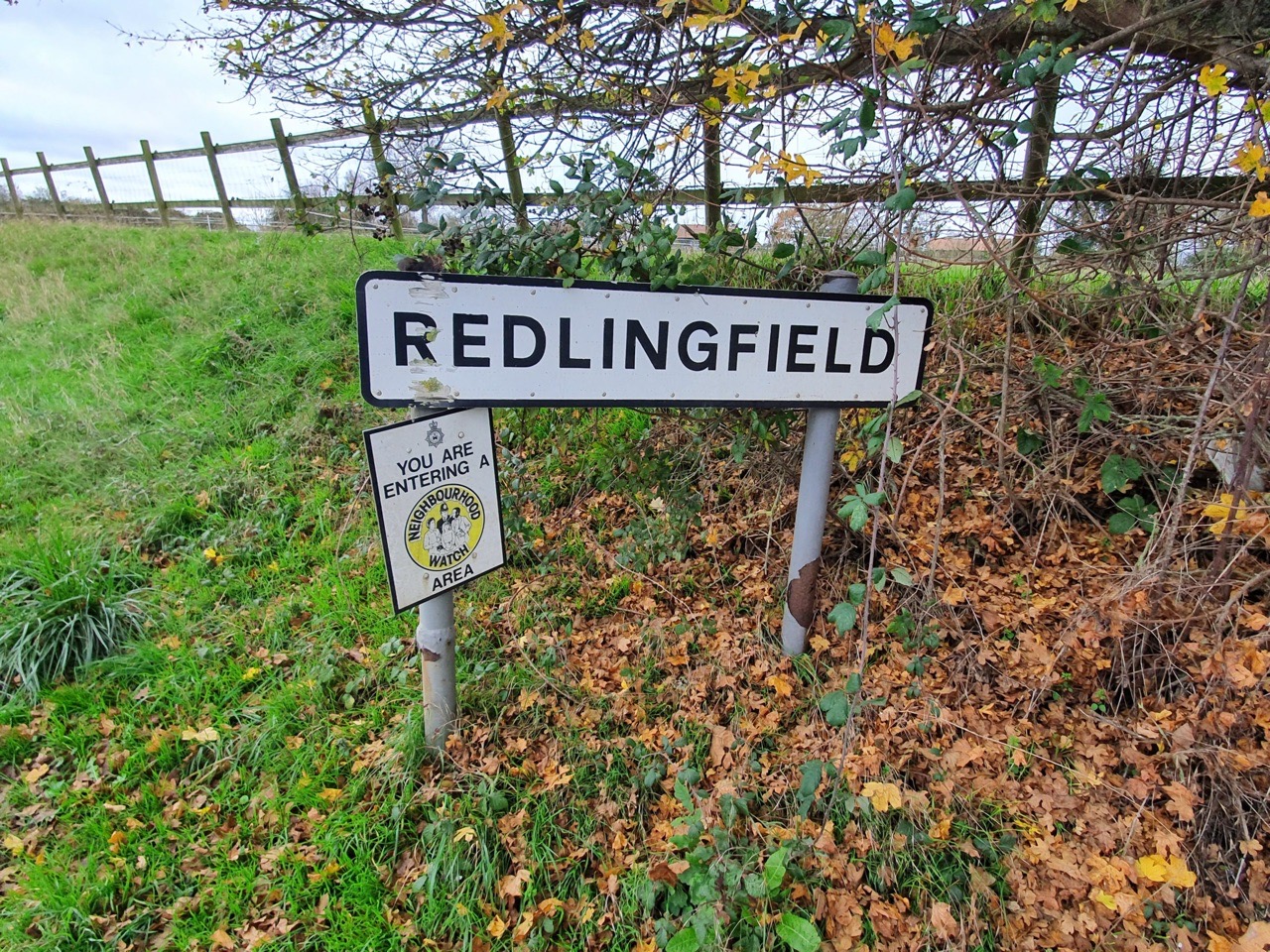
  • Redlingfield – Name Origin

    Redlingfield – Name Origin

    We meandered through Redlingfield on our 27-mile walk at the weekend and this is what The Concise Oxford Dictionary of English Placenames says…..

    Redlingfield, Suffolk. Radinghefelda in Domesday Book, Radlingefeld in 1166, Redlingefeld in 1203, Ridelingefeud in 1254 and Radelingfued in 1285. The feld of Raedel’s people or Raedla’s people. Raedel is found as the name of a moneyer.

    A moneyer is a person who mints coins, with feld meaning an area of open land, usually free of trees. As an entirely irrelevant comment, I admire that locals have kept such a long place name for so long, it would have been easy to just shorten it over time to something like Redling.

    The village is also where the Redlingfield Memorial is located.

  • Hoxne – Name Origin

    Hoxne – Name Origin

    The village of Hoxne in Suffolk that Liam and I walked through on our 27-mile walk…… It’s a slightly strange name (Hoxne I mean, not Liam) and this is what The Concise Oxford Dictionary of English Placenames says…..

    Hoxne, Suffolk. Hoxne in 950, Hoxa in Domesday Book, Hoxe in 1121, Hoxna in 1232. The place is on a spur of land between the Waveney and one of its tributaries. The name is probably OE hohsinu, meaning heel-sinew which, to judge by the later hockshin, hough, was probably used also in the sense of ‘hough’. The place was named from the similarity of the spur of land to the hough of a horse.

    That’s one of the more complex reasonings I’ve seen and it’s also of note that the place-name today is the same as in 950 (that reference is from the Cartularium Saxonicum).

    And the village sign, which was only introduced here in 2019. It makes reference in its design to the Hoxne Hoard that was found nearby and also to King Edmund (the King of East Anglia from 855 until his death in 869), who might have been martyred nearby. It would have been a clearer photo if we’d have got round the walk a little quicker I must admit.

  • Athelington – Name Origin

    Athelington – Name Origin

    I was quite intrigued by this village’s name and this is what The Concise Oxford Dictionary of English Placenames has to say about it….

    Athelington, Suffolk. Alinggeton in 1219, Athelinton in 1234 and Athelington in 1254.

    That’s a surprising consistent village name given the centuries which have passed. The dictionary then notes that the word origin is the same as the village of Allington in Derbyshire, which is “the tun of the Aelle’s people”. The ‘tun’ is an enclosure or farmstead and Aelle was an Anglo-Saxon leader from the fifth century, noted to be the first English king of lands south of the Humber.

    And, St. Peter’s Church at Athelington.

  • Athelington – St. Peter’s Church

    Athelington – St. Peter’s Church

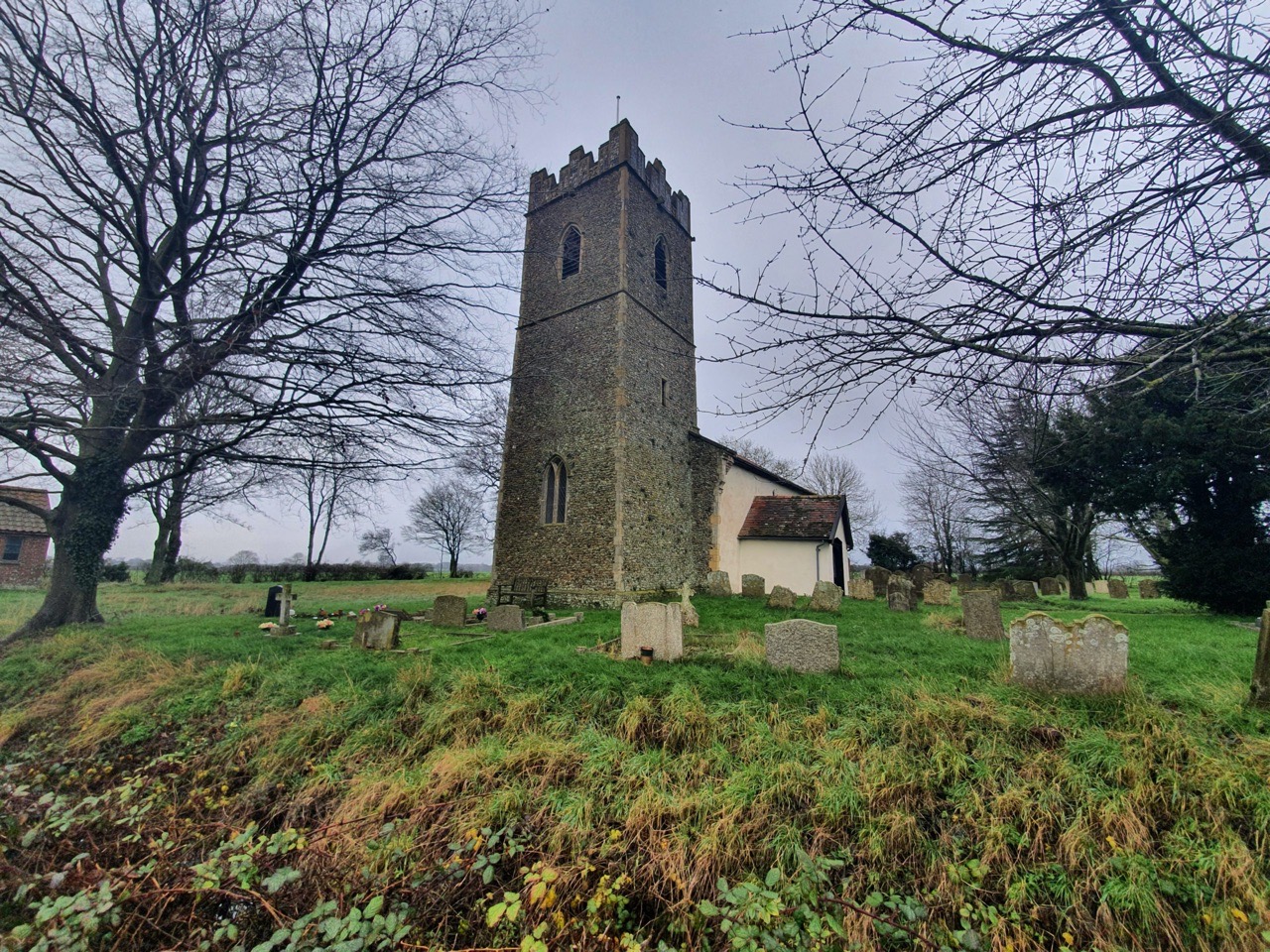
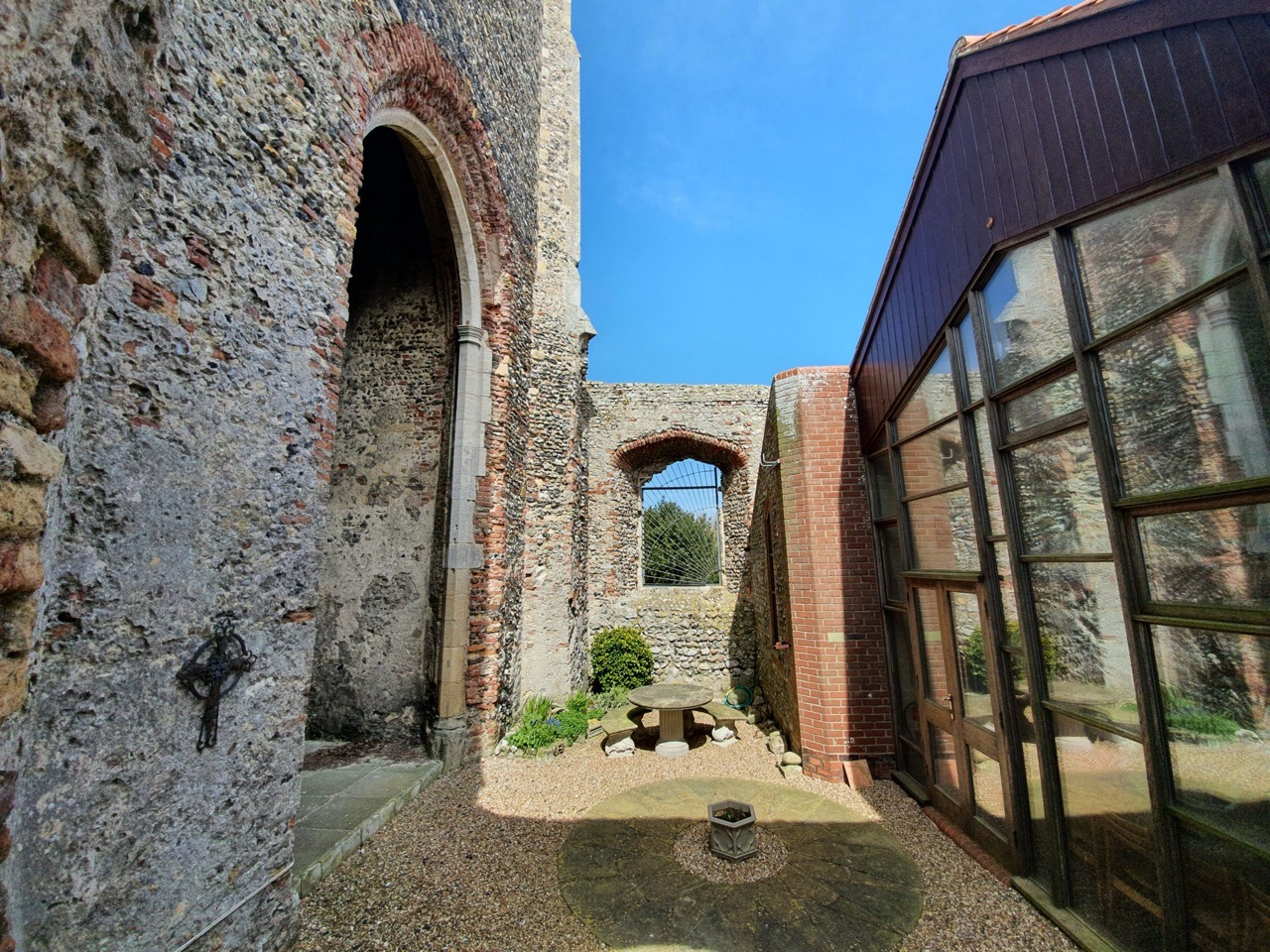
    This church dates from around the late thirteenth or early fourteenth centuries, although was faffed around with a fair amount during the Victorian period. There was an article in the Ipswich Journal in September 1873 which noted that the restoration had meant that “the building looks like a new church with an old tower” and added “the building had been in a horrible condition, but is now one of the prettiest churches in the county”. As an aside, the author of that article (an Ipswich man it seems) struggled to find the village and reported that he got lost, adding that “the village cannot boast of having a public house or a beer house”, which must have been quite unusual at the time.

    The west tower with its external staircase visible and there were also some older gravestones in the churchyard, some from the eighteenth century.

    There’s no separate chancel, it’s all a continuous structure with the nave.

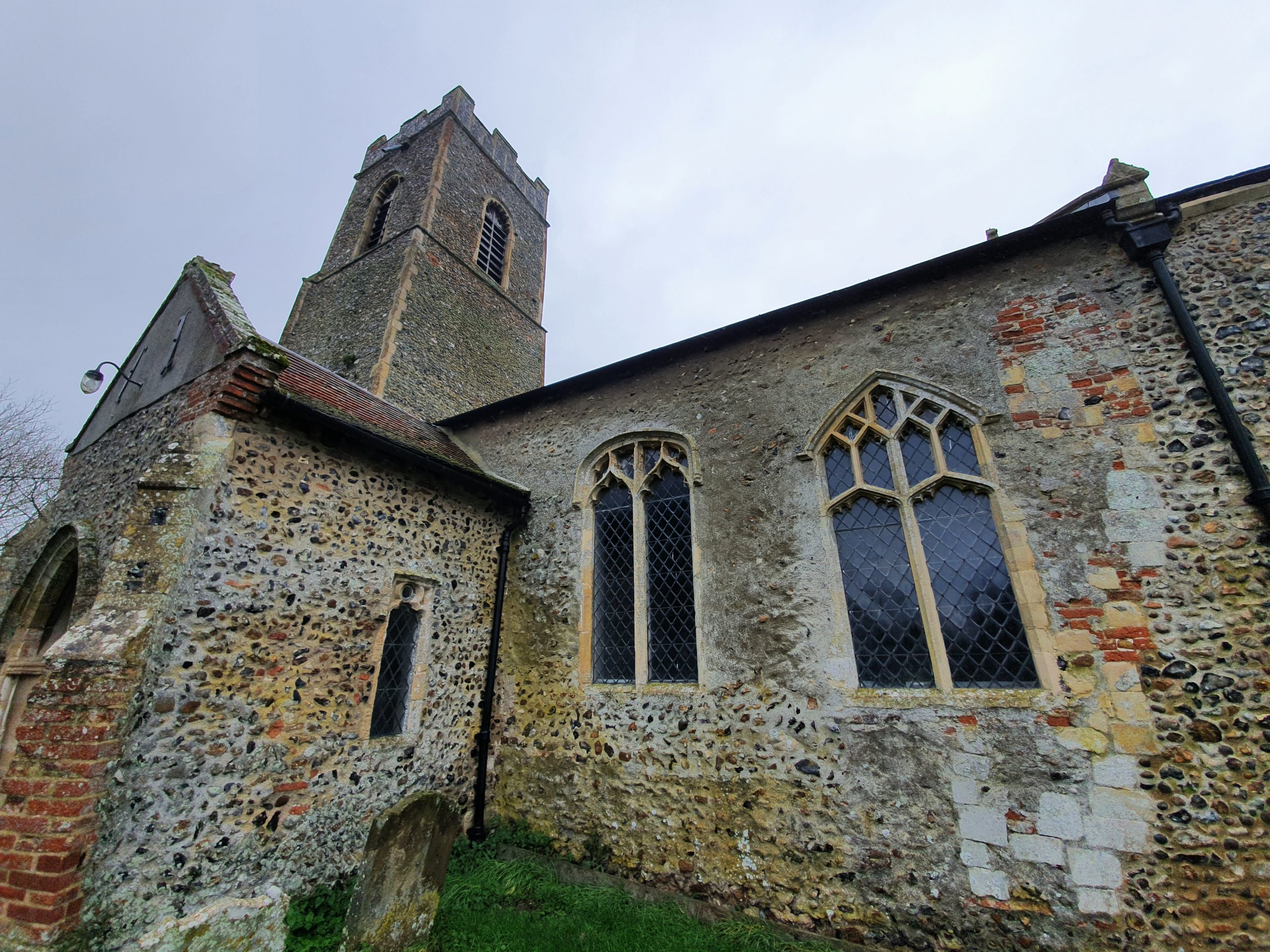
    The tower, which is mostly fifteenth century, was likely once taller and the top section has been knocked off, with a nineteenth century pyramid thing stuck on top. One improvement which was made, in my view, during the Victorian restoration was that this doorway was opened up again, as a previous generation had bricked it up.

    The listed building record notes that these corbel heads are nineteenth century, although I thought that they looked a little older.

    This flint porch addition is though more obviously from the nineteenth century and it replaced a wooden porch which it was thought at the time was contemporary to when the church opened. It’s a shame that such an historic structure has been lost for something that I think looks rather generic.

    The interior of the church was shut when we visited, although there are apparently some intriguing fifteenth century bench-ends still on the pews. The fourteenth century structure of the original roof is also still in place and the whole building seems to my very untrained eye in reasonably good condition. The Victorians tossed away the “dilapidated pulpit” for a new one made of oak, with the floor also being ripped out. I can’t help but feel the Victorian restoration didn’t much improve matters here in terms of the historic integrity of the church, but, perhaps without their intervention the building may have deteriorated and not survived.

  • Redlingfield – Redlingfield Memorial

    Redlingfield – Redlingfield Memorial

    This memorial was placed here in 2010, commemorating the ten crew who lost their lives on 19 November 1943, when the B-17G aircraft (registration 42-31123) they were in crashed at this site.

    This is the land behind the memorial, by the village green in Redlingfield. The aircraft had taken off from nearby RAF Horham and failed to reach the flying speed that it needed, so the pilot attempted to bank the plane to return to the airfield and it then stalled and lost power.

    There’s a memorial sign nearby which gives some information about the ten men who died:

    Pilot 2nd Lt Kenneth B Rongstad (born in 1922, single and worked as a photographer in Montana)

    Co-Pilot 2nd Lt Warren Franklin Mansfield Strawn (born in 1919, single and worked as a doorman in Missouri)

    Navigator 2nd Lt Richard E Diete (born in 1920, single and worked as a photo engraver in Illinois)

    Bombardier 2nd Lt Joseph F Spicer (born in 1920, single and worked as a printer in Illinois)

    Flight Engineer Staff Sgt Gail A Richmond Jr (born in 1924, single and worked as a tool worker from Pennsylvania)

    Radio Operator Staff Sgt Gordon V Sorensen (born in 1919, married and worked as a chauffeur and driver in Michigan)

    Tail Gunner Staff Sgt Kenneth Cosby (born in 1921, single and worked as a clerk in Ohio)

    Turret Gunner Sgt Ball Charles E Phinney (born in 1915, single and worked as a driver in New York)

    Waist Gunner Sgt Right Julius W Torok (born in 1919, divorced and worked as an aviation worker in Connecticut)

    Waist Gunner Sgt Left Louis M Mirabel (no details known)

    Which is certainly a wide spread of jobs and places of origin from across the United States, united only really by relative youth.

    (Copyright American Air Museum / Imperial War Museum, UPL 14979)

    BACK ROW

    S/Sgt Gordon V.Sorensen (radio), Sgt Julius W.Torok (right waist gunner),
    Sgt Charles E. Phinney (ball turret),Sgt Louis M. Mirabel (left waist gunner),
    Sgt Aloysious L. Godek, S/Sgt Agnew R. Eckert

    FRONT ROW

    2nd Lt Kenneth B. Rongstadt (pilot), 2nd Lt Strawn (co-pilot),
    2nd Lt Richard E. Diete (navigator), 2nd Lt Joseph M. Spicer (bombardier)

    Eckert and Godek weren’t in the crew when the aircraft crashed and the photo doesn’t include Cosby and Richmond.

    There’s more information at http://redlingfield.onesuffolk.net/home/local-history/the-second-world-war-2/b-17-crash-view-from-the-village/.

  • 27 Mile Walk from Eye

    27 Mile Walk from Eye

    I’ll write up separately some other interesting elements from this walk, but this was a rather lovely 27-mile walk today, starting from Eye.

    So, some photos from a day where we were fortunate with the weather. I haven’t turned some of the photos from portrait to landscape, so it might be necessary for anyone reading to turn their phone or computer…..

  • Sudbury – The Brewery Tap

    Sudbury – The Brewery Tap

    This visit dates back to August 2020 to the Good Beer Guide listed pub The Brewery Tap in Sudbury.

    Nathan was relieved to see that the bar billiards table was out of action, as he didn’t have his cue and he’s apparently out of form. I’ve rarely seen him in form, but there we go.

    It’s a sizeable pub, although it was nearly entirely empty when we visited on a Saturday afternoon.

    The community weren’t in the pub when we were there, but there was still a sense that this was a community-led pub, albeit welcoming to all. The landlord was helpful and tolerant that one of our group ordered some cheap lager, with table service being offered due to the current health situation. Everything felt clean and safe, so was well-managed. There are usually board games, books and the like to further amuse customers, although these had been temporarily removed for cleanliness reasons.

    This is a Mauldons tied pub, apparently the oldest brewery in Suffolk. They had four beers from the brewery on, the Mole Trap, the Silver Adder, the Suffolk Pride and what I consider to be their best known, the Black Adder. That’s the one that I went for and it was well-kept, at the appropriate temperature and had a suitably rich taste. It’s not as full-bodied as some stouts, but it’s slightly bitter and rather drinkable. And it’s also reasonably well distributed, I had one at the JD Wetherspoon operated Ledger Building in London a few weeks ago. Given the limitations on trade that existed when we visited, having four real ales was a real effort and they also have mini beer festivals here during the year.

    I can’t remember whether Liam or Ross were trying to play with the dog (I don’t know the name, but someone on a review is saying it’s called Silver) here, but this is one beautiful border collie. He kept us amused throughout the visit and we did think about whether we could trade Ross for the dog, but we decided we’d better not ask. He was also immaculately behaved (the dog, not Ross), poking his head out of the window to see other people and dogs go by. Every pub should have a border collie….

    I’m pleased to see that the pub has been relisted in the 2021 Good Beer Guide, all very much deserved.

  • Sudbury – Grover & Allen

    Sudbury – Grover & Allen

    Our weekend mostly consisted of visiting pubs in the Good Beer Guide, but there was a quick visit I thought I’d make, which was to the only JD Wetherspoon outlet in Norfolk and Suffolk that I haven’t been to. I accept that I need to get out more, but this also proved to be a handy breakfast spot.

    It’s not the most inspirational of buildings and it takes its name from the grocers who traded on this site between the 1870s and the early 1900s. They, as can be imagined, had a rather more beautiful and glamorous building, with the site taken over by the Co-op during the twentieth century, until it became a Wetherspoons.

    The breakfast which was perfectly adequate other than the egg was over-cooked. But, this isn’t an expensive breakfast, so I managed to cope with what was served. Someone appears to have pinched the pub’s milk jug though, as they didn’t have one and I was invited to just pour it from the 4-pint plastic containers that the pub had behind the bar.

    The reviews on TripAdvisor for this pub are pretty dreadful for a JD Wetherspoon outlet, mainly about cleanliness. I have to say, when we visited, it could have all been cleaner. Everything was keenly priced though and so there was little to complain about, but equally, there was nothing particularly exceptional. Anyway, that at least means I’ve visited every JD Wetherspoon in Suffolk.

  • Brandon – Brandon Railway Station Update

    Brandon – Brandon Railway Station Update

    Some good news from SAVE’s Britain’s Heritage who have issued a statement today about Brandon railway station. I must admit I’m surprised, although having written that, I couldn’t get any answer from Greater Anglia about this and they didn’t seem to really know what they were doing. They couldn’t even tell me if there was to be any salvage attempt at the building or whether any of the frontage could be kept.

    Anyway, SAVE’s press statement notes:

    “A delightful country station dating from the golden decade of railway building and used in the filming of Dad’s Army has received a reprieve from imminent demolition. A High Court order issued today quashed the decision by Breckland District Council to allow the demolition of the 1845 station building at Brandon on the Cambridge to Norwich line. This follows judicial review proceedings launched by SAVE Britain’s Heritage seeking the quashing of the Council’s decision.

    The Council had issued a lawful development certificate which said that Greater Anglia could construct a new car park under the railway permitted development rights. The Council accepted that they had failed to apply the legal test for what was railway land and overlooked SAVE’s representations.

    In its response to the legal challenge the Council consented to the quashing of the certificate. Greater Anglia did not resist the Court order. SAVE will now work with the Suffolk Building Preservation Trust on new plans for repairing this historic station and bringing it back to use. A listing application has also been submitted to Historic England – supported by SAVE – and we are expecting a recommendation imminently.”

  • Brandon – Brandon Railway Station (Again)

    Brandon – Brandon Railway Station (Again)

    A couple of years ago I posted about Brandon railway station, a pretty and quaint station which is a little similar in style to nearby Thetford railway station. Thetford is partially closed up, but Brandon is entirely closed up and the station buildings are falling down. And now there is a plan to demolish them entirely, which has seemingly been passed by the local council.

    Much as Greater Anglia annoy me occasionally, I’ve still been very impressed generally about their responsibility towards their railway infrastructure. But, it looks to me that there’s been a slight failure of communication here from Greater Anglia, who have presented nearly nothing about what they’re doing to mitigate the historic loss if the station buildings are demolished.

    I post on this blog quite a lot about the dreadful mistakes made in the past, indeed, just yesterday I whittled on about the demolition of a street in Norwich which was turned into a beautiful car park. And here, in Brandon, that’s what Greater Anglia wants to build. A car park that apparently needs the demolition of the station buildings, even though building a car park wouldn’t require their demolition so that all seems something of a misnomer. Perhaps the building is too far gone, but there’s no talk about saving any interiors, about keeping any part of the structure, about keeping the facade or indeed anything.

    There’s a news release from Greater Anglia which really seeks to shift the blame onto the Railway Heritage Trust, which strikes me as clever, but unfortunate. The news release seems clumsy to me as well, I’m really not sure that many people reading it are that engaged about improving drainage on the site that could be achieved by demolishing some buildings of not inconsiderable heritage.

    Personally, I think the demolition is something that will be regretted in years, rather than decades, but Greater Anglia does perhaps owe it to the public to actually state what they’re doing to preserve what heritage they can, rather than applaud their exciting new car park. Their logic about how it has been falling down for years with nothing being done also perhaps says more about Greater Anglia’s corporate responsibility rather than anything else. They’re spending a million pounds on this project and I’m struggling to see how they can manage to save absolutely none of the heritage in any shape or form with that level of funding.

    To those heritage groups fighting for the railway station, good luck….