Category: UK

  • Norwich – Ship (Two Julians)

    Norwich – Ship (Two Julians)

    20210309_125522

    This is a slightly different visit to those I usually write up, it’s a pub on King Street that unfortunately closed all the way back in 1969. It was known as the Ship, or the Ship Inn, and it is the building in the photo which is painted red. This means that I haven’t visited it, although Julian probably has in his younger days. Firstly, it’s useful to have a look at the photo that George Plunkett took of the pub in 1939 from a very similar position to mine. The main door of the pub is in the centre of the photo and the former cellar hatch is underneath the window just to the left of the door.

    The building was a licensed premises from at least 1760 and it was acquired by Youngs, Crawshay & Youngs in the nineteenth century and their branded pub sign is visible in George’s photo. The company was then bought by Bullards and then that was in turn acquired by Watney Mann. After closing its doors on 26 May 1969, it was then purchased by Norwich City Council who in the following years turned it into two residential properties. The ownership by Youngs, Crawshay & Youngs was rather handy as their brewery, the Crown Brewery, was located nearby on the other side of the road, so the beer didn’t have far to go.

    The brewery advertised in the Eastern Daily Press in September 1889 that a boozer was available (fortunately, the newspaper didn’t actually keep calling every pub that in the nineteenth century) opposite the Crown Brewery and this was taken on by James Catchpole and he ran it until he died in 1898 and his wife then carrying on operating it for another five years. There was a large auction in the pub in October 1889 which included 150 lots of “useful furniture” and if that wasn’t a sale on behalf of someone else, the recently deceased landlord Walter Blyth must have liked his chairs, tables and headboards.

    20210309_125545

    Ship Yard is located behind the pub and I won’t give any prizes for those who work out how it got its name. This is the entrance to Big Ship Yard and there’s an entrance to what was Little Ship Yard on the right hand side of the pub.

    Here’s a map from the 1880s which might make things a little clearer.

    20210309_125549

    The rear of Ship Yard and the buildings down here were demolished around 1970 and rebuilt to provide more modern accommodation. George Plunkett took a photo down here in 1938 and I suspect it might be the only one surviving of this courtyard.

    20210309_125534

    Quoting the great George Plunkett, he noted that “The yard to its south has at some time been partly built over, so that while formerly wide enough for the passage of carts it will now accommodate only pedestrians. The finely carved lintel above bears a design of foliage together with the rather contradictory inscription “Princes In”; it is believed that this was brought here at some time from the famous inn of that name, first mentioned in 1391, which once stood in St George Tombland parish on the north side of Princes St.” This feels a logical argument to me, meaning that this lintel could date back to the late medieval period or Tudor period with a bit of imagination.

    20210309_125701

    That’s the former main door to the pub and I rather like that those timber surrounds to the door are original. The building dates back to around the seventeenth century and was constructed from flint rubble and topped with a pantile roof. The casement windows, the ones either side of the door, are thought to date to when the building was constructed, although the sash windows are later.

    20210309_124856

    During the period after lockdown, Jonathan and I went on an expedition to look for all the parish boundary markers in Norwich. I need to return to the posts I’ve made about these and fix the broken images, but then Jonathan and I can start completing our project.

    The loss of this pub is a huge shame and I don’t say that about absolutely everywhere, although Julian often has a crack at that line of argument. There are no pubs remaining on the stretch of King Street and imagine the heritage of this building if it was still a licensed premises, I suspect that it would be something of destination real ale venue given the history. The building was listed in 1954 and it was that which perhaps meant that the city council decided against demolishing it and instead repurposed it, so at least it has survived in some form.

  • Charlecote House – Billiards Room (Painting of George Lucy)

    Charlecote House – Billiards Room (Painting of George Lucy)

    20250426_124032

    This painting is located in the billiards room of Charlecote House and it’s of George Lucy (1714-1786) who was also known as the Bachelor Squire. The painting is by Pompeo Girolamo Batoni (1708 – 1787) and it’s that which I’m most interested in here as George had a long and complex life that is far beyond any short blog post. Batoni became famous for painting members of the British aristocracy, and indeed many others, who were visiting Italy as part of the Grand Tour. George Lucy himself noted:

    “I have shown my face and person to the celebrated Pompeo Battoni, to take the likeness thereof. These painters are great men, and must be flattered for ‘tis the custom here, not to think themselves obliged to you for employing them, but that they oblige you by being employed.”

    George Lucy arrived in Naples in 1756 and soon realised that he didn’t quite look the part and he promptly asked for his clothes to be shipped from Charlecote to Italy. I’m not sure how you would go about doing that, as UPS weren’t quite fully formed at that point, but it didn’t do much good as the vessel they were on was promptly intercepted by Moorish pirates and his fineries ended up in Algiers. It was in 1758 that he moved onto Rome, with what I assume was a new wardrobe he had acquired out there, as he was clearly in no rush on this Grand Tour, and it was then that he commissioned Batoni to paint him. This was a considerable honour, the artist didn’t speed paint and he was careful what work he took on.

    Lucy paid 40 guineas for this artwork which was completed after he had left Rome and so it was shipped back, fortunately not being intercepted by pirates on this occasion. He looks very on-trend in the painting, he’s wearing fancy and fine clothes, he looks elegant and he looks very travelled. Batoni was often said to have inspired Thomas Gainsborough and on Lucy’s return he also had a painting commissioned by the British artist. The phrase Bachelor Squire was polite, he was known by others as the “wild bachelor”, obsessed with travel, society and food. I make no comment. Lucy found the process a bit of a faff, he had to sit on three occasions for Batoni and he wrote to his housekeeper at Charlecote that “he would not undertake to do me in less time”.

    Batoni’s paintings are scattered everywhere today, but this one of George Lucy hasn’t gone anywhere far since it was installed in Charlecote in the late 1750s. Along with the entire house, it was given to the National Trust in 1946.

  • Charlecote House – Billiards Room (Colonel Sir Henry Fairfax-Lucy)

    Charlecote House – Billiards Room (Colonel Sir Henry Fairfax-Lucy)

    20250426_123946

    This artwork is located in the billiards room at Charlecote House and is a painting of Colonel Sir Henry Fairfax-Lucy (1870-1944). The date of the artwork is unknown, but the artist was Alfred Edward Borthwick (1871-1955) and he has painted Fairfax-Lucy wearing the uniform of the Royal Company of Archers.

    As some background, he was born Henry William Fairfax on 25 September 1870 in Leamington Spa, Warwickshire and he was the eldest son of Sir William George Herbert Taylor Ramsay-Fairfax, 2nd Baronet, whose family seat was Maxton in Roxburghshire, Scotland. His education followed the conventional path for his class, attending Eton College and it was evident that he would go on to do great things. Upon the death of his father on 19 January 1902, he succeeded to the baronetcy, becoming the 3rd Baronet Ramsay-Fairfax-Lucy (the ‘Lucy’ having been added previously into what was becoming a ridiculously long name if I’m being honest, although I’d likely take a double barrelled name if I got a country house from the arrangement). Alongside the title, he inherited the family estate of Maxton and at this time has embarked on quite a successful military career. He also managed to become a chartered accountant, which doesn’t feel like an obvious fit alongside a military career and numerous political responsibilities, but I suppose that someone has to do it.

    As for the link with this property. On 26 July 1892, Sir Henry (then Henry William Ramsay-Fairfax) married Ada Christina Lucy (1866-1943). Ada was the eldest daughter and, crucially, the heiress of Henry Spencer Lucy of Charlecote Park. Her father had died in 1890, and Ada inherited the historic Charlecote estate. This marriage thus brought Charlecote Park, with its centuries of Lucy family history, into the sphere of the Ramsay-Fairfax family. Despite the historical significance and grandeur of Charlecote Park, Sir Henry reportedly preferred to live in Scotland, presumably at his ancestral estate of Maxton. Nevertheless, he remained involved in the parish life of Charlecote. During the Second World War, he offered his services in an advisory capacity to Winston Churchill, though this offer was apparently not taken up which I imagine Sir Henry felt was sub-optimal.

    I was interested in Henry (if I might call him that) as this was the last real period when the property was run as a country house. Following his death in August 1944, the baronetcy and the associated estates, including the financially strained Charlecote, passed to his eldest son, Sir Henry Montgomerie Cameron-Ramsay-Fairfax-Lucy (1896-1965), who became the 4th Baronet. It seems that there are numerous factors here including the more obvious death duties which would have been substantial. However, his interest in his Scottish estate did mean that there had been a lack of investment at Charlecote and it wasn’t in the best state of repair, another factor as to why it was all given to the National Trust in 1946. The decision was also clearly being made much earlier, as the Stratford-upon-Avon Herald reported on 1 June 1945 that the property was likely being given to the Trust, so discussions about this seem to have begun shortly after the Colonel’s death.

    So, as a painting, this feels important as Henry was a pivotal figure. I can’t imagine that he could have saved Charlecote in terms of keeping it as a family house, and the National Trust deal did mean that the family could continue to live in one wing of the property permanently anyway. His life was certainly an interesting one, even if he didn’t get to work for Winston Churchill…..

  • Food from Every Stall on Norwich Market (2025 Edition) – Week 9 and Jacket Spuds & More

    Food from Every Stall on Norwich Market (2025 Edition) – Week 9 and Jacket Spuds & More

    20250502_131700

    This week’s attempt to eat at every food stall at Norwich Market is Jacket Spuds & More, which we visited last time we embarked on this same project in 2023. Incidentally, for anyone thinking that we’ve done three visits this week, we have as I’ve been away which has disrupted our dining schedule no end. Since we made our last visit, jacket potatoes have undergone something of a revolution in this country and that’s to a large part down to social media. Operating from his van in Tamworth, Spudman has become something of a viral sensation and he’s been able to build up a large regular trade on the back of that. Following this have been numerous other retailers trying similar things and even Subway got into the action when they started to sell jacket potatoes in a trial that was launched a couple of months ago. I’m not sure whether that trend has impacted this stall on Norwich market, but I’m impressed at how many toppings that they offer here.

    20250502_131802

    The service from the two team members was friendly and I think that they thought I was nervous in ordering, when I was just faffing about deciding what to have. There is a wide variety of choices including jacket potatoes, sandwiches, toasties, breakfasts and omelettes. The reason for my delay is I was debating having something different to a jacket potato, but I decided in the end to stick with that as I’m sometimes not very adventurous. It was clear how to order (unlike last time when we got muddled up) and the whole service was efficient and helpful, with the team members checking if we wanted a drink or anything else with the food. The stall accepts card and cash, with the prices having gone up around £1 an item over the last two years.

    20250502_132611

    I opted for the jacket potato with chicken curry and no butter, which was £6. That heap of black pepper on the top is me and not them, I’ve made that look worse presented than when it was handed to me. I’m not usually one to opt for a jacket potato when dining out (pizzas make quite an appearance though), but this whole arrangement did surprise and delight me. The jacket of the potato was crispy, the inside retained some firmness but was cooked through and the chicken curry was plentiful and actually had some reasonable sized pieces of chicken in it. There was sufficient curry sauce for the amount of potato, with the portion size in general feeling generous.

    IMG-20250502-WA0003

    After standing about taking photos from odd angles, James started to eat the beef chilli jacket potato with extra cheese added that he’d ordered and he noted:

    “During a recent midday peregrination through Norwich, serendipity led me to partake of a rather exemplary tubercule en chemise. This was no quotidian spud, but a specimen of discernible, superlative provenance, its preparation evincing considerable culinary adroitness: the integument crisped to perfection, the interior exquisitely fluffy, and the whole presented with commendable aesthetic fastidiousness at an eminently suitable thermal point. Crowning this farinaceous marvel was a generous impartation of piquant bovine concoction – a beef chilli of satisfying depth – further embellished by a liberal cascade of molten caseous adornment. The resultant gustatory experience, an agreeable amalgamation of textures and flavours, represented remarkably judicious expenditure considering the modest pecuniary outlay. One departed thoroughly gratified by this unexpectedly sophisticated rendition of humble fare, acknowledging the substantial contentment derived from its consumption.”

    In short, he liked it, even though he managed to spill some on his trousers, nearly choke halfway through and have chats with about ten people he knew. Talk about a social butterfly.

    All told, I thought that this was a really decent visit that was really most lovely. The service was polite, the potato and the topping had a depth of flavour, there were a range of textures and it felt like value for money.

  • Charlecote House – Billiards Room

    Charlecote House – Billiards Room

    20250426_124443

    I can’t imagine that I’ll ever need to live in a large house, not least as it would be expensive to heat, complex to maintain and I would fill it with books. But, if I did, I’d have a snooker table in it. Putting that thought to one side, this room is located on the ground floor of Charlecote House and is part of the original Tudor house and was part of a suite of three rooms and it might have been a bedroom. It was later changed into a dining room but was remodelled under the guidance of Mary Elizabeth Lucy to become a billiards room in the 1850s and the Elizabethan style ceiling was installed here at the same time.

    These billiards rooms were the on-trend thing to have in country houses in the late nineteenth century, a place for gentlemen to retire after dinner to smoke, drink port and play billiards (this was before the time of snooker being commonplace).

    20250426_123823

    The room guide told me that when the National Trust acquired the house they got rid of the original snooker table, which had some considerable heritage, as they didn’t intend to put it on display when they laid the room out as a dining room. When they decided later on that they did want to put one on display they then couldn’t get back the one they’d flogged off which all feels a bit sub-optimal. The replacement table has the annoying attribute that there are two baulk lines slightly out of alignment. The room guide also said that the National Trust believe that the lighting set-up above the table is original, that apparently went into storage but they were able to recover it (there’s a pun there about re-covering a billiards table, but I won’t labour that point).

    20250426_123907

    The rules of billiards are on the wall and they certainly go into some detail here. Anyway, this was one of my favourite rooms in the property and I’ll just have to console myself that I won’t ever own a snooker table, but maybe a bar billiards table one day….

  • Charlecote House – St. Leonard’s Church (Christina Cameron-Lucy)

    Charlecote House – St. Leonard’s Church (Christina Cameron-Lucy)

    20250426_144453

    I’m rather more interested in the graves and memorials of the less wealthy, such as William Malins, but it’s hard to entirely ignore the wealthy and this is the memorial located in St. Leonard’s Church at Charlecote commemorating Christina Cameron-Lucy (1845-1919). Born Christina Campbell, she married Henry Spencer Lucy (1830-1890) at St. George’s Church in Hanover Square in London in 1865, so there’s some considerable decadence there. In 1898, she decided to take the surname of Cameron-Lucy to bring the two families together in her name. There’s a disconnect here as Henry is buried at Charlecote, but circumstances meant that at this stage Christina decided to let the entire property out.

    Christina is buried in the Cameron of Callart Mausoleum, which has fallen into a state of slight disrepair, although bits of it have been repaired relatively recently. Indeed, her memorial at Charlecote refers to her as Christina Cameron Campbell of Callart, this link was important to her. Christina and Henry had four children, Ada Christina Lucy (1866-1943), who married Sir Henry Ramsay-Fairfax (later Fairfax-Lucy), Constance Linda Lucy (1867-1955) who married John Secker, Sybil Mary Lucy (1868-1886) and Joyce Alianore Lucy (1871 – 1948), unmarried.

    There’s a story somewhere here about why Christina decided not to be buried with her husband, I assume it’s because she felt a greater affinity to her Scottish roots although I wonder what Henry would have made of that.

  • Charlecote House – St. Leonard’s Church (William Malins)

    Charlecote House – St. Leonard’s Church (William Malins)

    20250426_145414

    This grave is located outside St. Leonard’s Church at Charlecote as I’m rather engaged, or as much as anyone can be, with burials at what are effectively country house churches.

    William Malins was born in 1781, the son of William Malins and Elizabeth Malins, and he married Catherine Smith in the church on 18 July 1820, although this would have been in the medieval building that was demolished and rebuilt after his death. He lived long enough to appear on the first census in 1841, which noted that he was 60, his wife was 55 and he had a son George Malins, aged 20, and a daughter Emma Malins, aged 17. The census also noted that he was a farmer and this would fit, as his family had owned a farm at Ettington, which is in the neighbouring village to Charlecote. William died on 29 August 1843 and was buried on 2 September 1843.

    There’s an interesting question which underlies this which is whether William Malins would have had any social interactions with the owners of Charlecote Park, namely George Lucy and Mary Elizabeth Lucy at the time. It was likely that Malins was a tenant farmer, as that was the most common set-up in this period, paying rent to the Lucy family and perhaps (but not necessarily) having something of a long tenure. Although I like to imagine that William would have popped down to Charlecote House to have his lunch, it doesn’t seem entirely likely, although perhaps he was in the same fox hunting brigade. William is buried outside of the church, whereas the Lucy family had their own chapel inside, so I’m imagining that in life, as in death, they were kept close but still separate.

  • Charlecote House – St. Leonard’s Church

    Charlecote House – St. Leonard’s Church

    20250426_144143

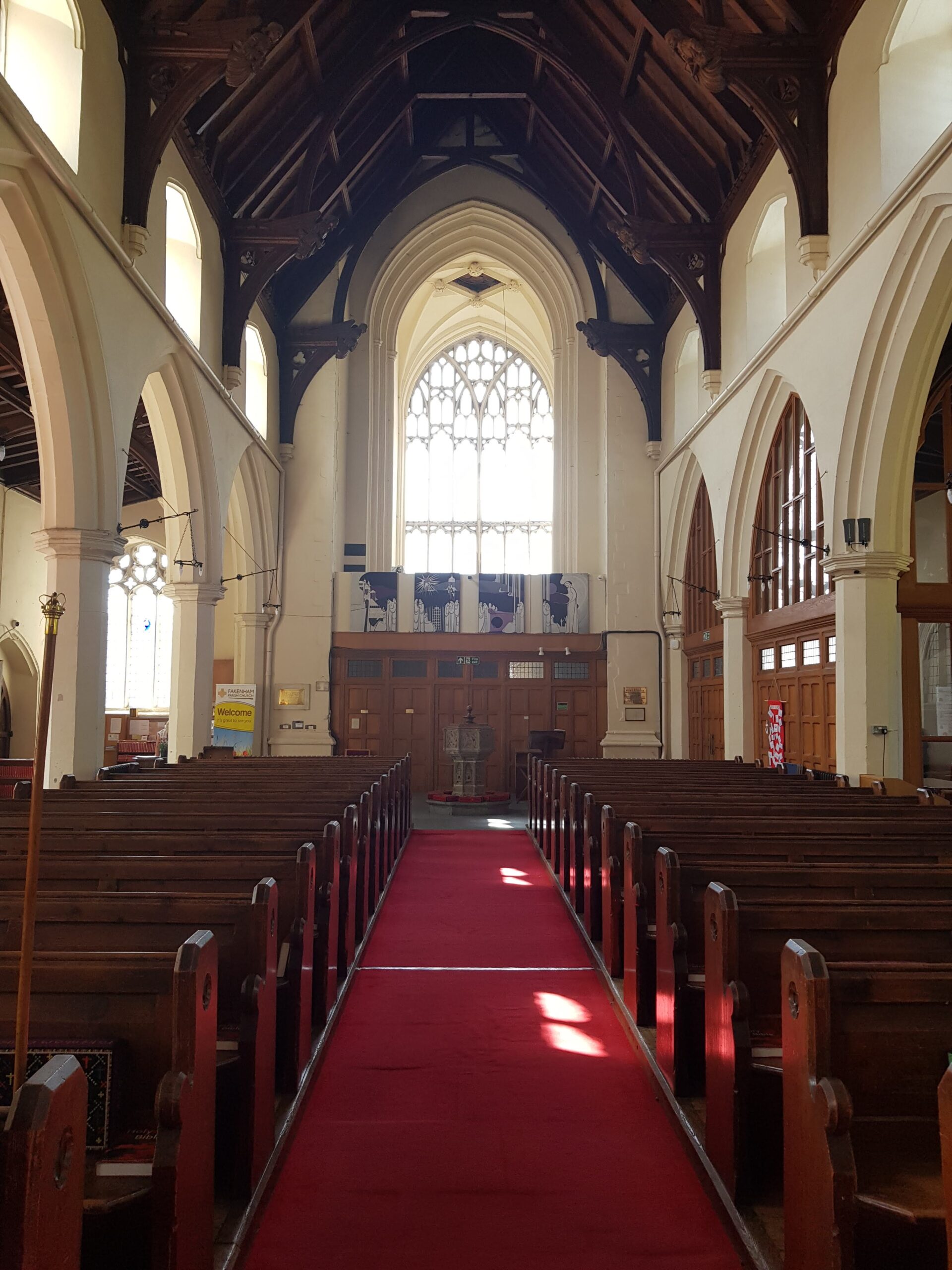
    St Leonard’s Church occupies a significant position within the historic landscape of Charlecote and it is situated immediately adjacent to the main entrance gates, forming an integral part of the approach to the great house. It’s thought that there has been a church in this location since at least the twelfth century, although little remains of the medieval church as it was pulled down in 1849. The old building just wasn’t good enough for the country house, the Lucy family wanted something rather more decadent.

    The new church was constructed between 1850 and 1853, with the impetus for this ambitious project coming from Mary Elizabeth Lucy (née Williams, 1803-1890) who was the wife of George Hammond Lucy (1789-1845). Following her husband’s death, Mary Elizabeth conceived the rebuilding as some sort of grand memorial to him, personally funding the work and laying the foundation stone in 1850.

    20250426_144240

    The lighting was a little odd in the church and my photos have come out looking like postcards from the 1980s. The interior of the church is in the Gothic Revival style and it was designed by John Gibson.

    20250426_144250

    The font was also designed by John Gibson and it’s an impressively decorated piece.

    20250426_144255

    Some of the detail on the font.

    20250426_144329

    The chancel of the church and we didn’t investigate too much further down here as the organist was playing away and occasionally stopping and angrily commenting on his own performance, so Richard and I didn’t want to disturb the arrangement. I must admit, I like a bit of musical frustration when visiting an historic monument, it adds some atmosphere to the proceedings.

    20250426_144337

    Looking back along the nave with a rather svelte Richard strolling down purposefully.

    20250426_144512

    A rose window in the Gothic style and some intricate stained glass work.

    20250426_144547

    It’s rather a shame that the church has faced attack.

    20250426_145408

    From the outside, the size of the private chapel leading off from the chancel is particularly noticeable. Apparently, some of the wood used in this chapel dates from the earlier church which the Victorians demolished.

    Personally and this might be evident by the slightly short post, I’m not that engaged with the church as although it’s beautiful, there’s little of heritage and it’s the medieval aspect that particularly intrigues me. Everything obviously cost a lot of money, it was done well and it was in keeping with the rather decadent nature of the main house. But, I like a slightly rough and ready church, one where there are traces of medieval changes all over the place, something that has been erased here.

  • Charlecote House – Worn Out Sundial

    Charlecote House – Worn Out Sundial

    20250426_130930

    Adding to my long series of irrelevant posts, I was intrigued about this sundial. I think it’s because Charlecote House is relatively pristine maintenance wise and looked after, but this has fallen into disrepair at some stage. And, no-one seems to know much about it, but the best guess is that it was installed in the 1820s when the property was being modernised. But, it might be older, so that’s another riveting factual post from me. I did ask AI to date it, but it knew that it was at Charlecote and then based its guesswork on that. It seemed to like the idea that it’s an older sundial that was restored in the 1820s, so that seems a decent compromise. Anyway, I just like some things to fade away without being restored and that’s reason enough for a whole blog post about a bit of old stone.

  • Acocks Green (Birmingham) – The Spread Eagle

    Acocks Green (Birmingham) – The Spread Eagle

    20250426_105519

    At the weekend, slimline Richard and I thought that we’d pop to the Spread Eagle in Acocks Green near Birmingham. As usual, I’ll take the history of the pub name from the JD Wetherspoon web-site:

    “Named after one of the oldest pubs in Warwickshire, which stood close by, until it was demolished in 1929, through road-widening, The Spread Eagle (the first pub) was pulled down in 1929. The green, far from being an age-old local landmark, was created in the early 1930s.”

    The pub is located at the ‘413’ in the above map from the 1870s. It’s certainly all got a lot more developed in the area in the last 150 years.

    20250426_102301

    One of the display boards in the pub mentioned Hancock’s Half Hour and this intrigued me. There’s no direct link between Tony Hancock (1924-1968) and the pub, but he did live in nearby Hall Green.

    But, back to the food planning. Richard decided that he would treat himself to some toast which was the most that his diet would allow, and even that was pushing it. He ordered his toast and waited excitedly. I was pleased to discover that the pub was in the lowest JD Wetherspoon price band and so I went for a traditional breakfast and unlimited coffee.

    20250426_101447

    My traditional breakfast was served promptly and just as a team member came over and said to Richard that they didn’t have any toast and they wondered if he would like anything else, as they assumed he wouldn’t want raw bread. The team member obviously didn’t really expect to have a customer come in that wasn’t really meant to be eating anything as decadent as toast, so there was little else that could be offered. Meanwhile, I had lost interest in his problems at this point as I had food to eat and although I would have rather had toast than raw bread myself, this food and unlimited coffee came in at under £5 so I didn’t feel the need to be overly disappointed. Full marks for the eggs still be runny and the bacon not being fatty. Richard was contemplating his entire day as his hopes to just have a little toast were shattered and I did wonder whether it might have been easier for them to buy a small-scale toaster until their commercial arrangement was fixed.

    As it’s a JD Wetherspoon venue, I felt the need to have a little look through the on-line reviews and see if anything there surprised or delighted me.

    “We were having fun as a family for a Birthday and the old blonde dragon came over and told us to be quiet in a very rude way”

    I bet “having fun” meant being loud and disturbing other customers as why otherwise would a team member even be engaged in worrying about matters?

    “The manager a move her station threatened to bar customers spending money for singing and having the craic for no reason obviously feels insecure in her job and cannot control the clientel on her establishment.”

    It sounds very much like she was in full control of the customers.

    “To noisy stink of smoking as you enter”

    There are a few of these and they’re right, the smokers are dominating the entry doors….

    “Staff very rude and got barred for no reason”

    I’m not convinced.

    “I am getting sick of people deciding what we can and cannot do in pubs. Now this pub, on an empty Thursday evening, is telling me I cannot stand at the end of the bar and have a beer.”

    Probably as the team members know that customers blocking the bar is sub-optimal.

    “Dreadful typical weatherspoons pub to be avoided if possible if you have any taste in pubs you visit.”

    I like it  🙂  Anyway, lack of toast aside, this seemed a well run venue although the coffee machine was struggling to cope with the number of customers seeking to use it. I liked it here, although I tend to like nearly anywhere, and although it was too early for beer there were a number of keenly priced real ales. All really rather lovely.