Category: UK

  • Buckenham – Name Origin

    Buckenham – Name Origin

    Further to my visit to Buckenham this week, this is the origin as given by The Concise Oxford Dictionary Of English Placenames. To confuse things just slightly, there are three Buckenhams in Norfolk, Old Buckenham, New Buckenham and what is mostly now just called Buckenham, but has historically been known as Buckenham Ferry.
    Buckenham, Norfolk. Buchanaham in Domesday Book, Bokenham Ferye in 1451. From Bucca’s Ham.

    Ham is a village or settlement, with Bucca being one of the early leaders of what became known as the Anglo-Saxons, a similar word origin to Buckingham, as well as the other Buckenhams in Norfolk. Unless he meandered around a lot between Buckinghamshire and Norfolk, I assume this was some related group of people who came to Norfolk in the seventh century. Incidentally, the ferry at Buckenham operated until the 1940s, but more on that another time….

  • Buckenham – St. Nicholas’s Church

    Buckenham – St. Nicholas’s Church

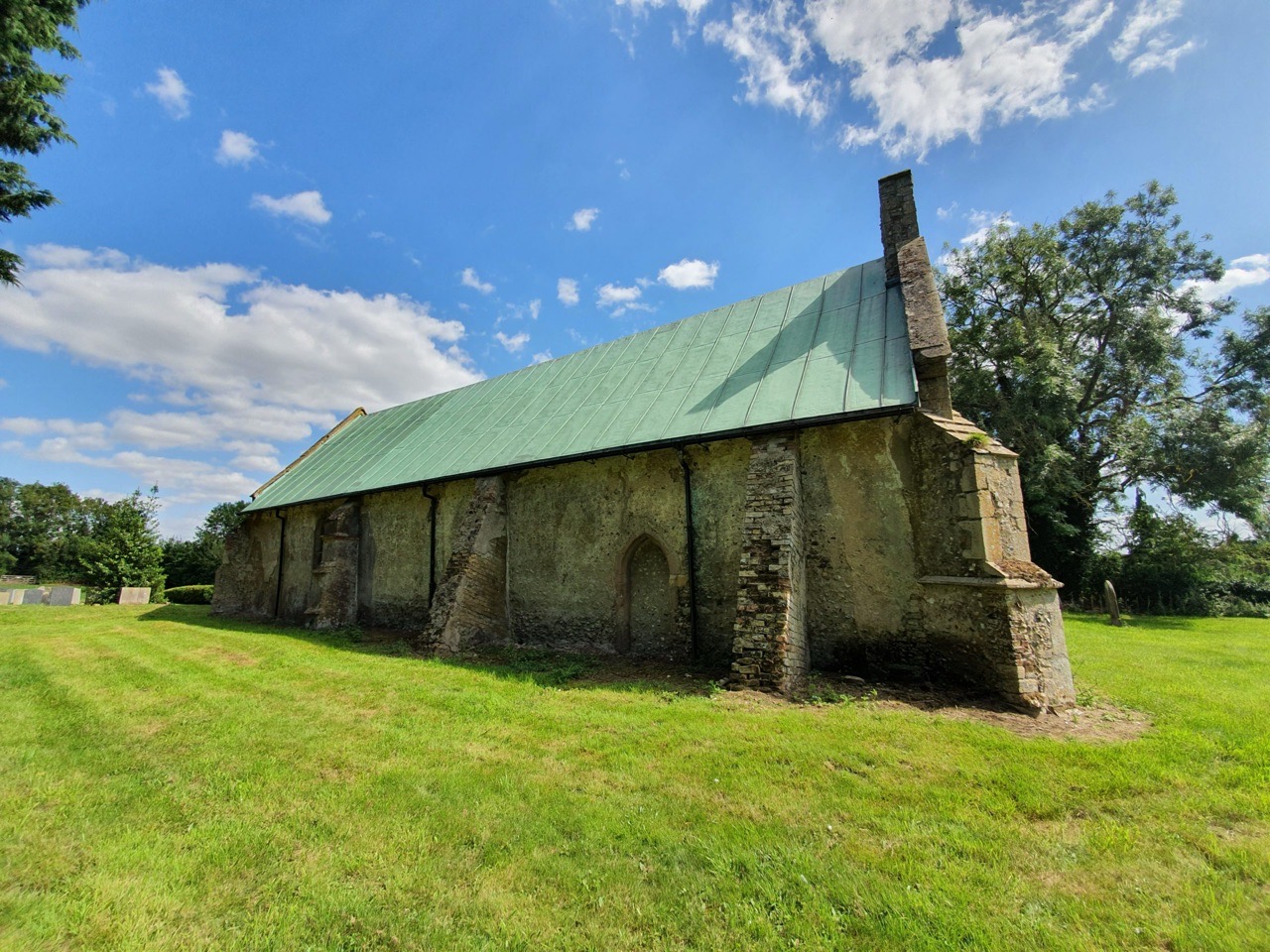
    This is the secluded church of St Nicholas in Buckenham. Unfortunately, the churches are currently closed given the ongoing health issue, but it’s possible to peer inside at the boxed pews and otherwise quite empty interior. There’s not much else in the area of the church, although it is a short walk from Buckenham railway station for those who can navigate themselves onto one of the few trains which stop there.

    The Norman tower, which was originally round and was later reworked to make it octagonal. That’s also an original Norman doorway and is in situ and probably wasn’t moved here from elsewhere in the church.

    The entrance to the stairs within the tower.

    The nave, which is the oldest part of the church and dates to the eleventh century.

    The fourteenth-century chancel.

    The north side of the church.

    The east window, and this tells a story of its own. The church was deconsecrated in 1968 and was just left by the Church of England to a slow abandonment. Fortunately, it was taken over by the Redundant Churches Fund around ten years later, but there had been vandalism and destruction during that time. One of the oldest bells in Norfolk was stolen and much of the Victorian stained glass had been smashed. The Churches Conservation Trust gathered up what glass they could and they’ve reset it in the upper part of the window, but the lower part is now just plain glass. This could though have very easily had a different fate, perhaps something more like what happened at Bixley.

    It’s difficult to know whether this is a deliberate wildlife garden approach to their graveyard, or whether they just haven’t been able to cut the grass recently. The village of Buckenham depopulated over the centuries, so there hasn’t been much of a congregation to support it for some time. The church was remodelled in the 1820s, which gives it a different feel to the much more brutal and comprehensive restructurings of the later nineteenth century, although a guide from the beginning of the twentieth century called the changes “fitful and destructive”. Numerous Roman remains have been found in the area, suggesting some form of Roman encampment locally, likely because there was a ferry site nearby.

  • Cantley – Cantley Marshes

    Cantley – Cantley Marshes

    And, just photos, from my walk yesterday around Cantley Marshes, a 650-acre Site of Special Scientific Interest. The RSPB oversee the area and there are numerous rare birds that reside here, along with numerous deer that we saw darting around. And lots of cows, fortunately not near the footpath. I also like to think that they’ve removed the snakes, but I suspect they’re still in there somewhere….

    There’s Cantley sugar beet factory in the background, which looms over the local countryside somewhat and has done since it opened in 1912.

  • Buckenham – Buckenham Railway Station

    Buckenham – Buckenham Railway Station

    Buckenham railway station was opened in 1844 and it is now situated on the line which goes from Norwich to Great Yarmouth and Lowestoft. It’s not a very well used station, not least as there are no trains on weekdays, but a few people use it at weekends to access the nearby walks and bird reserves. It’s the least used railway station in Norfolk, with only a couple of hundred people a year using it, with passengers having to request a stop here.

    The railway building, which seems to have now been converted into a house. This railway station was once frequently used to sell livestock, so I’m sure there was some freight trade here at some time. There was a signal box in the area that is now trees to the left of the gate, which was derelict by the 1980s and has since been demolished.

    The buildings, none of which are listed, that front onto the platform, all of which are now closed off to the public. Not that the handful of passengers realistically need any facilities here.

    The socially distanced bench, along with cat for scale. This is the same cat that was waiting for the train.

    Looking in the direction of Norwich, there is another platform on the other side and further down the tracks, although I’m puzzled why they’ve shoved it down there.

    And the new lights on the automated crossing which has been recently installed. There’s little need for this railway station, especially when considering how many much more needed stations were lost, but it’s a quirky piece of history that it remains and it’s handy for the RSPB reserve. And, should anyone miss the infrequent train on weekends, it’s not far to walk to the metropolis that is Cantley.

  • Buckenham Railway Station and the Waiting Cat

    Buckenham Railway Station and the Waiting Cat

    More on Buckenham railway station in another post, but I liked the cat waiting patiently at the platform.

  • Bristol – Edward Colston Statue (an update….)

    Bristol – Edward Colston Statue (an update….)

    This statue was taken down and thrown into the river today, although since it was a listed monument I imagine it’ll be recovered and then placed in one of the city’s museums.

    Here’s my original post about it, namely as I liked the anti-slavery display around it.


  • Hardley – Hardley Cross

    Hardley – Hardley Cross

    I’m pleased that Łukasz showed this monument to me today, which I’ve somehow managed to miss entirely although I’m sure that I’ve likely walked by it many times. It’s near to where the River Chet and the River Yare meet, but it’s more importantly the former boundary between Norwich and Great Yarmouth.

    Once marking the end of Breydon Water, there have been numerous panels and inscriptions added to the cross, this one being from the 1899 repair. The base of the cross is likely medieval and probably dates to the fourteenth century, although repairs have been made in 1820, 1834, 1899 and 1971. There was a wooden cross added on top of the base in 1543, and likely before, with a stone version added in 1676 and that’s the one that is there today.

    And the information sign. And it’s evident why this has survived, because it’s effectively in the middle of nowhere, although it is along the route of the Wherryman’s Way.

  • Mulbarton – Name Origin

    Mulbarton – Name Origin

    Harking back to our second training walk, we headed towards Mulbarton and the village’s only remaining medieval building is the church. The Concise Oxford Dictionary comments on the origins of the village name:

    Mulbarton, Norfolk. Molkebertuna in Saxon period, Molkebertestuna in Domesday Book, Mulkebertun in 1250. Comes from Meolc-beretun, meaning outlying dairy farm.

    According to the same dictionary, the ‘eo’ often became ‘o’ or ‘u’ because they sounded similar. The ‘molke’ section is milk, similar to the current Dutch word and derived from the German ‘milch’.

  • Norwich – Coast to Coast

    Norwich – Coast to Coast

    Sad to hear that Coast to Coast, located to the left of TGI Fridays in the above photo, is closing permanently in Norwich. They bemused me, they were becoming popular locally and their reviews were positive. But they were for months deluging out offers whereby anyone who had a Tastecard, Gourmet Society card or voucher could get 50% off of food. If you were a diner who went in without those cards, you were getting charged twice the amount of everyone else and I’m not sure how that could ever end well.

    They can run their restaurant how they wanted, but why they devalued their product so much never quite made sense to me. Anyway, I hope the space is used for a large Greggs, constantly good value without gimmicks.

  • Bath – Bath Abbey (Clock)

    Bath – Bath Abbey (Clock)

    As part of a tour of Bath Abbey, there’s the chance to see the inside of the clock. There are two small benches so people can sit by the clock for a few minutes, although the guide gave several warnings to not touch anything connected to the clock, which seemed sensible advice.

    Located on the north side of the building, the abbey’s clock, which belongs to the people of Bath, was moved here in 1834 after being lowered from a previous position when the structure of the tower looked a bit unstable. It was originally once backlit by gas to ensure that it was visible at night, but electricity has made that much easier.

    The advent of the railways brought problems to time-keeping in UK cities, as they often had slightly different times and this was problematic when trying to run a railway. Before the railways, no-one much minded if Bristol and Bath were running at different times by five-minutes, but what became known as ‘railway time’ required some standardisation. Bath did this by in 1845 installing a band of metal on the clock which would show railway time. Scaffolding was put up to ensure this addition could be made, although I wonder why Bath didn’t just keep railway time to keep things simple.

    The clock looks relatively small in the above photo, but that’s deceptive, and in 1926, the Bath Chronicle wrote about a refurbishment of the clock. They noted:

    “The diamond-shaped aperture in the face of the clock is due to having been removed in order that the hands might be disconnected. From the ground it does not look more than big enough for more than a fist to emerge, but that is deceptive as George Willis [the man in charge of the project] was able to project his head and shoulders through the opening. The minute hand is 3 feet long, and the hour hand 1 foot 10 inches in length. They revolve on a face having a diameter of 6 feet”.

    https://commons.wikimedia.org/wiki/File:Bath_Abbey.002_-_Bath.jpg

    And here’s a photo of the clock from the outside.