Category: UK

  • Norwich – Earlham Cemetery (Valorous John Wright)

    Norwich – Earlham Cemetery (Valorous John Wright)

    This is the war grave of Valorous John Wright, buried in the older military graves area of Earlham Cemetery. Incidentally, my photo of this grave is at an angle as there’s a big bush in front of it.

    Valorous is a wonderful name and it’s because he was born on HMS Valorous, a Royal Navy paddle frigate built in 1851, on 24 December 1866. He went to North Road Boys /Steynton School at Milford Haven and his school records remain from 1878 and 1879.

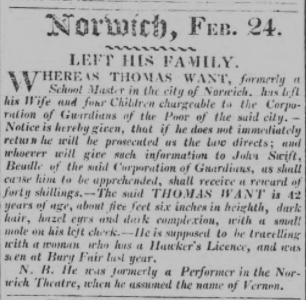
    As is this document which I very much like about the school’s progress and the students clearing off home, with Valorous mentioned at the bottom.

    At the 1881 census, Valorous was living with his mother, Mary Jane Wright, at Robert Street in Steynton, his father having already died. There were two lodgers in the property as well with Valorous and his mother, Richard Wakeham and William Tinkham.

    He joined the army at Pembroke Dock on 14 June 1883 at the age of 16, although he declared on his form that he was 18 years and 5 months old. He asked to join the Royal Welsh Fusiliers and his medical was the next day and magically he declared his age to be 19. The records show that he was 5’6″ in height and weighed 8.7 stone.

    During his time in the army, Valorous married Martha Huggins on 10 September 1896 at the Church of St. Ethelreda in Norwich. At the 1891 and 1901 censuses, Valorous was away in the army, whilst his wife Martha was living with her father John Huggins, on King Street in 1891 and at 54 Argyle Street in 1901.

    Whilst in the army, Valorous fought in South Africa, but was mostly stationed in the UK and he was uninjured in battle during his service. He was promoted to Colour Sergeant on 25 February 1900, moving to the Norfolk Regiment on 27 February 1906 and then leaving the military entirely on 31 July 1909.

    Valorous died on 11 December 1910 at the age of 43, leaving his wife who was ten years younger than him, with his burial being on 17 December 1910. During their final year the couple lived at 115 Sprowston Road, a house perhaps more notable today for being opposite the rather lovely Brewery Tap pub. But, my favourite part of this story is really the name, and I think it’s not unusual for people born at sea to be named after the boat that they are on.

  • Norwich – Earlham Cemetery (Robert Love Gracie)

    Norwich – Earlham Cemetery (Robert Love Gracie)

    This is the war grave of Robert Love Gracie, buried in the older military graves area of Earlham Cemetery. Robert was a Canadian who born on 9 March 1893, the son of Elizabeth Gracie. The real story behind this post is though the excellent state of the Canadian archives, all freely accessible and with substantial documentation retained for members of their armed forces. Robert’s war records are 78 pages long and contain more information about his medical condition than anyone could perhaps ever need to know.

    Robert was single and he worked as a clerk at Eaton’s department stores, living at 124 Hogarth Avenue in Toronto, a property which is still there, and he had a brother and two sisters. We know from his sign-up medical that he was 5’8″, had a dark complexion, had brown eyes, black hair and declared his religious belief to be Presbyterian. Robert was given the service number 404091 and he joined the 14th Battalion of the Canadian Infantry.

    On 4 June 1915, Robert sailed from Montreal to the UK on the SS Metagama, a new cruise ship which the Canadian military had requisitioned as a troop carrier. He remained in the UK until 20 January 1916, when he sailed to Le Havre and from there he was sent to the front line with his unit on 2 February 1916.

    I wonder when writing these wills what the soldiers thought, as Canada at this stage didn’t have conscription, so Robert signed up voluntarily. Robert was placed on the front line for the first time on 2 February 1916, but on 9 March 1916, he was seriously injured with shrapnel wounds to his right hand and his right leg.

    He was taken to a field hospital on 9 March and an operation was undertaken and x-rays were also taken, which has survived in the archive. I don’t know what I’m looking at here to be honest, but on 13 March it was decided that Robert needed to be returned to a hospital in England.

    The above is his temperature chart for the time that he was at the field hospital.

    The hospital that Robert was sent to was the Norfolk War Hospital in Thorpe (St. Andrew’s Hospital) and on 15 March he was seen by the doctors there. It was noted that a shell had blown off some of his fingers and the stump of his hand had gone septic. His knee and leg were very swollen and there was a penetrating wound to the upper part of his calf.

    On 16 March, the doctors noted that Robert’s leg remained very swollen, but by 19 March, although the swelling was going down, he remained in a poor condition. However, on 20 March, Robert suffered from a secondary haemorrhage and his leg was amputated at the thigh, where it was discovered that his thigh muscles were riddled with pus. Unfortunately, at 10:45 on the 20 March 1916, Robert died at the age of 23.

    The authorities seemed to take care of providing a suitable burial, checking if his next of kin wanted his body returning to Canada. He was buried at Earlham Cemetery, a long way from home, at 14:30 on Friday 24 March 1916, with a contingent from the military and a bugler present.

    And it’s not often that there are photos available of those who died in the First World War, but this is Robert. I don’t know why he wanted to serve in the army, whether it was because he felt it was his patriotic duty or whether he wanted adventure. But, he joined at a time when it was clear that the war wasn’t going to be over quickly and he would have been aware of the loss of lives that was taking place. Either way, he seems like a hero to me.

  • Norwich – Earlham Cemetery (David McSweeny)

    Norwich – Earlham Cemetery (David McSweeny)

    This is one of the earliest graves in the old military burial area at Earlham Cemetery in Norwich. This story particularly interested me as the funeral was so well covered in the local press that it gave me quite a picture of what the burial must have been like.

    It’s not clear whether it’s David McSweeny or David McSweeney, I suspect it’s the latter, although the grave uses the former spelling. He was born in around 1839 and he joined the military in 1858, serving in the 7th Queen’s Own Hussars and he had reached the rank of Paymaster Sergeant.

    It is the death of David that received much local press attention, including the inquest and the burial of his body. On the evening of 24 June 1875, he was in a rowing boat with his friend David Couper and they were nearby to St. Anne’s Staithe in Norwich (pretty much opposite the Queen of Iceni, nearby to the new St. Anne’s housing development) when a steamer hit them. David’s body was pulled out of the water a few minutes later, but he was already dead, aged just 36.

    A coroner’s court took place in July 1875 at the Cinder Oven pub on King Street, in Norwich (a building now demolished, but it once jutted on to the city wall near to the Carrow Bridge boom tower). The Deputy Coroner heard evidence from numerous witnesses, but there was confusion as to how David had fallen into the water and died. Captain Thompson from the army said “it seemed rather odd that no-one appeared to see the deceased get into the water”.

    One of the witnesses was WR L’Estrange, a brewer at the Bullards brewery, who said that there was no need for David to have jumped into the water as he would have been safe given the low speed of the steamer. When asked, he put his decision to jump as being “out of terror”. Captain Thompson confirmed that David hadn’t drunk alcohol for 15 years as he was tee-total, so a poor decision due to drink was ruled out, and he also confirmed that David was able to swim. The whole thing was a bit of a mystery and a verdict of accidental drowning was given.

    David wasn’t married, but the non-commissioned officers clubbed together to pay for a headstone for him, a rather lovely gesture. And this is how the Norfolk News reported David’s funeral:

    “On Monday afternoon, the remains of the Sergeant were interred at the Norwich Cemetery. The firing party was followed by the body of the deceased borne on a gun-carriage, the coffin being covered by a velvet pall upheld at the sides by six Sergeants of the regiment. Next came deceased’s charger, followed by the men of the troop. The military procession was succeeded by three mourning-coaches containing the relatives and friends of the deceased, who was unmarried. The bands of the regiment played a dead march, and several thousand persons assembled to watch the mournful procession on its route to the place of burial”.

    The thought of that number of people watching and paying their respects is quite a picture to build up in the mind. The backdrop to this though is that the military were held in high repute by most locals and the period when David died was one where there were relatively few British military deaths. Over 10,000 had lost their lives in the Indian Rebellion in the 1850s, but the next major loss of life wasn’t until the late 1870s with the Second Anglo-Afghan War and the Anglo-Zulu War.

    This does all mean that although David died relatively young at 36, his death was at least marked with respect and dignity.

  • London – Southwark (Borough of) – The Old Salt Quay

    London – Southwark (Borough of) – The Old Salt Quay

    This visit to the Old Salt Quay (or just Salt Quay, I’m not quite sure what name they prefer) pre-dates 2020 and the current restrictions, and the photos were also taken on my older phone, so the quality isn’t great. Anyway, this is a Greene King pub located in a former warehouse by the River Thames.

    I liked the interior, it was spacious, interesting and clean, so all perfectly welcoming. There’s also further seating on the first floor, although that was closed off when I visited.

    I confess that this is Greene King IPA and I remember it tasted exactly as Greene King IPA is designed to taste, so I can’t really blame the pub for that.

    The chicken burger, all nicely presented, hot, perfectly reasonable quality.

    The reviews are mixed, although I noted this one:

    “My friends and I went to have a drink and something to eat . We go id’d on the door the man on the door knows us as we are regulars at this pub.”

    Which got the beautiful response from the pub of:

    “Unfortunately, the “man on the door” is not proof of ID.”

    Or the customer who posted:

    “Called into Salt Quay 12:30 on Thursday with my family and asked for a Cappuccino. The barman tutted, rolled his eyes and shook his head.”
    I accept that’s not great customer service, but I’m secretly a little impressed. But I shouldn’t be. In response to another customer, the pub noted:

    “We do have some staffing challenges at the moment, but we are trying to sort these out at haste!”

    That’s honest from the pub, I like that as well. This comment from a customer shouldn’t have also amused me, but it did, solely because I’ve built up a picture in my mind about this. I have a vivid imagination I think.

    “It was also freezing with the security guards opening and closing the doors every 5 minutes because they had absolutely nothing better to do.”

    But, this is my most favourite response of all from the pub to a customer:

    “I must disagree with your review for the simple fact that your narration does NOT correspond to the truth.

    Allow me to use this space primarily to apologize once again with all the guests present in the Pub during your presence.

    You phoned the pub check availability for 25 people within half an hour of arrival, the person speaking on the phone was told that unfortunately the pub was fully booking.

    This is the case on Sunday’s at this time of year. Almost after about 15 minutes from your phone call, you entered the pub without even responding to our welcome greeting of a member of your group, after ignoring the blackboard at the entrance that stated “before going to the first floor wait to speak with a staff member because the room is reserved “.

    We had drawn your attention and I had personally reaffirmed the state of affairs of our availability. I suggested you wait and occupy the tables that would be liberated in time. So you did, except then began to approach the tables already occupied by guests who were dining and drinking and you invited MY guests to leave the table for you, this for me is unacceptable. I pointed out that it was not an acceptable method and that for any request you should have referred to myself or another member of staff, instead you ignored my request and you had resulted to your personal “hunting” for a table.

    At that point, perhaps, I may have become a bit rude, but I can not allow my guests to be harassed during a moment of pleasure and relaxation. I would have done the same thing if anyone else had the same attitude towards you.

    Thank you for your time and God bless you.”

    That ‘God bless you’ at the end is rather beautiful, and this sounds a most exciting afternoon for the staff.

    I’m not sure that I’d say this is a pub worth travelling far to get it, as Greene King’s turnkey operation means their pubs are often all a bit too samey and bland. But, the staff were friendly, it felt a safe environment and it’s a perfectly good option for anyone in the area. It’s an interesting building though, with decent views over the Thames and apparently (CAMRA say this, I trust them) the carveries on Sunday are first class.

  • Norwich – Earlham Cemetery (Walter Peter Smith)

    Norwich – Earlham Cemetery (Walter Peter Smith)

    This is the grave of Walter Peter Smith, located in the old war graves area of Earlham Cemetery. Unfortunately, there’s not much of a story here, other than some sympathy to anyone called Smith who is trying to research their family history.

    I do know that Walter was born in the third quarter of 1893 and he married Rachel Bailey on 9 May 1915 in St. Augustine’s Church in Norwich. And I know that on 31 March 1915, he joined the 5th battalion of the Coldstream Guards with service number 15935. Walter died on either the 10 February or the 11 February 1916 (different dates for this, but I assume it’s the latter since that’s what is on his grave) at the age of 23.

    His grave, which predated the CWGC stones, was erected by his wife, at that point living in New Catton. The reason for such a short story here is that Walter’s war records haven’t survived (other than for a single page from the Coldstream Guards records) and there are three Walter Smiths in Norwich at that time and it’s not clear to me which is which. Which is moderately annoying, but a usual challenge for those with this surname. Anyway, maybe I’ll work out more one day…..

  • Norwich – Earlham Cemetery (Frank Samuel Tann)

    Norwich – Earlham Cemetery (Frank Samuel Tann)

    This is the grave of Frank Samuel Tann, located in the older military burials area of Earlham Cemetery. These graves offer some very different sorts of military stories to those who died in the First World War, and there was no conscription in the nineteenth century so everyone in the army is there by some form of choice.

    Frank was born in 1875, the son of Ransome Bransby Tann and Hannah Tann (nee Sayer), who had married at St. Peter Hungate Church in Norwich on 6 April 1874. The couple lived at Philadelphia Lane in Norwich, a street which is still there, but the Victorian housing has all long since gone.

    For reasons that I don’t understand, Frank was living with his grandparents (on his mother’s side) at the 1881 census, Henry Sayer and Hannah Sayer. Henry worked as a shoemaker and the family lived at Gildengate Street in Norwich. He was still living with them at the time of the 1891 census, although they had by now moved to Middle Street and Frank was also working as a shoemaker, like his grandfather.

    At the age of 19 years (and 9 months), the excitement of working as a shoemaker (specifically he was working as a clicker in the shoe trade) in Norwich had perhaps worn off. He had been serving in the Norfolk Artillery Militia and decided that he would sign up for the army, agreeing to serve for at least 12 years. He attested for military service on 29 August 1894 (and he was given the service number 4058) and his medical revealed that he was 5’7″ in height, weighed 9.5 stone, had brown hair and was a member of the Church of England.

    Frank’s war records remain, so it’s possible to say where he was stationed, although not unfortunately the exact area of any particular country. He was at his home base with the 1st Norfolk Regiment, which was at the Britannia Barracks in Norwich which had been constructed between 1885 and 1887, from 29 August 1894 until 9 November 1894. He then went to India from 10 November 1897 until 25 February 1904, before returning home between 26 February 1904 and 14 January 1905. His final overseas posting was in South Africa from 15 January 1905 until 16 February 1907, then coming back to the Britannia Barracks. I do wonder what these soldiers thought about these places they were sent, it must have felt very exotic.

    His military records also give details of his promotions, he started as a private in the army, then was promoted to a lance corporal on 27 April 1896, although returned to being a private on 10 November 1896. He was made a lance corporal again on 11 September 1897, then a corporal on 18 September 1899, a lance sergeant on 1 December 1901 and then a sergeant on 6 July 1903. He served in the army for a total of 15 years and 134 days, as he died in Norwich on 9 January 1910 at the age of just 35, the cause of death being given as a malignant tumour.

    On 14 September 1908, Frank had married Ellen Ethel in Brentwood and they lived at 2 King Street in Norwich. The witnesses at their wedding were Frederick Marshall and Alfred Hyatt, with Ellen Ethel later working as a nurse and she lived until 1956.

    Frank was buried at the military section of cemetery and the authorities must have thought that they would have enough space for many more decades, unaware of what was ahead just a few years later with the First World War. His gravestone is a good quality one, although some of the lettering is coming off, something which the CWGC repair for the graves in their care. A life sadly cut short far too early and I do wonder what Frank thought about his over seven years in India.

  • Norwich – Earlham Cemetery (Daniel George Hatton)

    Norwich – Earlham Cemetery (Daniel George Hatton)

    This is the grave of Daniel George Hatton, located in the old military cemetery at Earlham Cemetery. He is remembered by a gravestone which was placed here by his family, pre-dating those that were provided by the CWGC. Daniel was born in 1894, the son of Daniel and Emma Hatton. Daniel (the older) had been born on 10 January 1872 and Emma on 21 May 1875, with Daniel working as a shoe finisher.

    At the 1901 census, the family were living at 11 Greyhound Opening in Heigham, a property which has since been demolished. There was Daniel, his parents, and his new-born little brother, John William Hatton. By the time of the 1911 census, Daniel was using his middle name of George, with the family living at 29 Greyhound Opening, another property since demolished. Daniel George’s uncle was also with the family at the time of the census, another John Hatton. The younger Daniel was working as a boot maker and the older Daniel as a boot finisher. As an aside on this, it can only be wondered what people like Daniel would have done as a job in today’s economy, the choice of options that they had back in the early twentieth century was far more limited and many in Norwich worked in the shoe industry.

    At some point after 1911, the family moved to nearby 53 Midland Street, yet another property since demolished. Daniel’s war records seem to have been lost, but he joined the 4th Norfolk Regiment in 1914 (with service number 3659), although I don’t know if he saw any service overseas.

    Daniel died on 17 June 1915, at the age of just 21 after he was killed whilst travelling from London Liverpool Street to Norwich by train. The inquest found that “death was due to injuries to the head from a blow described as a terrific nature. The line had been examined, but no marks found on the bridges or signalposts.” The coroner said that this was “a mystery”, but noted that his service colleagues he was travelling with were entirely free of blame. After having to endure the inquest in Bishop’s Stortford to their son’s death, the family paid for his nice gravestone and I can sort of picture them standing there saying their final goodbyes.

    Daniel’s parents were still living at 53 Midland Street at the time of the 1939 register, so they saw the start of the Second World War and perhaps wondered whether they lost their son in vain. Emma died on 1941 and I can’t find when Daniel senior died. As for John William Hatton, Daniel’s little brother, he was living with his wife Gracie at 5 Lound Road at the time of the 1939 register, dying in 1989. It must have been difficult for John, he lived for 74 years without his younger brother, having lost him when he was aged just 14.

    There’s something sad about all war deaths, but for Daniel (or George, his 1911 census and one of his service records call him that) the three houses he lived in have been demolished, his war records are seemingly lost in the fire and the coroner never worked out how he died.

  • London – Kensington and Chelsea (Borough of) – National Army Museum (Earl Haig Fund Poppy Badge)

    London – Kensington and Chelsea (Borough of) – National Army Museum (Earl Haig Fund Poppy Badge)

    This is my photo of the Earl Haig fund poppy which is on display at the National Army Museum.

    This image (courtesy of NAM) is much clearer though. The poppy was made at a factory in Edinburgh and the operations there were set up Earl Haig’s wife, as few of the poppies produced in London were getting to Scotland. The factory was opened in March 1926 and initially employed just two people, but this increased to over 100 within just a few years.

    The poppy in the collections of the National Army Museum dates to around 1930, at a time when poppies were made out of different materials which were charged at different prices. It wasn’t until 1954 that only the paper poppy was produced, with no fixed price but offered instead by donation.

    And one thing I never knew until today, the Scottish poppy has four petals, whereas those produced in the Richmond factory in London have two petals. Which goes to show how unobservant I am…..

  • Norwich – Earlham Cemetery (Marsham Elvin Wrench)

    Norwich – Earlham Cemetery (Marsham Elvin Wrench)

    This is the war grave of Private Marsham Elwin Wrench, located in the older military cemetery within Earlham Cemetery. Unfortunately, the age of this soldier are wrong, he died at the age of 48 and not 42. Marsham was born in Kensington on 13 November 1872, the son of Marsham and Margaret Wrench.

    At the 1881 census, the family lived at 43 Monteith Road in Bow where the older Marsham was working as a general dealer. Marsham the younger was the only boy in the family, living with his older sister Susan and his younger sisters Mary, Alice and Maud. As an aside, Martha Elizabeth Land lived in this house during the Second World War and she was one of 173 people killed at Bethnal Green underground station when people fell down the stairs and died in the crush that ensued.

    At the 1891 census, Marsham was 18 years old and he had decided to join the army, where he was listed as being a gunner living at the Woolwich Barracks. He doesn’t appear in the 1901 census, so was likely serving somewhere else in the army. He had by this time got married, hence his move to Norwich, although he had been widowed by the time of the First World War. Fortunately, the war records have survived, which means there’s a story of his expeditions around the world.

    Marsham joined the army in Woolwich on 11 December 1886 at the age of just 14, with his trade being listed as a musician. He signed up for the Royal Artillery, agreed to serve for 12 years and was happy to be vaccinated. He was just 4’6″ tall, weighed 5.8 stone, had brown hair and declared himself as a member of the Church of England.

    Marsham was disabled with haemoptysis in June 1911 in Karachi in what was then India, but is now in Pakistan. He was moved to a hospital in Bombay before returning to England. He rejoined the army reserve on 20 August 1914 as part of the Norfolk Regiment, briefly going to serve in France. On 11 November 1914, a medical report though declared that he was unfit for service, his usual weight of 12 stone 5 lbs had fallen to 9 stone 10 lbs and he had a frequent cough.

    Marsham died on 20 April 1920, and by nature of him having a war grave, he would have died of injuries incurred in the war, although I’m not sure what they were or where he went.

  • London – Southwark (Borough of) – The Rockingham Arms

    London – Southwark (Borough of) – The Rockingham Arms

    I’ll add now that this visit was from some weeks ago, they’re not open during the second lockdown. I’m working through old photos since I can’t currently go to pubs….

    This is an image from Google Streetview of the front of the Rockingham Arms (taking its name from another pub which had been in the area), the JD Wetherspoon pub in Elephant and Castle, London. It’s not the most glamorous of buildings, it’s in the 1960s Metro Central Heights building, the former home of the Department of Health and Social Security. It was another little design error, the Government were very pleased with their new building, but it soon fell out of favour and it suffered from sick building syndrome. The civil servants moved to a lovely new building in Whitehall and this structure was repurposed to be used for residential flats.

    Anyway, back to what it is now, a JD Wetherspoon pub. Punk IPA, always cheaper than Brewdog charge in their own pubs, I find that this a very drinkable beer. It might be one of Brewdog’s more generic beers, but it’s still nicely citrusy and with some depth of flavour to it.

    And the chicken jalfrezi from Curry Club, which is very rarely a disappointment and wasn’t here either. Served quickly, at a hot temperature and by a staff member who was perfectly polite, it’s hard to find anything to complain about here.

    The pub interior is perhaps a bit bland, but it feels like a safe environment and I’ve never experienced any problems in the times that I’ve visited here. It lacks the atmosphere of some of the more historic buildings that Wetherspoons operate and the open plan of this pub does make it all feel a bit generic. The toilets, which are located downstairs in the basement, could do with a little bit of a refurbishment as well.

    The reviews for the pub aren’t great, but I think that’s more because some customers are keen to complain and the ones who are happy don’t tend to post. There was a 1-star review as the barman didn’t serve a customer who was on the phone, with the customer noting “I told him that it doesn’t matter that I’m at the phone as far as I order properly”. I suspect a fair few bar staff would have agreed with the pub here.

    Anyway, all perfectly acceptable, keenly priced and just a short walk away from the London Underground.