Category: London

  • London – Camden (Borough of) – Remnant Street

    London – Camden (Borough of) – Remnant Street

    20241125_133331

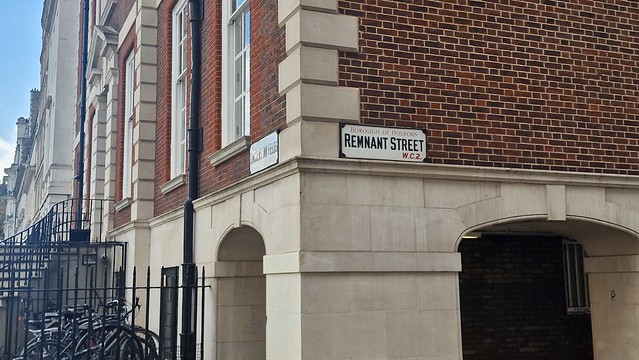
    I noticed this street a few days ago when I was meandering about in London and I wondered about its history and whether there were a few tales to tell. I’m not entirely sure that there are, indeed, the street only took its current name in 1935 as before that it was defined as being an extension of Great Queen Street. The street got its name from James Farquharson Remnant, 1st Baron Remnant, a British politician and lawyer. He was the Conservative MP for Holborn (the area where the street is located) between 1900 when he was elected unopposed until 1928. His great grandson, Philip John Remnant, is still in the Lords as a result of the hereditary Peerage, although he’s one of the elected ones by fellow Peers and he will be removed soon as part of the Government’s changes to the Upper House. I had to look this up, but apparently Remnant comes as a name from the Middle English remenaunt(e) ‘remaining part survivor’ perhaps used for someone whose siblings had died in infancy.

    The street is the one in the middle of the image (the unnamed bit to the right of Great Queen Street). This map is from the 1880s and before they built the road known as Kingsway in the first few years of the twentieth century, which is what caused this stub of street to need a name of its own.

    Incidentally, we can tell that the street sign is before the 1965 borough changes, the year that Holborn, Hampstead and St. Pancras were all joined together to form the Borough of Camden. As an aside, in 1900 the Borough of Holborn was formed when the below parishes were all merged together:

    St Giles in the Fields and St George Bloomsbury
    St Andrew Holborn Above the Bars with St George the Martyr
    Liberty of Saffron Hill
    Furnival’s Inn (part)
    Gray’s Inn
    Lincoln’s Inn
    Staple Inn

    20241125_133353

    And there’s Remnant Street in the middle, looking towards Kingsway (or the A4200 for those who prefer that). There was some excitement in November 1964, when the Daily Express reported that there had been an armed raid on the Post Office on the street, with a motorcycle escape by a gunman who took off with £240. And the News Chronicle reported in 1969 that self-service for postal orders had been introduced in London, at the Remnant Street Post Office. Indeed, nearly every mention of this street in newspapers on-line seems to be in reference to the Post Office. The building still stands, but the Post Office closed long ago and it’s now part of the Centre for Commercial Law Studies.

    20241125_133323

    It’s not really the most exotic of streets, I could have chosen somewhere with a bit more obvious history, but there we go. I had thought that it might have been named as it was a bit of a remnant street, and although that oddly is indeed what it has become, that’s not the reason for its naming. There was some excitement at the other end of Remnant Street in 2018 though when the Co-operative Bank was shut and they opened up a Greggs in its place, but that’s about as far as I can go in terms of shattering stories about the street.
  • London – Camden (Borough of) – The Seven Stars (Good Beer Guide)

    London – Camden (Borough of) – The Seven Stars (Good Beer Guide)

    20241125_141829

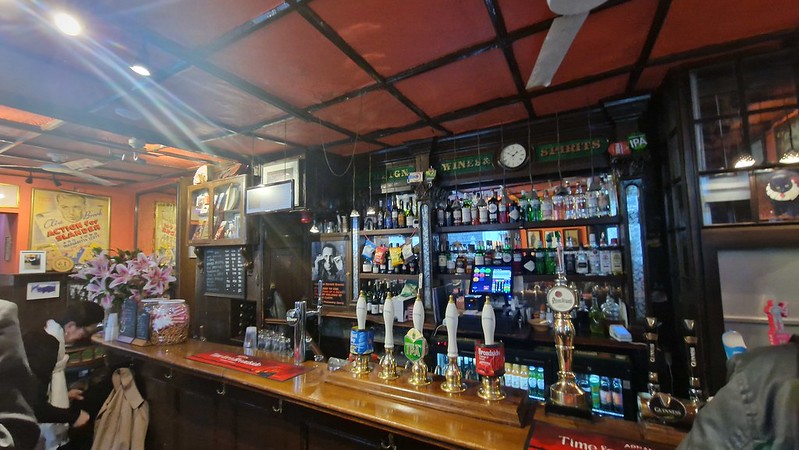
    I’m slowly, but steadily, working on my project to visit every pub in the Good Beer Guide. This building, located on Carey Street near to the Hunterian Museum, is thought to have been built in 1602 although the bar is mostly Victorian. There’s no shortage of history to the pub, which was originally called the The League of Seven Stars in a nod towards Dutch geography (the Seven United Provinces of the Netherlands). I didn’t go up to the toilets in the pub, but they are noted for their steep stairs and a sign which requests customers not to swing on the rail. It’s located near to the Royal Courts of Justice so they are treated to a considerable amount of trade from the legal profession.

    20241125_134927

    A range of Greene King and Adnams beers is not what I was hoping for as they’re so common in East Anglia, but it’s something perhaps slightly different for London. I went for a pint of Broadside which cost £6 and was well kept and tasted as expected. There are some reviews which mention, quite grumpily, that the pub doesn’t offer tasters and that is highly unusual. Anyway, the service was friendly and engaging, so the atmosphere felt inviting.

    20241125_135332

    The slightly infamous pub cat visible in the background. It’s said that Shakespeare might have visited the building given that his plays were performed at Middle Temple, although that’s perhaps a little fanciful. More likely is that the pub was used as the inspiration for The Magpie & Stump featured in Pickwick Papers. The building is listed in CAMRA’s list of outstanding interiors of national historic importance and they note:

    “The frontage bears the date 1602 but the building itself probably dates from “only” the 1680s, and was extended into the building on the right in 1878. The core of the pub is the part with doors embellished with etched and gilded glass, declaring ‘private counter’ (on the left) and ‘general counter’ (right). These names are probably unique, certainly in the experience of the writers, and correspond to the more commonly used ‘private bar’ and ‘public bar’. So there were evidently two separate areas fronting on to a common servery and divided, no doubt, by a timber screen. The counter (a plain affair) and bar-back are Victorian and the coloured advertising panels in the head of the latter are typical of the period around 1870-1890. The pub further expanded into the building on the left hand side in relatively recent years to form a cosy drinking area called the ‘Wig Box’.”

    20241125_135500

    A rather better cat photo than my efforts.

    20241125_140623

    I did try though.

    20241125_141117

    I couldn’t quite understand these chairs, as one customer tried to sit on them and nearly fell off before meandering to one of the tables. The tables have table-clothes on so it wasn’t entirely clear to me whether drinkers were allowed to sit at them. The pub is primarily food led and there’s a blackboard which is chalked up with the daily menu. I must admit, the whole arrangement felt a little uncomfortable so I wouldn’t want to linger, but it’s a popular venue. Most surfaces were sticky which made it a little challenging to find somewhere to stand and not stick to something, but the food is very well reviewed and I’m sure it’s marvellous. Anyway, another Good Beer Guide venue ticked off.

  • London – Westminster (Borough of) – Hunterian Museum

    London – Westminster (Borough of) – Hunterian Museum

    Just to break up my witterings on old Soviet statues displaced around Estonia, here’s a quick distraction about my visit to the Hunterian Museum in the week. I decided long ago that I wasn’t cut out to be a surgeon (there’s a pun there, but I won’t labour it) due to numerous factors, mostly relating to being slightly sensitive. The museum asks for visitors not to post close-ups of human remains on social media, so I’ve avoided taking any photos of all the human things that they have in jars.

    It’s a well signed museum and I pre-booked a ticket, although I don’t think it was essential on a Tuesday afternoon in November. A staff member pointed out where to put my backpack and that was relatively simple after I had worked out the instructions on the lockers. I say relatively simple, it took me two minutes of standing there confused. The next stage felt a little sub-optimal, I was given a welcome and then told “there’s no fixed admission charge, you pay what you like but we recommend £5” whilst being walked to a contactless card machine. This slightly odd customer service approach is perhaps just a little sub-optimal as their web-site notes “the Hunterian Museum is free to everyone” and I ignored the situation and meandered in.

    This is my first visit to the museum and I noticed a few reviews noting that they went through a large renovation a few years ago and moved the collection out of the grand two storey room it was displayed in and instead put it in some corridors. It is a poorly designed museum by any measure in terms of the customer flow, there are pinch points all over the place so groups cluster together. However, it’s free (well, sort of) and so it feels a little unfair to complain too much. During the renovations, they did though finally take the skeleton of ‘Irish Giant’ Charles Byrne off from display, this was a controversial thing to even be shown, although they’ve still denied him the burial he wanted.

    This is a splinted fractured forearm from the Nubian Valley, although its date range is wide and anything between 2500 BC and 500 AD. It looks like something I would have been in charge of if I had been a medic back in those days.

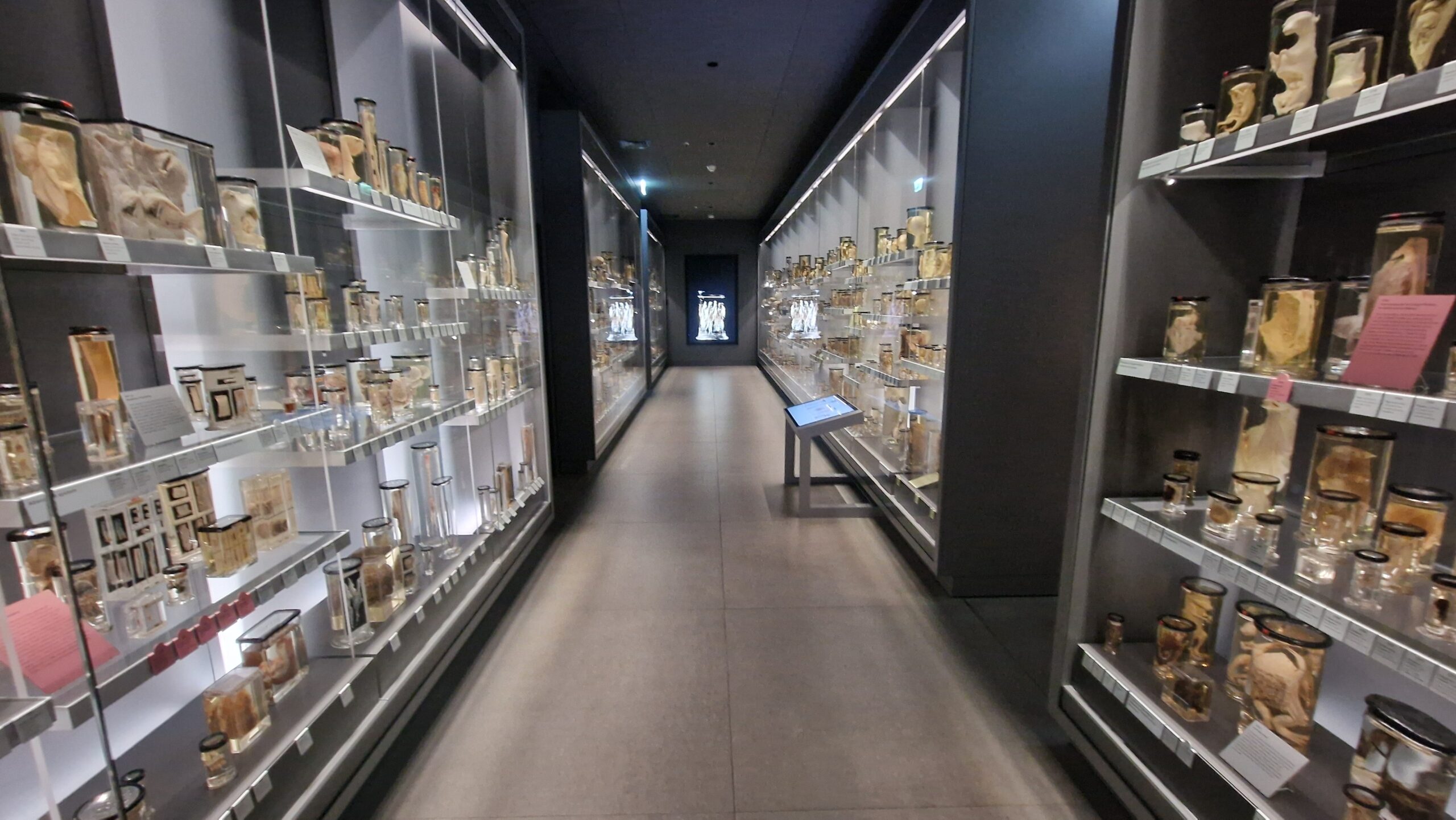
    There are lots of these displays of things in jars, I used this as an example as there are no human remains in it and it’s mainly fish and lizards here. I didn’t take a photo as they’re of human remains, but the Evelyn Tables were quite something, the oldest anatomical preparations in Europe.

    The Hunterian doesn’t shy away from the darker side of medical history. Early surgical instruments, some looking more like torture devices to me, illustrate the crude and often painful procedures of the past. Pathological specimens, including tumours and diseased organs, offer a stark reminder of the fragility of human health and it’s been a useful resource for surgeons over the generations. It’s thought provoking though and I like that in a museum.

    One of the displays of modern medicine, although I got the impression that most visitors seemed more interested in looking at the things in jars. I thought that this was a fascinating museum and I’ve been meaning to go for years, so I was pleased to finally visit. It’s a unique museum in very many ways and an essential part of the history of medicine in this country, with some considerable heritage to the collection and to the building. There’s a learning aspect which is perhaps becoming less relevant, but there was a school group when I visited and that’s part of the education side of the museum’s offering. It is a little macabre by its nature and feels dated, but that’s inevitable when the collection in jars was mostly put together two hundred years ago. There are moral sensitivities here about what should be on public display, as these are human remains. The museum benefits from being part of the Royal College of Surgeons, the moral issues are minimised here as there isn’t a commercial imperative behind what’s happening.

    Anyway, I’m glad that I went and I’d say it’s worth an hours of anyone’s time, although I noticed two people from the school group saying they were feeling very queasy, but the museum themselves warns about this. It’s probably best to book a ticket in advance, it’s free and can be done quickly from the museum’s web-site. Right, back to Soviet statues in Estonia.

  • London – Greenwich (Borough of) – National Maritime Museum (Kangaroo Painting from 1772)

    London – Greenwich (Borough of) – National Maritime Museum (Kangaroo Painting from 1772)

    20240902_132834

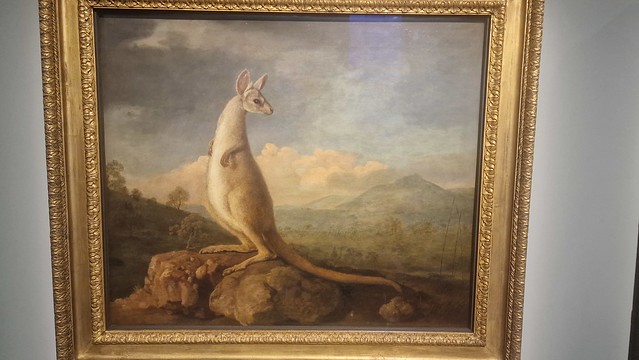
    This artwork was originally known as ‘The Kongouro from New Holland’, and it’s notable as the first painting of a kangaroo (or at least in terms of western artwork). It was painted by George Stubbs, alongside a similar one of a dingo (more of which in a later post, as if this blog’s excitement couldn’t already be topped), in 1772 and they were the only two artworks he completed that weren’t based on actually seeing the full animal. Instead, he had just skin and skull bits of a dead kangaroo which had been collected whilst the good ship Endeavour was being repaired after a little incident when it ran aground and nearly sank on the Great Barrier Reef. Goodness knows what the public would have made of this kangaroo thing, they wouldn’t have seen anything like it before. Indeed, it just looks like a big rodent.

    The artwork was first presented at the Society of Artists in London in 1773 and it, alongside the dingo painting were sold to an Australian buyer in 2012 for 9.3 million Australian dollars. An export ban was promptly put in place by the Government and Sir David Attenborough led a campaign to keep them in the UK. Although the National Gallery of Australia really wanted the artworks, a large donation from the Eyal Ofer Family Foundation (alongside donations from the Heritage Lottery Fund, the Monument Trust, the Art Fund and the general public) meant that they were able to remain in the country. The National Gallery of Australia’s loss was the gain of the National Maritime Museum, which is where both artworks now reside. The artworks had been in private hands since they were painted and were on display at Parham House for some time before their auction sale, with both paintings always being displayed together. It’s quite an achievement that these works are now on public display at a location with no admission charge, successfully saved for the nation.

    Incidentally, I like the old spelling of the word, namely ‘kongouro’, although it actually started off as ‘gangurru’.

  • London – Greenwich (Borough of) – National Maritime Museum (Percy the Penguin)

    London – Greenwich (Borough of) – National Maritime Museum (Percy the Penguin)

    20240902_133819

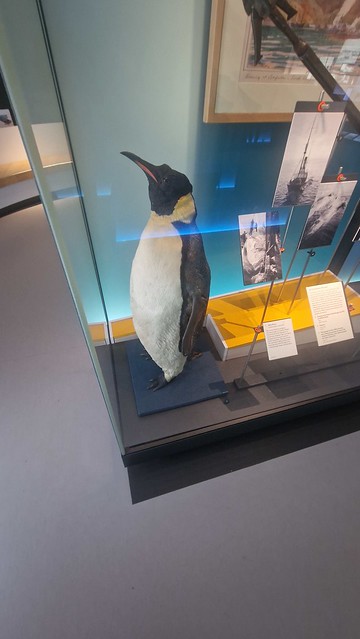
    I went back to the National Maritime Museum earlier this week and I felt the need to post about Percy the Penguin. It’s a stuffed penguin, although that is likely fairly evident to even the most casual observer of the photo, dating back to 1904 (the penguin, not the photo). It was caught on Captain Robert Scott’s first expedition to Antarctica, between 1901 and 1904, and the label reads that this fascinated scientists at the time as they thought penguins were the link between birds and dinosaurs. I’m unsure where it spent the last 120 years, but there’s a note on the museum’s web-site that a label said “PRESENTED BY THE CAPTAIN, OFFICERS AND CADETS, HMS WORCESTER, 1950.”. This is also known as the Thames Nautical Training College, so it likely was looked at by cadets for many a year before finding it’s way to the permanent collection of a national museum.

    Bristol Museums also have their own penguin, collected on Scott’s ill-fated expedition between 1910 and 1913. And, if that’s not enough, there was recently a dead penguin flogged off at auction. I’m not sure what they intended to do with all these penguins that they were collecting, I assume surprise and delight relatives back home with them as I would have thought the scientists didn’t need a whole job lot of them to study them.

    And, the Maritime Museum clearly likes Percy as well, they’ve got a section on their web-site on how to make your own penguin. I likely won’t to be honest, but it seems a sound idea.

    Anyway, I’ve digressed. All these wonderful exhibits at the museum and I get engaged by a penguin.

  • London – Greenwich (Borough of) – National Maritime Museum (John Hawkins Painting)

    London – Greenwich (Borough of) – National Maritime Museum (John Hawkins Painting)

    [I’ve reposted this post from February 2021 to fix broken image links and also because I have more ‘riveting’ content coming about the National Maritime Museum.]

    20201214_112904-scaled-e1612639933624

    When I visited the National Maritime Museum a few weeks ago, there were numerous signs on how they were modernising the displays to be more representative and inclusive. This is an interesting interview (in.doc format) which took place last year with Daniel Martin, the Head of Collection Services at the museum and they seem to be pragmatic and forward thinking.

    20201214_112424

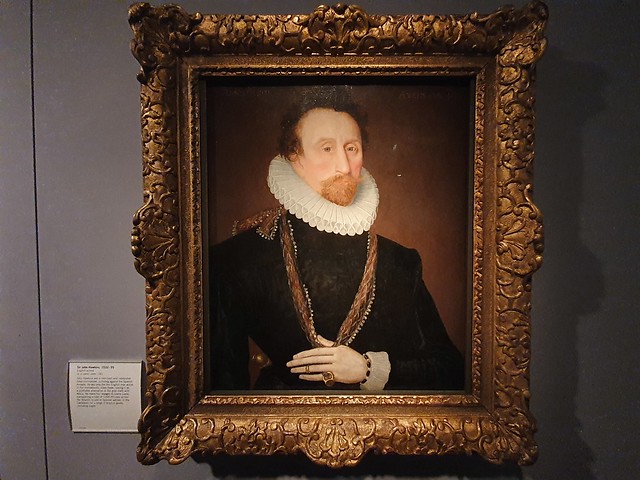
    This painting of John Hawkins (1532-1595), in the gallery which is being reviewed, is going to present the museum some problems in terms of its interpretation. Depending on your viewpoint, this is either one of the greatest English naval commandeers that there has been, or he’s one of the men most responsible for starting the slave trade. Which doesn’t even cover that it’s Hawkins and his crew who brought tobacco back, thereby causing no end of addiction issues over the centuries.

    There was a Royal Navy cruiser between 1919 and 1947 which was named after Hawkins, which does reflect that his naval prowess likely enabled England to fight off the Spanish Armada. The town of Chatham was so proud of Hawkins that they named a flyover after him, which has only recently been demolished. I’m not sure that flyovers actually need to be named after anyone, but there we go.

    There was a book, Devon Seadog, published about John Hawkins in 1907 written by Robert Alfred John Walling and this condemned Hawkins for his involvement in the slave trade (although it made passing note that this often benefited the slave in some ways, which isn’t necessarily an argument that might be pursued today with such vigour) so there has long been condemnation of some of his actions.

    Martin mentions in the above interview that it’s not possible to put every viewpoint in 150 words or so, which is challenging with individuals like this. The museum has though made an attempt on its web-site, where it has more space, to tell the story of Hawkins from different perspectives. I’m not sure I envy though the museum in its attempt to tell the story of Hawkins, as it can’t just ignore him as he’s an important naval figure and they’re a maritime museum, but they need to add context as well as to the impact that he had on the world.

  • London – Visiting London Underground Stations in 2023

    London – Visiting London Underground Stations in 2023

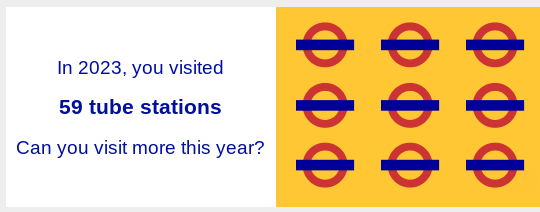
    How exciting, I’ve never had an e-mail before from TFL telling me how many tube stations I’ve visited in the year. This is a very poor performance for someone who loves London and the underground so much, especially as I did a quiz this weekend on how many tube stations I knew and I think I did rather well (on the same theme, try this…..). Anyway, I aspire to beat 59 tube stations this year   🙂   In other statistics, I made 108 journeys on TFL in the year and made the most in August. I’m sure my two loyal readers will be thrilled to know this. Oh, and if anyone wants an adventure involving craft beer, London breweries and visiting underground stations later in the year, let me know  🙂

  • Bucharest Trip – Day 1 : British Airways Flight to Bucharest

    Bucharest Trip – Day 1 : British Airways Flight to Bucharest

    20231111_092530

    I mentioned in a previous post for my two loyal blog readers that I was on razor thin timing for my flight, having left the hotel just 2 hours 30 minutes before take-off. I considered the reality that it might take over an hour to walk to the bus stop, get on the bus and then arrive into Heathrow Central bus station. In reality, it was 11 minutes. But, that meant one thing, I was safely at Heathrow Terminal 3 ready for my British Airways flight to Bucharest. For all of its faults, I’m still keen to use British Airways and I opted for them to get me to Bucharest. Steve had used BA the previous evening, whilst Bev, Susanna and Thim had decided that Ryanair was for them. Bev would use a cattle truck to get there if she could, but I’m surprised that Susanna and Thim weren’t a little more decadent. But, naturally, I didn’t say anything about the matter.

    Back to the flight though. The boarding gate process was handled well, there was no wait and there was a seat whilst they called the groups forwards. All very organised and calm, this felt well managed. It’s always pleasant when the boarding process feels calm, sometimes it all feels a little chaotic and stressful.

    20231111_092725

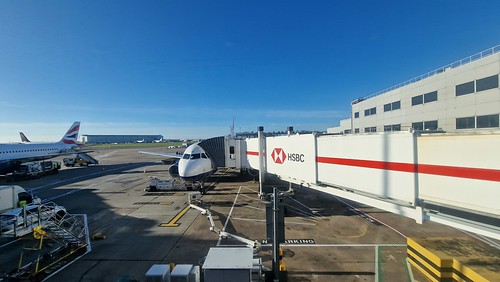
    Here we are on board. I say we, but I primarily mean me and the other passengers. It was an Airbus A320 aircraft, registration G-EUUF (although I need to check this, as two sites have different aircraft registration codes for this flight which I haven’t seen before). Assuming it was G-EUUF, BA have had this plane since new when they purchased it in 2002 and I don’t think it’s one that I’ve been on before (but my records are quite patchy, I didn’t know I was going to become interested in recording this for some time). Once again, I should really get out more…

    20231111_092734

    One of the vestiges of my status with British Airways is that I can still book these for free, so I got an emergency exit row seat. I’ll be back to silver status early next year (the lowest status I can get which gives me lounge access), required given that I do like visiting the airport lounges as I get excited by free cans of Fanta. Also for my comfort, there was no-one on else this row which was quite handy. Especially given that Thim was reporting he had a somewhat less comfortable experience on the Ryanair flight he was on. The seating area was clean and everything worked as it should,

    20231111_094219

    Satisfactory leg room and the cabin crew were pro-active and friendly. There were also working power points on the service which proved handy. The pilots were the usual middle to upper class sounding British Airways flight crew, sounding reassuring and competent. Not that other pilots aren’t competent, it’s just that the announcements made by British Airways crew seem to be so quintessentially British that it fits their brand well.

    20231111_101230

    There were no delays on departing and the passengers all seemed sensible and efficient which meant no issues with people trying to shove large bags in awkwardly to the overhead lockers.

    20231111_102431

    The free snack and water, which I still think is a positive touch rather than the previous effort they had which involved giving passengers absolutely nothing.

    20231111_145733

    And safely into Bucharest, twenty minutes earlier than expected. There was little to report from the flight, which is a positive thing as too much drama on board is often sub-optimal. I had mentioned to Bev that I didn’t want her, Susanna and Thim waiting for me as they got in 90 minutes earlier, but that was good since they didn’t bother anyway. Once again, I didn’t comment negatively on that situation. On the matter of the weather, it looked just a little bleak, but the temperature was fine for my needs and the rain wasn’t too bad.

    20231111_150448

    I won’t go on about the European Union as my thoughts on this are well known to my two loyal blog readers (and for anyone else, #iameuropean) and EU citizens were able to breeze through passport control. Those from the UK had a much longer wait which was sub-optimal. Anyway, I was again impressed with British Airways, everything worked as it should, everything was clean, the crew were friendly and the service was efficient. The flight cost £42 each way, which I think is very reasonable, especially as I used Avios from previous flights to reduce that to £24 each way. All rather lovely.

  • Bucharest Trip – Day 1 : Superloop Bus to Heathrow Airport

    Bucharest Trip – Day 1 : Superloop Bus to Heathrow Airport

    20231111_072917

    I admit to being slightly, but just slightly, geeky about London transport. Buses, trains, trams, underground services all hold some excitement and I’ve been following the introduction of TFL’s Superloop services. I decided to wait for a short while to get service SL9 which is the orbital route from Harrow to Heathrow Airport.

    20231111_073229

    And here it is, the SL9. Admittedly, this isn’t really that exciting, it’s a standard bus that until recently was just branded the X140. For anyone further interested there’s more on Wikipedia at https://en.wikipedia.org/wiki/London_Superloop, with the new system being a little complex if I’m being honest. Or, at least, it seems complex to me which might be a different thing.

    For the purposes of the trip to Bucharest, it took five minutes to get into Heathrow’s central bus terminal and the service wasn’t too crowded.

  • London Metro Memory Game

    London Metro Memory Game

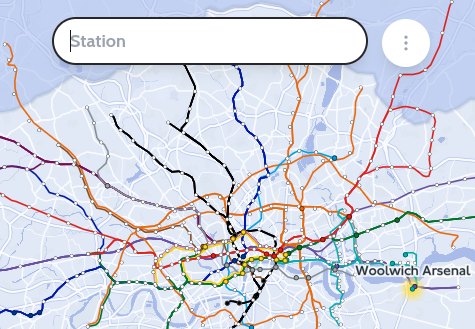
    I like on-line quizzes, although not real-life ones as I realise how little I know compared to others, but this trending London Metro Memory game is just the sort of thing that I should be good at. It’s a memory test to remember every one of London’s stations and I confess that I haven’t done as well I would have liked. I got to 40% and then thought that was enough, I wasn’t getting anything more.

    The game can be played at https://london.metro-memory.com/. I think I need to study the map for longer when I’m next on the network, I’m sure I should be able to get to 50%!