
A few years ago I went to the Cavern Club in Liverpool and was moderately disappointed to discover that it’s not quite in the same place as the original. In 1973, British Rail decided that they must definitely have the site of the Cavern Club (although they were prepared to build elsewhere if they were given some extra money to pay for their costs) and so they compulsorily purchased it, filled it in, then decided they didn’t want it. An attempt was later made to excavate the site which wasn’t entirely successful, so the current Cavern Club is sort of where the old one was with some of the same bricks.
And, I mention this tangential story because this is what has happened to the London Mithraeum. Not British Rail this time, but Legal & General and the construction of their far from beautiful Bucklersbury House. It would have been possible to redesign the building and keep the Roman finds, but the Government announced it would cost £500,000 and they weren’t spending that. However, it shouldn’t be under-estimated just how interested Londoners were, it attracted unprecedented interest for historic remains and the site was being opened three hours earlier than anticipated in its last week, such were the number of people who wanted to see it. These were challenging times for London in the mid-1950s where much was still being rebuilt following the war, so there was a great deal of positivity when this Roman structure was being uncovered.
The end result was that they shoved out the Roman remains into the street and called it a compromise. Perhaps less a compromise and more of a sell-out. There was talk of just destroying the site entirely, so the option chosen did at least save the stones. Anyway, Bucklersbury House has now gone and been replaced by a lovely new building designed by Fosters & Partners. And it’s in the cellar of that new building that this temple now resides once again.
The hole that was dug for the Legal & General building. There’s a lot of history, including some interesting video of people there in the 1950s, at the official web-site at https://www.londonmithraeum.com/about/. Given the quantity of information there, I’ll just borrow a little of their text to ensure my history is correct.
“The site lies over the course of one of London’s lost rivers, the Walbrook. Nearly 2,000 years ago when Londinium was founded by the Romans, this river marked the limits of their first settlement. In the 3rd century AD, nearly 200 years after the founding of London, a Roman Londoner, built a temple to the god Mithras on this reclaimed ground, next to the river.
The mysterious cult of Mithras first appeared in Rome in the 1st century AD. It spread across the Empire over the next 300 years, predominantly attracting merchants, soldiers and imperial administrators. Meeting in temples which were often constructed below ground, these were private, dark and windowless spaces. The mythological scene of Mithras killing a bull within a cave, the ‘tauroctony’ is at the heart of the cult, and its full meaning is subject of much speculation.”

But, going back in this story a little bit, there’s a ground floor entrance to the new Bloomberg Building which gives access to a museum and public space. The first surprise was seeing my friend Steve, who had coincidentally booked the exact same time to visit the same location. And there was one other person (who we didn’t know) booked for this time, as although the tickets are free, they need to be pre-booked at the moment. And we chose the right day to book our tickets to visit, as changing tier restrictions meant that this was to be its final day of opening for the moment.

This is the first part of the experience. I’m not sure they call it an experience, but it’s a word that perhaps adds an extra dimension to a visit, so I’m using it. The staff member who welcomed us gave a spirited explanation of it. The other person vaguely looked at it and walked off, whereas Steve and I decided we would make an effort to look at it and pretend to understand it. I’m not sure that we did, and I did think this would be a handy spot for a cafe. I’m not sure that’s what the artist had intended me to think, but there we go.

Some of the finds are now on display, although 14,000 items were found, so I’m not entirely sure where the rest are. Going downstairs, and before getting slightly lost, we found the second part of the museum, where there are some screens giving more of the site’s history.

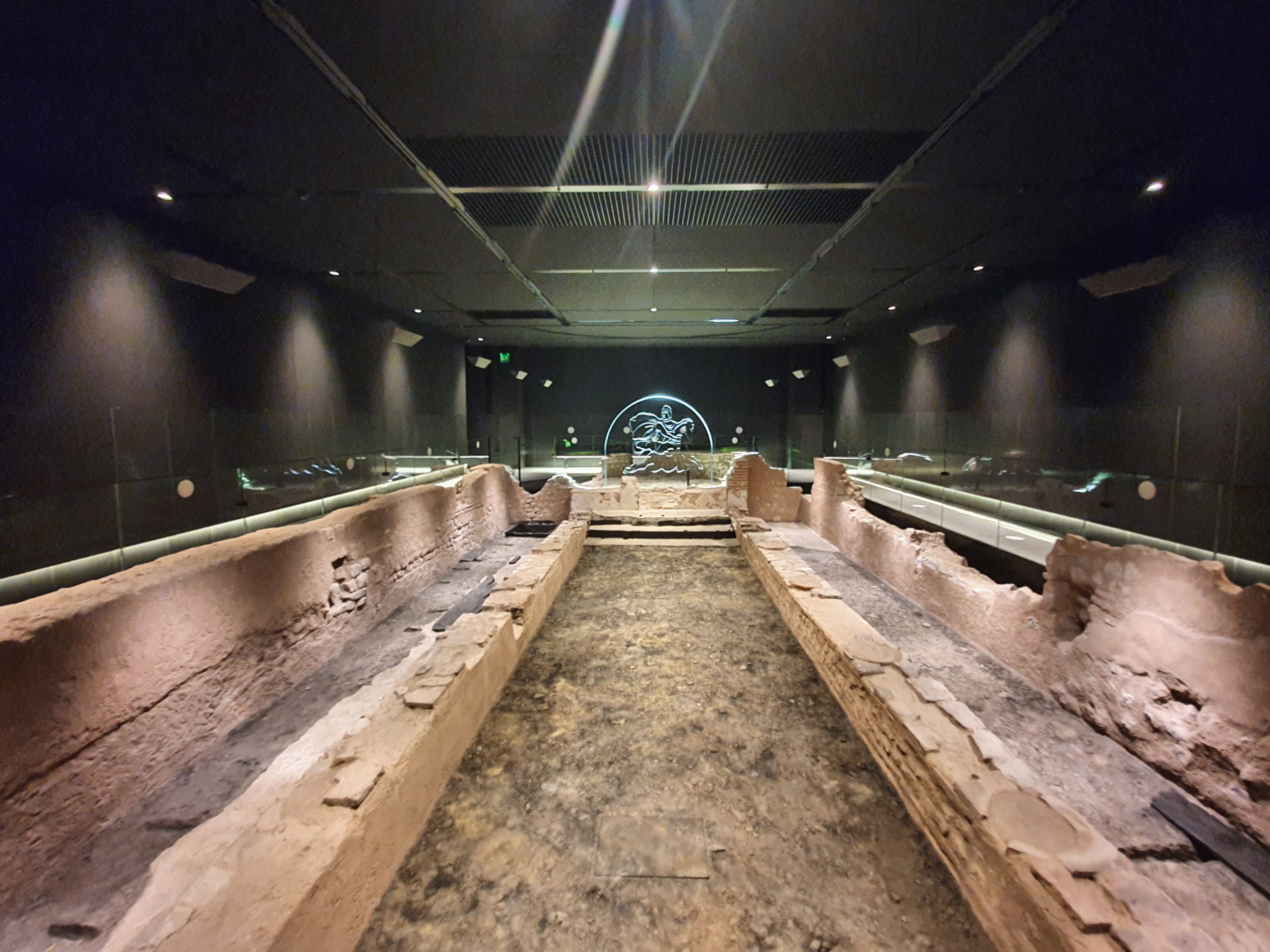
And, this is the centrepiece of the attraction located down another flight of stairs. I understand there’s usually some form of audio-visual experience for visitors before entering here, but for reasons unknown, the current health situation makes that impossible.

And another photo of the Roman remains with visitors being able to walk around the outside. I couldn’t help be distracted by the neatness of the stones, it all felt too polished and modern. And the reasons for this are clear, namely that when they moved it to an outside location and slightly crudely rebuilt it, much of the original was lost in terms of the mortar and indeed its authenticity. Eric Morecambe’s line is often quoted, but there’s an element of truth to say that “there are all the right stones, but not necessarily in the right order”.
There’s an article in the Sphere on 23 October 1954 with a photo of a wall being built, subtitled “workmen are rebuilding the lower walls with the stones made by Roman masons”. I’m not convinced that there was complete archaeological rigour going on with the rebuilding, although this seems to have been glossed over a little in the telling of the temple’s story.
But, I have no complaint with the efforts made by Bloomberg, they’ve restored some dignity to this site after some rather casual and off-hand treatment of it over the last few decades. The web-site they’ve created is informative and useful, with the reviews of the museum nearly all veering towards the very positive. And there’s been some magic put back to these stones, in whatever order they’ve been relaid. A visit isn’t likely to take much more than thirty minutes, but I’m glad that I got to see this site at Walbrook.