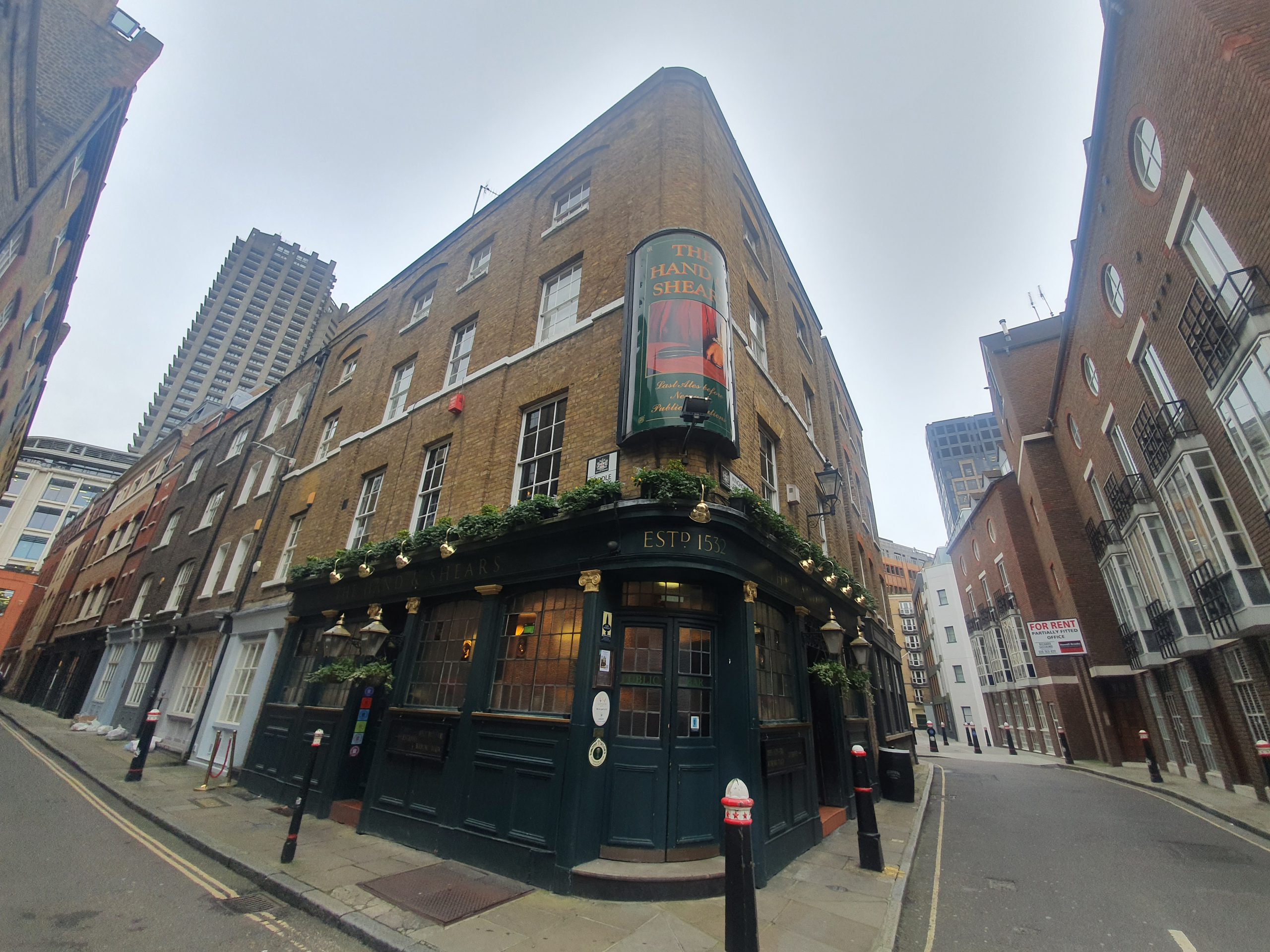
Category: Central London

  • London – Central London – Roman Wall at St Alphage Garden

    London – Central London – Roman Wall at St Alphage Garden

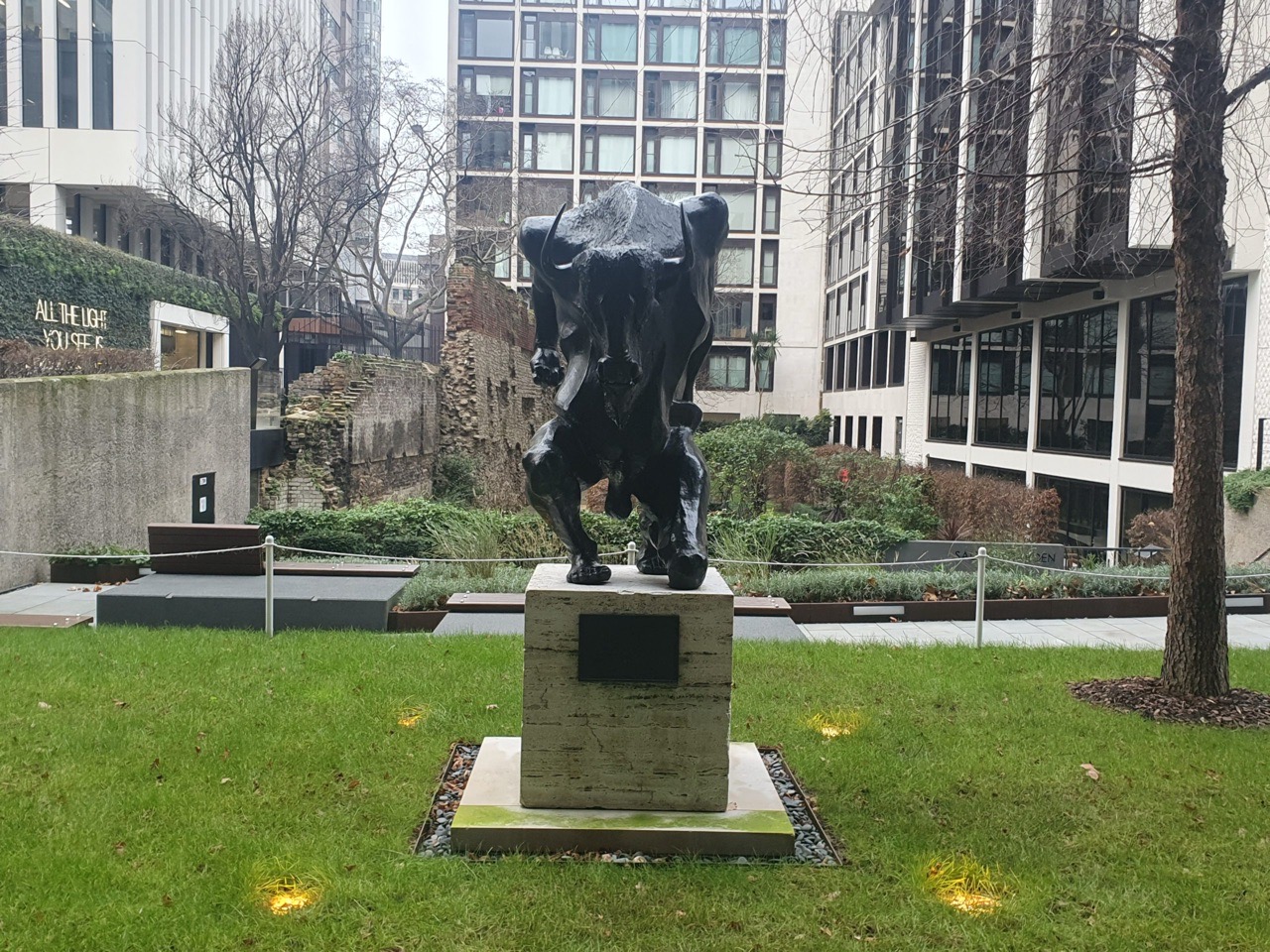
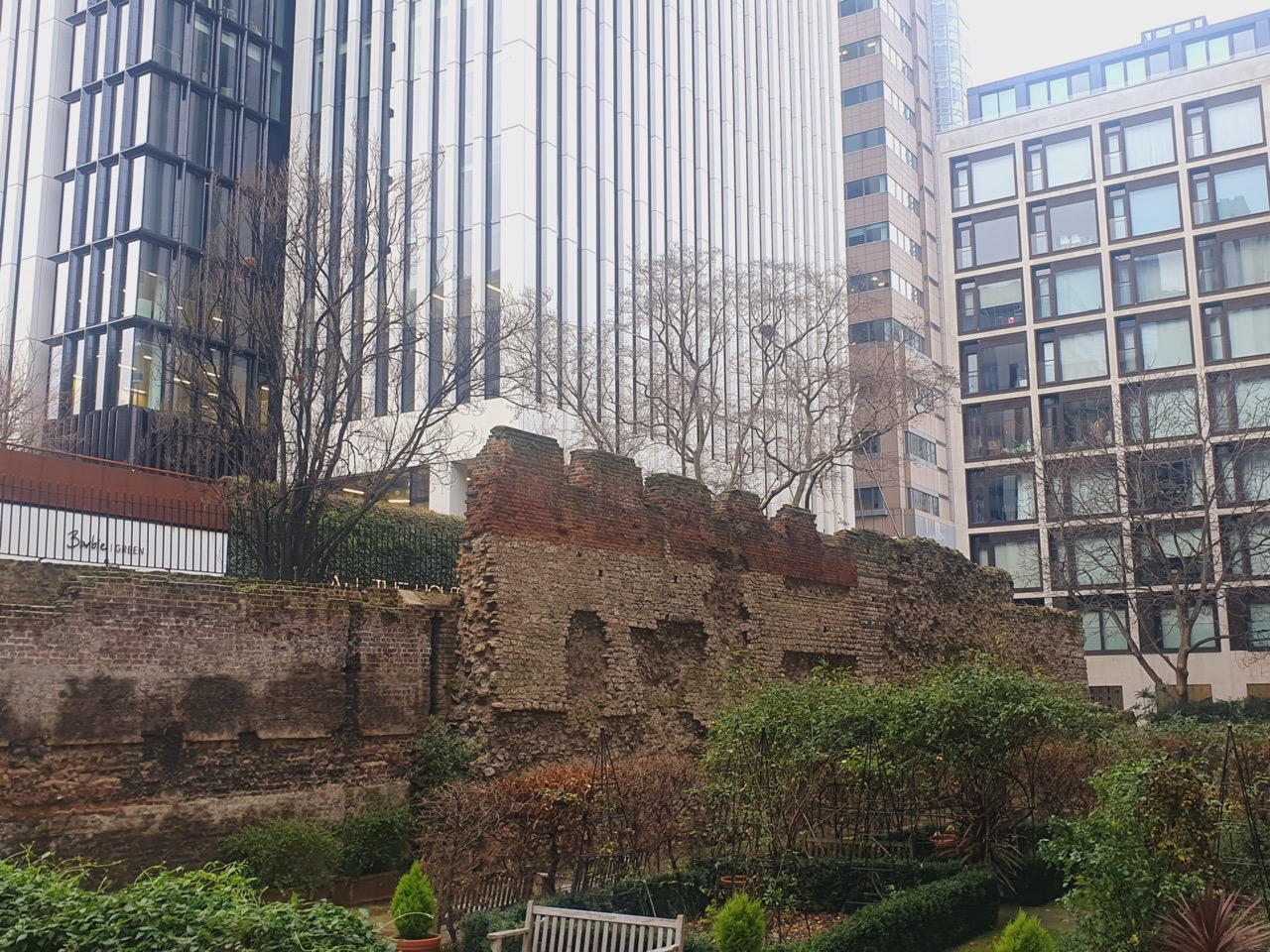
    This stretch of Roman Wall is located next to the Tower of Elsing Spital, by what is now the road named London Wall.

    This is the listed building map of historic buildings in London, with the red line being the scheduling of the remains of Roman Wall that still stand (or where foundations are known to survive), a series of large and small fragments which show the size of early Londinium. This section of Roman Wall is near to the top of the image, a little closer to the Blackfriars end rather than the Tower of London end.

    Looking down from the aerial walkway, this would be a much busier scene in summer months with people eating their lunches or just taking some time to get outside in the relative peace and quiet of the surroundings.

    That’s Salter’s Hall in the background, now a large charitable institution, but previously one of the Livery Companies of the city. It’s a modernist style building which is in keeping with the nearby Barbican development in its post-war contemporary architecture, although it doesn’t fit quite as easily with the Roman wall.

    The plaque is now harder to read, but notes when this area was laid out as a public garden in 1872.

    Much of what is visible isn’t part of the Roman wall, although the foundations of the original structure are still there, but they were built on during the medieval period when it was being strengthened. The brick section on the far right of this photo is from 1477 when Ralph Jocelyn ordered substantial repairs to the wall, at that stage in a bad state in some sections, during the War of the Roses. He bravely raised taxes to fund this endeavour, as well as purchasing large quantities of bricks and lime.

    There was also a church, St Alphage, which backed onto this site and the former wall lines are marked on the ground. This church was constructed in the eleventh century, but was knocked down during the Dissolution of the Monasteries.

    Another Victorian stone, but it’s now nearly entirely unreadable, damaged by the decades of London smog, pollution and not helped by the bombing of the area during the Second World War.

    The medieval putlog holes are still visible where the wooden scaffolding was once placed against the structure.

    The rear of the wall is visible from the gardens of Salter’s Hall which are sometimes open to the public, but which were closed when I visited. The medieval brick additions, and the only stretch of crenellations along the wall which survive, are much more easily seen from this side. The reason that so much of this wall survived was due to it being incorporated into later buildings, although it was only after the bombing of the Second World War that it became quite so visible.

  • London – Central London – Tower of St Elsyng Spital

    London – Central London – Tower of St Elsyng Spital

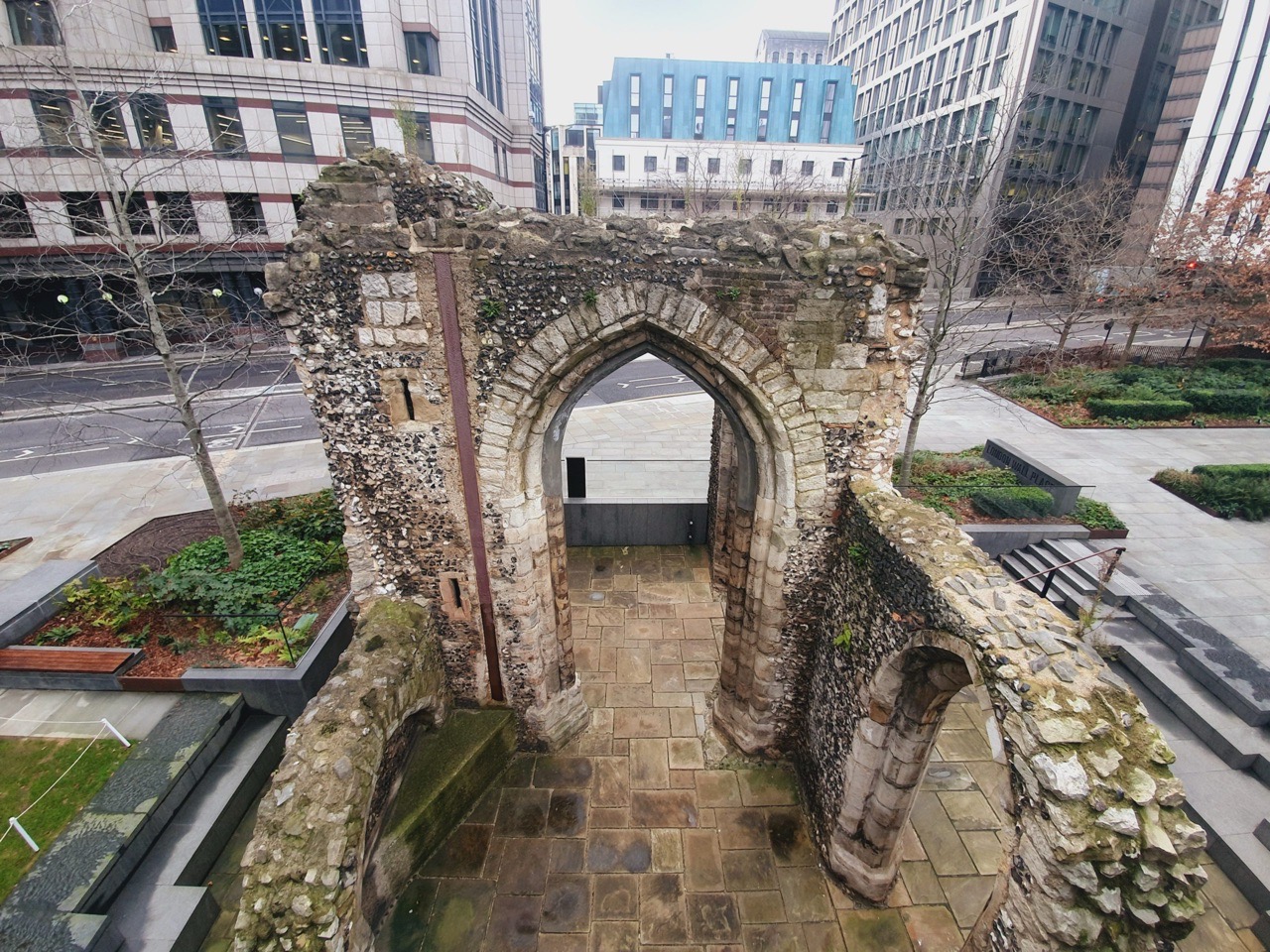
    Located on London Wall, the road named after the Roman defensive wall, this is all that remains of St Elsyng Spital church. It was part of the structures built by William Elsyng, a wealthy London merchant, as a hospital in 1330 to help the poorest members of society in medieval London.

    Clicking on this image will make it larger and it’s the site in around 1900 and next to it, what there is today. Reconstruction following the Second World War saw much of this area swept away, but the remains of the church were kept. The landscape has changed substantially though, London Wall now ploughs through this part of London and the area has been opened up to the public. The little cursor on the map on the left is where the remains of the tower stand today.

    Through the central arch would have been the main part of the church, the choir and then the nave.

    The hospital section of the site was the first to be constructed, with the priory church being completed in 1340. This was later turned into a parish church in 1536, following the Dissolution of the Monasteries. Much of the rest of the site was damaged in 1541 and some of the buildings were turned into a private house, which all became part of Sion College in 1630. There was substantial damage caused by the Great Fire in 1666, but the College remained here until 1886 when they moved to a new site in Victoria.

    The cloisters and cemetery would have been off to the right, under what is now London Wall road. The church was damaged in a First World War air raid and part of it was reconstructed in 1919, but the nave was removed in 1923. This wasn’t an entirely destructive process in terms of the history, as the nave of the building only dated to between 1774 and 1777 when it was rebuilt as the old church was falling down, but they did keep the original tower. Following the demolition, the tower and porch were turned into a small church of its own, but this was in turn damaged during an air raid during the Second World War, with the area being comprehensively redesigned.

    The stone steps into the tower remain, although are gated off. The steps aren’t easily visible due to the assorted litter that has collected up here.

    There’s now a walkway to get a better view of the church and in the centre is where the stone steps come out.

    The remains of the church in their new post-war surroundings in what is a decent public space, with numerous interpretation boards explaining the history of the site. Although the medieval street plan has been lost here, the tower is now more visible than it would have been in previous centuries since all of the buildings around it have been removed. I’m sure that there have been many times in the past when planners thought that it would just be easier to remove this section, but it’s now an important part of the local landscape.

  • London – Central London – Postman’s Park

    London – Central London – Postman’s Park

    This park is a short walk from St. Paul’s Cathedral and was once three separate churchyards before being merged together in 1880 as a space that the public could use to exercise and relax. It’s a relatively sizeable space for such a central area of London, but it had long since struggled to deal with the number of burials that were needed at the site. With London’s central churchyards being not only full by the 1840s but also a dangerous health hazard where diseases spread, the idea was to open up cemeteries around the city (the Magnificent Seven) and turn sites such as this into public spaces.

    This map from the end of the nineteenth century also gives a clue to the reason for the park’s (named as the recreation ground) name, simply that it was commonly used by staff from the General Post Office.

    The park is made up of three different churchyards, those belonging to St Botolph’s Aldersgate church, Christ Church Greyfriars and St Leonard Foster Lane. Only the former is still standing, with Christ Church now being in ruins due to bomb damage during the Second World War and the third was lost in the Great Fire of 1666. Some of the ruins of the latter church remained until the nineteenth century, but they were destroyed during the construction of the General Post Office in the nineteenth century.

    The former Christ Church churchyard entrance.

    Looking across the park to St Botolph’s Aldersgate church.

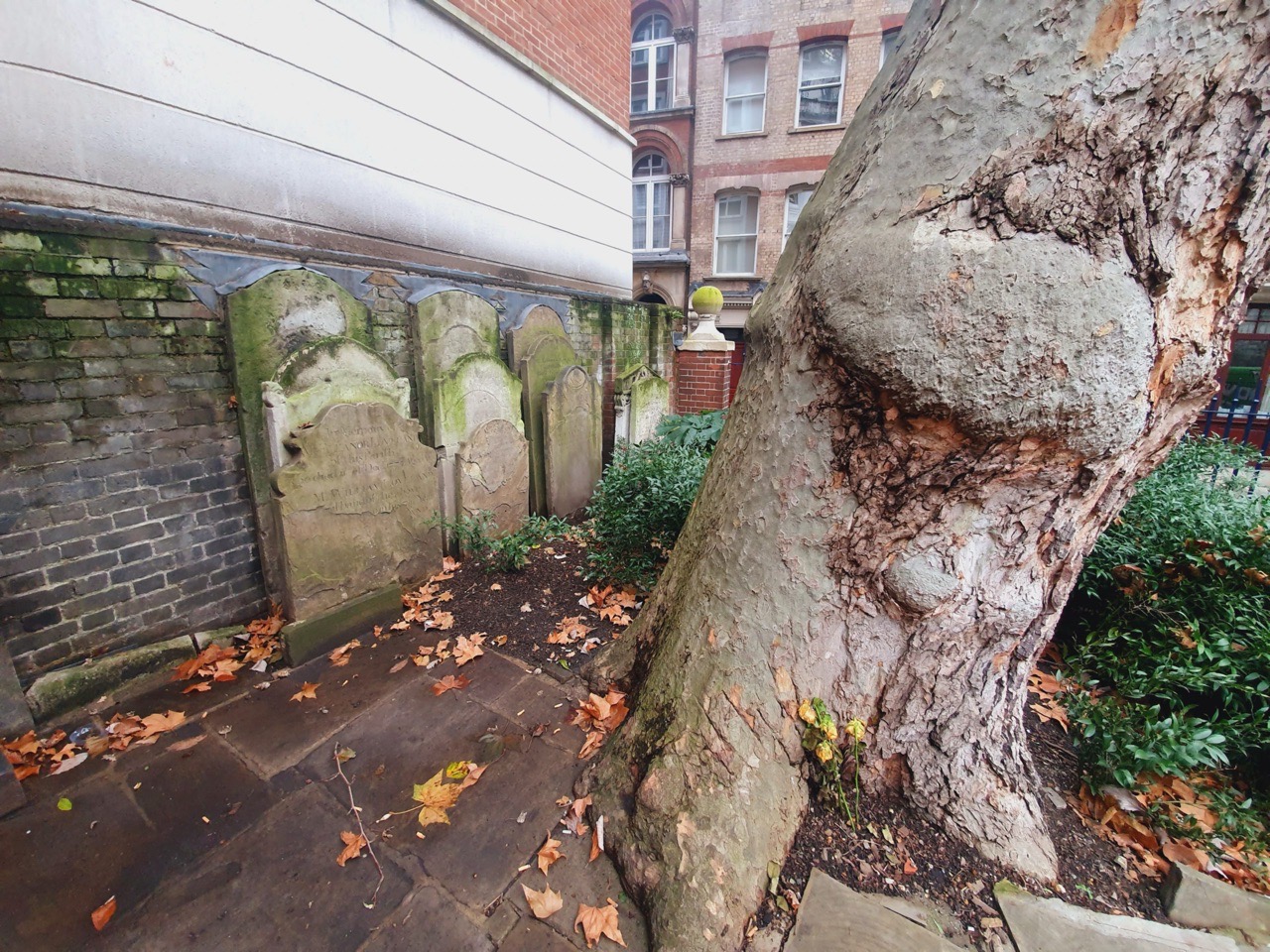
    A rather large tree that has been here for some considerable time, with some graves which were once in the churchyard of St Botolph’s Aldersgate, but which were shoved against the wall in the late nineteenth century when the park opened.

    A rather lovely little water feature.

    The St Botolph’s Aldersgate church entrance to the park.

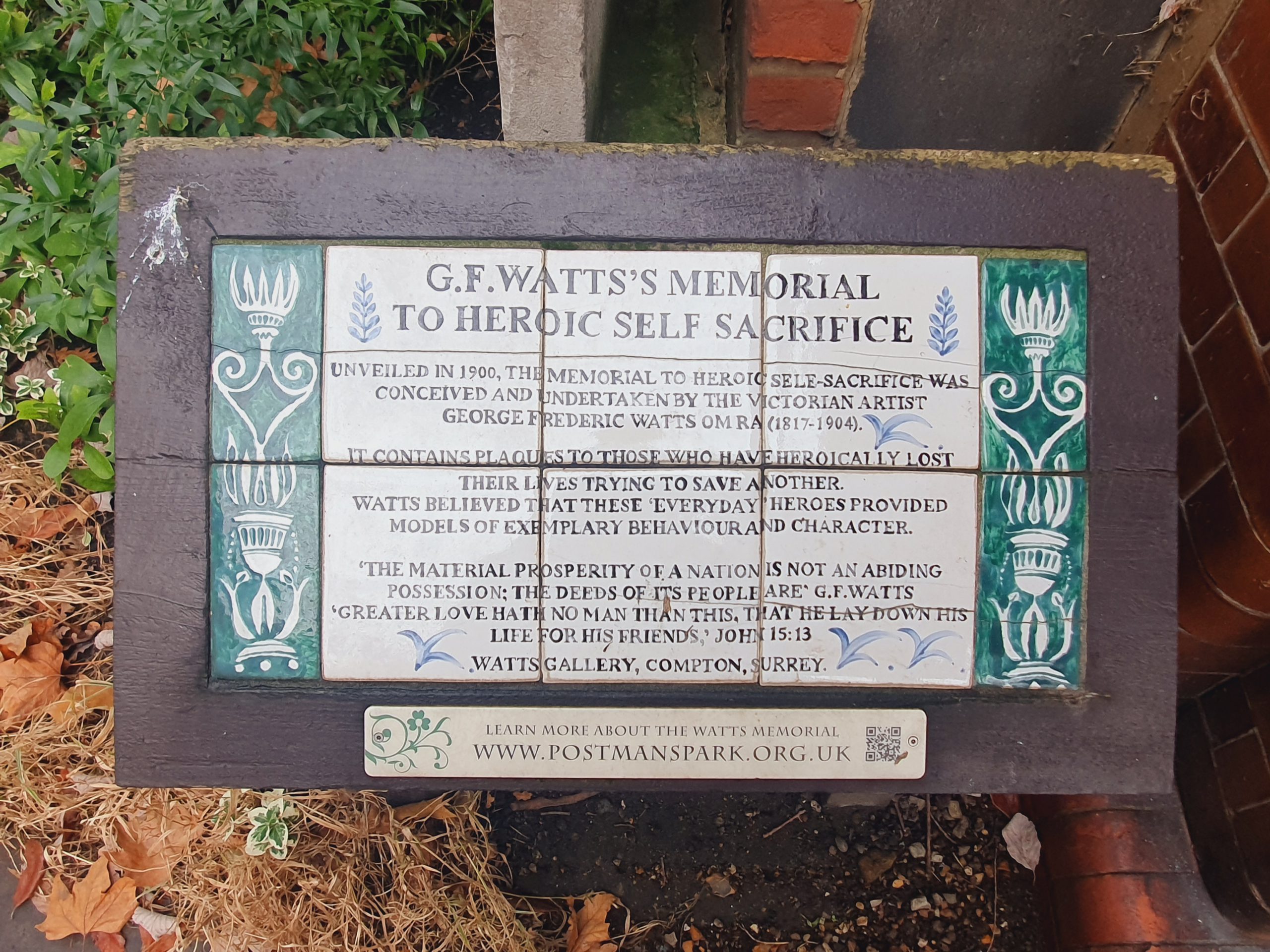
    Also in the park is the Memorial to Heroic Self-Sacrifice.

  • London – Central London – Memorial to Heroic Self-Sacrifice

    London – Central London – Memorial to Heroic Self-Sacrifice

    Located in Postman’s Park and on the site of the former graveyard of St Botolph’s Aldersgate church is this memorial to those brave individuals who have died through acts of great self-sacrifice. This is the idea of George Frederic Watts, a painter and sculptor, who wanted the bravery of ordinary men, women and children to be remembered for generations to come. The memorial opened in 1900 and most of the tiles were produced by William De Morgan (later on Royal Doulton produced the tiles), but the project slowly ground to a halt and by 1931 only 53 of the planned 120 tiles were in use. The church has recently started adding more tiles again, bringing the original concept back to life.

    There was a memorial held in the church in December 1905, a year after Watts had died, which was attended by the Bishop of London. A statue of Watts was unveiled and the Bishop referred to the “humility of character and simplicity of life” of the former painter.

    Some of the names on the memorial, with some tragic stories amongst them.

  • London – Central London – The London Stone

    London – Central London – The London Stone

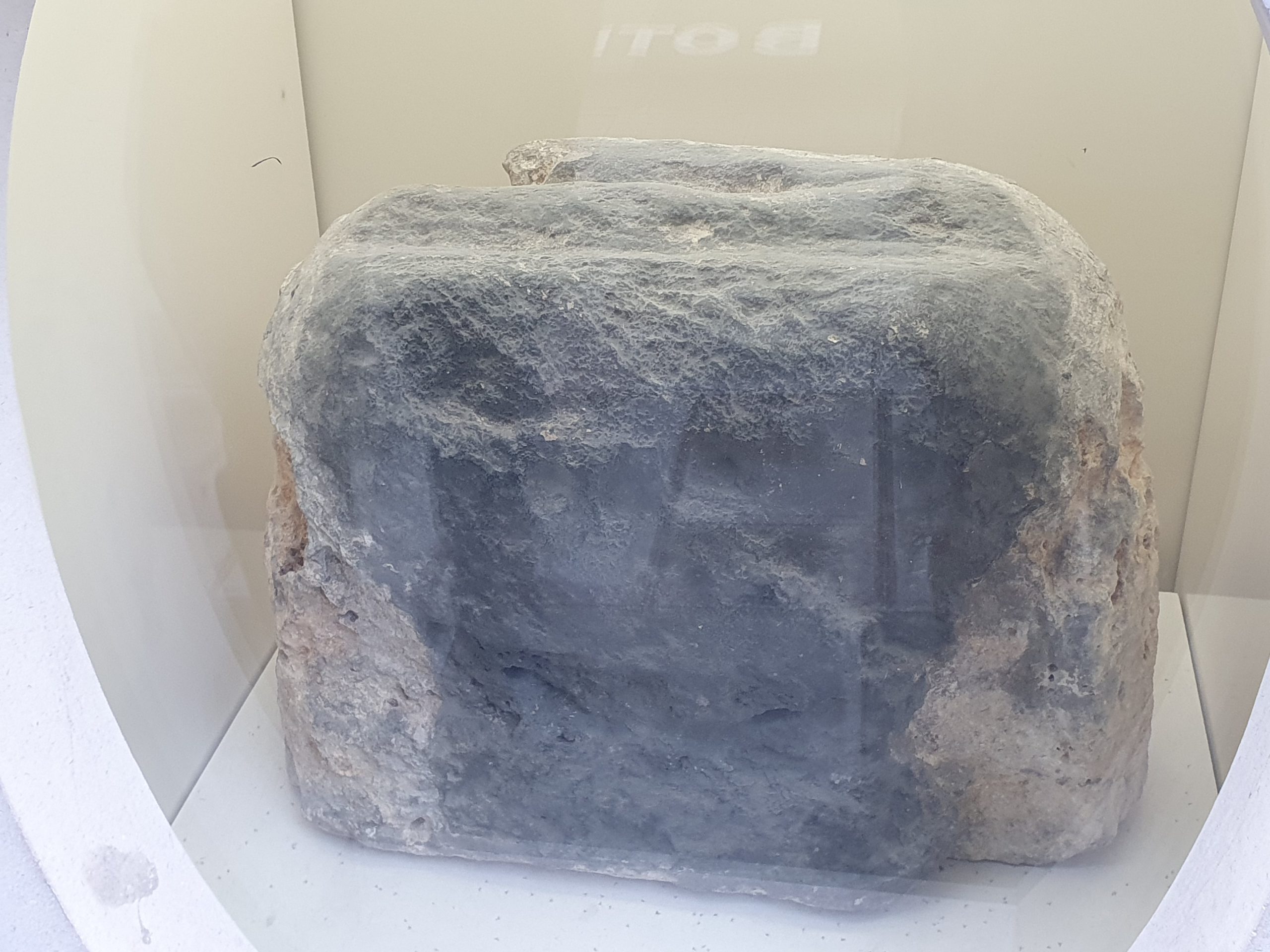
    There’s not much that I can add to the collective on-line resources about this stone, but I still find it an interesting survival. It was once part of a larger stone structure that might date back as far as the Saxon period (some say the Roman period), although the written record is more substantial from the medieval period. It’s known that in 1450 Jack Cade, the leader of a revolt against the governance of the country, entered London and struck the stone with his sword, which he claimed made him the Lord Mayor of London. He was dead soon after, the process wasn’t quite as smooth as he might have hoped.

    Here is the stone in its current home, 111 Cannon Street. It was once located at Candlewick Street, which was later widened to create the current Cannon Street. It has been something of a tourist attraction since the sixteenth century (I suppose they didn’t have many other options then, places like the London Dungeon weren’t trading in the way that they are now), although it had to be moved as it was in the way of traffic. Bloody typical that they move items of historic interest to make way for traffic, but nothing much changes. From the seventeenth century, the stone was placed safely in the wall of St. Swithin’s Church, but that was damaged during the Second World War. It was though included in the replacement building to ensure its future.

    The situation became a little ridiculous more recently when the stone became included in the WH Smiths store and got stuck behind the magazine rack. The entire building was demolished in 2016 and today it’s back in a nice alcove so that the public can easily see the stone. It might not be much to look at, but it’s a remarkable survivor and there’s some considerable heritage to the whole arrangement.

    There’s an information board by the stone (clicking on the image makes it larger). I accept that individuals have to use a lot of imagination here when looking at this lump of rock, but I like that it’s there.

  • London – Brewdog Tower Hill (Scramm’s Mead)

    London – Brewdog Tower Hill (Scramm’s Mead)

    My friend Richard was on another of his decadent trips to London at the weekend, which was handy as he was dropping my tent off for my week of camping. We popped into Tower Hill Brewdog and I wasn’t going to write about this, as I’ve written before about this bar which is near to the Tower of London (I’ve taken my main photo for this post from an earlier visit as well). We were slightly surprised to get a table as it two hours before the football started, but, fortunately, the fans weren’t much interested in Brewdog until the football was about to start.

    Two things of note though. Firstly, Richard wasn’t impressed at his avocado and feta bowl (I don’t know why he ordered this, but I didn’t say anything) as it was mostly leaves with only limited sprinklings of anything else. I didn’t bother taking a photo of the meal but would have done if I had known how disappointed he was with it. He was about to tell the staff his thoughts about it, but there was no check back and the staff member who collected the mostly left plate of leaves didn’t say anything either. I was a little disappointed by this, I would have been interested in what they had to say. Probably “why didn’t you order a burger?” or something….

    Anyway, of more relevance was the very decadent Marionberry from Schramm’s Mead which Richard spent a small fortune on. I was fortunate enough to pinch a little of it, because I noticed that this is one of the best rated breweries in the world. Schramm’s Mead are located in Ferndale, Missouri and I’ve decided that I need to have a visit to their taproom at some point in the future. Untappd note that this brewery averages at 4.52 from their 111,386 ratings, a quite phenomenal score. I accept that not everyone gets excited by very high scores on Untappd, but I’m easily excited by this.

    As for the Marionberry, which is a fruit mead (or melomel), this was absurdly good. Made with Marion Blackberries it had the taste of a rich jam and it was moving towards being a red wine in my eyes. Smooth for its 14%, but packed with flavour and a very different drinking experience. Not the cheapest, but I’d absolutely order from this brewery again if I see anything of theirs in the UK. And if not, I’ll just have to wait until I go and see them in the United States. A very lovely drink indeed and full credit to Brewdog for making this available.

  • London – City of London – The Walrus and Carpenter

    London – City of London – The Walrus and Carpenter

    For the first time in a long while that I’ve been in London, I haven’t needed to go anywhere by public transport today, such is the advantage of staying in the centre of the city (I haven’t got wealthy and decadent, just that the nearby Ibis Budget was cheap). That meant I thought I’d visit a few pubs that I’ve never managed to get to in the area of the Tower of London, on the grounds that they’ll be reasonably empty of business-people and tourists so I’ll be able to see inside properly.

    This is another Nicholson’s pub (although until 2006, this pub was operated by Young’s) and they’ve made their usual effort of not overly engaging about the history of the building, although their web-site does talk about the nearby Monument. They do explain that the pub name comes from a verse in a poem by Lewis Carroll, although they don’t give a reason why they changed the name from what it was called, which was the Cock. Although perhaps they don’t really need to.

    The interior was bright but empty, although the pub had a bustling area to the front where people could sit outside overlooking the busy road. There was a polite welcome from a staff member at the door and, before I could get my app order in, I was asked what I wanted to drink. The staff member at first seemed to prefer to just take my order rather than me faff about via the app, but then I explained that I wanted the 25p discount from the app, so he gave up and let me get on with it. I should go when it’s a little bit busier, then they don’t get chance to try and take my order before I’ve made it. I make many things awkward with trying to save 25p….. The staff seemed to be from a number of different countries, they did add positively to the whole atmosphere of the pub.

    Anyway, the beer choice was limited to London Pride and Nicholson’s Pale Ale, which was hardly thrilling. I went for the latter and it was satisfactory. I’ve gone back a bit on Untappd to see if the choice ever gets more exciting and the short answer from the last three years is rarely, this is really a lager and spirits led pub (although that doesn’t seem to have been the case a few years ago, when the real choice was quite extensive).

    As is usual with Nicholson’s, they have a theme to their food, and here it’s pies. It’s a clever gimmick and one that I think is quite successful for them, although the food seems to still be brought in en masse so there’s still a lack of individuality here. Pricing for food and drink is around average for the area and it’s not a bad choice for tourists to the Tower of London as it does have the feel of a traditional British pub.

    Although it’s always interesting to see another pub, it’s not really one for me because of the lack of beer choice, although it seems competently managed judging from the consistently good reviews. The pub is though large, with an upstairs and downstairs that can be opened up, so there’s some flexibility here and those wanting food are likely to be rarely disappointed that they can’t be seated.

  • London – City of London – Seething Lane Tap (Brewdog)

    London – City of London – Seething Lane Tap (Brewdog)

    My aim of visiting all the Brewdog bars in London is nearly complete, but they also have a few pubs which are remnants of the Draft House chain which they took over a few years ago. This is one of them which is located very near to Brewdog Tower Hill and the Tower of the London. I think this one is quite sports orientated, although I visited on a Wednesday afternoon, so I’m not sure that there’s much to show which was handy.

    It was quite busy on the tables outside, but it’s fair to say that it wasn’t entirely packed inside. There was a friendly staff member who welcomed me near to the entrance and noted that I could sit anywhere. A lot of the tables had power points located by them, which is always a handy facility to have. The ordering process is the same as with Brewdog, so I ordered via the app and went for half a pint of Amygdala from the Solvay Society brewery in London. The food menu also looks the same and I noted that they offered Wings Wednesday, although I decided against going for that today.
    What arrived was a pint and I did own up to having only ordered a half, not as a complaint, but in case they had brought the wrong drink over. The staff member said it was fine to keep it, and I did, as I’m very accommodating and helpful like that. It’s a saison, not a beer style that I’m particularly used to drinking, but I do know that I like the flavours. As I haven’t had many of these, it’s a little hard to compare with others, but I liked the aftertaste, a very drinkable beer.

    There seems something slightly disappointing that Brewdog have nearly entirely incorporated these pubs into their chain without keeping them distinct in some way. Much as I like being familiar with the ordering system, they could perhaps have kept some of the original Draft House character. They do seem to have a larger food menu than Brewdog bars though at least, including fish & chips and some more starters. But, no complaints about my visit here, five different guests and the standard Brewdog options, all in a clean environment and friendly staff. And definitely no complaints about the free half a pint, much appreciated.

  • London – City of London – The Ship Pub

    London – City of London – The Ship Pub

    This is the Nicholsons operated pub in the city of London, a short walk from Greggs and Monument station. As an aside, and not that I’m one to moan (but yet here we are as someone used to say…..) but it’d be nice if Nicholsons didn’t just say on their web-site that their pubs were historic, but actually said why. Fortunately, CAMRA have something to add on this, namely “on the site of the Talbot which was destroyed in the Great Fire of London”. The former name of the pub, and the current name of the court, is named after the breed of hunting dog, known as the Talbot.

    Also, if anyone has a Good Beer Guide book from the last couple of years (but not last years), let me know, as I think that this pub was listed, but it seems to have been removed from the latest edition. As I have the app, I can only see currently listed pubs and not ones that are no longer listed. There’s another pub called the Ship nearby as well, to add some extra confusion to arrangements.

    I was welcomed by a friendly member of staff who was standing near to the door to meet the Covid requirements. It was quiet inside, but there are some tables outside (apparently something that they’ve only recently been allowed to do) which I studiously ignored on the way in as I was quite happy to sit inside in the cold. The staff member offered to take my order, but I mentioned I’d use the app, as then I can automatically get the 25p off my half pint without having to ask for it and look stingy. Anyway, although it was agreed it’d probably be easier for the staff member to take the order (and I’ve discovered they can apply the 25p themselves now), they also wanted to test the app as they’ve had problems. So I ordered via the app. Fortunately, it went through, although the staff member had already brought my drink over before I’d finished paying using the app.

    There are five real ales available here, perhaps none exceptional, but the Timothy Taylor’s Landlord was well kept and tasted fine, and indeed better than I remember it. I do like the element of history in this pub, although there’s a touch of the generic in what is a very distinctive building. That’s not the fault of the very capable staff, just the whole Nicholson’s vibe doesn’t really offer anything particularly unique for individuals to rush there. It’s a decent pub through, a comfortable evening and they serve traditional pub food. For tourists to the nearby Tower of London, this isn’t a bad location to walk to for a British pub experience.

  • London – City of London – Blackfriar Pub

    London – City of London – Blackfriar Pub

    I’ve never bothered trying to get in this Nicholson’s pub before, located near to Blackfriars Station, as it always looks heaving with people (the pub, not the station, although that’s just as bad). It was a little busy outside, but I ventured in and discovered that it was very quiet inside. As I mentioned when visiting the Old Bank of England pub last week, this is an ideal time to visit pubs that are usually too busy to get in, although I accept it’s hardly the ideal situation for the hospitality trade in London.

    Not that it much matters, but there’s a difference in opinion in whether this pub is the “Black Friar” or the “Blackfriar”. CAMRA and Wikipedia go with the former, but since the pub goes with the latter, I’m going with that.

    The pub has been here since 1875 and the flatiron style building was designed by the architect H. Fuller-Clark and artist Henry Poole, with John Betjeman being involved in a campaign to prevent its demolition in the 1960s. The pub is in a slightly strange position and I can imagine that a much bigger building would have made more money, but I’m glad that this piece of Victorian history has survived. The pub, as well as the area and the railway station, takes its name from the monastery that was here until the Dissolution of the Monasteries in the sixteenth century.

    I was welcomed promptly and informally, so it all seemed a comfortable environment. I had no end of problems with the Nicholson’s app and with the menus not loading, but I persisted and got my drink ordered. There wasn’t a great deal of choice, three relatively standard ales, but at least there was that so I had a little bit of a selection.

    Some of the decoration in the pub, which I suspect has more character and atmosphere when there are more customers in it. There were quite a few staff, so I wondered whether perhaps it wasn’t as quiet as they’d anticipated. It’s difficult to walk around during these Covid times, otherwise I would have liked to have explored the interior a little more. I see that the listed building record notes:

    “Small, windowless extra rear vaulted room, known as the Grotto, excavated from a railway vault, designed by Clark in 1913 but not executed until 1917-21 owing to the war.”

    For anyone who is interested, CAMRA have a page on the pub’s heritage.

    I didn’t want to repeat the same drink I’d had earlier in the day in another Nicholson’s pub, so I just went with a Doom Bar. I know a beer that this is modelled on, but I won’t comment on that here…… The beer was fine, at the appropriate temperature and all that (someone will be glad to hear that I know). The pricing in the pub was a little expensive, although this is central London, but the app gave me 25p off as a little reward, so that was handy.

    The reviews for the pub are pretty favourable, there don’t seem to be any real issues here and I felt welcome. There wasn’t a huge amount of engagement from the staff members, but since orders needed to be placed via the app, that does restrict things a little. The pub has made its way into the Good Beer Guide, I suspect more from its heritage and character than necessarily the slightly limited beer range (although CAMRA suggest that there’s normally much more choice, and I understand that these are difficult times). Either way, I’d come back here again, and it’ll be positive to see it much more packed once again as that might just mean things in London are nearly back to normal.