Category: Switzerland

  • Dreiländereck – Austria, Liechtenstein and Switzerland

    Dreiländereck – Austria, Liechtenstein and Switzerland

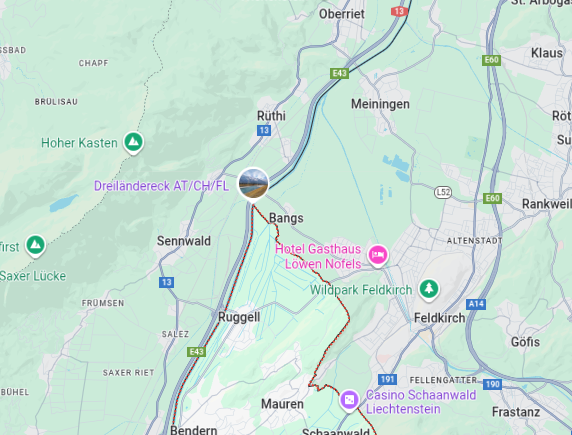
    I’m very engaged with borders and their meeting points, so I was pleased to have the opportunity to visit the Dreiländereck which is the meeting point of Austria, Liechtenstein and Switzerland.

    20250824_144850

    And there we go, the actual spot is in the middle of the river and I decided against wading in.

    20250824_145638

    We were standing on the Swiss side of the river, over there is Austria to the left and Liechtenstein to the right. There’s nothing evident to mark the actual spot where the three countries meet, so we were reliant on looking at a map to ensure that we were at the right place.

    20250824_145653

    Walking back to the rather interesting place that Richard left the car. It’s the Rhine and this is near the start of this river before it goes off thundering through Germany and then entering the North Sea via the Netherlands. It’s all very peaceful and there were plenty of cyclists and walkers on both sides of the river.

    20250824_144908

    And we saw what I think is a grey heron.

  • Basel – A Choice of McDonald’s From Three Countries

    Basel – A Choice of McDonald’s From Three Countries

    20250423_131852

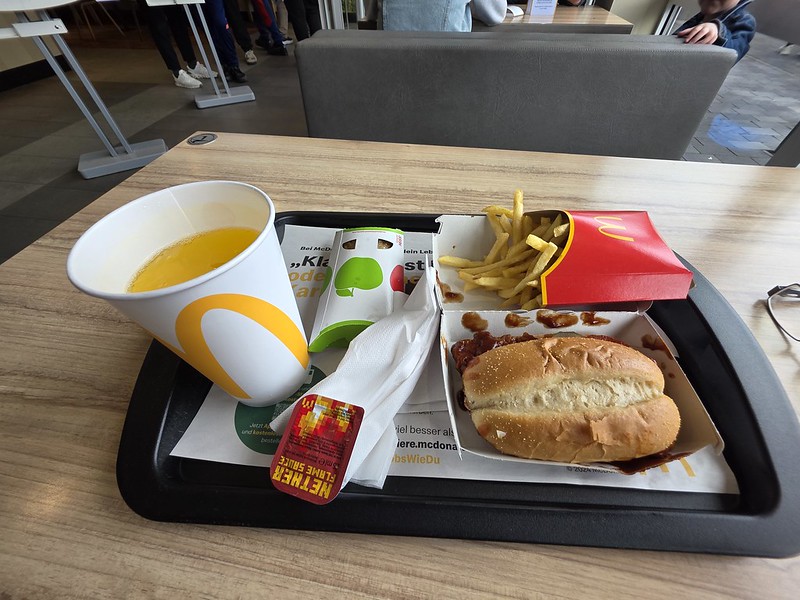
    Inspired by Dreiländereck, I could choose a McDonald’s in Switzerland, France or Germany. Easy decision for Germany, it’s my tradition of always having a McRib within 24 hours of entering the country…. And they were the only one of the three countries who let me download their app to get vouchers so they were by far the cheapest of the three countries….  So, forget diplomacy, my choice was purely based on superior digital infrastructure and bargain hunting. And the McRib of course. That’s the kind of high-octane travel blogging you get here….. Oh, and the McRib was lovely, with the usual excessive amount of sauce.

  • Basel – Dreiländereck

    Basel – Dreiländereck

    20250423_120318

    I’m not sure that many people would be excited to see the three country point where Germany, Switzerland and France meet. But, as my friend Liam often tells me, I’m not most people.

    20250423_120333

    It’s a bit of a trek there from Basel, about a 40 minute walk, but it’s pleasant enough walking along the Rhine.

    20250423_120548

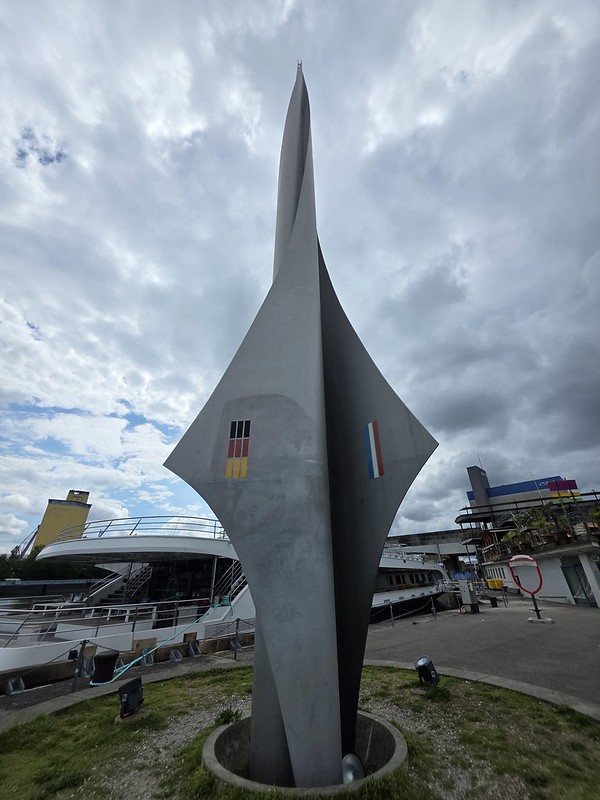
    Standing look out, that’s France on the left, Germany on the right and I’m standing in Switzerland. Actually, that is a slight limitation with the monument, it’s actually entirely in Switzerland as the meeting point of the three countries is in the middle of the river.

    20250423_120554

    The monument which was erected here in 1957, with the three wings of the rocket looking thing representing each country. When it was constructed, Europe was very different and I’m not sure many would have imagined that the borders would have come down between these three countries. Incidentally, it looks relatively lightweight but it weighs 8 tonnes and had to be hoisted into place by crane. Apparently, a Hungarian mathematician, Istvan Csontos, who had fled to Switzerland, was involved in painstakingly calculating the complex curves of the monument.

    20250423_120539

    From another angle.

    20250423_135757

    The monument from another perspective, it’s visible in the centre-left of the photo with Germany on the left, the monument in Switzerland and France on the right. I’m overly excited by stuff like this…..

  • Basel – Basel Minster

    Basel – Basel Minster

    20250423_105024

    This is perhaps the major landmark in Basel, the medieval Minster, located on Münsterhügel (or Cathedral Hill). The first religious building on the site was probably constructed here in around the ninth century, but it was expanded and rebuilt a few times until and a grand new structure was completed in something like the 1220s. The cathedral sort of, well, fell down in the 1356 earthquake, but they built back better and stronger. The first phase of reconstruction finished in 1363 and by all accounts, it was once again a grand Minister.

    In the fifteenth century, the rebuilt Minster became the backdrop for a major event in European church history, the Council of Basel. Convened initially by Pope Martin V in 1431 (who promptly died shortly thereafter), the Council aimed to address church reform (which seems rather aspirational to me) and resolve the Hussite Wars. Held within the Minster’s walls, the Council became a focal point for the Conciliar Movement, which asserted the authority of church councils over that of the Pope. This whole arrangement placed Basel and its Minster at the epicenter of ecclesiastical power struggles, attracting dignitaries and theologians from across Christendom in the debate between whether the Pope was all powerful or not. What happened, like after most things created to end disputes, was that there was a huge schism and decades of arguments.

    But, there were huge changes to come, as the Reformation hit Basel with some force in 1529. The Minister found its statues smashed by the local populace following a surge in religious fervour, and realistically a load of alcohol, with altarpieces destroyed and substantial damage to the building and indeed other churches in the city. In many cities, the organ was smashed up as part of this revolution, but the populace quite liked the music that came out of Basel Minister, so they kept it. What it meant was that the Catholic church lost their Minster, but the Protestants gained one. The two towers are called Georgsturm and Martinsturm, the former dates to 1430 and is 67.3 metres high, whilst the latter was finished in 1500 and is 65.5 metres in height.

    20250423_105100

    This bit of action on the front of the Minister is St. George slaying a dragon and the sculpture is thought to date to around 1450. Although, and not being critical, it looks like a baby dragon that isn’t very ferocious, but the Swiss have always been a peace loving nation and perhaps this is the most that they could muster.

    20250423_105237

    The north aisle in the Minister.

    20250423_105207

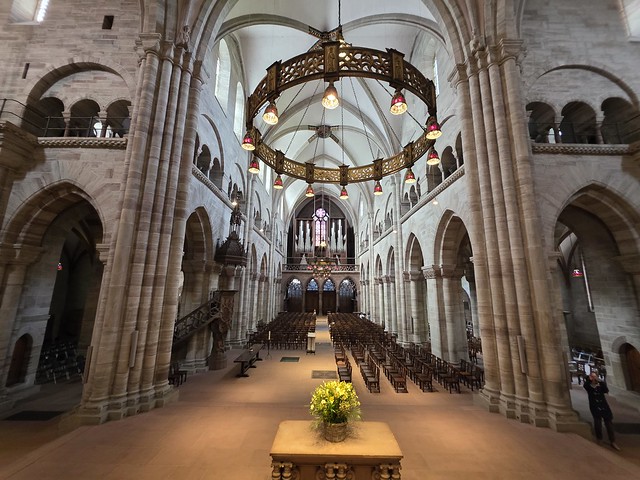
    The nave, with the post-earthquake Gothic ribbed vaults.

    20250423_105220

    Some choir stalls which seemed to have some age to them.

    20250423_105253

    The tomb of Thüring von Ramstein who died in 1307 and he was the Dompropst, or ‘Provost of the Cathedral Chapter’, a senior ecclesiastical official just below the Bishop.

    20250423_105345

    The St. Vincent Panel (Vincentiustafel) located in the north aisle. The relief depicts the ‘Martyrdom of St. Vincent’ (Martyrium des HL. Vincenz) of Saragossa, a deacon who was martyred around 304 AD in Valencia in Spain, during the persecutions under the Roman Emperor Diocletian. This sculpture is important as it was created in around 1100 and was installed in the cathedral which partly fell down in the earthquake, so it’s one of the oldest artworks still in the building.

    20250423_105416

    Looking towards the choir and apse, it’s a grand affair.

    20250423_105445

    A stained glass rose window in the south transept with the stone tracery depicting the Star of David.

    20250423_105549

    Looking back down the nave and the stone pulpit, dating to 1486 and designed by Hans von Nussdorf, is visible.

    20250423_105606

    Looking up to the impressive mid-nineteenth century stained glass above the apse.

    20250423_105638

    Stained glass dating from the nineteenth century,

    20250423_105711

    Look into the crypt from above.

    20250423_105824

    The font is carved from sandstone and dates from around the early sixteenth century. There’s a grander font in the crypt, which isn’t accessible at the moment, but this is the one now used for baptisms and it’s octagonal and highly decorated.

    20250423_111515

    A side door on the West Facade and there used to be a statue of the Virgin Mary here, but that went during the Reformation. The reddish sandstone used on the exterior is mainly sourced from quarries in the nearby Wiesental and Degerfelden regions across the Rhine in what is now Germany.

    20250423_104941

    It’s not a very clear image, but the roof has a rather lovely decorative pattern.

    It’s certainly worth visiting and there’s no admission charge, although it was a shame that the crypt was shut for the winter months and slightly odd that there was no history anywhere about the building.

  • Basel –  The Elisabethenkirche

    Basel – The Elisabethenkirche

    20250423_101412

    The Elisabethenkirche, known in its contemporary function as the Offene Kirche Elisabethen (Open Church of St. Elisabeth), was constructed in the mid-nineteenth century as the first Protestant church to be built in the city since the 1529 Reformation. Faced with substantial growth in the city, a decision was made in the 1850s to construct this church. The impetus and financial backing for the Elisabethenkirche came from Christoph Merian (1800-1858) and his wife Margarethe Burckhardt-Merian (1806-1886). Christoph Merian was a significant figure in Basel as he was a wealthy banker, an accomplished agronomist and one of Switzerland’s largest landowners, having received the extensive Brüglingen estate as a wedding gift. Unfortunately, he promptly died before seeing the church complete, but at least wife saw the finished building.

    A competition for the design took place in 1855 and it was won by Ferdinand Stadler, with construction of the church starting in the following year. It was built in the Neo-Gothic style and stands 72 metres in height, one of the tallest buildings in the city.

    20250423_101620

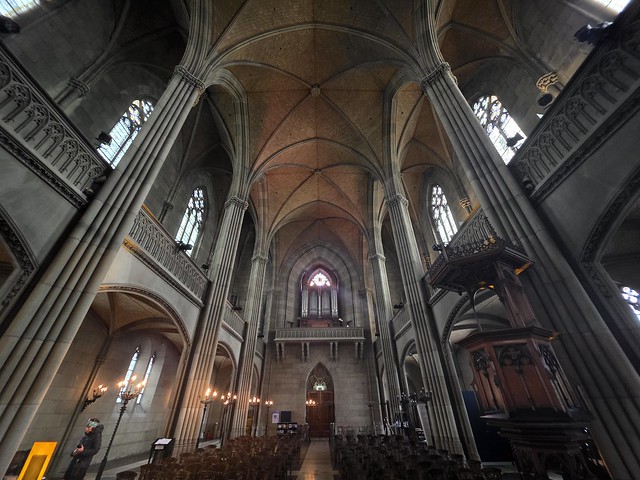
    The pulpit is grand and looks rather splendid.

    20250423_101512

    The side aisle. There were plans in 1968 to demolish the building as the congregation size had fallen, but, fortunately, it was saved.

    20250423_101547

    Since 1994, the church has been classed as an “Open Church” which is welcoming to anyone and the plan is that they are “diverse spiritual, cultural, and social needs of contemporary urban dwellers, explicitly welcoming people irrespective of their background, origin, race, religion,or sexual orientation.”

    20250423_101633

    The Chancel.

    20250423_101639

    Looking back along the nave.

    20250423_101718

    The decorative ceiling. It’s fortunate that the building is still standing and it gives an impression of being older than it actually is. There are some who clearly aren’t impressed with the church’s new role in society, with someone complaining alongside their one star review that they had a LGBT banner on display, but the owner responded with “and what wrong with this, other than your narrow mind?” which is entirely the right reply as far as I’m concerned. Another person posted that “It is a cafe, and the building is used for promotion of activist causes.”

    The reply was:

    “You are so wrong and only show by this review how yesterday-ish you are! We are and allways will be: a place to worship and celebrate. But we have to earn our own money – so we rent the church out, when we don’t need it to pray or celebrate. It’s unfair by you to rate with 1 point, what you can’t tell or judge. And obviously you can’t! Hopefully won’t be judged so harsh like you judge.”

    I’m going now to leave them a five star review. There’s an irony here that the situation is now perhaps more tolerant, welcoming and diverse than it was when it was a church. That’s perhaps a little controversial for my little blog, but there we go.

  • Basel – St Johanns Tor

    Basel – St Johanns Tor

    20250423_091229

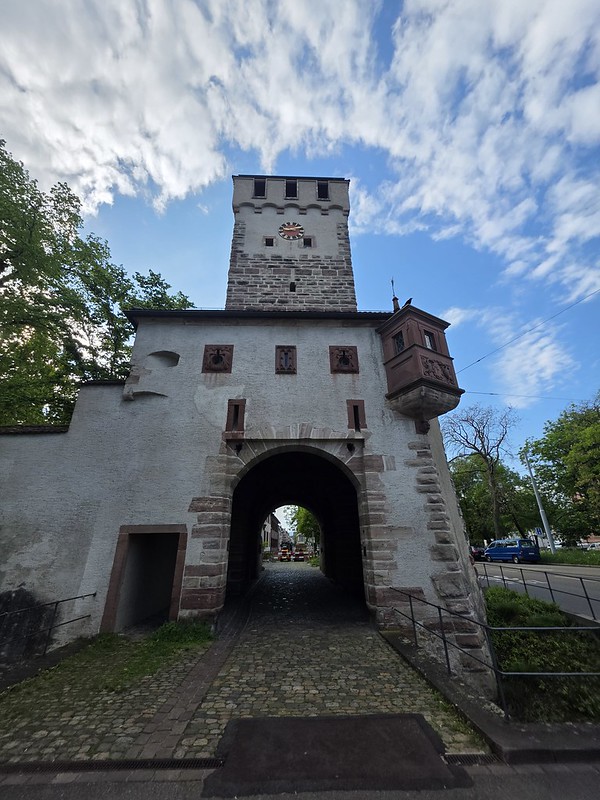
    St Johanns Tor (St. John’s Gate) is one of three remaining gates into Basel, once attached to the city walls although they were nearly entirely pulled down in 1859. Back in the late fourteenth century, matters were quite different as there were seven major gates, forty towers and a heap of battlements to keep the riff raff out. It’s located relatively near to the River Rhine and it’s something of a medieval survivor. As some background, 18 October 1356 was quite a bad day for Basel as it was hit by one of the worst earthquakes to have taken place in central Europe. It’s not a surprise that chunks of the city promptly fell down. That did though give the city authorities a chance to rebuild and expand their defences.

    20250423_091243

    20250423_091250

    It’s a chunky door and is some centuries old. There was once a portcullis arrangement here, but they replaced it with a system where vertical oak beams could be lifted individually.

    After it was decided not to demolish the gate, it was restored in 1874 and then again between 1983 and 1985. During the 1980s renovation, it was decided to reverse the new roof added in 1874 and return to something more as the building would have looked like in the medieval period. There are some sculptures on the exterior of the building, but they’re replicas from the early twentieth century and the originals are in the Historical Museum of Basel.

    20250423_091305

    Looking towards France. The rooms in the gate are now used by Basel’s cantonal police force (Kantonspolizei Basel-Stadt) so it continues a tradition of civil function, although it means that the structure isn’t open to the public.

    20250423_091356

    There are some steps to get to the level above and it’s possible to walk down to the Rhine from here.

  • Basel (Saint-Louis in France) – Aparthotel Adagio Access Saint-Louis Bâle (Accor Hotels)

    Basel (Saint-Louis in France) – Aparthotel Adagio Access Saint-Louis Bâle (Accor Hotels)

    20250423_085211

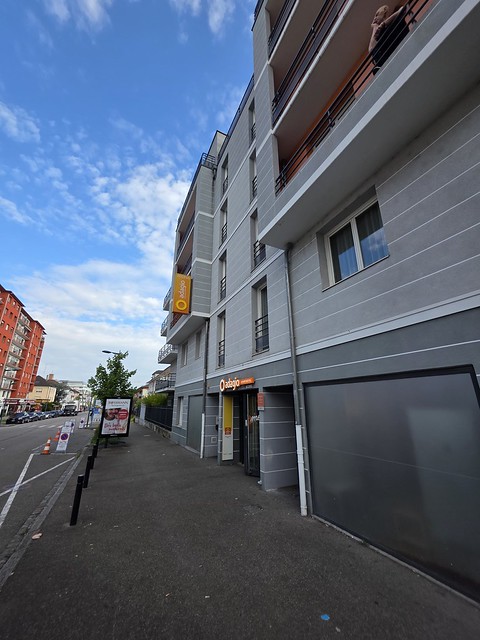
    I haven’t stayed at an Adagio before, but this one was showing as the cheapest Accor option in the area. The Adagio Aparthotels brand is offered in three distinct tiers, Adagio as the standard option, Adagio Access for budget-friendly stays and Adagio Premium for a more upscale experience. No surprise I was visiting an Adagio Access, I know where I stand in the hotel hierarchy….

    20250422_215456

    After the faff of getting here, I was pleased to see the welcome gift of crisps and water, a nice little gesture. The check-in had been a little convoluted as the person in front decided to ask far more questions than I felt necessary about the hotel, but as patience is one of my middle names, I just stood and tried not to look too passive aggressive whilst standing there waiting. The team member at reception was helpful and engaging, with everything feeling well managed here. Unusually, I was given an actual key to get into the room rather than a card, it felt like something of a throw-back…

    20250422_215500

    The bedroom area of the room, with everything being clean and organised.

    20250422_215504

    The kitchen area, with the desk and bathroom at the rear of the photo. I didn’t need to use the kitchen area at all, as I decided to eat my crisps from the packet rather than from a plate, but I noticed from signage that they would be charging if the washing up wasn’t done.

    20250423_084713

    The view from the window over semi-rural France. It’s located in the French village of Saint-Louis and is literally a one minute walk from the Swiss border and it’s easy to meander into Basel from the hotel.

    As I rather like doing this, since I don’t get out much, I thought I’d have a little look at the reviews to see if there was anything exciting.

    “I was going to take a shower and didn’t have hot water, tried to call the reception and they wouldn’t answer the telephone. Had to go there in a towel.”

    No, there is no logical requirement here to walk to reception in a towel.

    “Catastrophic. Having to leave the hotel at 7:00 a.m., I asked if it would be possible to have a simple breakfast made for me, namely a small coffee and a glass of orange juice. I was told that breakfast opened at 7:30 a.m., period.”

    I’m not sure that being a refused a breakfast before they were open is “catastrophic” especially when each room has a little kitchen, but each to their own….

    “Well situated, but disastrous bedding. Definitively NOT recommended for side sleepers as the beds are as hard as a rock.”

    Disastrous?

    “We reserved 2 rooms at this Aparthotel when flying from Denmark to Basel. Unfortunately, our flight was cancelled at the last minute after we already traveled to Copenhagen Airport and got our boarding passes. We had no options at that point but to cancel our trip to Switzerland, France, and Germany, because we had to return to the USA soon. On top of this great disappointment, the hotel would not cancel the room and refund our money. We called as soon as the flight was cancelled, which was late, but they were unwilling to make any adjustment. I understand that was their policy, but in a situation like this, I would expect better customer service, rather than hiding behind their policy.”

    I liked that the hotel reminded them that they had booked non-refundable rooms and that their policy was common in the industry, adding “the cancellation of your flight was not our doing” and they’re not wrong there….

    As they’re designed as apartments for slightly longer visits, I doubt that many guests usually stay for just one day at these hotels, but I suspect they are sometimes quite cheap as they have gaps between bookings that they can’t easily fill. Anyway, it’s not really a brand within the Accor chain that I’d prioritise in terms of staying as I don’t need kitchens and the like, but if it looks like an affordable option I suspect that I’ll be there again…..

  • Basel Airport – Going Out the Wrong Door…..

    Basel Airport – Going Out the Wrong Door…..

    20250422_204623

    My Wizz Air flight from Warsaw was uneventful, I had been given a window seat (always random as I refuse to pay extra) and although we set off late, it was a dramatic delay. During the flight, my fellow passengers were exhibiting only baseline levels of annoying behaviour, nobody tried to initiate a singalong, perform interpretive dance in the aisle or applaud when we landed, so frankly, a resounding success.

    But, back to the unique nature of this airport, which is properly known as EuroAirport Basel-Mulhouse-Freiburg as it’s serving the three countries of France, Germany and Switzerland. I was aware that there were two exits at the airport, both visible in the above photo, and Bill mentioned on Facebook to make sure that I got the right one. His comments were sensible, but it was unclear to me what I was actually supposed to do here and why. I was staying in France and I didn’t need to enter Switzerland at all, so I went for the French option. This proved not to be quite the correct choice.

    20250422_204749

    I got outside and realised I needed to walk down here, but there’s a problem as someone has taken part in some ‘bring your own fence to work day’ arrangement. Switzerland is in Schengen, so I hadn’t quite expected this level of fencing everywhere. I did wonder perhaps the Swiss just wanted to keep their side tidy, but that seemed a slightly stereotypical thought….

    20250422_205038

    I realised from Google maps that there was another pedestrian walkway so I left the French side of the airport to discover that it was a gated footpath for those who had a code. I considered this whole arrangement as sub-optimal.

    20250424_095234

    So, after navigating the ‘Great Fence of EuroAirport’ outside, I was genuinely bracing myself for some sort of Herculean faff to get back to the side I actually needed, or some sort of passport check. The only alternative seemed to be hailing a taxi which would have been an act of such wild extravagance my thrifty soul practically recoiled at the thought, so that wasn’t happening. However, it it was just like meandering through a shopping centre, there was no security, customs or border controls. If I had wanted, I would have had time to buy a Toblerone and everything.

    20250422_205827

    And that little stroll back through the airport meant that I was back on track and heading towards my hotel in France.

    20250422_211615

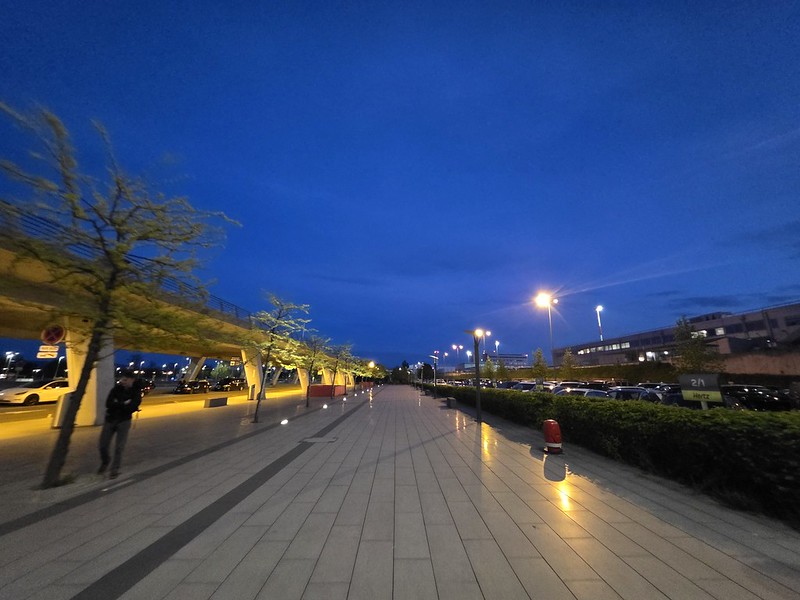
    It’s hard to read here, but it says “open borders” and I wish they were at this airport. It was then a three mile walk and it was pleasing that they had street-lights all the way along the path, but less pleasing that they hadn’t switched them on. The road was relatively busy and my eye-sight adjusted, so it was a fast walk and I then realised that this path was also heavily secured, I think a legacy of just over ten years ago when Switzerland weren’t in Schengen. Which meant that I had to walk into Switzerland which isn’t what I had intended.

    20250422_213746

    There’s the Swiss border. I was in Switzerland for around five minutes and only because there was no way to access all the paths in France. And this is a legacy of the history of this airport, which was built in France as Basel didn’t have space, a process all overseen by a 1949 international treaty. So, because of this, the pre-Schengen path was something of a secure corridor straight into Switzerland, logical as I had left the Switzerland side of the airport.

    20250422_214530

    Still on the Swiss side, there’s the former border control post, now just used as a customs post.

    20250422_214503_001

    There was no-one there and people could walk freely through. Luckily the hotel was literally a one minute walk away from here and I was pleased to get there after yet another slightly unexpected journey. I had started to consider myself as an expert in the Swiss and French border, although that was until the next day, but I’ll save that riveting story….

  • Zurich – Zurich Airport (Observation Deck)

    Zurich – Zurich Airport (Observation Deck)

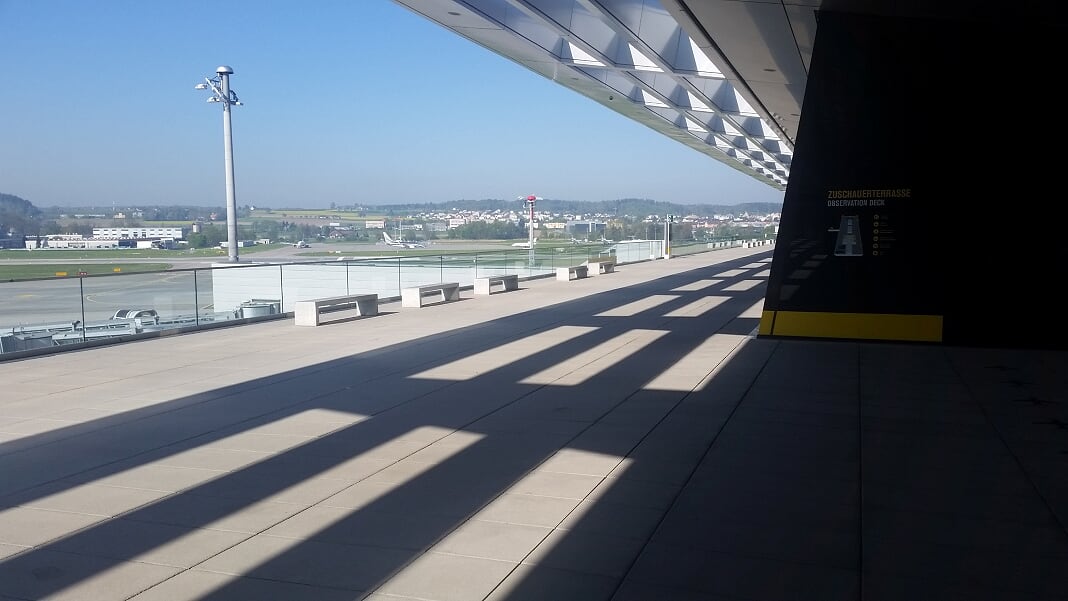
    Unfortunately, very few airports seem to now have observation decks and there’s little reason for this that I can think of. Since they’re after security, there’s no risk of attack and if they’re worried about smokers, they can always post security staff up there or shove in a smoking area discreetly.

    Zurich Airport have what I think is the best observation desk that I can recall visiting at an airport, free of charge and of some considerable size.

    It was possible to listen in to the radio communications system, with the phonetic alphabet displayed. I can never remember this, I just make words up, usually relating to food or products which Greggs manufacture.

    The view of an aircraft owned by Swiss Air Lines, with Zurich Airport being their hub.

    An Air Berlin aircraft.

    An explanation of the air traffic control system.

    A detailed explanation of the runway system.

    Everything was clean and well implemented, with the whole area offering somewhere more interesting to wait for a flight than sitting in the main terminal. It also adds an extra element of excitement for children and it’s a shame that more airports don’t offer this. Heathrow has made little effort here and although there’s an observation deck at T4, it’s enclosed and has obstructed views. Now that Heathrow have said they don’t intend to build a Terminal 6, I don’t imagine much will change in the UK’s main airport….

  • Zurich – Starbucks Train Carriage

    Zurich – Starbucks Train Carriage

    This is an old photo, from when I visited Zurich in 2015. The Swiss rail network (SBB – Swiss Federal Railways) had installed a Starbucks outlet on this train in 2013 in a bid to encourage people to use public transport. The branding doesn’t seem to have lasted long and there’s little mention of this on-line after 2015, so I assume that it was discontinued.

    But this does remind me of my idea to put a Greggs carriage on every train, or at least every intercity train to begin with. No point in getting too ambitious straightaway….