Category: Bucharest

  • Bucharest – Pasajul Macca-Vilacrosse

    Bucharest – Pasajul Macca-Vilacrosse

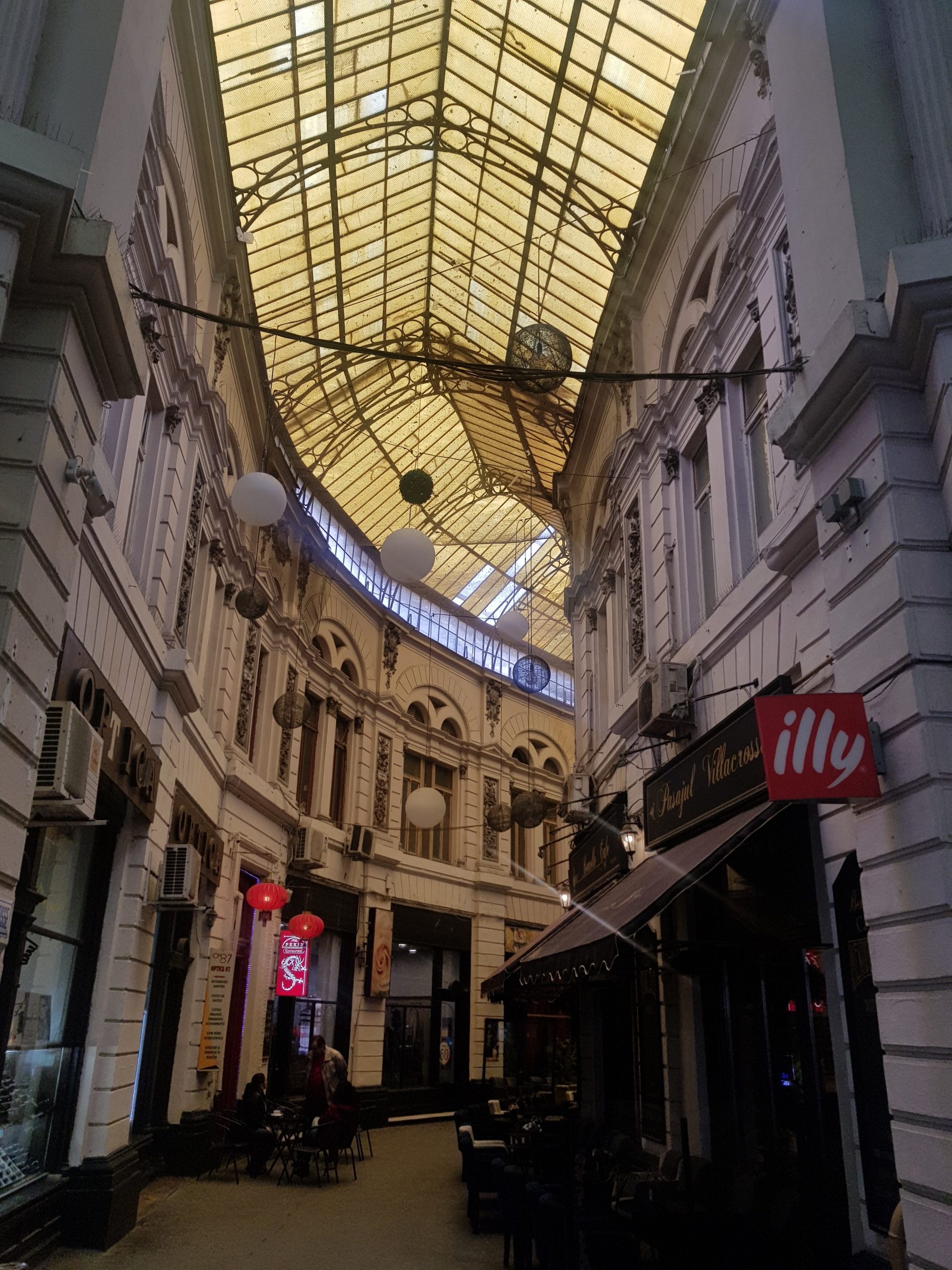
    This shopping centre is perhaps the earliest surviving in Bucharest, constructed in 1891 and named after Xavier Villacrosse, a former city architect.

    There’s a grand entrance portal to the centre, which is in a fork shape as the owner of the central area, the Pesht Hotel, didn’t want to sell. That must have been slightly annoying for the developers at the time, but at least they got to build their street in some form.

    It’s a stunning interior, but it needs repair and I wasn’t really that excited by any of the premises inside. This was primarily due to most being closed when I visited in the afternoon, with some others having a rather seedy look, even if perhaps they weren’t.

    With some money and the introduction of a few innovative tenants, this could once again be quite a grand shopping street given its central location. During the communist period from 1950 until 1989, the centre was renamed Pasajul Bijuteria, or the jewellery street. Many of the shops along the street during this time were jewellers, although this has now changed to mostly being restaurants and bars.

    The main dome isn’t in too bad a condition and it ensures that the shopping is well lit and bright. There are offices above the retail units and for a while this was home to the first Stock Exchange in the country.

  • Bucharest – Church of St. Anthony

    Bucharest – Church of St. Anthony

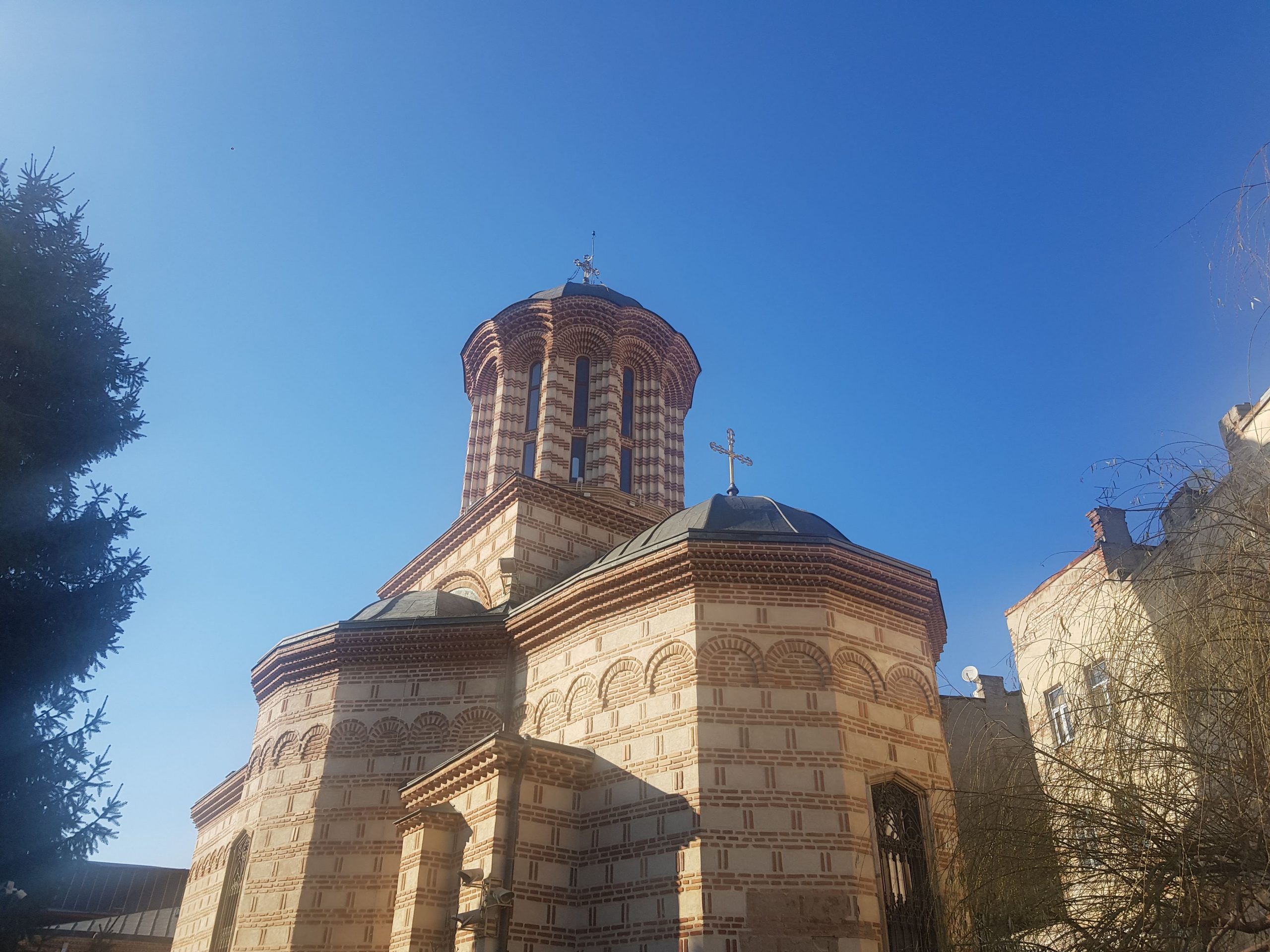
    The Church of St. Anthony is the oldest standing church in its original form which is left in Bucharest, dating back to the 1550s and constructed on the site of a wooden church. It has though been through the wars a little (including literally when the Turks attacked) and with a restoration in 1847 following a major fire which damaged much of Bucharest’s central area.

    The building looks relatively modern, mainly due to some recent cleaning and there were also restorations in 1914 and between 1928 to 1935 which reverted the church back to something more like its original appearance.

    The church’s facade.

    A fine entrance portal which dates to 1715.

    The church was busy with worshippers, so it didn’t feel appropriate to walk around it and disturb other people. It was a grand interior though, but also homely and with a strong sense of community.

  • Bucharest – National Museum of Art (The Jew With the Goose by Nicolae Grigorescu)

    Bucharest – National Museum of Art (The Jew With the Goose by Nicolae Grigorescu)

    This painting is by Nicolae Grigorescu (1838-1907) and was painted in 1880. Grigorescu is apparently one of the founders of modern Romanian painting and this artwork shows a Jew (the name of the painting) holding a petition and a goose. The original title of this artwork is “a Moldavian Jew going to the Romanian Parliament to petition for his naturalisation” which was something that Jews could do from 1879, although it wasn’t an automatic right. I’m not sure whether the goose was meant as a bribe, although I’m not sure why anyone would traipse a live goose to Parliament without some good cause.

  • Bucharest – National Museum of Art (Catholic Church in Câmpulung)

    Bucharest – National Museum of Art (Catholic Church in Câmpulung)

    This artwork of a Catholic Church in Câmpulung was painted by Theodor Aman in 1875. The Romanian artist lived from 1831 until 1891, when he died in Bucharest and the house he lived in is now a museum which commemorates him and his work. I did try and find the same location on Google Streetview and the only Catholic Church looks different and the streetline has changed too much. I like the painting though, although I suspect that the town was more prosperous then than it is now if the characters and their formal wear are anything to go by.

  • Bucharest – National Museum of Art (The Revolutionary Romania by CD Rosenthal)

    Bucharest – National Museum of Art (The Revolutionary Romania by CD Rosenthal)

    This artwork, entitled The Revolutionary Romania, is by Constantin Daniel Rosenthal and was painted in 1850. Rosenthal lived from 1820 and 1851 and had an involvement in the 1848 Revolution, which later cost him his life when he was tortured to death by the French for refusing to give information about his contacts. There’s something tragic about looking at an artwork which was painted by someone who was so relatively young, but yet was about to be confronted with his death.

    Rosenthal painted numerous artworks on the theme of Romanian nationalism and he seems to have been quite active in the later part of his life. This painting was part of the Pinacoteca București collection which had been established by King Carol II, with many of the artworks being taken over by the National Gallery. It shows Marie Rosetti who was a friend of the artist and the wife of the author Constantin Alexandru Rosetti. She was dressed in traditional Romanian clothing and she has a dagger in one hand and a Romanian flag in the other hand.

  • Bucharest – National Museum of Art (Icon of Saint Nicholas by Mihail)

    Bucharest – National Museum of Art (Icon of Saint Nicholas by Mihail)

    I thought that this looked modern when I first saw it, given that it has something of a cartoony feel to it. Tempera on wood, it was painted by Mihail in 1754 and is a representation of St. Nicholas. I didn’t know this before looking it up, but St. Nicholas is often painted with a codex in his hand, as it is here, and has representations of Jesus and the Virgin Mary behind him, which is what I assume is also happening with this artwork. He’s also portrayed as an Orthodox bishop, as he is here, and often with three gold balls, which isn’t shown here. He was known for giving gifts to the poor and from that he evolved into being effectively better known as Father Christmas.

  • Bucharest – National Museum of Art (Grigorie Brâncoveanu)

    Bucharest – National Museum of Art (Grigorie Brâncoveanu)

    I liked this painting, there seems to be quite some depth to it, which is of Grigorie Brâncoveanu (1764 – 1832), who was the Great Ban (or regional leader) of Wallachia. The family had been important during the seventeenth and eighteenth centuries, but it came to an end with Grigorie.

    It’s not known who painted the artwork, nor its date, other than it was from the first half of the nineteenth century. History could have easily be just slightly different and Wallachia could be its own country, rather than subsumed into Romania. It was only the constant threat of Russia which led the leaders of Wallachia into wanting to unite with neighbouring countries.

  • Bucharest – National Village Museum (Half Buried House)

    Bucharest – National Village Museum (Half Buried House)

    This half-buried house dates to the beginning of the nineteenth century and it was brought to the museum in 1949 from Drăghiceni, a town in the south-west of Romania. There are two functions to this sort of property, with the primary one being that this helps with keeping the temperature under control, so it would preserve the cold in summer, but also the warmth in winter. I’d note that Ibis have some hotels like that, although they preserve the heat in winter and the heat in summer, which can be most annoying. There was also a defensive element as well though (to the half-buried house, not Ibis), there were occasional Turkish raids and this sort of property was easier to defend. It wasn’t though a cheaper construction option, as building a half-buried property apparently uses more wood than building a traditional structure.

    This house was popular with children at the museum, who enjoyed climbing down into the property. The roof was constructed with oak planks and there would be a straw type finish on the top.

    That’s the step down.

    And there’s the entrance room. Behind this would have been the kitchen, and further into the structure would have been the living room. It seems to me to be quite a fun place to live as well, something a little different.

  • Bucharest – People’s Salvation Cathedral

    Bucharest – People’s Salvation Cathedral

    Work on this religious building started in 2007 and it’s starting to come to an end now and it will be the Romanian Orthodox Church’s Patriarchal Cathedral, replacing the current Metropolitan Church in Bucharest. It’s an enormous building and is visible from throughout the city, standing at 135 metres in height and it will be the largest Orthodox Church in the world by area. It has cost €400 million all told, a significant sum of money for any religious building.

    Its location is next to the ridiculous Palace of the Parliament building that was the pet project of Nicolae Ceaușescu, with this being a deliberate choice. Nicolae Ceaușescu had demolished great chunks of the city to build his new building, which included the demolition of three Orthodox churches and the moving of two other Orthodox churches. It’s sited on Spirea’s Hill, which is for the same reason that the Palace of the Parliament was built there, it’s at a high point of Bucharest and the project can be seen from far and wide.

    The cathedral is though controversial, there have been links made with the excesses of the Palace of the Parliament building and the cost is not insubstantial for a country that still has a long way to go on its economic road. However, there has long been a demand for this building within the church, they’ve faced economic difficulties, the Second World War and then communism, so it’s not as though they haven’t been patient.

    Inside the cathedral is going to be impressive as well in numerous ways, not least because it will have the world’s largest free-swinging church bell in it, but also because of a one-million piece mosaic standing 16 metres in height. The Pope came to visit the cathedral on 31 May 2019, and it will likely be a popular site to visit for tourists and locals. The cathedral will be able to seat 7,000 people, or 10,000 people can stand within it, with the wider site being able to cope with 125,000 visitors. There’s still a lot to do though, the full opening isn’t expected until 2023 or 2024, when this enormous construction project finally comes to an end.

  • Bucharest – National Village Museum (Swing)

    Bucharest – National Village Museum (Swing)

    This nifty swing is from Zăpodeni, in eastern Romanian near to the border with Moldova. It’s relatively modern for this museum, dating to the early twentieth century, and it was primarily used on major holidays. Traditionally, two boys would start the contraption going and they’d be rewarded with a gift, such as Easter Eggs at Easter. If I had a garden, perhaps I’d create something like this for Dylan and Leon, although I suspect they’d take one look at my handiwork and refuse to go on it.