Category: Random Posts

  • Dictionary of the Vulgar Tongue – Day 257, 258 and 259

    Dictionary of the Vulgar Tongue – Day 257, 258 and 259

    The Dictionary of the Vulgar Tongue was first published at the end of the eighteenth century, and given that the current health crisis is giving too much time to read books, I thought I’d pick a daily word from it until I got bored…. And to catch up after getting behind with these posts, and because I’m getting towards the end of the book, I’m doing three days at once now. How lovely….

    Pin Money

    This is defined by Grose as “an allowance settled on a married woman for her pocket expenses” and it would have primarily been used to buy clothing and accessories (accessories here more defined as pins than anything more decadent). Sometimes it meant the sum of money given to the woman to run the household and there are some legal cases where pin money was given to women as settlements (not unlike today’s divorce arrangements). The phrase came into use in the mid-sixteenth century and is still used today, although usually in a wider meaning of just giving or paying someone a small amount of money.


    Plumb

    The definition here is “an hundred thousand pounds”, with Grose’s use of the word ‘an’ being common at the time as the ‘h’ of hundred was often not very clearly pronounced. This word could be spelled as ‘plum’ without the ‘b’ and the word ‘plum’ also meant wealthy, although I’m unsure why it came to mean £100,000 in particular. The word was mostly used by the criminal underworld and there were references to a ‘quarter of a plum’ and ‘half a plum’, so £25,000 and £50,000 respectively. It faded out of usage by around the middle of the nineteenth century.


    Porridge Island

    This is another one of Grose’s geographical definitions, “an alley leading from St. Martin’s church-yard to Roundcourt, chiefly inhabited by cooks, who cut off ready-dressed meat of all sorts, and also sell soup”.

    This is Horwood’s map of London from 1790, so from the same time as Grose’s book. St. Martin’s churchyard and the Roundcourt can be seen on the map (clicking on the map makes it larger). This is today a much visited part of London, as St. Martin’s Church still stands and is now on the edge of Trafalgar Square, which was laid out in the 1820s. Unfortunately, nothing else remains of the street plan where Roundcourt once stood, although the line of The Strand is unchanged. This part of London is now relatively modern and in places quite soulless, it must have been rather a sight to have seen this area inhabited by cooks selling their soup.

  • Dictionary of the Vulgar Tongue – Day 254, 255 and 256

    Dictionary of the Vulgar Tongue – Day 254, 255 and 256

    The Dictionary of the Vulgar Tongue was first published at the end of the eighteenth century, and given that the current health crisis is giving too much time to read books, I thought I’d pick a daily word from it until I got bored…. And to catch up after getting behind with these posts, and because I’m getting towards the end of the book, I’m doing three days at once now. How lovely….

    Pigeon’s Milk

    And a prank from times gone by, defined by Grose as “boys and novices are frequently sent on the first of April to buy pigeon’s milk”.

    Google Ngram shows how the prank has slowly fallen out of favour.


    Pillaloo

    This word is defined by Francis Grose as “the Irish cry or howl at funerals”, although it originated as a hunting cry. The word dates to at least the early seventeenth century and is derived from the old Irish word puilliliú.

    And Google Ngram’s history of the word, which is now used relatively infrequently.


    Pin Basket

    One of the more simple definitions, this is “the youngest child”. This harks back to a long lost tradition of when a pincushion used to be given as a present to a new mother, with pins inserted of various lengths to indicate the children by age. The youngest would thus have the shortest pin, with this phrase dating from around the middle of the eighteenth to the middle of the nineteenth century.

  • Dictionary of the Vulgar Tongue – Day 251, 252 and 253

    Dictionary of the Vulgar Tongue – Day 251, 252 and 253

    The Dictionary of the Vulgar Tongue was first published at the end of the eighteenth century, and given that the current health crisis is giving too much time to read books, I thought I’d pick a daily word from it until I got bored…. And to catch up after getting behind with these posts, and because I’m getting towards the end of the book, I’m doing three days at once now. How lovely….

    Pickthank

    This is defined by Grose as “a tale-bearer or mischief maker” and it evolved from meaning someone who was sycophantic, literally trying to pick up thanks. The word was first used in the late fifteenth century, was used by Shakespeare and was commonly used into the nineteenth century.

    The English language is a little mysterious, or at least how it’s used, as this word remained in usage for centuries and then just faded away in the twentieth century. I prefer its original meaning, someone who always looking to curry favour with others, in order to pick up a thanks.

    Pig

    This definition surprised me, as Grose’s definition pre-dates the formation of most police forces. He defines it as “a police officer. A China street pig; a Bow-street officer. Floor the pig and bolt; knock down the officer and run away”. There are all kinds of stories as to why this word came into usage, some have said it’s because the police were like pigs at rooting away, to solve crimes in this case. This seems unlikely to me, it’s likely just a derogatory term which the cant community (the criminal underworld) would have used and which gained wider parlance. Interestingly, the word wasn’t much used in this meaning during the later part of the nineteenth century or the early part of the twentieth century, but then in came back into usage more recently with the same meaning.

    Pig Running

    This is defined by Grose as “a piece of game frequently practised at fairs, wakes, &c. A large pig, whose tail is cut short, and both soaped and greased, being turned out, is hunted by the young men and boys, and becomes the property of him who can catch him and hold him by the tail, above the height of his head”. As a reminder, a wake was a fair in the nineteenth century, this wasn’t an activity held after someone was buried. What is moderately surprising to me is that this still goes on in a few places in the United States, although animal rights concerns have caused this to start to come to a juddering halt. The activity has had numerous other names, such as pig wrestling, pig scrambling, pig catching and so on, and it went on for centuries in the UK.

  • Dictionary of the Vulgar Tongue – Day 248, 249 and 250

    Dictionary of the Vulgar Tongue – Day 248, 249 and 250

    The Dictionary of the Vulgar Tongue was first published at the end of the eighteenth century, and given that the current health crisis is giving too much time to read books, I thought I’d pick a daily word from it until I got bored…. And to catch up after getting behind with these posts, and because I’m getting towards the end of the book, I’m doing three days at once now. How lovely….

    Peter Lay

    This is defined by Grose as “the department of stealing portmanteaus, trunks, &c”, which is a throwback to when bags, parcels and trunks were known as ‘Peters’. I’m not quite sure where that word origin came about, but there was another phrase, not mentioned by Grose, which was to “peter-drag”, which was to steal bags from carriages. Google doesn’t much like me searching for ‘Peter Lay’, it seems to think that surely I must mean ‘Peter Kay’….. Anyway, this was one of these phrases, mostly used by the criminal underworld by all accounts (Peter Lay that is, not Peter Kay).

    Petty Fogger

    This phrase is defined as “a little dirty attorney, ready to undertake any litigious or bad cause: it is derived from the French words petit vogue, of small credit, or little reputation”. The phrase came into use in the sixteenth century and it remains in use today, although it’s usually now just one word such as pettifogging. The OED give a different word origin, noting “from petty + obsolete fogger ‘underhand dealer’, probably from Fugger, the name of a family of merchants in Augsburg in the 15th and 16th centuries.” Grose is right though, the word at the end of the eighteenth century was pettyfogger with the meaning that he gave, but it now tends to mean a lawyer or politician who focuses on small or petty details.

    The evolution of the word with its different spellings, showing how frequently it was used in the nineteenth century compared to the twentieth century.

    Pharaoh

    This word is defined by Grose as “a strong malt liquor”, which sounds rather lovely. As an aside, when this word entered the English language, it was for some time spelled as ‘Pharao’ without the final ‘h’. The word was used in this way from the middle of the sixteenth century to the middle of the nineteenth century, and it likely came from the belief that Pharaoh was a strong or powerful leader, hence a powerful or strong beer.

  • London – Ryan Taylor

    London – Ryan Taylor

    And in quite a complete departure from my usual boring drivel about museums, long distance walking, gossip, beer, American food and old things, this is Ryan Taylor. He’s the most famous YouTuber I’ve met with over 2 million followers. That is slightly higher than my blog readership.

    I was vaguely aware of a connection between Ryan and Ally Law, the latter of whom I would recognise immediately (primarily as some media really don’t like Ally), and I do follow Nightscape videos. I was also aware of Ryan entering the Big Brother house using methods that weren’t quite within the rules, but sorry to Ryan for being slow on the uptake and not recognising him (although he at the time had his face nearly entirely covered)…. I’m a bit old (only just) for all this, so my knowledge stops there….. Anyway, he’s a really nice guy and it was an interesting 30 minutes or so.

    To cut a long story short, there are PS5s in that bag, and he was on a YouTube / Instagram adventure to give them away to his fans. Hence why he was hiding, and why I’ve taken a couple of hours to post about this. I thought at first he was a delivery driver who had managed to give someone the wrong food and they were chasing him, which is why I didn’t object to his joining my table.

    I admit that cycling isn’t quite my thing (makes me tired), I love the adrenaline rush of the LDWA 100, but I really like the concept of getting youngsters (in his case I mean, not mine) getting out and about in whatever form they want. All good physical and spiritual engagement.

    Anyway, nice to be part of his adventure, and thanks for the selfie (I might upload that later). It seems the Daily Mail don’t much like Ryan, so that’s another plus on his side as far as I’m concerned   🙂

  • Dictionary of the Vulgar Tongue – Day 247

    Dictionary of the Vulgar Tongue – Day 247

    The Dictionary of the Vulgar Tongue was first published at the end of the eighteenth century, and given that the current health crisis is giving too much time to read books, I thought I’d pick a daily word from it until I got bored….

    Penthouse Nab

    This phrase is defined by Grose as “a broad brimmed hat”, although there’s an interesting (well I think there is) history to the word ‘penthouse’. The original meaning of this was some sort of outbuilding, usually shoved onto the side of a building, sometimes nothing more than a shed. Then there was a move in what the word meant, with reference to a building which sloped, and often the top of a building would slope at the top, which evolved into meaning the apartment or space at the top of a property.

    In recent years, the word has become used much more frequently and a penthouse is now seen as a desirable place to live. It’s usually the grand residence at the top of a building which has more space, extensive views and is most certainly not some old shed stuck onto the side.

  • Dictionary of the Vulgar Tongue – Day 246

    Dictionary of the Vulgar Tongue – Day 246

    The Dictionary of the Vulgar Tongue was first published at the end of the eighteenth century, and given that the current health crisis is giving too much time to read books, I thought I’d pick a daily word from it until I got bored….

    Penny-Wise and Pound Foolish

    This definition hasn’t changed over the last two centuries, defined by Grose as “saving in small matters, and extravagant in great”. I don’t have much to add here, other than I find it surprising that the phrase has been in usage since the early seventeenth century, as it perhaps feels a little more modern.

    And the phrase’s usage over the last two centuries.

  • Random Posts – Pret Hot Shot Drink

    Random Posts – Pret Hot Shot Drink

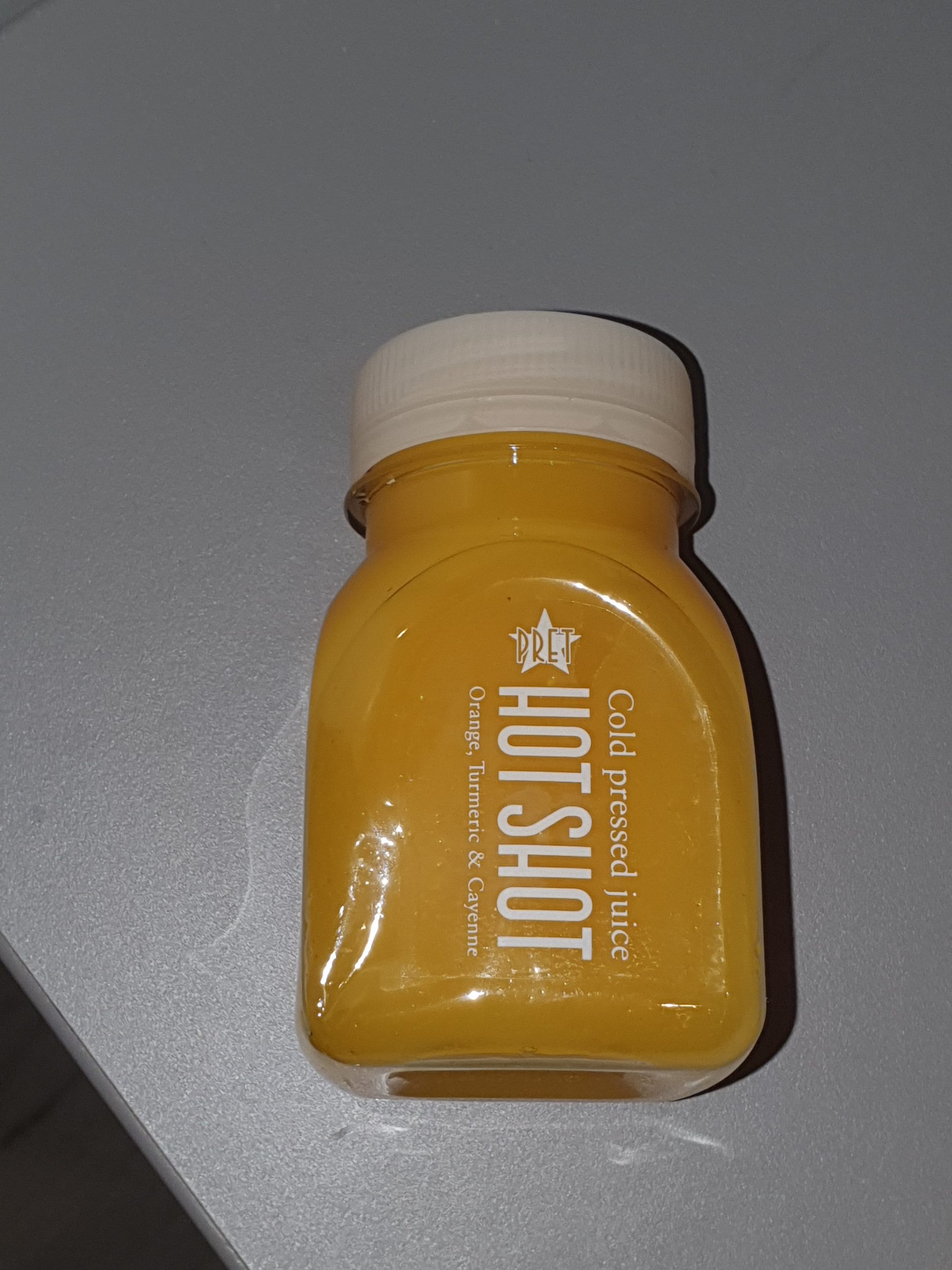
    Although anyone sensible would likely have a blog that concentrates on just one thing, it’s quite handy to be able to write about any drivel. On that vein I’ll shift over to food & drink issues, and this is a rather lovely little product from Pret. It contains orange, but to that is added turmeric, ginger and cayenne. It does give quite a kick, it’s an inventive product from Pret…..

  • Random Post  – Words Usage of Pub and Inn

    Random Post – Words Usage of Pub and Inn

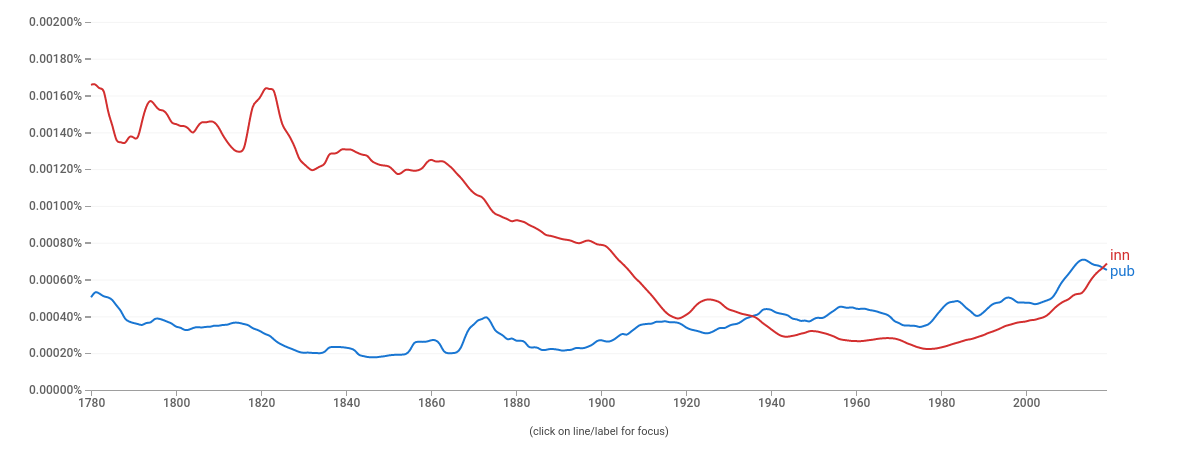
    As an another irrelevant aside, I just noticed this on Google Ngram, which is how frequently the words ‘pub’ and ‘inn’ have been used in literature over the last two centuries.

    It’s no surprise to me that the word ‘inn’ used to be used much more frequently when the word ‘pub’, but I’m puzzled how it is now used more frequently in writing once again.

  • Dictionary of the Vulgar Tongue – Day 245

    Dictionary of the Vulgar Tongue – Day 245

    The Dictionary of the Vulgar Tongue was first published at the end of the eighteenth century, and given that the current health crisis is giving too much time to read books, I thought I’d pick a daily word from it until I got bored….

    Peck

    This is defined by Grose as meaning “Victuals. Peck and booze; victuals and drink”, with victuals being a now mostly archaic word for food, so, “food and drink”. The word is derived from the verk ‘pekken’, or to pick, most commonly used now when referring to birds. The word ‘peckish’, which Grose defines separately as meaning ‘hungry’ could have evolved in one of two ways. It could mean feeling hungry and wanting to pick at food (from the ‘pekken’ verb), or it could have derived more directly from the word meaning food.

    And the usage of ‘peck’ and ‘peckish’ over time…