
Category: Malta (South Eastern Region)

  • Malta – South Eastern Region – Valletta – Wild Honey

    Malta – South Eastern Region – Valletta – Wild Honey

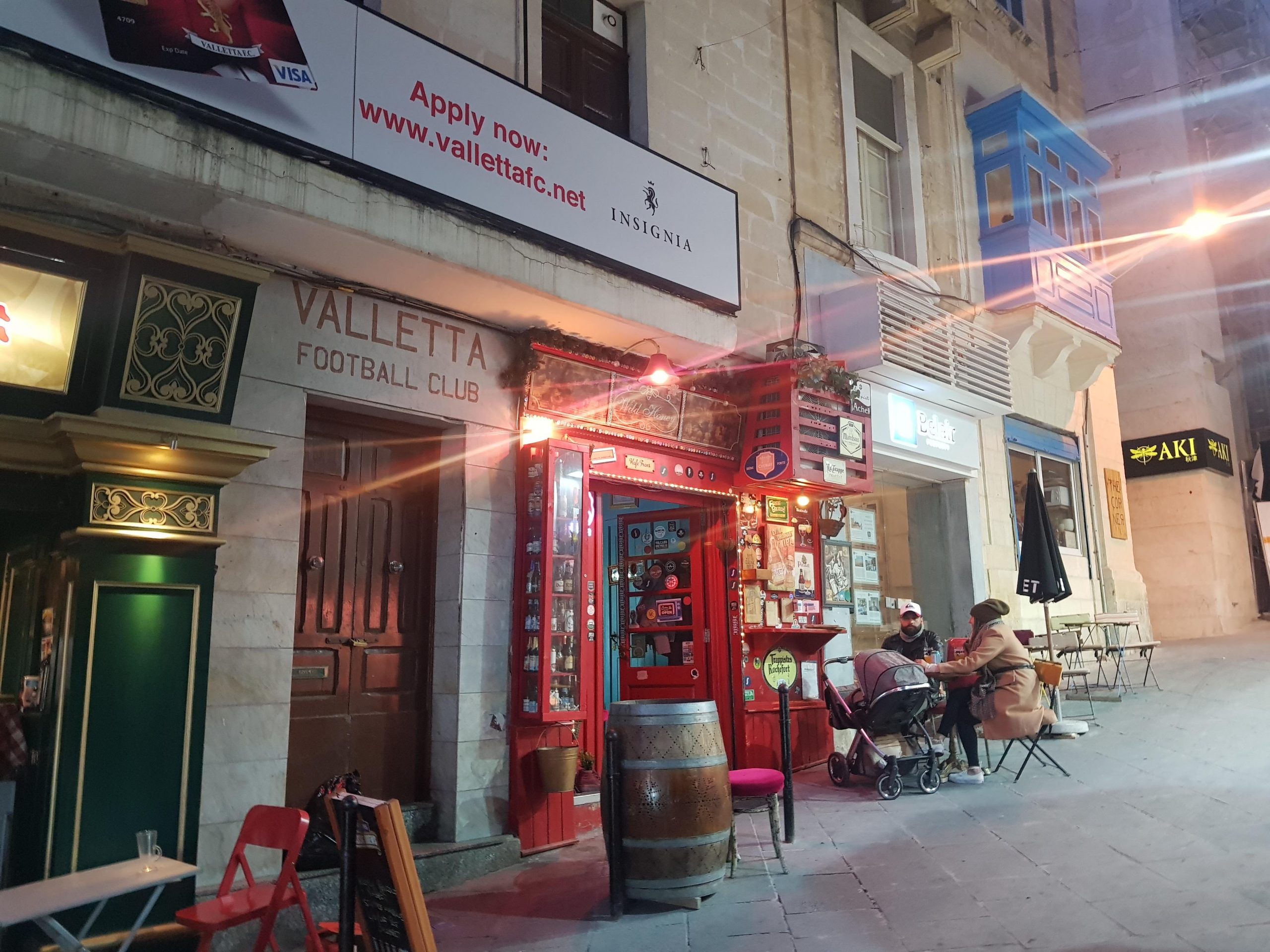
    Wild Honey is a small craft beer bar in the centre of Valletta and I think it’s fair to say that I liked this place. A lot.

    Beers in the fridges, some really innovative choices there.

    The staff member was personable and keen to make recommendations, and I was particularly excited when he suggested the Chocolate Cherry Yeti stout from the Great Divide Brewing Company in Denver, Colorado. The beer was excellent, at the appropriate temperature, slightly light on initial taste but with deep afternotes of chocolate and cherry. Which is good, as that’s what they’ve called the beer. Seeing this beer in Valletta was a delight, it must have been a right faff to get this here.

    There are only around six tables inside, making it cosy and well, small.

    There’s natural character in this bar, which the decor adds to. That’s the toilet to the right of the photo, neatly fitted into the very small space. Half of the tables were reserved when we visited, which was a mid-day evening in March, so I’m not sure how easy it is to get a seat during the warmer summer months. But, it’s in the heart of Valletta, so it’s easy enough to take a little stroll by and have a look.

    Liam enjoying some drink outside that he would have liked the look of (well, the look of the pump clip). There were a few tables here, although with the slight caveat that smokers may set up shop nearby.

    I was tempted to stay here for longer, and could have happily done so, but there were more craft beer bars to investigate….. It seems that they offer food judging from the reviews on-line, and it looks of a similar high quality to the beer.

    The reviews on TripAdvisor are, quite rightly in my view, very positive, although one visitor must have made clear he was ready to leave a negative review:

    “The two chaps who seemed to be running the place were less that obliging and we just left them with the undrinkable wine after a less than professional exchange once they got wind that we were likely to take the advice of the sticker they had in the window, and leave our impressions on ‘Tripadvisor’.”

    Anyway, a marvellous bar which was quirky, authentic and which had excellent beer.
  • Malta – South Eastern Region – Valletta – Beer Cave

    Malta – South Eastern Region – Valletta – Beer Cave

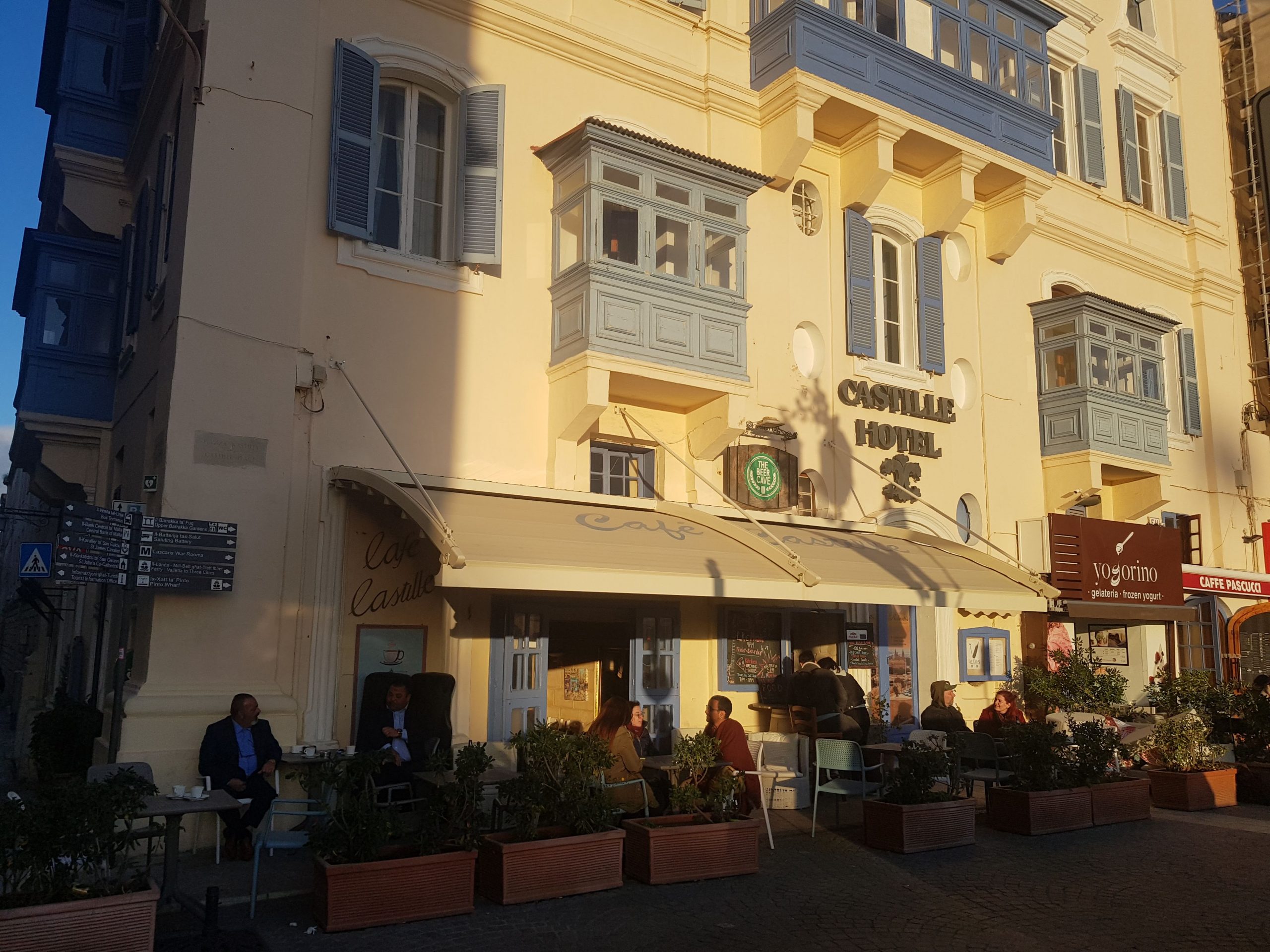
    There aren’t a large number of craft beer bars in Valletta, or indeed in Malta, so it wasn’t too onerous a challenge to try and visit them all in an evening. Liam and I were certainly brave and courageous in our endeavours. The first one of the evening was the Beer Cave, located under the Castille Hotel in the heart of the city.

    The entrance takes you straight down into the cellar, or cave, and it feels like a welcoming place. With one exception, which was the ridiculous volume of the music. I assume they thought it would attract people, but I can’t think of one single craft beer bar I’ve been to where they play music at high levels when there’s no-one in there. Personally, I like those bars who generate their own atmosphere without needing the crutch of music, but if they’re going for that (and this venue is big on live music and bands, which they seemingly do well), it’s probably best set against how many people are actually in the bar. So, we were always destined to make this a quick visit.

    The staff member was friendly enough, I’m not sure that he was entirely familiar with the options, but since he couldn’t clearly hear what I was saying and I couldn’t clearly hear what he was saying, it’s a hard one to call. Which is another issue really, this type of bar can surely only benefit from lots of engagement between customers and the bar staff, or just between customers. I’m perhaps just too old to be doing lots of yelling. The beer choices were also pretty well curated in terms of beer types, it seemed to cater to most needs. I had my delicious stout and Liam got his grapefruit pale ale.

    Downstairs, in an atmospheric location at least. I’d say that this is a music venue which happens to sell craft beer as opposed to a craft beer bar, but it’s well reviewed and so is clearly meeting a need. The bar remained empty all the time that we were in there, other than for two people who came down the steps and then went back up them again. Anyway, I’m glad it’s there, craft beer should be for the many, not the few.

  • Malta – South Eastern Region – Valletta – Royal Opera House (Pjazza Teatru Rjal)

    The city’s royal opera house was built in 1866 and was designed by Edward Middleton Barry, who had also designed London’s Royal Opera House a few years before. The new opera house in Valletta pleased and delighted the people of the city until it burnt down in 1873. Not set back by this minor disaster work started again on the rebuild and it opened again in 1877.

    All was well with the building until it collapsed on 7 April 1942 after being bombed by the Germans during the Second World War. The British decided that they’d demolish what was left to avoid any further injury, although since Malta was the most bombed location during the Second World War I’d have thought that the ruins were the least of the concerns that the local population had to deal with.

    Anyway, the efficient and effective post-war government roared into action and managed to achieve precisely nothing in terms of rebuilding the opera house. Money was approved in 1955 to fund a new building, but it wasn’t spent and there were then decades of delays. It was decided that the locals could use the central area of the building as a car park, which didn’t seem a particularly useful way to utilise this prime piece of real estate.

    In the 1980s the architect Renzo Piano contacted the government and made some recommendations about how the site could be used. The government once again roared into action and twenty years later they had again achieved nothing. However, in 2008 a decision was made to renovate the site and by 2013 the new open theatre was unveiled. It had taken just 71 years to resolve the problem……

    One of the former entrance doors to the opera house.

    The new open air theatre structure has been placed inside the original walls without impacting on them. The new building has been controversial as there were numerous suggestions as to how the site could have been redeveloped, but it is now known as the Pjazza Teatru Rjal.

    The pillars show how large the original opera house was.

    And to make it even easier to imagine, here’s what it looked like in 1911.

    It’s positive that the site has been reused and Renzo Piano has done an excellent job, as he has with the city’s new gate and the Parliament building which is located next door. It’s just a shame that it took the government so long to actually do anything with the ruins of the building.

  • Malta – South Eastern Region – Valletta – Muza

    Muza is the new art museum in Valletta which relocated and opened in its current location at the end of 2018. My visit came just a couple of weeks after they opened, so everything seemed quite new and modern. Although I didn’t like the stairs inside the building, but I mentioned them elsewhere….

    The gallery has been opened in the Auberge d’Italie building which dates back to the late sixteenth century. Over the centuries the building has been used as a Post Office, a school of arts, a courthouse and a military headquarters.

    The signage in the museum isn’t really very good, although I’m sure that they’re planning to address this. I had a Heritage Malta pass so I didn’t go to the ticket office and instead headed to what I thought was the entrance so that they could scan my ticket. That worked, but the museum seemed very small, but it transpired that I had just visited the temporary exhibition which is on the ground floor. Fortunately a staff member told me as I was leaving…..

    Anyway, above is a plaster portrait of HRH the Prince of Wales, sculpted by Vincent Apap, one of the most famous Maltese sculptors in recent history.

    This is the last artwork by Victor Pasmore and it was found on his easel when he died in 1998. The information panel explains that “it is a synthesis of his style in Malta, featuring simple forms, dynamic lines and symbols”. I haven’t got the slightest clue what the artwork, which is titled Bla Titlu (this actually means ‘without title’ in Maltese, so I suppose it isn’t really titled), is about.

    This artwork is by the Maltese Emvin Cremona and is a mixed media piece created in 1969. I have absolutely no idea what this is supposed to be about, which was a theme I was discovering about this exhibition.

    St. Anthony the Abbot, a sculpture in plaster by Vincent Apap, one of his earlier works having been created in 1932.

    This is the design created in 1917 by the Maltese sculptor Antonio Sciortino for a project to mark the unknown soldier. Despite many years of work the structure was never built.

    Another work by Antonio Sciortino, this one is a model for a monument of Anton Chekhov, which was in this case constructed.

    I like medieval triptychs, but this is a contemporary interpretation which was created in 1945 by the Maltese artist Anton Inglott.

    Everything above was in the temporary exhibition, so I then made my way up the stairs to the main collection. The museum was surprisingly quiet, although it was also much larger than I had anticipated. There were gaps where signs and panels should be, but I assume that this is simply because the museum has just opened and they weren’t quite ready.

    An early map of Valletta.

    This is the ‘Raising of Lazarus’ which was painted in the late sixteenth century by the Italian artist Andrea Vicentino. Of note is that this is one of the few works which has survived which was once hung in the Grandmaster’s Palace.

    This painting of ‘Madonna and Child’ looks older to me, but is actually from the late nineteenth century, although the painter is unknown.

    One of my favourite works in the gallery, this is a view of the Grand Harbour’s entrance, painted in oils in the early nineteenth century by Thomas Lyde Hornbrook.

    An interesting cartoon from 1803 representing the evacuation of Malta.

    Overall, I liked this museum and the design felt contemporary and modern, befitting the new building. I also very much liked that there were numerous information panels relating to the history of the building itself, which has gone through numerous transformations over the centuries. The layout was though just a little confusing and I hope no visitors manage to miss the main part of the museum and instead just see the downstairs exhibition area.

  • Malta – South Eastern Region – Valletta – Muza (Stairs)

    Muza is Valletta’s new art museum, and more on which in a separate post. But I feel the need to comment on the internal steps inside the museum, which I noticed a couple of other people stumble on. I’m not sure how this design got through the planning process but perhaps it was just me who found it slightly difficult to identify the edges of the steps. Well, and the other people I saw stumbling.

  • Malta – South Eastern Region – Valletta – Palace Armoury

    The Palace Armoury is part of the huge collection of armour that the Knights of the Order of St. John once possessed. Unfortunately chunks of it were stolen by Napoleon’s troops during the Napoleonic Wars and the storage area has moved to two former stable blocks, but solely because the original room upstairs was taken over by the Parliament of Malta.

    Collection of cannons.

    There were a lot of the various pointy weapon things attached along the walls. I can quite imagine an invasion requiring the Knights to come into a warehouse like this full of weapons and armour, taking what was appropriate. This is incidentally one of the largest collections of weapons in the world which is still located in the original building.

    It’s thought that this suit of armour was designed for the Grand Commander Jean Jacques de Verdelain, who lived from 1595 until 1678 and he was the nephew of Grand Master Hugues Loubens de Verdalle. I suspect there’s an element of guess work here, but it makes the armour feel more relevant when there’s a connection to a particular person.

    Some of the wax figures were quite realistic…..

    These are morions, or open helmets, which were used in the sixteenth and seventeenth centuries.

    The collection, even in its depleted state, is still extensive in size. Originally the collection of weapons and armour would have been sufficient to arm thousands of soldiers.

    A decorative shield.

    Chain mail which was worn under the armour and which looks heavy and clunky.

    There was a free audio guide available but the staff member forgot to tell me that, and it only became apparent when I reached the state rooms which are in the same building. Not that it really mattered, I’m not that engaged with audio guides and there was plenty of descriptive information on the panels. There are a few negative reviews about this audio guide process and it is a bit clunky.

    Overall, it’s an interesting enough museum although weaponry doesn’t overly thrill me and I tend to glaze over displays of guns and armour. However, it was clearly laid out and the highlight was seeing the armour which they had tried to associate with particular military leaders and Grand Masters from the period. The new location of the former stable block is a bit run down though, and perhaps a little bit of modernisation might be useful to the whole arrangements.

  • Malta – South Eastern Region – Valletta – Upper Barrakka Gardens (Bomb Disposal)

    This plaque is located in Upper Barrakka Gardens and I can imagine that this is well deserved, the bomb disposal teams must have been enormously busy during the Second World War. More bombs were dropped on the islands than were dropped on London and the attacks were relentless for years. The plaque is also relatively new, it was unveiled by Joseph Muscat, the country’s Prime Minister, in 2017.

    And here’s another photo of a cat, meandering around in front of the plaque.

  • Malta – South Eastern Region – Birgu – Malta Maritime Museum

    Malta Maritime Museum is located in Birgu in a building which was formerly used by the Royal Naval Bakery. After the end of the Second World War the building was instead used by the Admiralty Constabulary and it remained empty after the British left in 1979. After some years when the building stated to deteriorate it was decided to turn it into the country’s first dedicated maritime museum.

    Visitors enter on the ground floor and most of the displays are on the first floor. I decided to enter the museum by wandering by the ticket desk and finding myself in the exhibits area, before realising that I had probably better check with the ticket desk. This was excusable as there were some VIPs cluttering up the reception area, making it hard for me to ascertain what I was supposed to do. After I presented my Heritage Malta pass the staff member gave me a map of the site, which proved helpful in working out where I was supposed to go.

    One of the first sights in the museum is this Roman anchor, with this being one of the largest which has been found.

    In a slightly separate part of the building is some old machinery in quite a spacious display area. Indeed, the whole museum is spacious and they appear to have more space than they do exhibits at times. The building is probably too large for the museum as it currently stands, but they can always expand and keep building up the already substantial number of exhibits.

    Some kind of motor thing for a boat.

    The Knights of the Order of St. John, who ran the islands for centuries, had a strong navy. This is a model of one of their carracks, the Santa Maria, which was originally a Muslim ship which the Knights pinched. The Knights were very proud of their ship until a boy decided he’d play with gunpowder on its deck and managed to set the cannons off all by himself. In what could be considered as an unfortunate incident, the ship sank. It’s still there, at the bottom of Galley Creek.

    This is quite special, it’s the instruction manual for signalling on ships owned by the Knights.

    A replica of the naval uniform worn by a Captain fighting for the Knights.

    The Amati Column, which was erected in 1651, formerly stood on the waterfront in Valletta, named after the Italian Knight who financed a shelter in the area.

    There are some models of ships in the museum, this is one of the larger and more impressive ones. At this point I would comment on the lighting in the museum as it was nearly dark in some places, making reading the information boards difficult. They also decided that it would be useful to make the writing quite small, which added a game show element to proceedings, it became a little like a Krypton Factor test to try and see the text.

    Sailors weren’t allowed to gamble on board boats, but they did anyway. These are dice which the sailors created from whittling away bone, with an uncompleted one on the right hand side.

    This figurehead from HMS Hibernia was for a time located at the entrance to the nearby Fort St. Angelo and there is a sign there indicating where it used to be. When the British military left Malta they took this figurehead with them and between 1979 and 1994 it was displayed at the Royal Navy Museum in Portsmouth. When this maritime museum in Malta opened the British kindly sent it back again.

    The log book from HMS Hibernia.

    A collection of items from the NAAFI.

    A recreation of what a Royal Navy bar would have looked like.

    A letter from the Rear Admiral to the President of Malta following the departure of British troops.

    Overall, I liked this museum as it was spacious and there was plenty to see. The lighting perhaps needs looking at in places and it was a shame that there weren’t many other visitors when I was there. It’s a comprehensive museum covering maritime history from the earliest days right through to the end of the twentieth century. It’s not as polished as some of the other newer Heritage Malta museums, but still worth visiting.

  • Malta – South Eastern Region – Valletta – Upper Barrakka Gardens (Views)

    A post just of three photos taken from Upper Barrakka Gardens. This is the highest point of the city’s defensive walls and the views over the Grand Harbour are extensive.

  • Malta – South Eastern Region – Valletta – Upper Barrakka Gardens (HMS Orwell)

    Located in Upper Barrakka Gardens is this memorial to 15 men who died on the HMS Orwell when it was in collision with HMS Pioneer on 30 January 1903. The incident happened off Corfu and this memorial was funded by the officers and men of the fleet. The memorial is here as HMS Orwell was part of the Mediterranean fleet, which was stationed at Malta.

    Above are some drawings of the collision which were published at the time by the Illustrated London News. Incidentally and curiously, eight of the fifteen men were called William, which seems an unusual coincidence. HMS Orwell was used extensively in the First World War and was then sent for scrap in 1920. A sad end. HMS Pioneer was scuttled in 1931, although it was re-discovered by divers in 2014.