Category: Florence

  • Florence – Museo degli Innocenti (Christ the Redeemer by Vincenzo Ulivieri)

    Florence – Museo degli Innocenti (Christ the Redeemer by Vincenzo Ulivieri)

    This representation of Christ the Redeemer was painted by Vincenzo Ulivieri, or perhaps Francesco Morandini (also known as Poppi) but I’ve lost something in translation as the gallery states this was painted in 1530 on wood. That might make sense, but the same gallery information board says Ulivieri lived from 1565 until 1600 and Morandini lived from 1544 until 1597, so something doesn’t quite work there.

    Dating of the painting to one side, it’s a copy of the artwork painted by Andrea del Sarto in around 1515 for the Santissima Annunziata. This copy was commissioned by Vincenzo Borghini, a Benedictine monk who was the rector, or prior, at the Ospedale degli Innocenti from 1552. To my untrained eye, the painting of the face looks a little crude, but the colours remain rather vibrant and the face of Christ looks warm and compassionate.
  • Florence – San Lorenzo Church (Facade)

    Florence – San Lorenzo Church (Facade)

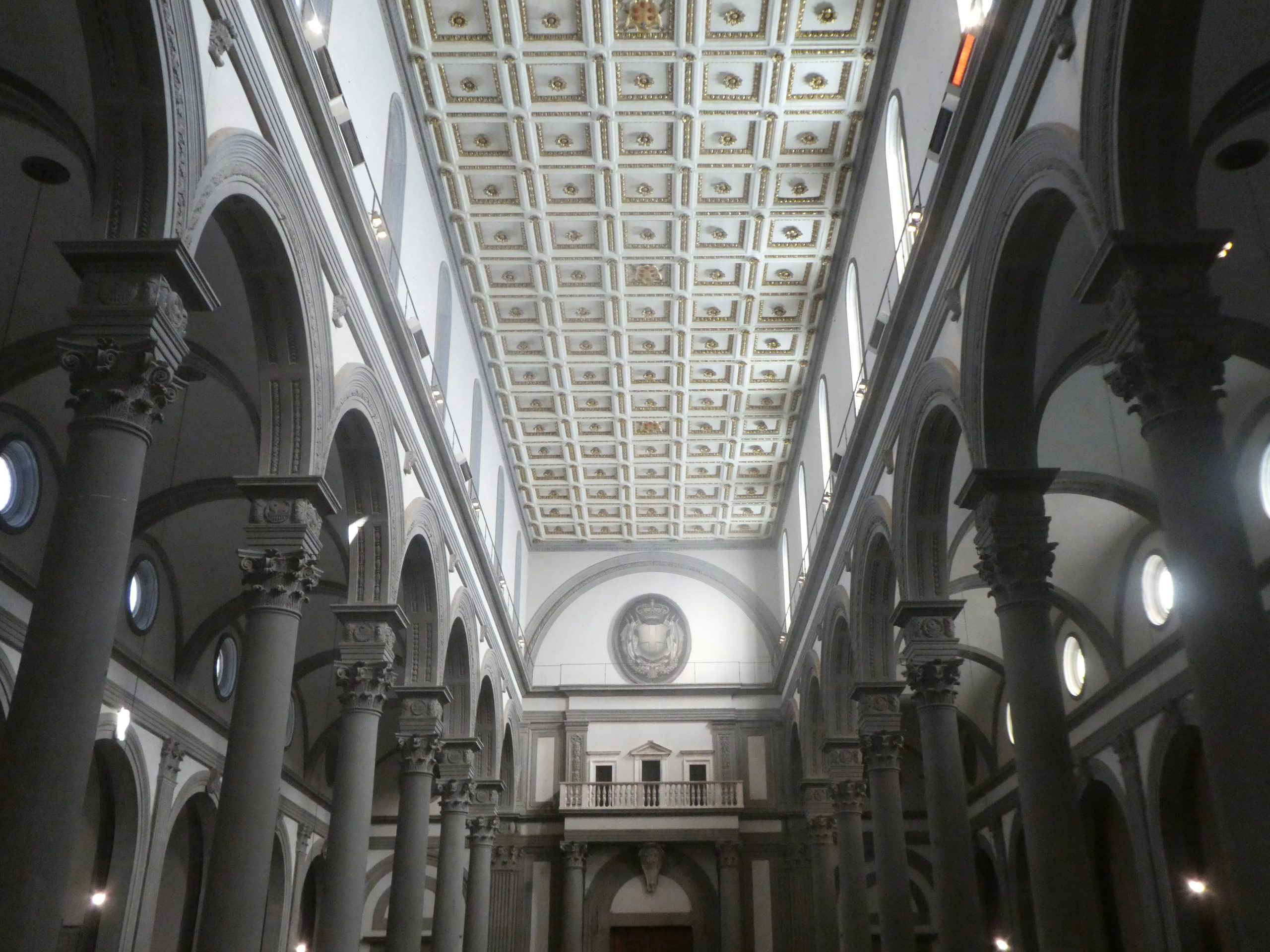
    San Lorenzo is one of the most important churches in Florence, but from its frontage, it doesn’t exactly look inspirational. Unfinished facades aren’t rare, with Florence Cathedral only seeing its frontage being completed in the late nineteenth century, but this one has just never been completed. In 1515, Michaelangelo drew up plans for an internal and external facade, but only the former was constructed.

    The Medici web-site has an image of what the external facade would have looked like if it had been completed and there have been numerous attempts, including recently, to reconstruct the frontage and to complete the works. The problem now though is that many people don’t want a historic building having a modern frontage stuck on the front of it, even if it is completed to the plans that Michaelangelo drew up over 500 years ago. So, this is probably what the facade will look like permanently, and it does have some raw beauty to it.

  • Florence – San Lorenzo Church (Tomb of Donatello)

    Florence – San Lorenzo Church (Tomb of Donatello)

    Donatello (1386-1466) was a sculptor, artist and architect who was born and died in Florence and his tomb is today in the crypt of San Lorenzo church. He worked on numerous projects within the church, including the Passion Pulpit, which was his last work. His burial was a prestigious one, it’s known that the sculptor Andrea della Robbia was one of the people who carried him to his final resting place, with his tomb being located underneath the altar of the church.

    The inscription on the tomb reads something like:

    “Here lies the body of Donatello, celebrated for reviving the ancient art of sculpting, most dear to the Medici Princes, generous patrons of the liberal arts who, as they revered him while he was alive, so they erected a tomb for him after death in a place close to their own.”

  • Florence – San Lorenzo Church (Passion Pulpit)

    Florence – San Lorenzo Church (Passion Pulpit)

    This rather grand pulpit was designed by Donatello (1386-1466) in around 1460 and it was the last of his works, sitting near to the Resurrection Pulpit which he had also designed. It’s 2.8 metres in length and 1.37 metres in height, taking into account the height of the columns, although the marble columns were a later addition.

    It’s also not entirely clear that they were built as pulpits, as they’re of a strange shape for that purpose, so they may perhaps have been designed as tombs. A suggestion that they might have been used as a choir loft has been mooted, although the choir wouldn’t exactly have had much space.

    There are Biblical scenes beautifully carved around the pulpit (or whatever it is) and Donatello’s elements were in bronze. Above is the south side of the pulpit, with the left-hand panel being the Flagellation, which was a section made from burnished wood added in the seventeenth century, similar to the middle panel which is of John the Apostle.

    The right-hand section on the south side is though Donatello’s work, the Oration of the Garden, showing the Mount of Olives of Gethsemane. The guide suggests that this depth of perspective is so finely carried out that it was attributed to Donatello, with Bartolomeo Bellano completing the remaining parts of the section. And I’m hardly in a position to know any better to dispute that…..

  • Florence – Palazzo Pitti (Jacob and Rachel at the Well by Lorenzo Lippi)

    Florence – Palazzo Pitti (Jacob and Rachel at the Well by Lorenzo Lippi)

    This painting is by Lorenzo Lippi (1606-1665) and shows Jacob and Rachel at the well, the parents of Joseph and Benjamin, two of the representatives in the Twelve Tribes of Israel. It was painted during the period between 1640 and 1645 and the artwork was acquired by the Italian Government in 1910 from the Galli-Tassi family in Florence.

    But, onto the story of Jacob and Rachel, which is told in Genesis and is just a bit overly fluffy for my liking, something that Barbara Cartland might have written in terms of the storyline. The upshot is that in the ancient city of Haran, there was a woman called Rachel and numerous sheep, which Jacob came to meet. The sheep were thirsty, but there was a stone across the well which required several men to move. But, Jacob wanted Rachel’s sheep to have water immediately, so he impressed her by using his great energy to move the stone on his own and then they became a couple. That’s the short version of the story anyway, hence why there are some slightly strange looking sheep in the painting.

  • Florence – Palazzo Pitti (Oliver Cromwell by Peter Lely)

    Florence – Palazzo Pitti (Oliver Cromwell by Peter Lely)

    This isn’t the greatest imagery of a painting that I’ve seen, but unfortunately, some of the artworks were quite hard to take clear photos of due to how they were presented within the room. So, that’s my excuse here. Anyway, this is one of many Peter Lely (1618-1680) works and, as with this one, it was painted in his studio rather than necessarily by the artist himself. This is also why there are several versions of this artwork in galleries around the world, as well as at the wonderful Cromwell Museum in Huntingdon.

    The gallery thinks that this is the portrait purchased by Amerigo Salvetti, a diplomat with strong familial links to Italian nobles, and sent to the Grand Duke of Tuscany in 1654. Lely did well in ensuring that he was able to switch from painting members of the Monarchy to members of the Commonwealth, but Oliver Cromwell wanted no flattering, saying to Lely:

    “Mr Lely, I desire that you would use all your skill to paint my picture truly like me, and not flatter me at all; but remark all these roughnesses, pimples, warts and everything; otherwise I will never pay a farthing for it”.

  • Florence – Palazzo Pitti (Grand Ducal Kitchen)

    Florence – Palazzo Pitti (Grand Ducal Kitchen)

    The Grand Ducal Kitchen at the Palazzo Pitti can only be visited as part of a private guided tour, which are offered free of charge to those who have paid to access the palace complex and they just require visitors to put their name down. I think it’s fair to say that there wasn’t a big rush for spaces on the English speaking tour, so Richard and I were the only two people initially, with someone else who didn’t really speak English then adding their name down just before we got started.

    So, the three of us set off with the very enthusiastic guide and it started with a quick tour of the King’s Apartments, which are en route to the kitchen and are also closed off to visitors not on this tour.

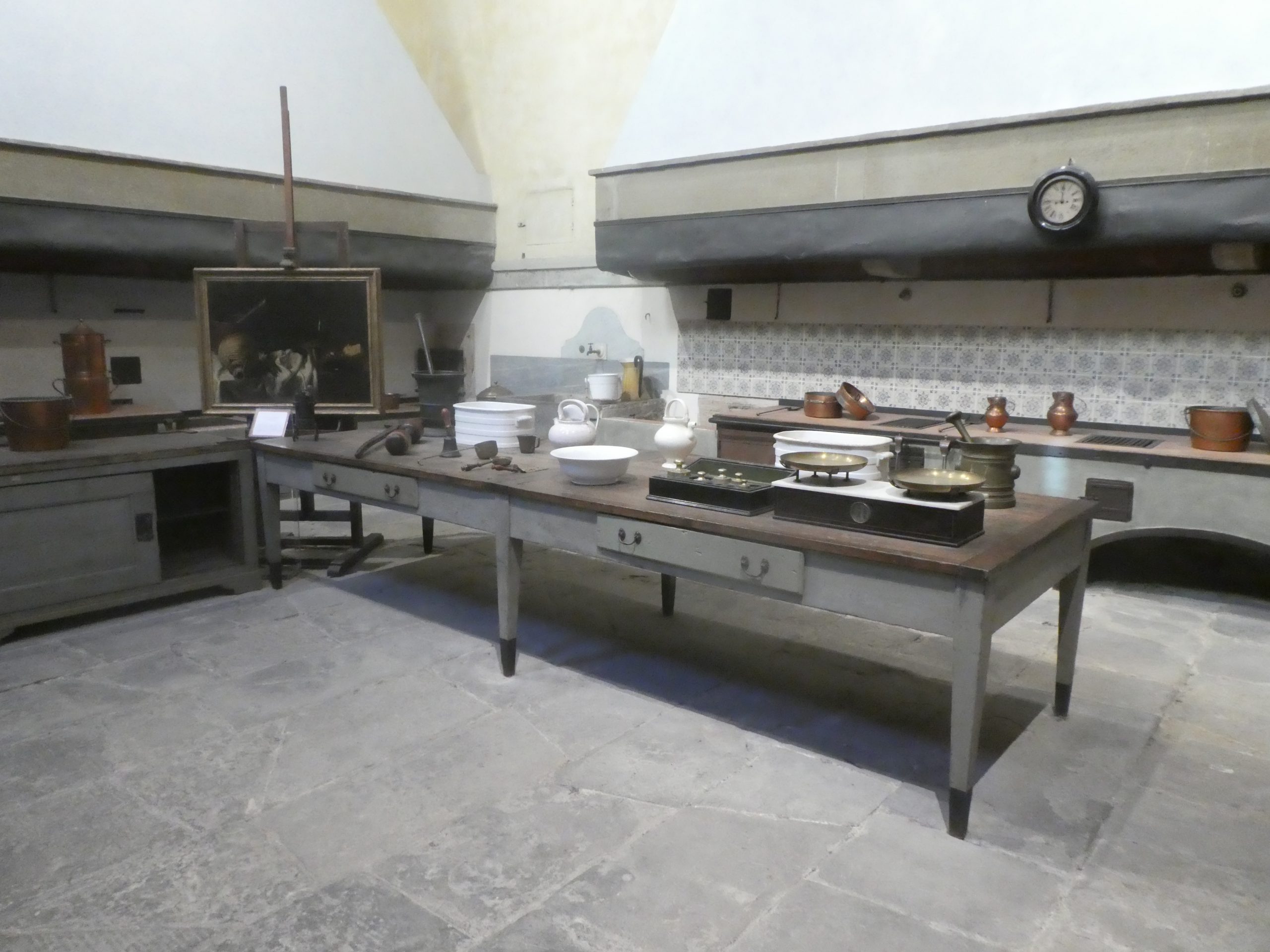
    The kitchen was large and spacious, but still dominated by this enormous chimney which was installed in around 1599 as part of the project led by Bernardo Buontalenti.

    The view from the bottom of the chimney and looking up.

    Some views of the kitchen as it now looks, which reflects how it might have appeared in the nineteenth century. Meals were cooked here for the main palace and there are corridors that connected this grand kitchen, located to the side of the house, to the main rooms. The kitchen was restored relatively recently, as for the best part of the last century this area had been used for storage and had been somewhat forgotten about.

  • Florence – Museo degli Innocenti (Coronation of the Virgin by Benedetto Buglioni)

    Florence – Museo degli Innocenti (Coronation of the Virgin by Benedetto Buglioni)

    This is a glazed terracotta altarpiece that was moved here in 1905 from the Bottigli Chapel at the manor of San Miniato al Montanino outside Figline. There’s an inscription at the base of the altarpiece which dates it to 1520 and it was commissioned by Madonna Francesca.

    This work celebrated its 500th anniversary this year, it’s survived remarkably well since it was created by Benedetto Buglioni, a Florence artist who lived from 1459 until 1521. The colouring gives it a vibrant feel and it depicts the Coronation of the Virgin with St. Dominic and St. Francis. These saints are the founders of two of the most important Catholic orders, the Dominicans and the Franciscans.

  • Florence – Museo degli Innocenti (St. Mary Magdalen by Agnolo di Polo)

    Florence – Museo degli Innocenti (St. Mary Magdalen by Agnolo di Polo)

    This terracotta figure dates from the first part of the sixteenth century and was inspired by a wooden statue produced by Donatello. It was created and painted by Agnolo di Polo, a local artist who was born in Florence in 1470 and died in 1528. Due to old damage, the hands of the figure are modern and were added in 2015, but are connected with magnets and can be easily removed if required.

    This is the wooden statue, now in the Cathedral’s museum, produced by Donatello.

  • Florence – Florence Cathedral Museum (1523 Choirbook)

    Florence – Florence Cathedral Museum (1523 Choirbook)

    Always lovely to see an old book on display, this one in the Cathedral’s museum dates to 1523 and is known as an antiphonary, or a religious book which was used by the choir. The imagery, beautifully created, depicts Moses showing the Tablets of the Law.