[I originally posted this in July 2018, but have reposted it to fix the broken image links]
Limoges has a museum which is dedicated to the history of the French resistance during the Second World War, so a visit here was essential for me. This was part of the free entry on the first Sunday of the month arrangement which Limoges has, which was most agreeable.
I’m not normally one for audio guides, but as I knew the entire exhibition was in French, I thought it’d be useful. It cost €2, but since entrance was free of charge, I considered that a reasonable deal. The audio guide proved really useful, the numbering system was clear to follow throughout and I would have missed out if I hadn’t have got it.
A map of the French defences in Limoges towards the beginning of the Second World War.
The next section of the museum explains how the French Government split into wanting to enter into negotiations with Germany, and those who wanted to fight to defend the country. The end result was the free zone of France and the occupied zone, with the former being known as Vichy France, led by Philippe Pétain.
This poster was produced by Charles de Gaulle and encouraged French to stand up and fight for the country. At the time the French Government, known as the government in exile, was based in London and most of the posters were distributed in England.
The agreement that Philippe Pétain made to keep part of France free is now seen as highly controversial. Philippe Pétain was imprisoned for treason after the end of the Second World War, and narrowly avoided execution. One of the concessions made by Pétain was to enact anti-Jewish legislation, and the above photo is one French Jew who was sent to a concentration camp.
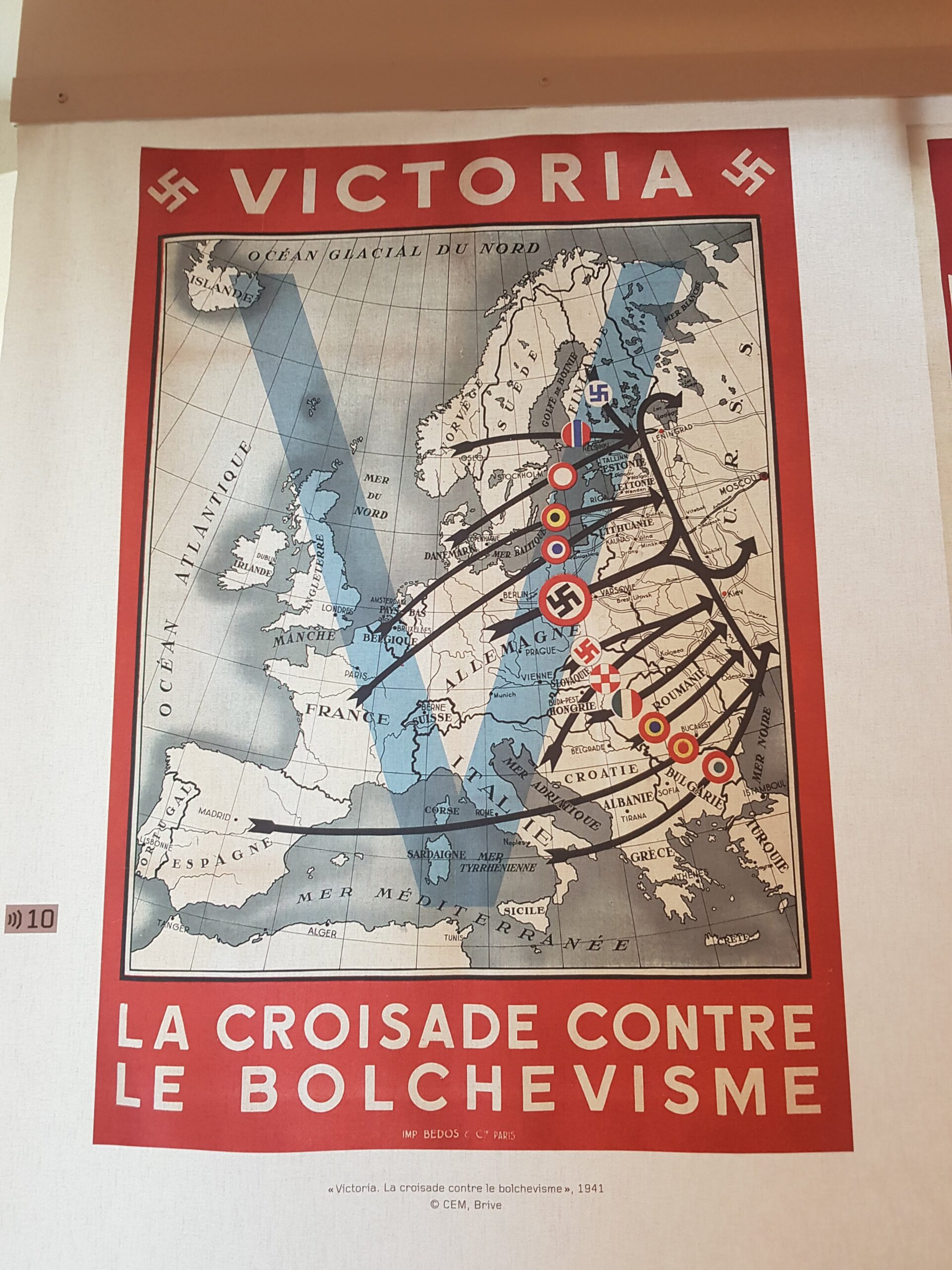
The political situation in France was inevitably very difficult to justify to the people, so there was a poster campaign to try and defend the regime. One way of doing that was to present the conflict as being a combined one against the spreading of communism from the Soviet Union.
There were numerous photos of members of the French resistance, who sought to bring down the German military forces.
Members of the French resistance were for a long time not part of a unified group, although they had a similar aim of wanting the liberation of France. They presented a real challenge to the German military, whether by attacking troops or damaging military infra-structure.
Many French men were forced by legislation to go and work in Germany for the war effort. Some of them were sent to concentration camps to do that, with nearly 10,000 Soviet and French slaves worked at the Buchenwald concentration camp.
This German plane was brought down by fire in 1944 at the town of Jumeau-le-Grand. It was placed on public display for some time, before being restored and brought to the museum when it opened in the 1980s. To do that, they had to bring it in through the roof. The second photo is of the inside of the aircraft, where the pilot once sat.
Overall, this museum took me around two hours to go through, and even though it was free of charge, there was only one other visitor. The displays were laid out chronologically and gave a really useful history of the work of the French resistance and the wider political system with which they to operate within.
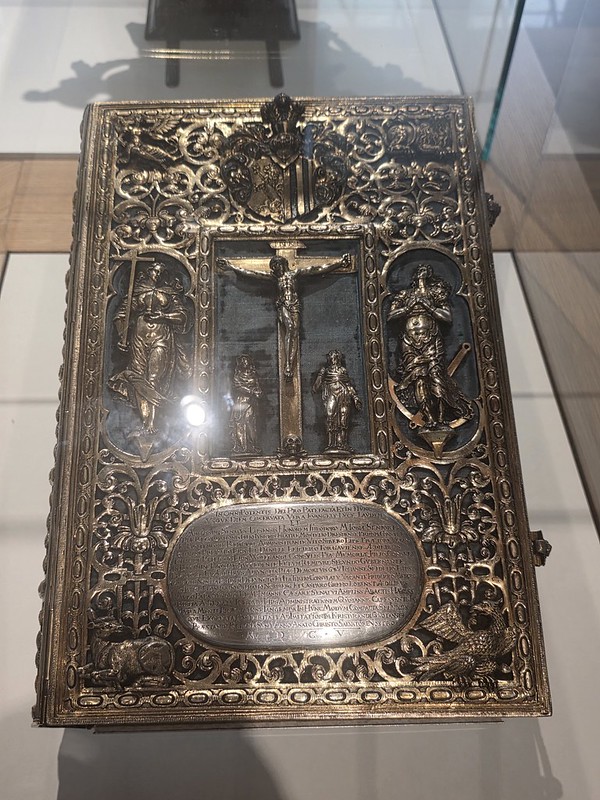
This Bible was printed in Leipzig in 1605 and there’s some impressive gold-working (or whatever the technical term is) undertaken here by the city’s goldsmiths. But, impressive as the Bible might be, the element that surprised and delighted me the most was knowing that generations of council members swore their solemn oath of office on this book, pledging to help everyone in the city regardless of whether they were rich or poor.
There is another Bible, published in 1597, that is near identical and was by Leipzig’s two most important goldsmiths, Hans Reinhart the Younger and Elias Geyer, and an early city chronicler, Johann Jacob Vogel (1660-1729), mentioned that they were made in quick succession, one for the judges and one for the council members. Both Bibles are hugely important as previously the council members had sworn on Catholic relics, meaning that it took them half a century for them to swear on a Lutheran Bible, making this something of a public declaration of Protestantism.
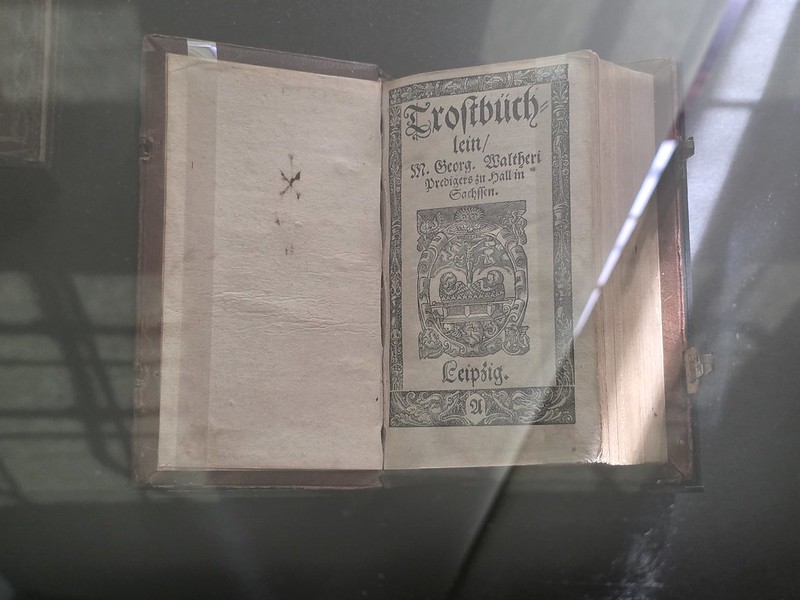
I love an old book and this is the Trostbüchlein, loosely translated as the Little Book of Comfort, that was published in Leipzig in 1571. There’s a relevance to religious books of this period to the city, as Leipzig was a centre of printing and it’s also where Martin Luther’s controversial views had been debated in 1519. The author is listed as Georg Walther, a Lutheran pastor from Halle, which suggests the content was likely a soothing blend of theological musings and gentle chastisement. I was probably a little over-excited to visit St. Thomas Church in the city (but more on that in another post), which is where Martin Luther preached and I wonder whether the congregation realised just how large the Protestant and Catholic schism would become.
I had nearly three hours to spare before my flight, thanks to the efficient security process and border control at Tirana Airport, giving me a chance to visit the airport lounge. I was pleased to see that it was relatively quiet and there was plenty of seating available. Note that not only has he got the country’s main square named after him, he also has this lounge, I wonder which Skanderbeg would be most pleased about.
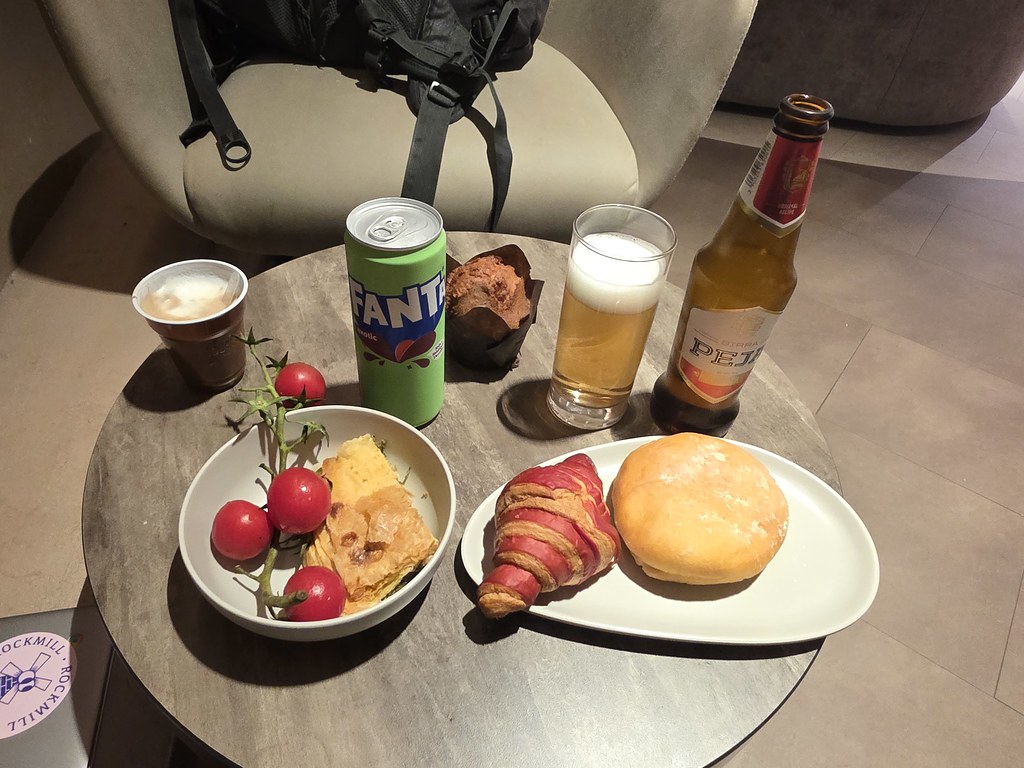
Some of the food and drink options, it’s fair to say that the range was extensive.
I was glad the person in front asked where the cups were for the coffee machine, it transpired they’re in the machine. It’s a long time since I’ve experienced a coffee machine which uses plastic cups and they come out extremely hot which adds some jeopardy to the whole arrangement, it’s good to need to use reflexes whilst collecting a drink.
The food and drink I had, with lots of fresh food alongside the pastries and baked goods. There was one beer and numerous different Fantas, which combined to surprise and delight. For the sake of completeness, I should mention that the beer was the Peja Pilsner from Birra Peja, a brewery from Kosovo, and it was clean, crisp and unexciting.
The staff in the lounge were friendly, efficient and very much on top of the cleanliness and customer service. The wifi worked, although they had a quite a reliance on low seating and I would have personally preferred some more higher seating, but that’s hardly much of an issue. I liked the availability of power points, the variety of food and the laid-back nature of the lounge. A very positive location to spend time in before the flight.
[I originally posted this in July 2018, but have reposted it to fix the broken image links]
Many years ago I watched the landmark World at War series, produced in the early 1970s and at the time the most expensive documentary ever produced. The very first episode begins with some film of Oradour sur Glane, and I’ve remembered that for some time, and I’ve wanted to visit the site.
So, I decided to spend the day here and got the bus from Limoges. I’ll do another blog post about that, as it’s not the easiest bus to find, and I noted that there were no other tourists using the service.
So, back to what Oradour sur Glane is. In 1944, the German military entered the town one summer’s day and started to round everyone up. The process didn’t take that much time, the citizens were compliant and rather confused as to what was going on.
Oradour at the time was part of Vichy France, so the section of France that was self-governed, almost as a puppet state. However, it wasn’t controlled militarily to the same degree as the occupied part of France, and the local French police force were expected to keep order across the territory. So, the villagers of Oradour weren’t used to seeing Germans in the town, something limited usually to just a couple of Germans soldiers perhaps visiting a restaurant.
The men were taken to various garages and barns across the town, and the women and children were taken to the town’s church. It was said that the men were shot by machine guns in the legs, so as to harm them, but not kill them. They were then set on fire, so for most, they were burned alive.
The women and children in the church heard the shootings across the otherwise quiet town. The women did their best to comfort the children, but the Germans used a suffocating gas to try and kill those inside. They then finished their killing with machine gun fire, to catch anyone who had survived.
The Germans killed 642 people on that summer’s day in June 1944. Of those, 205 were children.
There is no questioning this chain of events, but there is much historical debate as to what happened here to cause this. It was one of the worst war crimes ever committed and it took place without warning or because of any particular reason.
The German military were, for the most part, disciplined and effective in implementing orders. There’s no doubt that there are very many war crimes throughout the German occupied territories over the period of the Second World War, but they were usually official sanctioned from senior Nazi figures. Concentration camps were used to kill millions of Jews and political prisoners, Warsaw was bombed to try and prove a point, that reprisals wouldn’t be tolerated.
So, this gives a problem as to what happened in Oradour. Adolf Diekmann was the military commander who went to Oradour, and it was he who ordered the killings of everyone in the town. Diekmann was killed just a few weeks later on Normandy, meaning that the story of what he was ordered to do was never revealed. But, senior German military officers who had given him his commands were said to have ordered him to take thirty men hostage to try and use as a ransom for the return of a German officer who had been seized by the French resistance.
So, either Diekmann entirely ignored what he was told to do, or he really had been told to kill hundreds of people to act as a warning to those involved with the French resistance. That the French resistance were a problem to the Germans in undeniable, but if Oradour was meant as a warning, then why didn’t the Germans publicise it? Instead, they covered it up as best they could. And why would Diekmann ignore orders, if he was a loyal German officer?
So, the attack remains a mystery in its intentions. It is likely that it was a response to the attacks made on the Germans by the French resistance, but it has been suggested by some historians that the Germans had the wrong facts and perhaps entirely the wrong town.
One decision was made after the end of the Second World War, which was to keep the ruins of the town undisturbed and to not repair the damage done. A new town was created, just a short distance away, and the former site was to be kept as a permanent reminder of the massacre which took place here.
That brings me to my visit. I was there at the opening of the museum and I went straight through to the former village site, instead of going to the museum section first. This meant that I had the first half hour of the site to myself, which means that I was able to take the photos that I wanted.
I did take a lot of photos today, and I also made sure that I took photos of the signs which described what each building was. I’ve just uploaded en masse some of the photos, just to give an indication of the size of the site and what’s there, with apologies for the lack of tagging in some of them. If anyone is particularly intrigued by an individual property, message me, and I’ll bore you for ages with what they all were.
The old town is now sealed off, so that visitors have to go through the visitors centre. Above is where the road used to go straight down, but it now bends off to the right.
The visitor centre, which has a museum, shop, toilets and an information desk. Visitors can just walk straight through the entrance area if they don’t want to visit the museum area. Visitors also aren’t allowed to take photos in the museum area, just in the main part of the site.
This is what visitors see when they come up from the underground passage which goes under the road from the visitor centre.
Walking around did feel very surreal, as if this was some sort of open air museum. The beautiful sunny day meant that it didn’t feel like the site of a massacre, and so coming across signs noting people died on a particular spot was always a shock. I also found it interesting to see the buildings themselves, and all of the different layers of history within them, such as when extensions had been added or there were changes in building styles.
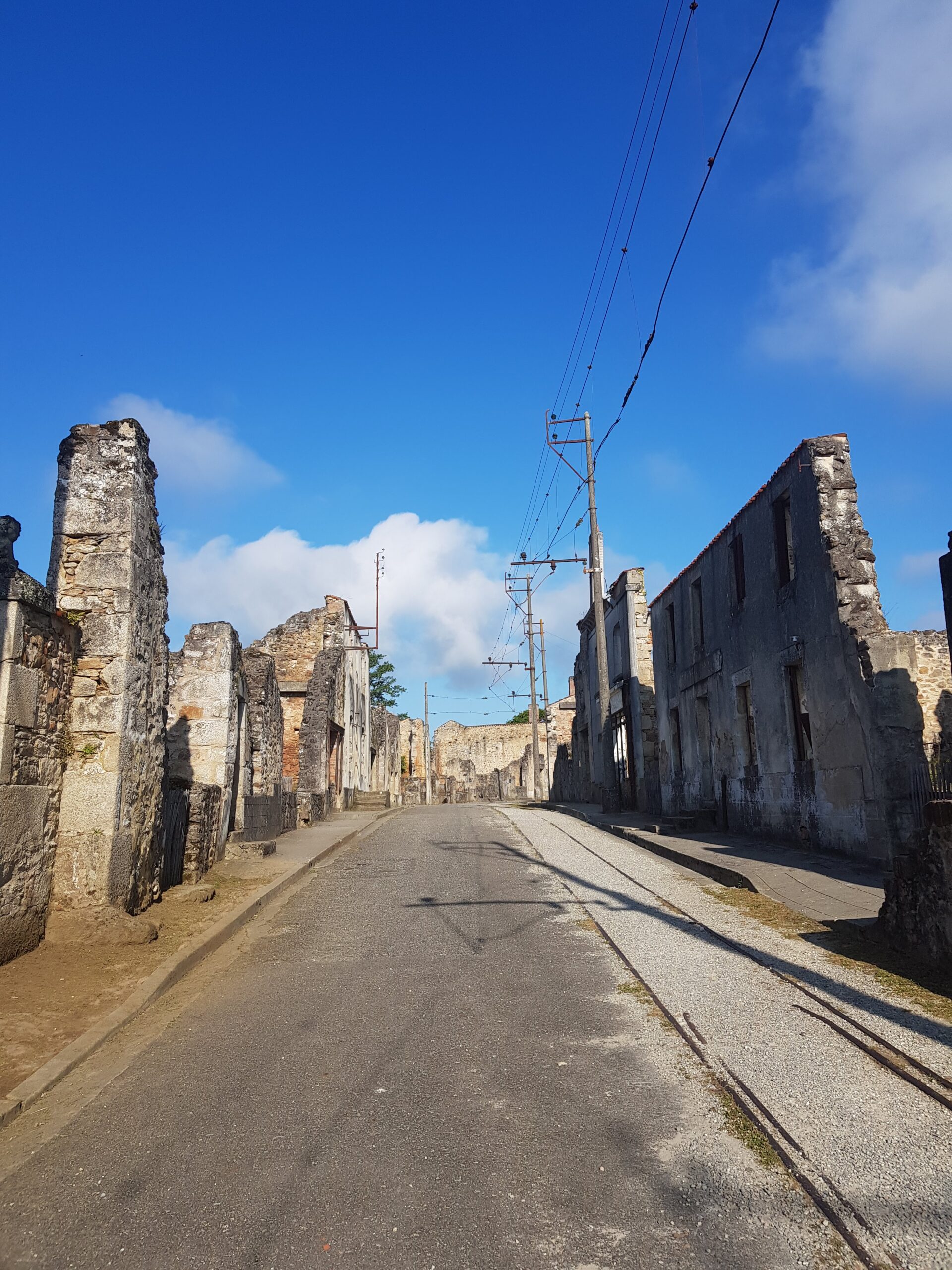
Above a number of photos along the main road of the former town, showing that it was a relatively substantial settlement. What look like power lines in the above two photos are tram lines, as there was a tram service which operated to Limoges.
On the day of the attack in 1944, a tram came into the town from Limoges, and the Germans stopped it. They shot dead the engineer and sent the tram and its driver back to Limoges, a decision that didn’t quite make sense to me. Nor did the fact that the tram then picked up more passengers and went back to Limoges, where it was stopped again. The passengers were allowed to go free, as long as they didn’t go into Oradour, but it’s another strange sequence of events which suggests that there was some considerable confusion on the day.
The above photos are of the church, where the women and children of the town were killed. The lump of metal are the bells, which melted in the heat of the fire which was started after the killings. There are also bullet marks still visible in the walls of the church.
The exterior of the former town garage.
There are several of these markers around the site, they show where the men were killed during the day.
There’s an underground memorial on the site to those who died here, although I feel it’s a slightly strange design. I’m not sure why it needs to be underground like this, but it does feel quite atmospheric.
A sign in the memorial centre.
A list of those who died in the Oradour massacre.
The above photos show the range of material which was found in the houses following the looting and destruction of them. Much of the material, particularly that relating to children, is rather emotive.
As can be seen from the above lettering, this was once the town’s tram station and I’m intrigued that the trams went such long distances.
Above are photos of the town’s graveyard, which is within the enclosed historic site. Many of those killed have graves here, and they’re all remembered at the official memorial. The coffins with bones in are another reminder of the horrors of the massacre, but the graves are well tended and dignified. Some of the graves have photos on them of those were killed, which adds a more personal feel to them.
This phone box felt out of place, and it wasn’t actually here when the Germans raided the town. It was installed shortly afterwards for the visit of Charles de Gaulle when he came to see the damage done at Oradour.
As an historical site, I’m very pleased that I got to visit Oradour sur Glane after so many years of knowing about it. It wasn’t busy, which meant that I felt that I got a fuller experience. I’d also recommend that others go if they’re interested in history and I’m sure most people would find their experience memorable.
I did though note that someone left a negative review on TripAdvisor about the site. They said that it was a bit boring, and perhaps there could be some reenactments at the site to make it more interesting. A more stupid idea I don’t think I’ve ever heard, if they ever let people dress up as Nazis to reenact a massacre then I think I’d be the first to be writing a letter of complaint. Fortunately, wiser heads have prevailed and the site is dignified, peaceful and well maintained.
A newspaper article published in the Liverpool Echo around a week after the massacre. It’s an interesting first perspective as to what was being reported at the time. It’s a little hard to read as it’s a screenshot, but it’s just readable if you click on the image and stare closely at the screen….
This sign is present on the main exits to the site. Remember.
To avoid any card based dramas on the bus journey back to the airport, I prepaid for my ticket online and I was transported smoothly to the rather decadent frontage of the building.
I did have a relaxing lounge visit at this point, but to surprise and delight my two loyal blog readers, I’ll post about that separately as it’s sensible to ration excitement.
It’s a large, clean and organised terminal. The security process took under three minutes and the border control was once again automated, as I didn’t need stamps, so I was through to airside within five minutes. All very efficient.
There were a lot of size checks on bags at the airport and some people got caught out. I’m afraid I’m on the side of Wizz Air here, they’re not stopping marginal bags, but they are stopping bags which are nowhere near the size limit. They must have taken around £250 or so in extra charges which is no doubt annoying for the passenger, but they probably need to try and at least be near to the official limit to have some sort of chance of getting away with it.
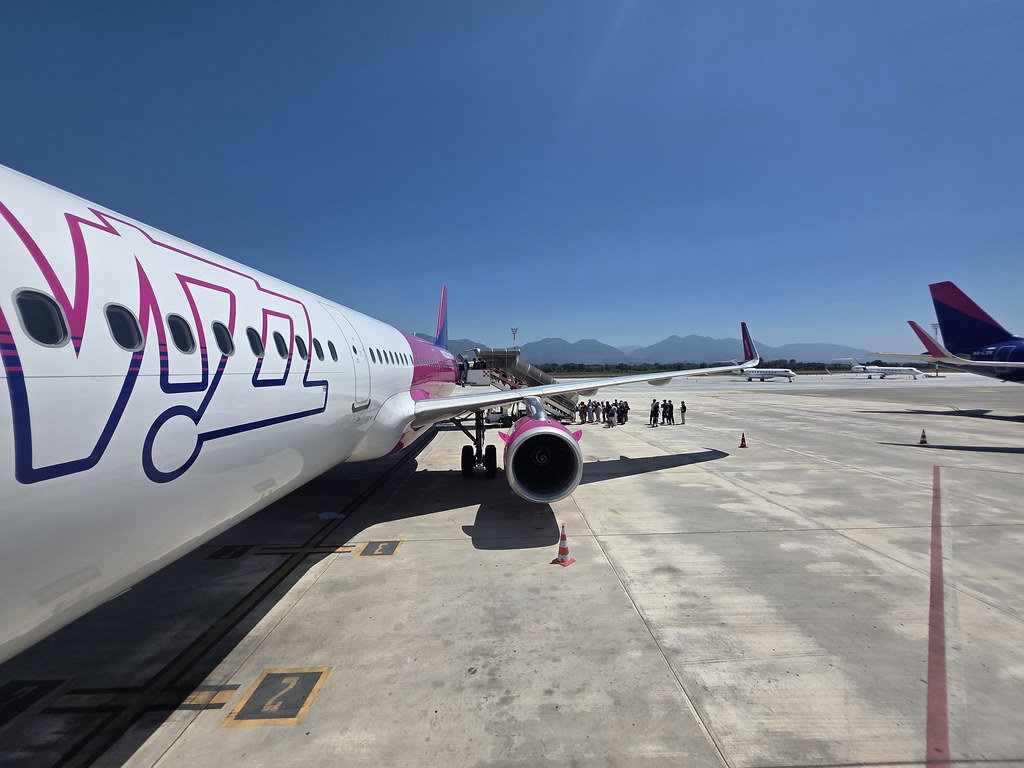
The aircraft registration was HA-LXB, not one that I’ve been on before. There were three buses to the aircraft and the doors of all three opened immediately, creating something of a huddle from those who felt the need to rush aboard. I just stay out of it and let the chaos play out.
Goodbye to the hills of Albania…. The journey was uneventful, the crew were once again friendly and efficient, although I couldn’t hear the announcements from the pilot. The seating Gods had given me a middle seat, but it was a relatively short flight and I kept myself amused watching YouTube videos.
And safely in Leipzig, fully ready for me to complain about Deutsche Bahn.
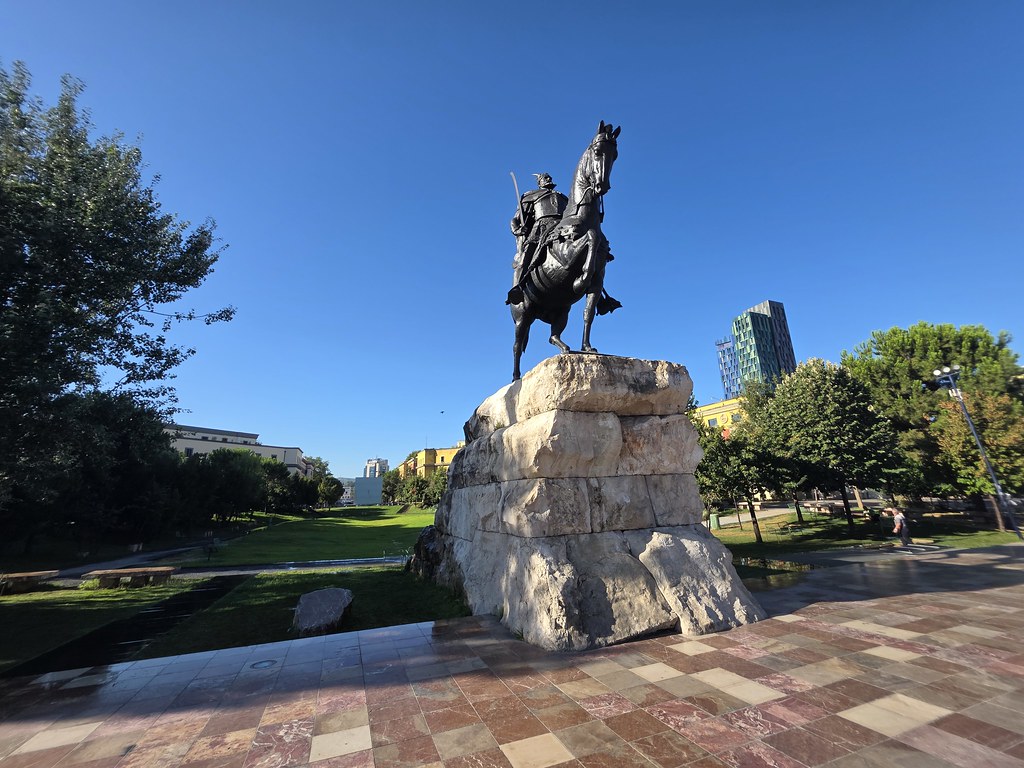
The Skanderbeg Monument is the proud centrepiece of Skanderbeg Square, a solid bronze reminder that Albania once had a national hero who wasn’t afraid of a bit of a fight. Gjergj Kastrioti Skanderbeg (1405-1468) was a fifteenth century nobleman who ditched the Ottomans after they’d trained him and instead spent decades leading a resistance movement against them. For that, he gets to be put on a horse in Tirana as the nation’s hero and he was also widely respected amongst western nations at the time for helping to slow down the Ottoman expansion into Europe.
The monument itself went up in 1968, marking the 500th anniversary of Skanderbeg’s death. He’s shown on horseback, mid-stride, looking suitably heroic, wearing full armour and clutching a sword. There’s no mistaking the message that this is Albania’s ultimate national symbol, the man who stood up to an empire and inspired a sense of independence that Albanians still cling to today.
The rather hard to read memorial stone by the monument. Of course, because this is Albania, there’s also a bit of irony as the monument was erected during the communist period, when national pride was carefully curated by the regime. Skanderbeg was recast as the people’s freedom fighter rather than the nobleman he actually was, but his importance wasn’t lessened. Enver Hoxha, the corrupt communist leader, ensured that a statue of him was erected as the centrepiece of the square after he died, although that was torn down when communism fell apart. There’s an interesting story about where that statue ended up….
Skanderbeg Square is the beating heart of Tirana, though it feels more like the lungs on a quiet day, expansive, calm and just a little surreal. It’s named after Albania’s national hero, Gjergj Kastrioti Skanderbeg, the 15th-century warrior who spent his life resisting the Ottoman Empire. His statue, naturally, takes centre stage, and it’s one of those heroic bronze figures that makes you feel slightly inadequate about how you’ve been spending your time. More on this statue in the next post though.
The square itself is enormous and it’s been redesigned in recent years with big, open stone spaces and a few splashes of greenery. It has the slightly odd quality of being both monumental and oddly minimal, which I think is part of its charm, especially now they’ve booted the cars out of it during the recent redevelopment. It’s ultimately a huge space with a lot of nothing going on at the centre. The history of this square started in 1925 when Armando Brasini was handed the task of shaping the new and shiny Albanian capital. Brasini, an Italian architect with a flair for the dramatic, came up with a grand Neo-Renaissance vision and his work was later continued by Florestano Di Fausto, who refined the Neo-Renaissance theme with what could be described as articulate angular solutions. Then came 1939 and the Italian invasion of Albania, and, as often happens when new regimes arrive, so did a new architect. Gherardo Bosio stepped in with a fresh master plan, tweaking the original designs to suit the occupiers’ tastes.
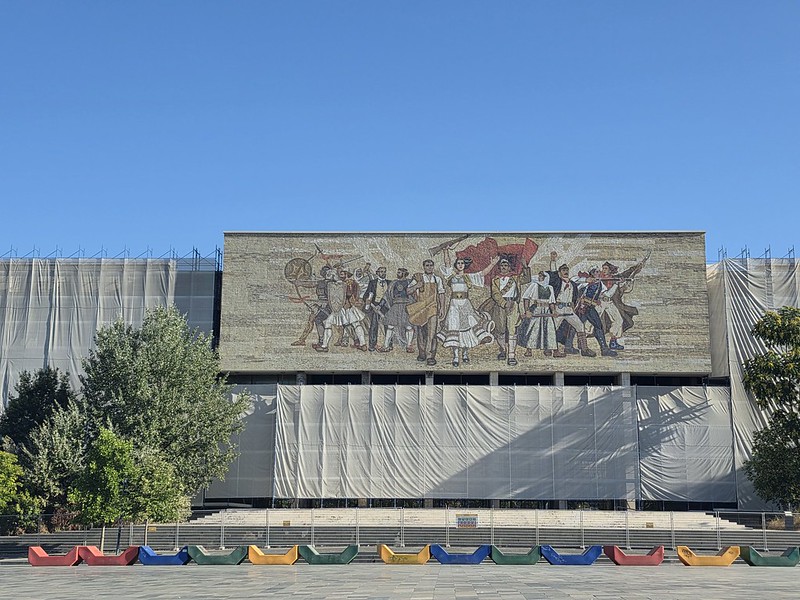
The mosaic at the National History Museum is called “The Albanians” (Shqiptarët) and it dominates the façade. It was created in 1981, during the height of the communist era, and is essentially a giant socialist-realist postcard in mosaic form. The mosaic had started to fall into disrepair, but in 2023 the restored version was unveiled which was partly funded by the European Union. There were calls for it to be removed, but this was a part of history that it was decided to preserve.
It’s a curious architectural cocktail as it’s Ottoman, fascist-era Italian, Soviet-inspired communist and modern Albanian, all happily coexisting in one giant open space. It shouldn’t work, but I think that it does, mostly because Tirana has decided to stop apologising for its past and just embrace the whole lot. The yellow building in the middle is the Tirana International Hotel and the old looking building to the right of that is the Downtown One Tower. Mostly hidden by the trees on the right is the National Opera House.
On the left is the Bank of Albania building, which was constructed in the 1930s, and in the centre of the photo is a skyscraper currently under construction.
The square is really also the unofficial stage for whatever Tirana decides to celebrate, protest or showcase. It’s a larger space than I had anticipated and there could be a little more seating and shady areas, but it’s all quite glorious and an architectural jumble which comes together quite nicely.
I’d just got off the bus from the airport and thought I’d take this photo with the beautiful light. Clearly so shaken by the bus journey, I managed to mess that up.
To make up for it, here’s a replacement shot from the following morning when I was marginally more awake and less traumatised by public transport.
The bar area of this Accor hotel.
The welcome drink and it was another smooth and generic European lager, but I like free things and it was refreshing in the extreme heat.
The room and they only had twins available. To my slight annoyance, this had a connecting door to the neighbouring room, which I hate anyway (and have to pile up furniture to prevent any access), and it was also not properly sound protected. They’ve only just built this hotel, so this just seems like a pointless small saving for the annoyance it’s already caused judging from the reviews. Anyway, I opened my window and the road noise drowned out any conversation from the neighbouring room. Fortunately, I very much like road noise, so all was well.
The view from the window.
If there’s a fire at the hotel, the general manager will get called out on this as the emergency plan is complete nonsense. Which means in the event of an actual emergency a guest might probably wander off in the wrong direction and for a brand new hotel, that’s a rather impressive oversight. They’ve been told about this in reviews and haven’t corrected it. Being quite dull, I always already know where the lifts and stairs are in nearly every hotel as I check in advance, but they’d be better to take these down and have nothing than to have widely incorrect plans. In this plan, the room highlighted is at the rear of the hotel, but I was at the very front.
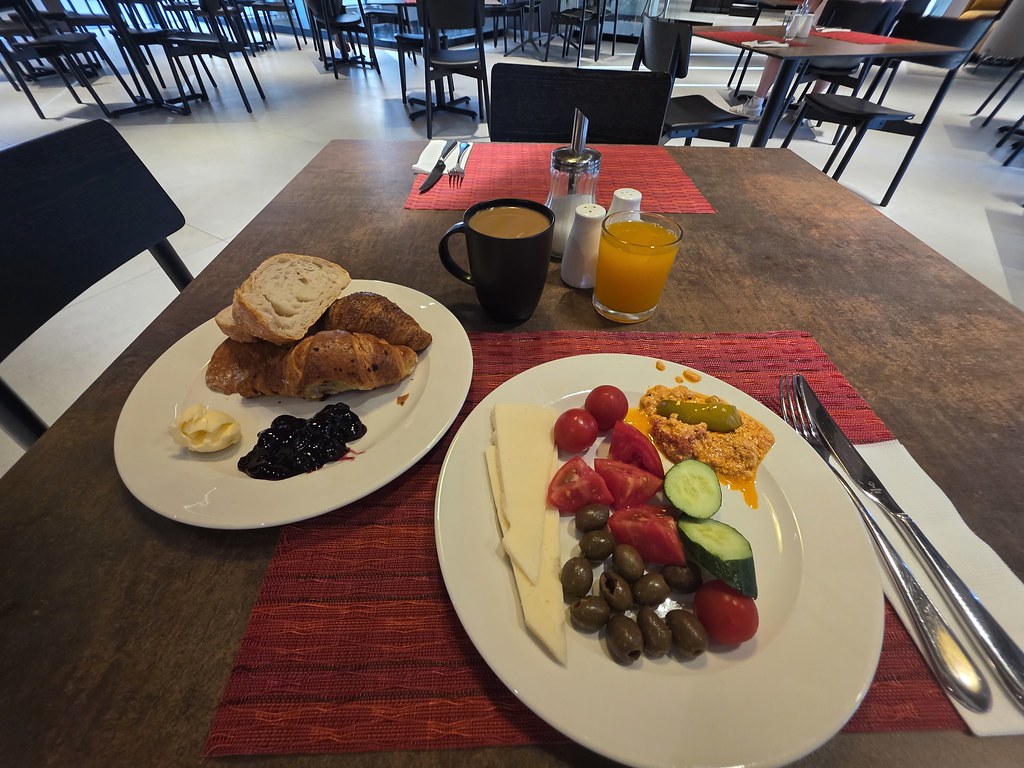
Breakfast was very peaceful as the dining room was large and quiet, with the staff being attentive and plentiful. The filter coffee was a little drab, but that cherry jam was formidable. It’s one of the punchiest cheeses that I’ve had, but there were plenty of juices to temper the flavour a little. All absolutely fine though with plenty of choice and numerous breads and croissants.
I liked this hotel and would stay again, but they really do need to sort out the sound protection between the rooms as it shouldn’t be like that in a new build. Most people don’t want to open the windows to hear road noise to resolve the issue, I accept that I’m odd in that regard. The air conditioning seemed temperamental, some reviews have suggested it’s because they’re turning it off and on at reception. Either way, the room was tolerable in terms of heat and I set the bar quite high on that, so I suspect most guests would have been entirely happy. The highlight was the breakfast, but as for the fire plan, let’s just say don’t rely on it unless you’re keen on a spontaneous tour of the wrong part of the building.
The hotel is around a one hour walk from the city centre, so I decided that’s what I would do in the extreme heat, although there are buses and taxis available for those who don’t feel the need to walk everywhere.