Blog

  • Bawburgh – St Mary and St Walstan Church (James Reeve)

    Bawburgh – St Mary and St Walstan Church (James Reeve)

    This is the grave of James Reeve located in the churchyard of St Mary and St Walstan Church. There’s not much of a story I can tell here, but I liked the inscription which reads:

    “LIfe is transitory and fleeting, death uncertain as to his approach”.

    James Reeve was baptised in the church on 27 September 1771, the son of Henry Reeve and Mary Reeve. He married Martha Petchell in the church on 2 December 1802. James died on Wednesday 18 March 1829 at the age of 57 and was buried on Thursday 26 March 1829 at a service overseen by the curate Edward Postle. It’s a reminder though of how important the church was in the lives of communities, where individuals would be baptised, married and buried all at the same location.

  • Bawburgh – St Mary and St Walstan Church (1939 and Now)

    Bawburgh – St Mary and St Walstan Church (1939 and Now)

    This is St Mary and St Walstan Church in Bawburgh as it looks in 2020, and as it looked from pretty much the same spot in 1939. Not much has changed, the grave in the bottom left of the photo is new, but in the older photo there’s a grave covered in ivy. That grave is still there, but the ivy has now been removed, although it has destroyed the inscription on the stone. Sometimes I wonder why some graves are badly damaged and illegible in cemeteries, this is one of the reasons why….

    This becomes a bit of a spot the difference puzzle, but I quite like seeing what has changed. The slightly wonky drainpipe in the old photo has gone from where the nave meets the chancel, a tree has been removed in the foreground, but otherwise nearly everything is reassuringly unchanged over the last eighty years.

  • London – Kensington and Chelsea (Borough of) – National Army Museum (Fragments of Arm Bone)

    London – Kensington and Chelsea (Borough of) – National Army Museum (Fragments of Arm Bone)

    This is another cheery little number from the collections of the National Army Museum, it’s fragments of bone taken from the damaged arm of Lieutenant Charles Fletcher, from the 48th Bengal Native Infantry. The incident took place during the Indian Rebellion when the compound at the Residency in Lucknow came under attack in 1857. A musket ball hit Fletcher, which isn’t ideal, causing this damage to his arm. The Residency building is still there in ruins, a reminder of the last days of the East India Company, before the 1858 Government of India Act transferred power to the British Raj. It’s an interesting souvenir to keep, I’m not sure that it’s something I would have kept in a little box though to remind me of the event….

  • London – Kensington and Chelsea (Borough of) – National Army Museum (Ration Biscuit)

    London – Kensington and Chelsea (Borough of) – National Army Museum (Ration Biscuit)

    I’ve seen ration biscuits that have been sent home in many museums, they weren’t particularly popular with troops and they did make for useful souvenirs. Bread couldn’t be distributed because it went mouldy, so members of the armed forces received these dried things usually made from flour, water and salt, which then had to be mixed with a liquid to become vaguely edible.

    The National Army Museum has this item on display, sent back home by Trumpeter S Foster from the 12th (Prince of Wales’s Royal) Lancers. It can’t be seen from how the museum has presented it, but on the rear is the receiver’s address and two postage stamps, so it really did go through the postal system. I imagine that amused the postal authorities and it is remarkably undamaged given its journey from South Africa.

  • Dictionary of the Vulgar Tongue – Day 234

    Dictionary of the Vulgar Tongue – Day 234

    The Dictionary of the Vulgar Tongue was first published at the end of the eighteenth century, and given that the current health crisis is giving too much time to read books, I thought I’d pick a daily word from it until I got bored….

    Oil of Barley

    I like this rather lovely little phrase, defined by Grose simply as “strong beer”. The first bit of the phrase, the ‘oil of’ was commonly used in the seventeenth and eighteenth centuries to describe many things, with the barley reference dating to at least as early as the seventeenth century.

    The phrase lingered on in usage until relatively recently, where it sadly finally seems to have gone out of the vernacular.

  • Bawburgh – St Mary and St Walstan Church

    Bawburgh – St Mary and St Walstan Church

    This is the Grade I listed Church of St. Mary and St. Walstan at Bawburgh, one of the few churches which is dedicated to a Norfolk saint. The stepped nave gables give it a distinctive look and these date from 1633, when the building was repaired following some decades of decay.

    There has been a church on this site since around the late tenth century, linked to the miracle of St. Walstan and the well. That well had ensured that the church had become a pilgrimage site and this brought some wealth, all suddenly brought to an end with the Dissolution of the Monasteries and the effective end of such pilgrimages. At one stage during the peak of its wealth, the church had seven Chantry priests and supported six canons.

    The tower of the church dates from the twelfth century, with the chancel being from the beginning of the fourteenth century. The nave is late fifteenth century, likely having been rebuilt given the funds that had come in from the pilgrims.

    This side of the churchyard drops down and the supporting buttresses are visible.

    The ancient north door.

    I have no idea how old this iron support is sticking out of the wall, but the bulging state of the north wall suggests there have long since been problems, even with the buttresses.

    The chancel end of the church.

    The bricked up doorway at the end of the chancel, the reasons for which I’m unsure of.

    There doesn’t seem to have been any excessive repairs from the Victorians, with the Reverend Gabriel Young noting in the early twentieth century that there had recently been a desperate need to raise funds to fix the tower to prevent it from ruin.

    The interior was closed, but apparently there are some notable wall paintings which the church hopes to have professionally restored over the next few years. In 1905, the local press reported that a handsome newly repaired wooden chancel screen had been installed in the church. The same report added that “the parish had the honour of furnishing the first couple who ever won the Dunmow Flitch in 1445”. This meant that a couple who could honestly say that they hadn’t had an argument in the first year of marriage were given a flitch of bacon.

  • Dictionary of the Vulgar Tongue – Day 233

    Dictionary of the Vulgar Tongue – Day 233

    The Dictionary of the Vulgar Tongue was first published at the end of the eighteenth century, and given that the current health crisis is giving too much time to read books, I thought I’d pick a daily word from it until I got bored….

    Odd-Come-Shortlys

    This is another one of Grose’s definitions that I can’t add much to, but I like the phrase. He defines it as “I’ll do it one of these odd-come-shortly’s; I will do it some time or another”. The first known author to use this phrase was Jonathan Swift in the early eighteenth century, with its meaning just evolving from being one of those odd days which may come shortly where there will be time to do something.

  • Norwich – Earlham Cemetery (Military Graves)

    Norwich – Earlham Cemetery (Military Graves)


    I hadn’t realised when I visited Earlham Cemetery the other day that there are two separate areas for military graves. One is the most obvious in the centre of the cemetery and this has been in operation over the last century. There is though another which backs onto Helena Road and it’s this one which filled up during the middle of the First World War, hence why another area was created.

    A war memorial commemorating those who died in the 1870s.

    And below are two of the different grave styles in this area of the cemetery, before the standardisation that came following the number of deaths during the First World War.

  • Colchester – Abbey Arms

    Colchester – Abbey Arms

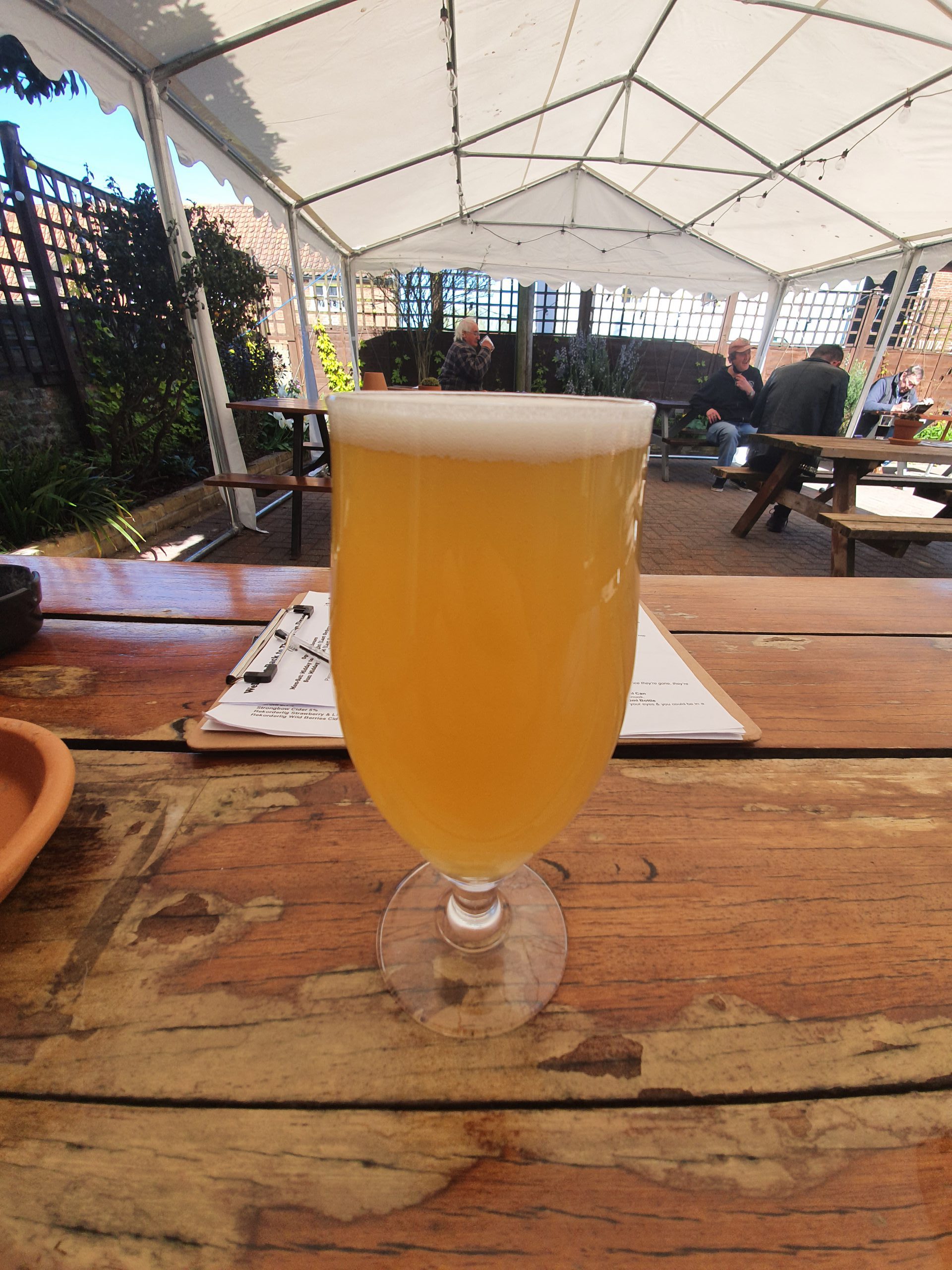
    Just for clarity, this visit is from a couple of months ago, this isn’t a pub serving illegally during the lockdown. This was our penultimate pub of the evening and it was busy inside, as well as outside by the time we left. The pub was modernised a few years ago and I do like what they’re done with the exterior, it’s much improved from what was here before.

    For some reason I’ve failed to note what I ordered in this pub, although knowing Nathan, he can probably still remember. So, it’s not ideal I can’t comment on that, although I do know that the choice wasn’t overly exciting in terms of there being no darker options, but the beer quality was fine (I’d have remembered if it wasn’t) and the primary selection is from the Colchester Brewery.

    I wasn’t overly impressed at the acoustics of the pub, it’s a large single bar affair with no room divisions and a more modern design which just seemed soulless to me. The pub staff were friendly, although were perhaps unfortunately distracted by some of the pub’s more vibrant customers. There was a community feel to the whole arrangement though, I suspect someone new to the area would find the environment welcoming in terms of meeting new people and feeling welcome.

    I wasn’t quite sure who the pub’s target clientele were, there was what I felt to be a slightly uneasy mix between the bright beer fonts and the real ales perched next to them. I’m more used to sports bars putting craft beer in alongside lagers to try and keep on trend (or just sell lagers and sod all else), and that’s something that is potentially quite exciting to me (well, not the sports bar or lagers bit obviously). But, I can’t complain that they’ve made an effort to sell real ale and it’s rather lovely that it’s working for them. The pub had also made an effort to stock a wide variety of spirits, so it wasn’t all generic and bland.

    There was nothing wrong with the pub, but I’ll mark this one as not being for me (in fairness to them, very few sports bars are, so I was never their target market), I think I’d have rather it was the old fashioned local it was a few years ago, or something more modern in terms of craft beer or innovative and exciting real ales. But, the pub was busy, so I hope it’s doing well and that’s all that matters in these challenging times….

  • Bawburgh – St Walstan’s Well

    Bawburgh – St Walstan’s Well

    This is St. Walstan’s Well in Bawburgh, which was a pilgrimage site in the medieval period. Walstan was an Anglo-Saxon Prince who would have likely had some wealth, but he decided when aged 12 that he wanted to dedicate himself to a life guided by God. Very pious….Anyway, after a worthy life as a farm worker and servant of God, he received a message that he was going to die within days.

    So, knowing that he was going to die, Walstan decided that he would stop his work and would allow himself to be pulled around East Anglia by two bulls. He must have loved the random, as he decided that the bulls could decide where he should be taken and this would be God’s will. God decided that Walstan’s now dead body would be taken to Taverham and Costessey, which doesn’t sound very exotic. Along this route wells had magically been popping up, which is what happened in Bawburgh. At this well, or spring, there was water which magically healed sick humans and animals. A pilgrimage spot had been created and this did very well indeed (excuse the pun). The Dissolution of the Monasteries saw an end to this little arrangement though.

    The medieval well structure has been replaced by this more modern arrangement. There was a local walk printed by the Norfolk News in 1896 which mentioned that in the river here that believers could still see the print of his foot in the water. Regarding the well itself, the author of the article reported that “it does not look very brilliant nowadays, though a rustic informed us that the water was good”.

    Don’t drink the water…..

    The Church of Bawburgh St Mary and St Walstan is visible in the background.