Blog

  • Annemasse – Ibis (Accor Hotel)

    Annemasse – Ibis (Accor Hotel)

    [I originally posted this in August 2018 about a visit from March 2016, but I’ve reposted it to fix the broken image links]

    ibisann

    One of the problems of visiting Geneva is that it’s very expensive, and so, since I had visited the city before I made the decision to go and explore some of nearby France. Annemasse is a town on the French/Swiss border and the prices are much cheaper. It’s about a ninety-minute walk or a thirty-minute bus journey (I walked, obviously) from Geneva to Annemasse, so it was a convenient place to stay on my first evening.

    The Ibis hotel (I pinched the above photo from the hotel) is towards the Geneva side of Annemasse, although it’s only a short walk into the town centre. It was a relatively cheap option and although it wasn’t particularly exceptional, it was clean and comfortable.

    20160318_095817

    20160315_085915

    I stayed in the hotel twice during the week, once on the evening my flight landed and another time the night before my flight departed Geneva. I’m rather risk averse, so I like to be as near to the airport as possible, to minimise the possibility of any little disasters taking place….

    As can be seen from the photos, I had the same exciting view on both of my stays since they gave me similarly located rooms during my two visits.

    20160315_085905

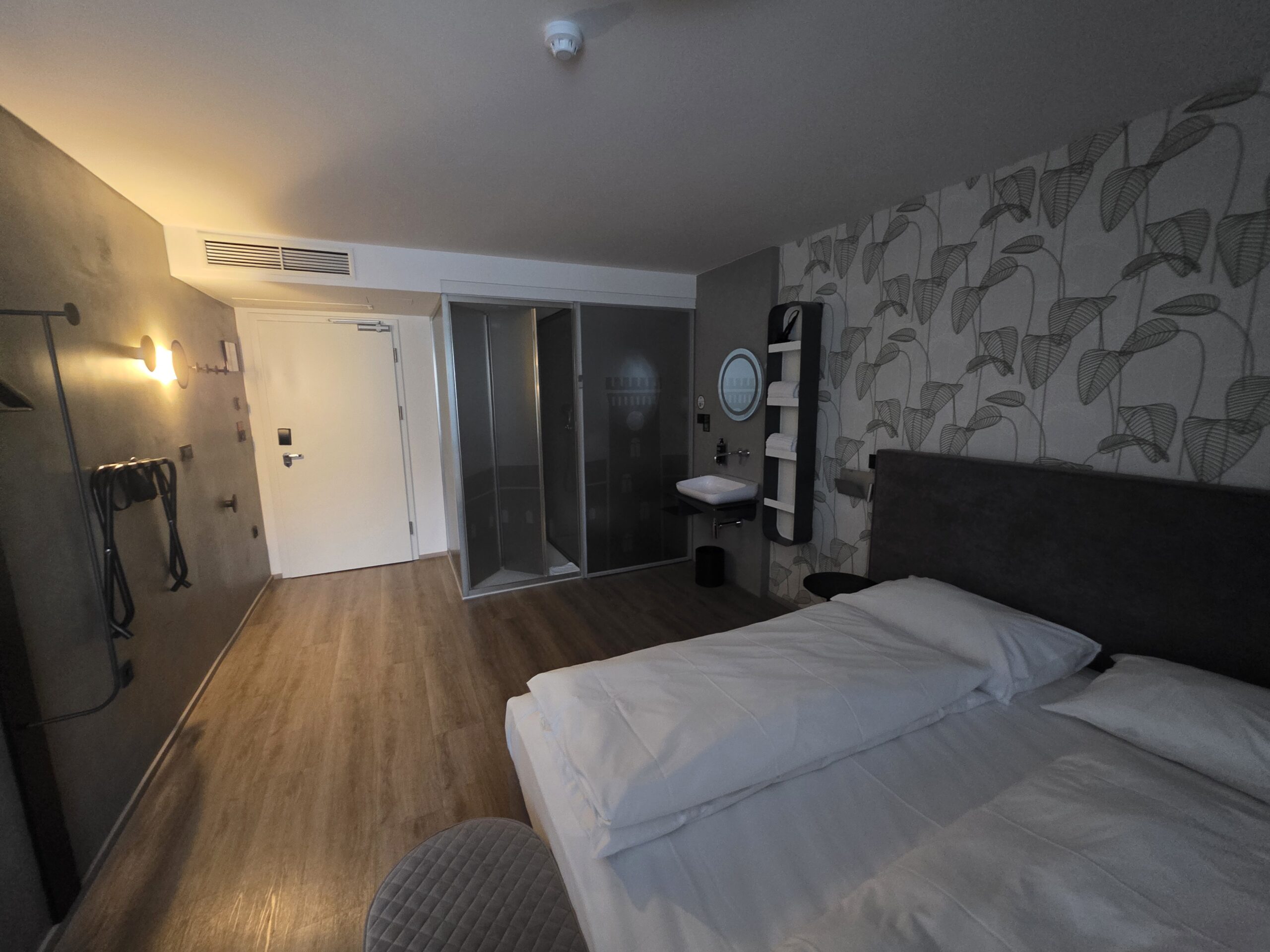
    Not the best of photos, but it doesn’t really matter with Ibis, as all the rooms look pretty much the same across the chain. Clean and comfortable, and I didn’t experience the construction noise that some people were complaining about when I visited.

    The breakfast, which rather unusually I didn’t take photos of, was adequate, although again, wasn’t exceptional. For visitors to Geneva though who want to save some money, this is a perfectly viable hotel and it’s within relatively easy distance of the Swiss city.

  • Food from Every Stall on Norwich Market (2025 Edition) – Week 27 and Tasty House

    Food from Every Stall on Norwich Market (2025 Edition) – Week 27 and Tasty House

    20250902_132355

    We’re approaching the end of visiting every food stall at Norwich market and this week’s expedition was to Tasty House, which we visited before when we did this before in 2023. I very much liked the food on this previous visit and everything felt organised and well managed, so my expectations were high. After we waded through the throngs of middle-class people that James knew, first impressions this time were positive as we reminded that the menu is actually rather exciting.

    20250902_131027

    The menu options with most of the dishes already being pre-cooked, although a couple are made fresh to order. There was also a daily special of ribs available as well, so the menu options felt extensive, with a choice of sticky rice, jasmine rice or noodles with each main course. There’s one vegan and vegetarian option, which is listed top of the menu, but all of the others are meat based.

    20250902_131223

    The counter and the stall accepts card and cash. The service was friendly and helpful, although there wasn’t much engagement beyond the minimum needs but there’s a lot to be said for efficiency. We had a wait of around thirty seconds to be served as the customer in front was asking quite a lot of questions, but James pretended not to be annoyed and obviously I’m always calm.

    20250902_131412

    I like the variety of free condiments that can be added to the food, although there’s a sister stand opposite the shop which sells all these raw ingredients. There was quite a lot of general litter on the counters such as abandoned water bottles, coffee cups and other detritus, so that didn’t feel entirely optimal. There’s a small seating area at the end of the stall, but we had our food standing near to the condiments.

    20250902_131453

    I went for the large panang chicken curry with jasmine rice which came to £9.50, an increase of £1.50 from when we last visited. This arrangement seemed a little odd as they were quite stingy on the portion of rice, but very generous with the amount of chicken. However, this meant that the meal seemed a little unbalanced as I had plenty of chicken curry, but nowhere near as much rice as would have been ideal. Given rice is a cheap ingredient, it’s usually the other way around. The curry was though aromatic, rich in flavour, the chicken was tender and moist with the vegetables taking on the flavour of the sauce. I can’t say that the lettuce does much here, but the quality of the arrangement was high and the curry was at the appropriate hot temperature.

    IMG-20250902-WA0003

    James’s food and he went for the Korean BBQ beef, the regular £8 size, but they forgot to ask him if he wanted noodles or rice, but he was satisfied with the sticky rice that he was automatically given. I’m not sure that there was much kimchi which was mentioned in the menu description, but James said that the food was agreeable although the beef a little dry.

    I left feeling satisfied with the lunchtime snack, it was filling and had a depth of flavour to it. Ideally they could have packed the large bowl out with a little more rice, but I have no complaints about the quality of the curry itself. The service was friendly, there was a minimal waiting time and I’d merrily recommend this stall to others once again.

  • Munich – Munich Documentation Center for the History of National Socialism (Thomas Wimmer)

    Munich – Munich Documentation Center for the History of National Socialism (Thomas Wimmer)

    20250820_103122

    Thomas Wimmer (7 January 1887–18 January 1964) was the Social Democratic mayor who became the public face of Munich’s post-war recovery, one of the heroes of his generation. He had been born in Siglfing near Erding, the son of a blacksmith and a domestic worker and he trained as a cabinet-maker, joined the woodworkers’ union in 1907 and the SPD in 1909 before settling in Munich after years as a journeyman. In the First World War he served briefly at the front before being released as an armaments worker and after 1918 he worked at the city labour office and was active in municipal politics. He sat on the city council from 1924 to 1933 and, with the collapse of the Weimar Republic, was arrested a day after the Nazi takeover in Munich, spending time in Stadelheim prison and at Landsberg, and later facing repeated Gestapo detentions. After the 20 July 1944 attempt on Hitler’s life he was held for six weeks in Dachau concentration camp, perhaps very fortunate to have managed to stay alive during this process. I rather suspect that if the Nazis had remained in power for just a little longer, his future would have been more in doubt.

    After liberation the American military authorities reinstalled Karl Scharnagl as mayor, Wimmer returned to City Hall as third, then second mayor, and in 1946 served in Bavaria’s constitutional assembly and entered the Landtag. When the SPD topped the 1948 city elections he was chosen as Oberbürgermeister, a post he held until 1960 while also representing Munich in the Bavarian parliament through the 1950s. These were hard years of shortages and ruins and Wimmer pushed pragmatic measures such as the “Holzaktion” to secure winter fuel and, most famously, the citizen clean-up “Rama dama” on 29 October 1949, when more than 7,500 volunteers, shovel in hand, the mayor among them, shifted an estimated 15,000 cubic metres of rubble in a single day. The Bavarian dialect slogan stuck, and the image of a hands-on mayor helped rally a city to reconstruct itself.

    Politically he resisted post-war schemes to drive a motorway-scale traffic cut through the historic centre, arguing that the city should be rebuilt for people rather than exhaust fumes. Twice directly re-elected (1952 and 1956), he left office in 1960 with a reputation for plain speech and practical administration. Wimmer died in Munich in 1964 and was buried at the Ostfriedhof. The city named the Thomas-Wimmer-Ring on the Altstadtring after him, and he was made an honorary citizen of Munich in 1957, receiving the Bavarian Order of Merit in 1958 and the Grand Cross of the Order of Merit of the Federal Republic of Germany in 1955 (with Star in 1959). For many Munich residents, though, his memory is still tied most strongly to a broom, a shovel and the decision to clear a path back to normal life.

    As a politician, his strength must have been substantial to have resisted the Nazis for so long and to have remained steadfast in his views. To have then been given the opportunity to influence the post-war Munich was at least some justice in his life and it’s evident that he continued to surprise and delight the communities which he served. I hadn’t heard of him before visiting the museum, but I very much like that they have a section on those heroes of their generation who stood up to the Nazis.

  • Munich – Munich Documentation Center for the History of National Socialism (Puppet Chanele and Maria Luiko)

    Munich – Munich Documentation Center for the History of National Socialism (Puppet Chanele and Maria Luiko)

    20250820_103808

    This exhibit at the Munich Documentation Center for the History of National Socialism is a little tricky to photograph because of the light, but it’s an important part of their current exhibition. The puppet is Chanele, created by the Munich Puppet Theatre of Jewish Artists which was in existence between 1934 and 1937 when it performed five plays and three musical dramas.

    The central person featured by the museum is Maria Luiko (1904-1941) who was a founding member of the theatre group and she made the puppets and most of the stage sets, so she was likely the first person to pull the strings of Chanele. Maria was unable to join the Reich Chamber of Fine Arts when it was created in 1933 as she was Jewish, which also meant that she couldn’t display or sell any of her works. Maria had ideally wanted to move to Palestine, but she was arrested and deported on 20 November 1941, along with her sister Dr. Elisabeth Kohn and her mother Olga Kohn (nee Schulhöfer), from Munich to Kaunas in 1941 and she was then murdered on 25 November 1941. These murders became known as the Ninth Fort massacres, the first systematic mass killings of German Jews during the Second World War.

    The museum notes:

    “Chanele still remembers what it was like to move on the stage, to tell her story, to play a role. She remembers the excitement and the applause, the hands that made her and the held her on the stage. The hands of the people who believed in the magic of theatre and the power of stories to transform, to comfort, to hold people together.”

    The puppet’s survival feels a little remarkable, but its existence means that the story of Maria Luiko is at least not lost to history.

  • Fakenham – Superstore

    Fakenham – Superstore

    [This is from August 2018, but I’ve reposted it to fix the broken image link for the photo that amused me at the time….]

    This isn’t particularly amusing, but this is certainly my sort of superstore   🙂

  • Smuggler’s Trod Challenge Walk 2018 – Yorkshire Coast LDWA

    Smuggler’s Trod Challenge Walk 2018 – Yorkshire Coast LDWA

    [I originally posted this in August 2018, but have reposted it to fix the broken image links]

    Screenshot_20180827-171002_GPX Viewer

    I thought it’d be a great idea to spend a weekend in Whitby and also complete the Smuggler’s Trod 25-mile challenge event which is held nearby as part of the adventure. Five other people from Norfolk & Suffolk LDWA came along and we were rather lucky with the perfect weather for the event, no rain and not too much sun.

    20180825_082546(0)

    The walk wasn’t particularly challenging in terms of hills, but there was a hill climb straight from the start at Robin Hood’s Bay. The total ascent for the entire walk was 657 metres though, which was hilly enough for me.

    20180825_091105

    The early section of the walk went along the official Coast to Coast path as we went inland.

    20180825_151435

    The colours along the route were beautiful and the whole walk was along a varied landscape with numerous wooded areas, moors and along riverbanks.

    20180825_095059

    Bev trapped in ferns.

    20180825_095723

    20180825_104613

    20180825_140305

    The food selection was wonderful throughout and the doughnut type things were particularly delightful and very moreish. One checkpoint was kindly making up sandwiches to order, so I quite happily waited there whilst eating jelly babies.

    20180825_150601

    We went through a farm with some interesting pieces of ironwork dotted about, including this fine looking soldier.

    20180825_155637

    Approaching Robin Hood’s Bay again towards the end of the route.

    20180825_162047

    The last part of the route was along the former railway line from Whitby to Scarborough. It’s a great shame that this line has been lost, but it is now a popular cycling and walking route.

    The end of the challenge event today leaves the railway line just before Robin Hood’s Bay so that entrants have to walk up the hill to the former railway station, which is the end point of the event. For those who are running out of time, the organisers allow them to just walk along the railway line to the end, which I was tempted by anyway, but that would have felt like cheating….

    20180825_172759

    This is what I had to deal with….

    We walked around the challenge event in two groups of three and I won’t go into details into what went wrong for the group of three that I wasn’t in. But I will say that Maria, Jane and Ray clearly weren’t able to navigate as well as me, as I didn’t end up walking four miles extra by mistake…..

    IMG-20180825-WA0000

    Everyone is rewarded with a pie at the end of the walk, and I was so brave that they let me have two. Actually, they let me have two without the bravery bit, but if they had known have brave I was, they’d have given me two anyway, so that’s the same thing…

    20180825_172009

    They were selling flasks from the 2017 event for £1, which seemed a bargain to me as another reminder of the event.

    I thought that the whole event was well run and the volunteers from the Yorkshire Coast LDWA group were all friendly and had a great sense of fun. I hadn’t intended before the event to repeat this one, but having completed it, I’m pretty sure that I’ll do it again in the future.

  • Whitby

    Whitby

    [I originally posted this in August 2018, but have reposted it to fix the broken image links]

    My visit to Whitby was rather short, but sufficiently interesting for me to want to come back. I thought that the pubs were particularly impressive, but there are numerous museums that I’d have liked to have visited as well. And some more pubs…..

    Black Horse Inn

    The Little Angel

    The Board Inn

    Station Inn

    Lewis Carroll Park

    Captain Cook Statue

    Khyber Pass Toilets

    West Pier Lighthouse

    Storm Gate

  • Whitby – Storm Gate

    Whitby – Storm Gate

    [I originally posted this in August 2018, but have reposted it to fix the broken image links]

    20180826_104540

    There’s a storm gate on Whitby pier to prevent people from going out fishing (or indeed anything else….) in dangerous conditions, and it’s a particularly impressive gate. It was designed by James Godbold who runs a blacksmiths in Egton, located just outside of Whitby. It’s made of galvanised steel and there’s an old ship portrayed on one side, and a more recent one on the other.

    20180826_104554

    The plaque, dated 2005, which is located next to the storm gate, as “a tribute to the fisherman, merchantmen, whalers, explorers and all seafarers of Whitby past and present”.

  • Whitby – West Pier Lighthouse

    Whitby – West Pier Lighthouse

    [I originally posted this in August 2018, but have reposted it to fix the broken image links]

    20180826_104449

    West Pier Lighthouse stands over 20 metres high and is located on one side of the harbour’s entrance. I didn’t realise until afterwards that following some restoration work that visitors are allowed to climb up the tower which seems an interesting little expedition.

    20180826_104507

    The lighthouse was erected in 1831 and the engineer in charge was Francis Pickernell. Princess Victoria visited the lighthouse in 1834 and there’s another on the other side of the harbour, which is brilliantly named the East Pier Lighthouse… The lighthouse remained in use until 1912 and it was then replaced by more sophisticated methods of alerting shipping to the dangers of crashing into the harbour wall.

  • Dreiländereck – Austria, Liechtenstein and Switzerland

    Dreiländereck – Austria, Liechtenstein and Switzerland

    I’m very engaged with borders and their meeting points, so I was pleased to have the opportunity to visit the Dreiländereck which is the meeting point of Austria, Liechtenstein and Switzerland.

    20250824_144850

    And there we go, the actual spot is in the middle of the river and I decided against wading in.

    20250824_145638

    We were standing on the Swiss side of the river, over there is Austria to the left and Liechtenstein to the right. There’s nothing evident to mark the actual spot where the three countries meet, so we were reliant on looking at a map to ensure that we were at the right place.

    20250824_145653

    Walking back to the rather interesting place that Richard left the car. It’s the Rhine and this is near the start of this river before it goes off thundering through Germany and then entering the North Sea via the Netherlands. It’s all very peaceful and there were plenty of cyclists and walkers on both sides of the river.

    20250824_144908

    And we saw what I think is a grey heron.