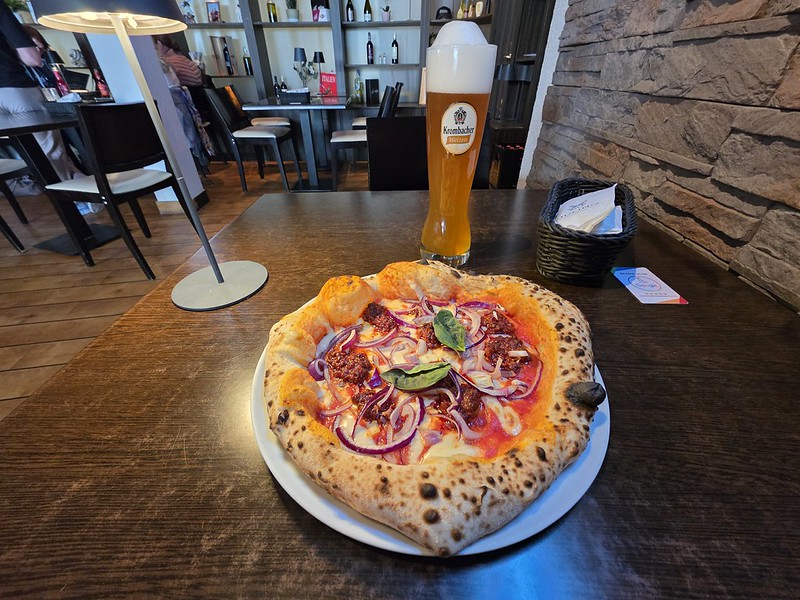
I’m not entirely sure that I made much effort to try local German cuisine, but this independent pizza restaurant is run by two brothers and has excellent online reviews. The restaurant state that all the dough is left to mature for 48 hours and the Neapolitan style pizzas are heated in an authentic oven to 450°C.
The menu options and the service was friendly, personable and efficient. The server, who appeared to be one of the owners, spoke fluent English, Italian and German which is a skill that I never cease to be impressed by.
Firstly, the beer is the Krombacher Weizen, which is a gentle and slightly sweet wheat beer with the expected banana notes.
Onto the food, the ‘nduja pizza was really rather very lovely, the base was light and fluffy, with the toppings being generous and there were plenty of ‘nduja. Cooked perfectly with some leopard spotting, this was suitably decadent. I’m not sure how healthy the whole arrangement is, but there we go, it tasted delicious.
I suspect that reservations are usually helpful here, there were only a couple of non-reserved tables when I visited early on a Friday evening, so I imagine that walk-ins would have been less likely later on during the evening.
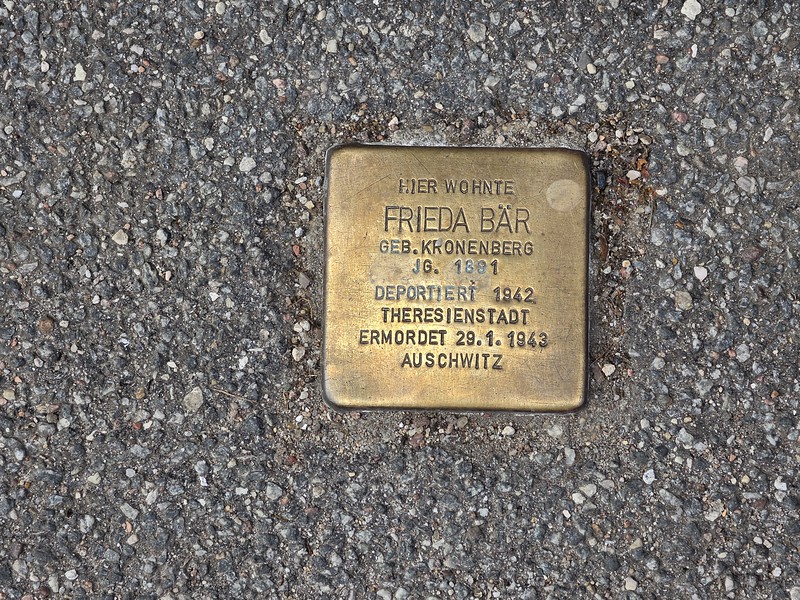
These stolpersteine (stumbling stones) are located all across Europe and there are now over 100,000 of them, mostly in Germany. They mark the last place that an individual chose to live before they were killed or persecuted by the Nazis. This stone was laid on 21 April 2010 at St. Annen-Straße 20.
Frieda Bär (1891-1943) lived here with her husband Selig Semmy Bär, who was born in the city on 14 January 1891. Frieda, nee Kronenberg, had come from Gierhagen in Westphalia and was born on 24 August 1891. In 1935, they moved into a flat together on the first floor at St. Annen-Straße 20 from their previous residence at Königstraße 45.
The Jewish couple avoided the deportation to Riga in December 1941, although soon after this they were forced out of their flat and had to move into the asylum of the Jewish community at St. Annen-Straße 11. There was space at this location because 90 Jews had been sent to Riga and they were nearly all killed. On 14 April 1942, Semmy died at the age of 57 at the house, with the doctor noting that he had a heart weakness and the cause of death was a stroke.
She lived next to the Jewish synagogue, although this was destroyed internally in 1938 during to Kristallnacht. It’s thought that the building wasn’t demolished by the Germans as it was next to St. Anne’s Museum. The building has since been restored and returned to the Jewish community, remaining as a synagogue.
On 19 July 1942, Frieda was sent to Theresienstadt, leaving Hamburg on the following day. On 29 January 1943, she was sent from Theresienstadt to Auschwitz where she died.
I visited St. Anne’s Museum during my day in Lübeck, the area is now middle-class, clean, refined and peaceful. It is difficult to imagine the synagogue being trashed and residents of the street forced out of their homes, ultimately to be killed at concentration camps.
The airport has helpfully signposted the nearest bus stop which is a walk of around 150 metres as the bus doesn’t come into the airport itself. I thought that I could manage that sort of distance.
It might have be handy to pop this bus stop just a little nearer to the airport, but there we go….
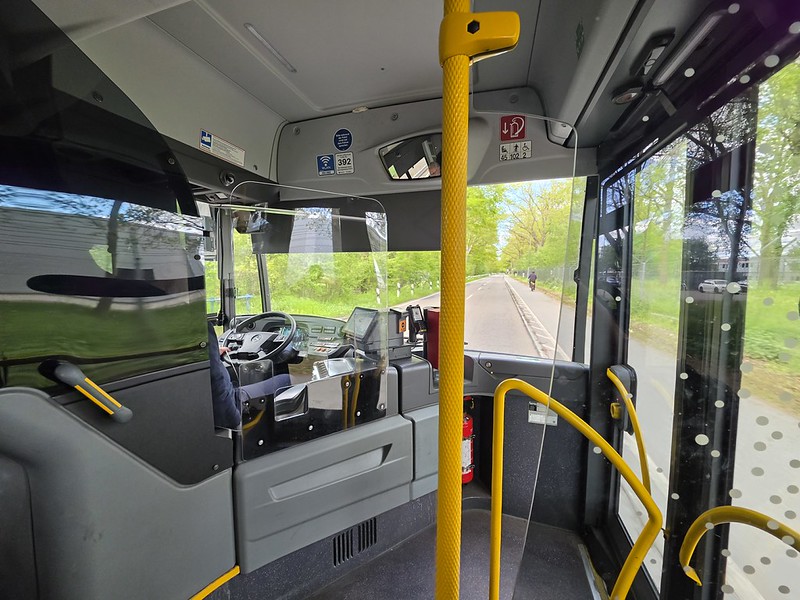
Paying for this bus was not obvious as information online isn’t consistent, which is the main reason for this post. I downloaded the bus company’s app, but they don’t let passengers buy single tickets, they have to be purchased from the driver. It says that drivers may accept cards or notes, which seemed vague to me, but it’s clear that the bus company wants the exact change or for passengers to use season tickets. The bus in the photo is the one going the other way as I was trying to see if they had a card machine.
I’m pleased to note that the driver accepted cards, which was handy as I wasn’t going to be able to be able to pay with cash. A fair number of passengers paid with card, so I assume that it is now a standard thing on the buses in the region.
This maximum number of standing passengers seemed a bit aspirational. I assume they mean that passengers should hold the pole rather than they should be some sort of warlock with a stick.
There’s a bus every thirty minutes during the day from the airport and it takes around thirty minutes to get to Lübeck City Centre.
The entrance to the security area at Stansted looked a little more glamorous than when I was last here. It was also a quick process with staff members that looked buoyant and not entirely worn down by life. The security process here means that liquids and laptops don’t need to be removed from bags, so it’s a bit quicker.
There’s currently no lounge available at Stansted Airport, other than for certain flights, as Escape has closed (and I don’t know what is opening in its place). However, my Priority Pass card gives me £18 to spend at Camden Bar & Kitchen, so I popped there.
I’ve never been upstairs in here before and it was much busier than I had expected, although that’s true for the entire airport. The team members here were particularly friendly and engaging, despite how busy they all seemed to be.
This cost just under the £18 that I had, which seemed slightly expensive, but the quality was high. The toast was soft, the tomatoes and avocado had a richness of taste and the eggs were runny when I cut into them. The latte had some flavour and it was an enjoyable breakfast all round.
Back in the busy main terminal and there was a shortage of seating. I think they must be adding more as the overflow seating area downstairs is currently closed, so I’m hoping that they have a plan.
Rather handily all of the screens had this error message on the left hand side, a little sub-optimal for those wanting to see what gate to head to.
Michael O’Leary, the boss of Ryanair, said this week that passengers shouldn’t be allowed to drink alcohol in the morning at airports. I have some sympathy for him on this, there were more drunken passengers than I’ve noted before, some being quite raucous before boarding. Unfortunately, much of this seemed to be facilitated by JD Wetherspoon and they lost a set of Stella glasses from one group who just took their beers to the gate.
Anyway, there was some certainly some vibrant behaviour from a couple of groups which continued all the way to the gate. It was about a ten minute walk and I wondered why they had so many drunken passengers wanting to get to Lübeck. All became clear here though, the left hand gate lane is for Ibiza, the right hand gate lane is for Lübeck. None of the raucous passengers were going to Lübeck and this felt like something of a relief.
I was the first one to the gate, which was more because the flight was quiet than because I had managed to become quite athletic.
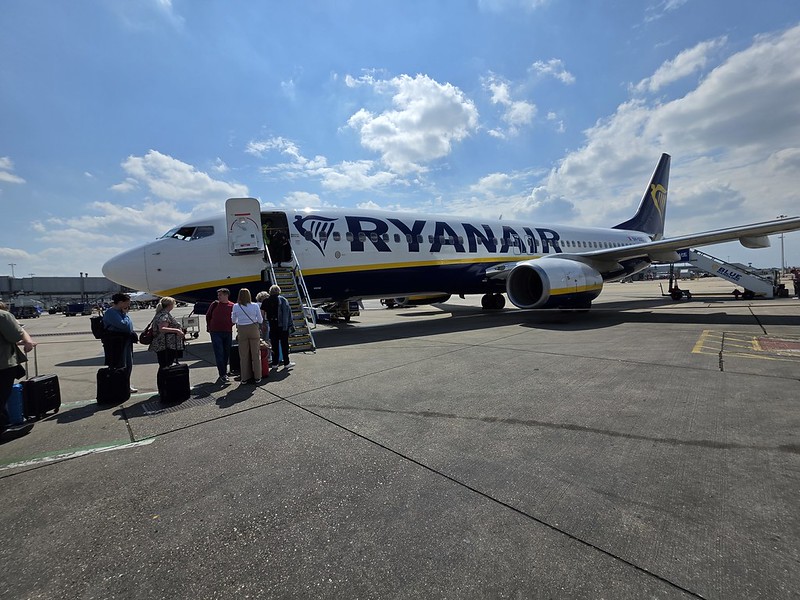
There was then just a short walk to the aircraft.
It’s aircraft 9H-QDD which I don’t think that I’ve been on before, but it’s been part of the Ryanair fleet since 2016. The seating Gods had given me a middle seat, but this was ridiculous as the flight was relatively empty so I had all three seats to myself. I assume Ryanair did that in the hope that I paid extra in advance to move to the window or aisle seat. The crew were friendly and the boarding process was efficient and it felt mostly clean, despite the number of empty cans and bits of paper left from the previous flight. With the quick turnaround, there’s only so much that can be done though.
Just after taking off and Liam and I walked the Stansted Stagger a few months ago which went around the airport, so we must have walked somewhere there.
We flew over Groningen.
And safely into Lübeck with the sun still shining so it was still too hot. The flight was only just over an hour and we landed 25 minutes ahead of schedule, although Ryanair do pad their schedules.
The border control process with the new EES was time consuming and took just under 30 minutes and I was towards the front of the queue. The EU passport queue was dealt with quickly, so for those of us without an EU passport it is all a bit sub-optimal.
The flight was £14.99, so more than my usual £8.99 that I pay with Wizz Air, but it’s cheaper for me to get to Stansted than Luton Airport, so it worked out pretty similar. The flight was efficient, the crew were friendly, the pilots were calm, so I thought that I received a bargain flight.
This won’t be the most riveting of posts as there wasn’t really any drama. But, I had the opportunity to pop overseas for the weekend and that’s not something that I was going to deny myself. That meant a train journey from Norwich to Stansted Airport which was a very reasonable £14 booked on a complex ticketing arrangement.
Waiting at the platform on a sunny Friday morning. It was already too hot.
Here comes the train sweeping in and it was clear that there weren’t that many commuters waiting to go to Cambridge, which meant for a quiet journey in.
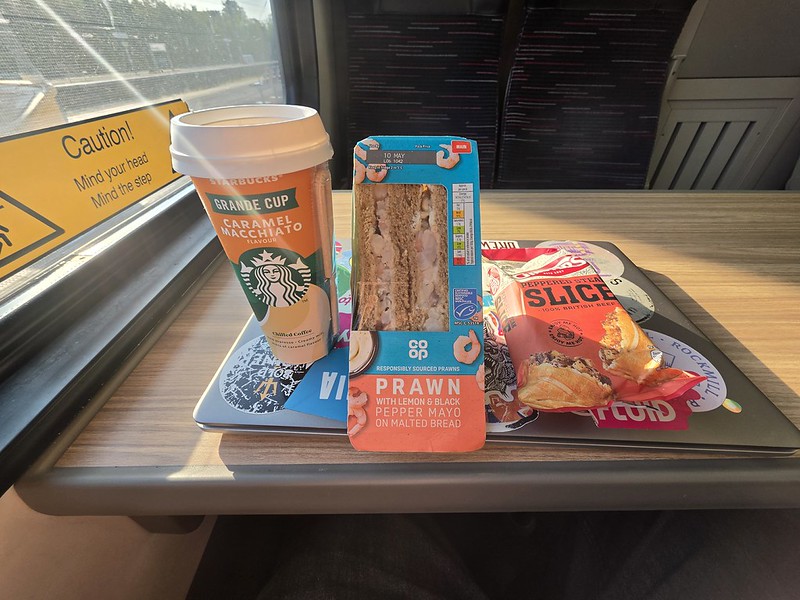
And there’s my meal deal arrangement from the Co-op, very healthy as I’m sure that everyone would agree. Co-op sandwiches are not of the highest quality, the bacon is usually excessively fatty and the chicken has not been lavished with taste, but the prawn sandwich is agreeable enough.
This was my view for most of the journey. Well, specifically I mean the empty seats, I didn’t have my head on the table.
The waiting room at Cambridge railway station where I had a wait for the next train of around thirty minutes. A quick word on my rail ticket which technically required me to get off at Cambridge North and then get onto another operator’s train to take me the short distance to Cambridge. With the guard’s permission, I just stayed on the same train to avoid that change, but it’s that quirky switch to a Great Northern train which is why the ticket was much cheaper than the usual fare even to Cambridge. To be honest, at times it feels that securing agreement for an international treaty would be easier than getting cheap rail fares, the system really is sub-optimal in many ways.
The view over Cambridge railway station from the bridge over the platforms.
The only photo that I have of the second train and it was also relatively quiet. Fortunately, everything was running on time and there were no delays. As a side issue, I note that my bag looks in excellent condition there.
I got muddled up at Stansted Airport railway station and managed to leave the ticket gates at the lift which I’ve never used before. I didn’t expect it to go straight into the terminal, I usually meander around some ramps to get there, so that was some operational efficiency that I hadn’t expected.
With that, I had arrived on time and I could start to think about my flight….
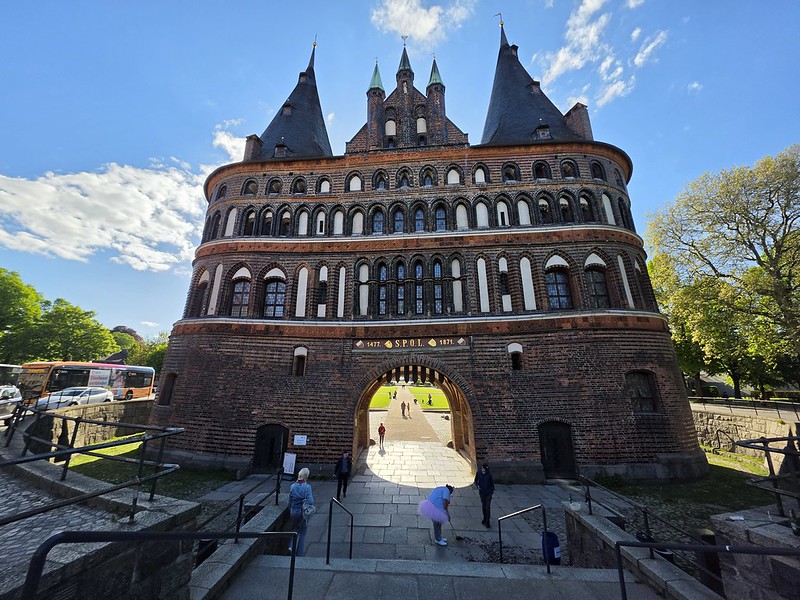
The Holstentor (Holsten Gate) isn’t a subtle little arrangement and it was very much a statement of power as well as defence. Built between 1464 and 1478, it formed part of the western defences of Lübeck, guarding the road in from Holstein and the landward approach to one of northern Europe’s most powerful trading cities. It was part of a wider system of walls, towers, gates and waterways that protected the old town island, but it also worked as a statement of status. Anyone passing through it was being reminded that Lübeck was no ordinary city, but it was the leading force in the Hanseatic League, a merchant republic whose influence reached across the Baltic, the North Sea and deep into the commercial life of medieval Europe.
This is the city side of the gate, with the inscription reading “1477 · S.P.Q.L. · 1871” It looks medieval, but that is a little bit of nineteenth-century theatre which timed rather nicely with the advent of the new German Republic.. The letters S.P.Q.L. were modelled on Rome’s S.P.Q.R. and stand for Senatus Populusque Lubecensis, meaning “the Senate and People of Lübeck”.
The fascinating story for me about this gate, which is now much restored and faffed about with, is how some idiots nearly demolished it in the middle of the nineteenth century. At this time, the Holstentor was in a poor and rather embarrassing condition. It had sunk into the soft ground over the centuries, some of the lower defensive openings were already around half a metre below ground level and the whole structure was leaning and looked like it might collapse. Although I’ve already claimed it was an idiot that wanted it demolished, I can see their concerns here. This wasn’t a delightful medieval monument, it was a falling down large lump of brick inconvenience in the way of the railway line. All rather sub-optimal in very many ways.
Lübeck debated demolishing it for a full decade, from 1853 to 1863. The final decision came on 15 June 1863, when the city’s Bürgerschaft voted by 42 to 41 to keep it, a majority of one. Restoration began that same year and continued through to 1871, after which the gate’s meaning changed. It was no longer treated as a failing lump of obsolete fortification, but as the symbol of Lübeck’s medieval greatness and Hanseatic identity.
This is part of the series of interviews that I’m doing for the 2026 100, there’s lots more information about this event, and previous ones, at https://www.julianwhite.uk/ldwa-100/.
This interview is with Ercole Lugari who is looking forward to entering his first LDWA 100. Madeleine Watson, the national LDWA chair, will likely agree with his comment about tea!
Q. Could you briefly introduce yourself and say how you came to be involved with long-distance walking?
A. I am a seasoned endurance athlete whose running career is defined by remarkable consistency, a deep-rooted passion for community, and a horizon for distance that only continues to expand. My commitment to the sport is reflected in my membership with both my local running club and the prestigious 100 Marathon Club.
My journey began with Collingwood AC in Surrey, a club that was always a staunch supporter of the Winter Tanner, a local LDWA (Long Distance Walkers Association) staple. For me, that event traditionally marked the start of the new running year; I carry fond memories of navigating its great routes and battling through the iconic, heavy mud of the winter trails.
In recent years, those early experiences have come full circle. I have increasingly dedicated myself to LDWA events, embracing the unique challenges of long-distance navigation and the endurance required to push beyond the standard marathon distance.
Q. How many LDWA 100s have you completed before?
A. This will be my first LDWA 100 but I have run other 100 mile races before.
Q. What made you decide to take on this year’s 100 in Kent?
A. I was always want it to be part of it and last year managed to participate in one of the qualify events
Q. How has your training gone so far, and have you done anything differently in preparing for this event?
A. The training has been going well so far. This is part of training for another event called the Spine. The Spine Race is a non-stop, self-sufficient ultra-marathon that traverses the entire 268 miles (431km) of the Pennine Way, from Edale in the Peak District to Kirk Yetholm in the Scottish Borders.
Q. At this stage, how prepared do you feel?
A. I feel ready for the event and looking forward to make some friends on the way too
Q. What are your hopes or aspirations for the event? Is it about finishing, achieving a time, enjoying the route or something else entirely?
A. For me, these events are about more than just the miles; they are an opportunity to enjoy the route, connect with new friends, and utilize a well-organized 100-mile course as vital training for the challenge ahead in June
Q. What are you most looking forward to about the Kent 100?
A. The LDWA “Hundreds” are famous for their unique atmosphere and probably looking forward to seeing the Kent countryside (the “Garden of England”)
Q. Is there any part of the event that makes you nervous, whether that’s the distance, the night section, the weather, navigation, tiredness or something else?
A. Looking forward to explore physical fatigue and to meet deep sleep deprivation But most of it is not that uncertainty is exactly why we sign up, isn’t it?
Q. On a 100-mile walk, what do you think will get you through any difficult moments?
A. A long challenge always bring moment of joy and moments of low. Looking forward to explore both of them as they will present during the challenge
Q. Finally, any particular food or drink that you’re hoping to see on checkpoints that you particularly like?
A. Tea and cake for me are the best food. A cup of tea always makes things better!
Talking to Mira before the main event, she’s given me my favourite quote about the whole arrangement yet, “my mindedness is as bloody as ever” which I find rather inspirational.
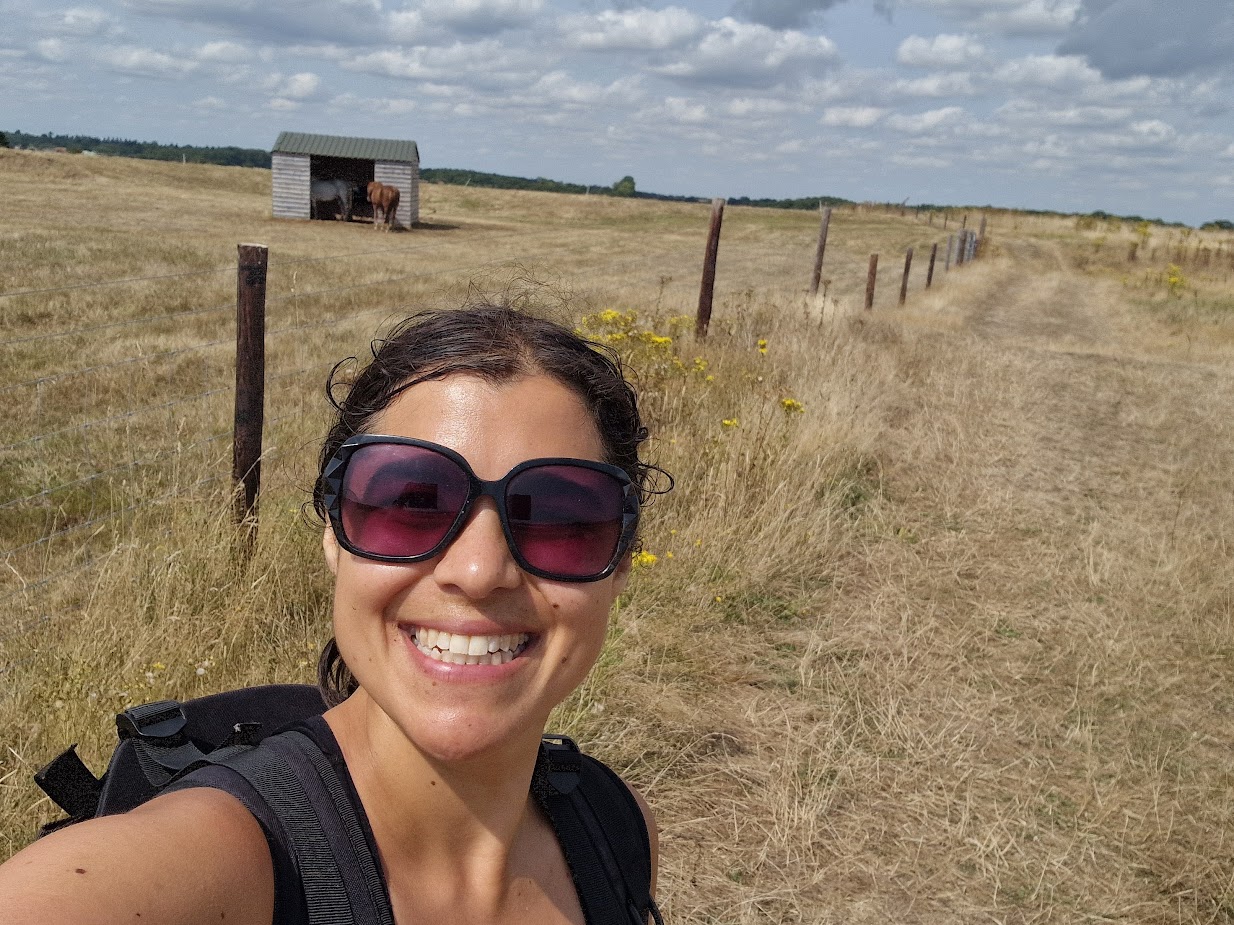
Myself and the media team will catch up with Mira at the event, but here are a few quick questions and answers to get us started. Mira is going to recce some of the route with her friend Paul, part of the LDWA media team, over the next week. And, on the day, she’s planning to complete a park run before the 100 mile walk. That’s determination that is!
Q. How has your training fitted around everyday life this year?
A. I have a very busy life so most of my walking is done locally to me for maximum efficiency around school runs and work. Paul being my best friend and training buddy helps a lot as it means I have someone to do random DIY long walks with locally to me so it’s not all by myself.
I also hate missing parkrun so he and I often design a DIY marathon or long walk that starts with a parkrun and then continues on in that area as a day walk; a couple weeks ago we did Lowestoft parkrun and then walked from Lowestoft along the coastal path and then got the bus back to the car, we like to pack in whatever we can and every walk with Paul is an adventure walk.
Q. What do you think will be the biggest challenge for you personally during the event?
A. The relative hilliness and toughness of this years route relative to the last few years I’ve done 100s, my last comparably tough 100 route was Hadrian in 2019 and I’ve had two children since then so will be taking a lot of vitamins I and P (ibuprofen and paracetamol) I reckon to get round.
Q. How do you manage the mental side of long-distance walking when tiredness starts to take over?
A. The biggest trick I use is to tell myself if I don’t finish the event, anything hard I’ve experienced thus far will be rendered hard for no reason at all. If I complete it, at least my struggle will have had a purpose. Talking a lot of crap with people also helps as a distraction. And having something to look forward to all the time. Like ‘at the next checkpoint I’ll have two cups of tea, or I’ll change my socks’ — I tell myself that thing over and over as I get through a hard section.
I also always tell myself I’m gonna finish which is controversial as most people say ‘well IF I finish it’ll be my Xth 100’ but I always say ‘when I finish’ because I don’t like to tell myself there’s any possibility of not doing it.
Q. What food do you look forward to at checkpoints?
A. Mac n cheese , anything homemade like homemade flapjacks or cake when that appears, crumpets, pizza, little yoghurts.
Q. What would make this year’s LDWA 100 feel like a success for you?
A. As always, getting it done. That’s the only important thing. Everything else is out of your control.
Q. If someone was standing at the start of their first 100 and feeling nervous, what would you say to them?
A. That it’s all in the mind so as long as they keep telling themselves to keep going and take the rest they need at checkpoints, they’ll get round. Never put speed over comfort or else you may risk wearing yourself out.
With two of our regular team unable to make this week, we had a little bit of excitement to get a team together tonight for this third match. However, we were able to get six players together and the rest of the team spent the early evening practising whilst I focused on finding the best pairing of beer and bar snacks. I went for 0% Guinness and Squares, quite a classy little combination.
Look at the contemplation from Cal before the other team arrived…… We were in the zone. Well, I was eating crisps and was pre-stressed, but the others were more positive.
We have some dramatic photos of me in this post thanks to Cal, who was helpfully documenting matters. Here’s myself and my very capable vice-captain Luke as we did the draw. Thanks to Cal for the clipboard and for the printing as the not quite as capable team captain managed to forget to bring a score-sheet.
And here’s the draw.
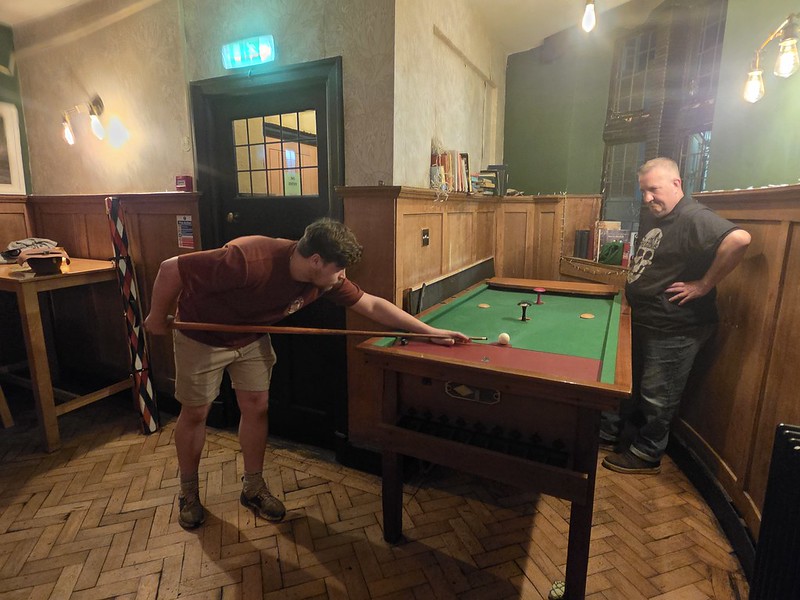
I thought that I’d referee the first game which was with the first time league player Cal as I try to be helpful.
We had a lot of interesting table layouts during the evening. I didn’t doubt that Cal was good, but he was very calm and collected with an entirely competent performance. It transpired that his score was the highest singles score of the evening, so I’ve decided that we’ll keep him.
I felt that Cal’s victory meant that I should reward myself with more Squares. Leadership takes many forms.
The next game was with Vaughan and once again I was ignored when I said that I didn’t want any games going to the final ball as they’re too stressful for me. He won the game by just ten points on the final ball…..
PJ’s game went the same way, but the final ball result went our way, which meant that we were 3-0 ahead and I could put us 4-0 up if I was any bloody good.
Thanks to Cal, there are the occasional photos of me playing in this post. I don’t wish to talk about my game though. OK, perhaps I should…. It was very close throughout, but my opponent was very strong at the end and I lost by 990 points to 850. My usual strategy is to try and score 1,000 points and that would have been dead handy here. Had I scored another 150 points, the result would have been completely different. I intend to apply this insight to all my future sporting disappointments.
Cal getting ready to serve the meal of snacks. I had ensured that this was served after my game as I wanted something to look forwards to and to settle my nerves.
Hmmmm, Taytos…. Next up was Gabriel, who insisted on getting to the final shot despite it being made very clear by Luke and myself that this is very stressful for us. Gabriel didn’t make this one, but his game was solid and he was very close.
The final player in the singles was Luke and the game was again very close throughout, he lost by just 40 points. This all meant that we had gone from 3-0 ahead to 3-3, so thoughts of the Black Stars last week came to mind…
Gabriel started to teach various players some hand gestures, but I didn’t get involved with that. Whatever he was actually doing remains unclear to me and I doubt whether any of it is recognised by Sport England.
And then there were three games in the doubles. PJ and Cal surged to nearly 900 ahead, but then the brave players on the other team clawed it right back. But, PJ and Cal triumphed meaning that Luke and I could win the whole game if we just won our game. We didn’t, which made it 4-4 and which put all the pressure on Vaughan and Gabriel. Suddenly the room had the atmosphere of a courtroom waiting for a verdict, except with better crisps. But they surprised and delighted the Artichoke Hearts with a win, a punchy performance which once again went down to the final ball.
A very hard won set of games, but full credit to the Coach and Horses team for not only some very close games but also being a marvellous group of people. There is a real pleasure in playing a team who are both good company and good players, even if it does make winning rather harder than I personally prefer. Cal’s first league appearance was alarmingly competent, which is always a little unsettling when given that my strategy is to build a team culture around anxious improvisation.
I have a new rule that every time the team wins, I go to the King’s Head to celebrate. With no Julian sr, as he’s in Liverpool, it was Cal who was called upon to escort me to the pub. A more professional athlete might have gone home, stretched and hydrated, but I went to the pub and declared the evening a success, which is broadly the same thing. We only went for one, although I got muddled up and we stayed until the pub closed. This wasn’t my fault though, these things happen when a strict sporting recovery protocol is not properly supervised.
And I’d like to note that it’s a fine team, a great atmosphere throughout and it’s all very exciting. And stressful when every game goes down to the wire. Next game is in Coltishall in two weeks and I’ll pretend that everything is under control.
I’m enjoying this. Although I won’t show that of course.
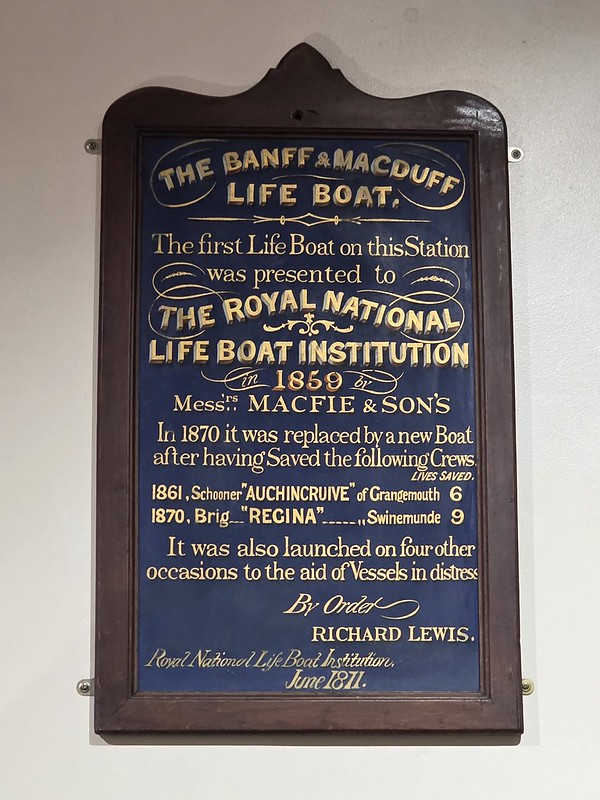
This board is at the RNLI Historic Lifeboat Collection at Chatham and it records the first lifeboat at the Banff and Macduff station. The lifeboat was presented to the Royal National Lifeboat Institution in 1859 by Messrs Macfie & Sons, before being replaced by a new boat in 1870.
In that relatively short service it helped save the crews of the schooner Auchincruive of Grangemouth in 1861 and the brig Regina of Swinemünde (now Świnoujście in Poland) in 1870, rescuing fifteen men in total, as well as being launched on four other occasions to assist vessels in distress.
What rather interested me is why this particular board was at Chatham, but the lifeboat station was closed in 1924 and so this was likely placed in safe storage. There had been problems finding crew during the First World War, so the lifeboat station had been temporarily closed in 1917, but continued crewing difficulties made the closure permanent.
Richard Lewis (1822-1883) was the Secretary of the RNLI between 1850 and 1883, credited with turning around the fortunes of a then depleted and financially deprived organisation into a world class search and rescue service.
I’m pleased that someone with some initiative ensured that this board was kept, so much is just thrown into skips and the heritage lost forever.