Author: admin

  • Dictionary of the Vulgar Tongue – Day 221

    Dictionary of the Vulgar Tongue – Day 221

    The Dictionary of the Vulgar Tongue was first published at the end of the eighteenth century, and given that the current health crisis is giving too much time to read books, I thought I’d pick a daily word from it until I got bored….

    Nicknackatory

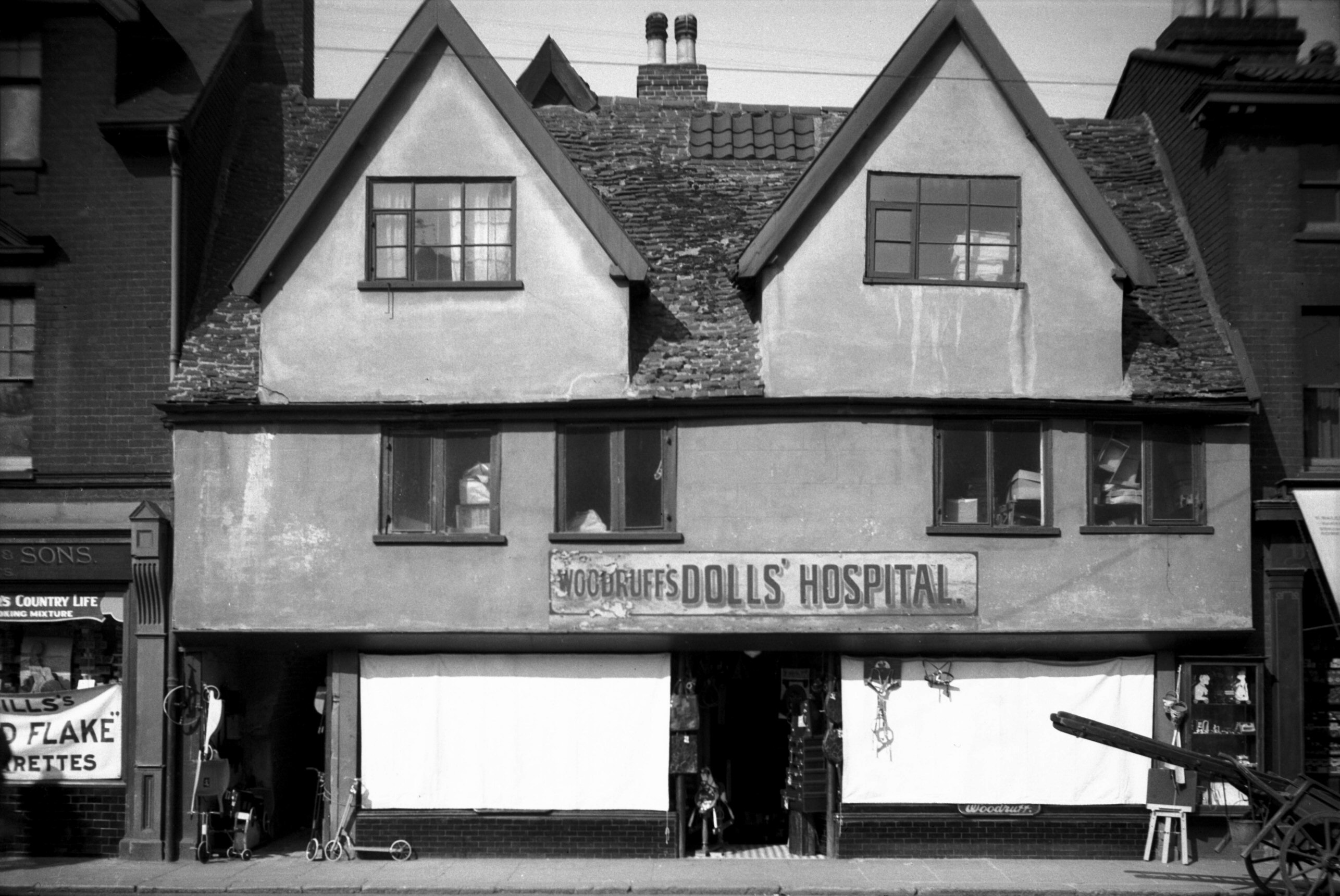
    I think that this is one of the more beautiful words in Grose’s dictionary, it’s defined simply as “a toyshop”. It’s derived from the phrase ‘knick-knack’ which originally meant a trick, but then evolved to mean something without much actual function. This meant that toys were seen as knick-knacks, hence why this became an alternative name for toyshops in the late eighteenth century.

    The phrase lingered on until the early nineteenth century, but then, unfortunately, fell out of usage.

  • Scottow – Scottow Cemetery (Otto Walter Kanturek)

    Scottow – Scottow Cemetery (Otto Walter Kanturek)

    This is a rather unusual gravestone, or at least the inscription element of it, at Scottow Cemetery. Otto Walter Kanturek was born in 1897 in Czechoslovakia and worked as a film-maker in Germany and the United States, specialising in aerial photography during the early years of the Second World War.

    Otto was at RAF Coltishall as he was filming some scenes of aircraft for the film A Yank in the R.A.F. which was being produced by Twentieth Century-Fox Film Studios. One of the shots they were trying to film was in the air, with Otto in one plane filming two Hurricane planes that would fly by. Unfortunately, one of the Hurricane aircraft crashed into the plane which Otto was in, and although the pilot was able to eject to safety, everyone else was killed.

    The sad incident was reported in the press at the time, also noting that Jack Parry, another videographer, was killed in the incident. It was mentioned in the media of the time that Otto had been the cameraman to all of the Gracie Fields films which had been made in the UK. This story was also featured by the BBC Inside Out television programme in 2006, who were able to interview one of his colleagues, Bryan Langley (then aged 97), who said:

    “If it wasn’t for Otto, I wouldn’t have been a Director of Photography for many years. He helped me with my career, a wonderful man”.

  • London – Hammersmith and Fulham (Borough of) – Hammersmith Bridge

    London – Hammersmith and Fulham (Borough of) – Hammersmith Bridge

    This is from my visit to London a couple of weeks ago and there’s something of a debacle about this whole Hammersmith Bridge arrangement. The bridge was first constructed here in 1827 and was paid for by tolls, with these charges finally being removed in 1880. All looked rather well for the local denizens, they had their bridge and they didn’t have to pay to use it. So, all rather lovely.

    Anyway, then a boat ran into the bridge in 1882, so it was thought that it had better be replaced. Joseph Bazalgette, best known for his construction of the London sewers, designed a new bridge and this sat on the same pillars as the previous structure.

    The bridge has struggled to cope with the weight of traffic placed on it throughout the twentieth century, it was never designed to deal with such volumes. It also hasn’t helped that the IRA have tried to blow it up in 1939, 1996 and 2000, all of which hardly helped with the structural integrity of the bridge.

    In 2014, the bridge was temporarily shut to motor traffic because of concerns about the safety of the structure, with this temporary closure effectively becoming permanent. A single bus was allowed to go over at any one time, but then Transport for London decided to remove its staff who were monitoring this, before an agreement was made. There has been a lot of arguing between Transport for London and the local council about this whole matter and who is paying for what, which seems to be the real reason for the delay. Cyclists and pedestrians were allowed to keep using the bridge, but then on 13 August 2020, this was then banned as well.

    The Government announced it was going to come up with a solution, but to cut a long story short, it announced that motor vehicles won’t be returning until at least 2027. I’m not sure how it takes that long to fix a bridge, but then I’m not a civil engineer…..

  • Norwich – Rosary Cemetery (Emma Jane Sendall + Herbert Sendall)

    Norwich – Rosary Cemetery (Emma Jane Sendall + Herbert Sendall)

    Since I’ve been grounded again by the Government, I thought I’d meander around the Rosary Cemetery located near to me in Norwich, in an attempt to see what stories lie there. It might not be the most fascinating blog content, but it’ll keep me quiet for a few weeks….

    This grave tells a story immediately, the death of a mother aged just 21, with her baby dying shortly afterwards at just a few months old. It commemorates the life of Emma Jane Sendall, born as Emma Abel and baptised on 27 July 1851. She was the daughter of James and Martha Abel of the Cranworth with Letton parish and she had a sister.

    At the age of 9, she was listed on the 1861 census as living at Gressenhall, as a pauper in a workhouse. She was with her father and sister, with her father being an agricultural labourer. That children were living in workhouses was ridiculous, but she was there just too early, as it wasn’t until the late 1860s that Thomas Barnardo started to open homes for impoverished children to live.

    This couldn’t have been a pleasant life for Emma Jane, but by the time of the 1871 census, she was living at Hammond’s Yard with her grandparents and sister, back in Cranworth, near to Mitford.

    In the late 1860s, a man called James Sendell married a local lady in Mitford, and I wonder whether Emma Jane somehow met his brother at that time, Arthur Sendall (born in around 1847). She married him in 1872 and perhaps this was looking like a new start for Emma Jane, something a little more positive. She had a child with Arthur in early 1873, named Herbert Sendall. Unfortunately, Emma Jane died in April 1873 and her only child died on 11 June 1873, with both being buried in the same grave.

    It’s perhaps possible to think of Arthur standing by this grave, mourning the loss of his wife, with perhaps their child also present. And then Arthur would have been back just weeks later, to bury their child. There was never much chance of any information being available about Emma Jane given that she spent much of her life as a pauper. And she would have likely remained anonymous, had it not been for her marrying Arthur, who seemed to have had at least a little money so that he could pay for a gravestone.

  • Rail Magazine and the Amtrak Pacific Surfliner

    Rail Magazine and the Amtrak Pacific Surfliner

    A letter from the Rail magazine issue of 18 November 2020 which is very hard to disagree with…. I’ve travelled that same journey from Los Angeles to San Diego, and the views are incredible as the train is effectively going merrily along the beach in places. But, landscapes aside, the Amtrak trains are spacious, better proportioned and there’s a more coherent set of snacks and meal options on board. But, there’s something rather lovely that guards welcome customers on board, they often seat them and remind me before their stop. I don’t mind the seats on the GWR trains, but these services have annoyed me with their insufficient staffing and seating on board (before the current restrictions were introduced).

    The rather beautiful train in San Juan Capistrano last year when I went back to Los Angeles…

    Anyway, perhaps it’s time that the next iteration of the railways in the UK is more like Amtrak. Amtrak needs new funding and expansion of its own, but at least it’s beautifully comfortable on board. Perhaps Amtrak Joe (the nickname of the new US President) might get going with providing funding to allow the reconnection of the Amtrak Sunset Limited line from Orlando to Los Angeles, which has been forced to start (or end, depending what direction you’re going in) from New Orleans since 2005 due to Hurricane Katrina.

    I do miss American trains…..

  • Dictionary of the Vulgar Tongue – Day 220

    Dictionary of the Vulgar Tongue – Day 220

    The Dictionary of the Vulgar Tongue was first published at the end of the eighteenth century, and given that the current health crisis is giving too much time to read books, I thought I’d pick a daily word from it until I got bored….

    Neck Verse

    This phrase is defined by Grose as “formerly the persons claiming the benefit of clergy were obliged to read a verse in a Latin manuscript psalter: this saving them from the gallows, was termed their neck verse: it was the first verse of the fiftyfirst psalm, Miserere mei,&c”. Firstly, as an aside, &c is the archaic version of etc, which I found interesting in its own right. I do need, as I may have mentioned, to get out more….

    This whole concept is fascinating, dating back to the times of when the two great powers in the country were the Church and the Monarchy. Both had their own legal systems, their own lands, their own powers and the Church didn’t like interference from Monarchs, and Kings and Queens were generally respectful of God. But, anyway, to cut a long story short, clergy could be tried in the secular courts, but they could also claim the ‘benefit of the clergy’.

    This claim allowed them to either get off the crime, or for the sentence to be modified (in effect, initially the case was transferred to the Ecclesiastical Courts which were more favourable), but it was also abused. So, the aim was to read Psalm 51, which Grose mentions, to prove that they were a member of the clergy. There were some big flaws in this system, notably that non religious figures could just learn the passage. The courts over time wised up to this, so they could ask the defendant to read another passage from the Bible, a useful mechanism as the clergy could read and write, whereas many others at the time couldn’t. If someone couldn’t read a passage, they could be killed or sentenced as planned.

    King Henry VIII didn’t like this whole set-up (there are plenty of things he didn’t quite like), although he did still respect the principles of the code, although he added more restrictions and limitations. The whole process lingered for longer than might be expected (well, longer than I had expected), although by the eighteenth century, the cases were no longer transferred to the Ecclesiastical Courts and were just treated more leniently in the secular courts.

    So, when Grose wrote about the “neck verse”, the law still favoured anyone at that time who could read that verse from the Bible and it could save their life. The matter was finally dealt with in 1823, and reinforced in 1841, so that this ‘benefit’ was struck from the legal code in the country. It’s a wonderful example of how power waxed and waned between the church and the monarch though over the centuries, and just how long the church’s influence lasted for.

  • Norwich – Rosary Cemetery (Thomas Swindell)

    Norwich – Rosary Cemetery (Thomas Swindell)

    Since I’ve been grounded again by the Government, I thought I’d meander around the Rosary Cemetery located near to me in Norwich, in an attempt to see what stories lie there. It might not be the most fascinating blog content, but it’ll keep me quiet for a few weeks….

    This grave commemorates the lives of three people, Hannah Swindell, her husband Thomas Swindell and his second wife, Caroline Swindell.

    Thomas Swindell was born on 1 February 1815 and was baptised at the Baptist Church in Knutsford on 26 February 1815. He was the son of Thomas and Elizabeth Swindell and he married Hannah Witter on 4 February 1843. They had five children, which I’ve listed on the post I wrote about Hannah, with Thomas working as a Primitive Methodist Minister.

    There’s a mass of material on Thomas, not least that provided at https://www.myprimitivemethodists.org.uk/content/people-2/primitive_methodist_ministers/s-2/thomas_swindell where there’s a photo of him. There’s no point my copying material over from that very useful site (which also has information about his son, Theophilus Witter Swindell who became an important figure in Great Yarmouth), but it’s of note that he travelled around the country with his preaching, including Preston, Bolton, Wrexham, Great Yarmouth, Docking, Upwell, Aylsham, Swaffham, Cambridge, Thetford and ending up in Norwich in 1875.

    At the 1871 census, Thomas was living on Arnold Street in Lowestoft, along with his wife Hannah and three of their children. He had moved to Norwich in the 1870s to live at Bloomsbury Place, before moving to Essex Street in Norwich by the 1881 census, when he lived with his son Arthur Swindell (by then a Professor of Music) and his second wife, Caroline Swindell. Hannah had died on 23 January 1876, with Thomas marrying Caroline Simpson (1828-1899) in the summer of 1878.

    By the time of the 1891 census, Thomas was living with Caroline at a property on Grove Road in Norwich. He was still living at this residence when he died, on 8 November 1897. Caroline was to die a couple of years later, but I can sort of picture her at Rosary Cemetery at what was likely a well attended funeral given the size of Thomas’s family and his reputation in the Methodist Church.

  • Norwich – Rosary Cemetery (Hannah Swindell)

    Norwich – Rosary Cemetery (Hannah Swindell)

    Since I’ve been grounded again by the Government, I thought I’d meander around the Rosary Cemetery located near to me in Norwich, in an attempt to see what stories lie there. It might not be the most fascinating blog content, but it’ll keep me quiet for a few weeks….

    This gravestone, which is leaning forwards hence the slightly strange camera angle, commemorates the life of Hannah Swindell. It’s in rather good condition, other than where the weeds have attacked the base, and also commemorates Hannah’s husband, the Reverend Thomas Swindell and his second wife, Caroline Swindell. More on these two other individuals in separate posts, as I find it a little unusual that they’re all on one grave.

    Hannah was born on 20 March 1819, the daughter of Thomas Witter and Mary Witter. She was baptised at the Baptist Church in Knutsford on 25 April 1819 and she met her husband Thomas Swindell and they were married on 4 February 1843 in the same church (I mean the same church she was baptised in, obviously the husband and wife were married in the same church….).

    Hannah and Thomas had five children, Mary, Thomas, Theophilus (a marvellous name), Frederic and Arthur. Hannah died on 23 January 1876, at the age of 56. The inscription on her grave reads “she was a Christian of unblemished reputation, considerable usefulness and eminent piety, and now sleeps in Jesus till the morning without clouds shall dawn”.

    There’s one thing that’s evident here, which is that there is reams of material on Thomas Swindell, her husband, and his work and contribution to society. There’s nearly nothing relating to Hannah, so I’d say that in terms of who she was as a person, the best we have to go on is that inscription on her gravestone and that she seems rather dutiful. Thomas travelled extensively during his career, and perhaps that “usefulness” was in supporting him with his work. Too often women are a footnote in history, and that’s happened here as well, so hopefully I’ll find out at some point in the future some more information about her as a person. Indeed, I’m quite intrigued as to what she would have thought about Thomas’s second wife being added to her headstone.

  • Dictionary of the Vulgar Tongue – Day 219

    Dictionary of the Vulgar Tongue – Day 219

    The Dictionary of the Vulgar Tongue was first published at the end of the eighteenth century, and given that the current health crisis is giving too much time to read books, I thought I’d pick a daily word from it until I got bored….

    Neck Stamper

    This is defined by Grose as “the boy who collects the pots belonging to an alehouse, sent out with beer to private houses”. The phrase dates from the early part of the seventeenth century, but the word origins are confused, it’s not known whether the boy stamped about with bottles around his neck or whether the boy stamped about carrying bottles by their neck (I can think of someone who would do that, stamped is a variant of stomped). It’s also interesting to establish why this job was necessary, who were these boys delivering to? There would have been no end of pubs near to where people lived, so maybe it was to the ill, infirm or those who didn’t fancy heading off into a busy pub.

  • Bologna – Asinelli (Photos from the Top)

    Bologna – Asinelli (Photos from the Top)

    I’ve posted about my bravery climbing this thing in another post….

    Here are some photos of the views…..