Author: admin

  • LDWA 100 – Training Walk 11

    LDWA 100 – Training Walk 11

    This was our eleventh walk in preparation for the 2021 LDWA 100.


    WALK NUMBER: 11 (Faffing about near Surlingham)

    DISTANCE COVERED: 17.8 miles

    NUMBER OF NATHAN’S FRIENDS WE “ACCIDENTALLY” BUMP INTO: 3

    SUFFICIENT BEER CONSUMED: No (all the pubs are shut)

    PUBS VISITED: 0 (not through choice)

    WEATHER CONDITIONS: Moist

    ATTACKED BY ANIMALS: No

    NUMBER OF SNAKES SEEN: 0


    We didn’t set out today with any particular route in mind, but we did want to walk some of the Wherryman’s Way, which will be the first half of the path we’re taking on our actual LDWA 100 effort. So, that’s where we started and since I didn’t take any food along with me, we couldn’t go anywhere too rural for the entire day.

    Nathan pointed this building out, which we’ve walked by many times, and I realised that I didn’t have a clue what it was. I’m not an urban explorer, as I’m not brave enough, but, fortunately, someone has done that already and taken photos of what’s there.

    Here’s a map from around a century ago, showing at the time that the site was the Norwich Corporation’s sewage works. The buildings were constructed between 1865 and 1871 under the supervision of Joseph Bazalgette, best known for his work on sewage systems in London. They’ve now been superseded by Whitlingham Sewage Works, but the buildings remain and are in a decent condition.

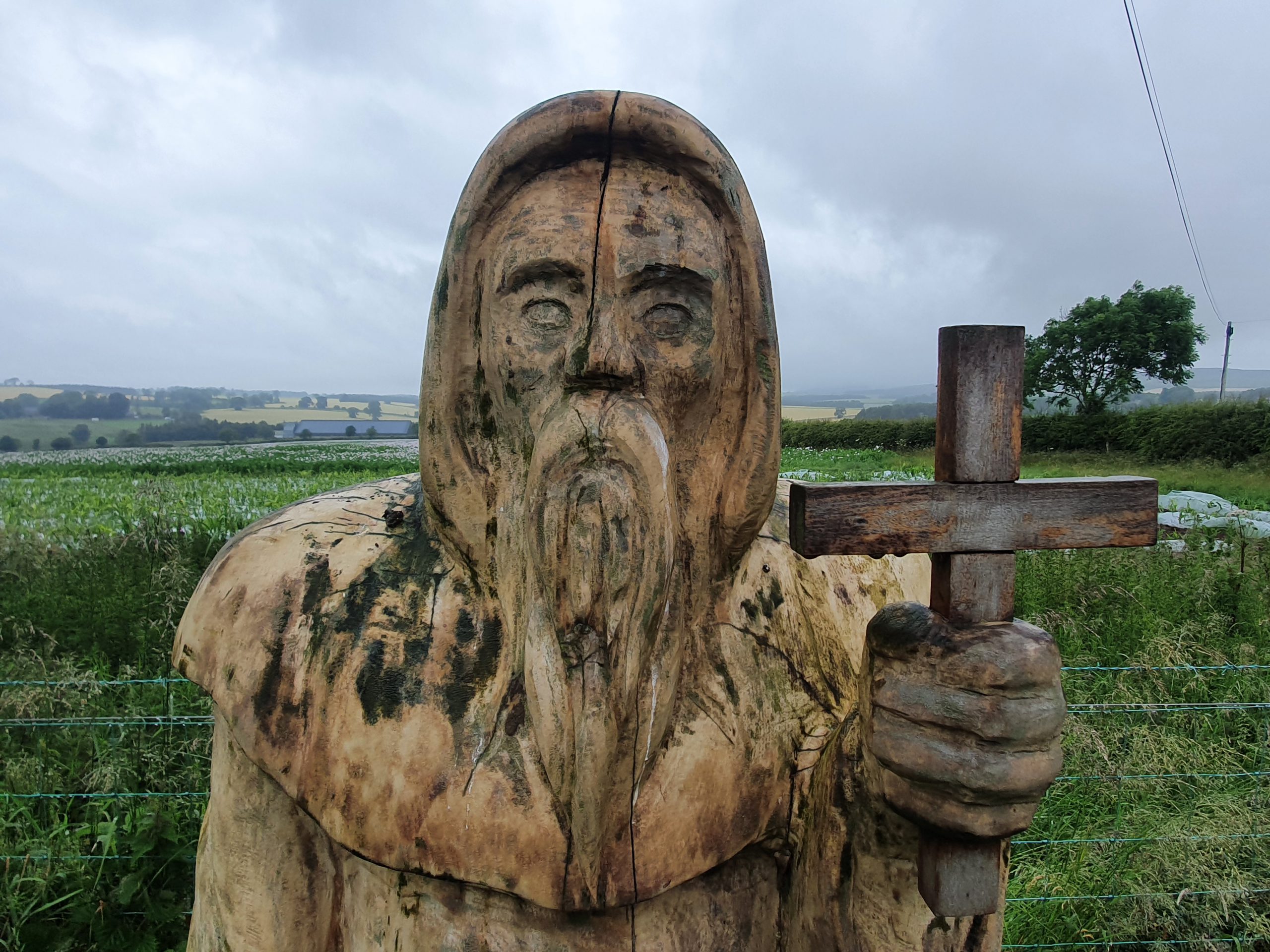
    One of the wooden sculptures at Whitlingham Lake.

    We set off along Wherryman’s Way walking along the river and this is Woods End. It started to rain quite hard during this time, so this wasn’t looking like the more ideal of days for meandering around, but it stopped after about an hour and didn’t return. Perhaps quite usefully, the route wasn’t at all busy and we didn’t see that many people during the entire day.

    It has been a wet few months and much of the area was either flooded or quite damp.

    Well, and quite muddy as well.

    We had a little meander around St. Mary’s Church in Surlingham.

    When we were walking down the road a local resident mentioned that there was quite a flood up ahead. Always hunting for some form of adventure (OK, it’s true that walking down a flooded road isn’t that adventurous, but we are a bit limited at the moment) we thought this sounded more exciting than off-putting.

    I had my phone ready to capture anyone (and I won’t name names) who might have slipped over into the water and although that didn’t happen, this is how moist the area was. It’s certainly not ideal.

    After Nathan had climbed over the stile I helpfully said the words “bull in field” just to warn him of the potential danger. He interpreted that as my having seen a bull in the field, and I was impressed at how fast he was able to return. It shows what excellent reactions he has, which will prove useful in the event of a snake attack during the warmer months when adders and grass snakes flood into the area.

    Mud, which was really rather quite slippy. Not ideal. There were also numerous fields like this where the line of the public footpath isn’t marked out even in the most basic of forms.

    Walking past the solar farm at Yelverton, fiercely opposed by many residents when it was announced in 2014, but it certainly makes an impression of the landscape as it’s a pretty huge site.

    The Old Water Tower on Framingham Earl Lane, which appears to have been converted into a residential property given the letter box arrangement.

    We did think about getting chips, but the excitement of a One Stop meal deal proved just too much to turn down. We were quite impressed at the efforts made by One Stop to offer a selection of craft beer and although we didn’t get any today, there’s definitely a tide turning where shops are focusing more on decent beers and less on other alcoholic drinks and generic lagers.

    We had a choice of two routes back from Arminghall into the city, and we perhaps chose the wrong one as this one was rather muddier than we expected. But, neither of us complained….. Well, not for long anyway.

    This is the sand and gravel quarry near to Trowse, which is one hell of a hole in the ground now. I’m hoping that they turn this into some water park arrangement when they’ve finished their digging, perhaps with a Greggs and decent pub there as well to serve visitors.

    The collections box on Boudicca Way, which has some random pottery which has been found in the field and some feathers…..

    A horse which stared at me in what I thought was quite a disdainful manner. I think I need to get out more….

    And back into Norwich, this is one of the warehouses beside the River Wensum which I suspect will be transformed by property developers over the next couple of decades. It took us some time to get back into the city centre as we had to keep stopping so Nathan could talk to his friends that we kept bumping into. We had a variety of people on this one, including work colleagues and a former teacher…..

    In terms of the walk itself, it was only 18 miles and that’s obviously a long way short of the 100 miles LDWA challenge that we’re planning. But, there were no problems during the way and so it was useful to get some distance in given the current limitations that we have. We had hoped to walk Wherryman’s Way in its entirety again, but we can’t use public transport to get to Great Yarmouth at the moment, although hopefully that might change.

    As for the write-up of today, that’s the best I can do with the route we chose, which was quite a lot of wet footpaths and river banks and it’s territory that we’ve walked along before. It’s still what I’d call a training walk though, so I didn’t want it to pass by without making at least a brief reference to it.

  • Surlingham – St. Mary’s Church

    Surlingham – St. Mary’s Church

    This is St. Mary’s Church in Surlingham, located a short walk away from the River Yare. The church sits on slightly higher ground in a bid to protect it from the nearby marshes, something evident when we were walking through them to get here. George Plunkett has a photo of the church from 1978 which was taken in around the same place as above, although little has changed in that time.

    There is a nearby ruined church, St. Saviour’s, which was constructed in the twelfth century but which became redundant in the early eighteenth century.

    The round tower is Norman at the base, with the octagonal top dating from the fourteenth century. Much of the current nave is also fourteenth century, with the north aisle having been added in the fifteenth century.

    There are numerous patches of repair on the tower, mostly using this tiled style to fill in the gaps. I’m unsure why such a different looking material was chosen in the repairs, although it gives the tower a rather memorable look. As is noticeable on photo further down this post, the tower was once covered in ivy and that might have meant repairs were less noticeable.

    The stair turret on the tower.

    The chancel dates from the eighteenth century and was made from brick, giving quite a contrasting look to the church. Although I’m not sure how comprehensive the repairs were, as there was an appeal made in 1831 to secure funds to pay for a new church roof and advertisements were placed in the Norwich Mercury to find carpenters and bricklayers.

    This photo is from the beginning of the twentieth century, and both graves leaning against the end of the chancel wall are still there, although a few others seem to have disappeared. The church tower is fortunate not to have that much ivy still attached to it.

    The other side of the chancel is built in old stone, seemingly solely with the intention of giving it an older appearance. I’m unsure where that stone has come from, but I suspect that its been taken from another old building at some point.

    The end of the chancel, it’s all quite a clean design, but perhaps not breathtakingly beautiful.

    A rather beautiful carved stone font inside the church and it probably dates to the fourteenth century.

    Looking down the nave of the church into the chancel, where there’s evidence of where the rood screen stairs were located.

    Looking back down the nave towards the organ loft, I thought that everything was nicely proportioned and all seemed calm. It was possible to peer inside the tower and I’m not normally that interested in church bells, but this church has two which were cast in 1381 and that’s a pretty impressive survival……

    I liked that the church was open during this difficult times and although there are bits of Victorian repair which are readily visible, there’s lots of history to the building which hasn’t been swept away. It’s another of those churches where I suspect the parishioners from the late sixteenth century would have found relatively little had changed over the centuries, although they might have wondered where their box pews had disappeared to. These were removed in 1888 and the local press noted that there were now more open and airy pews, although I love the character that box pews have.

  • Saloon Bars and Public Bars

    Saloon Bars and Public Bars

    This article was published fifty years ago today in the Birmingham Post and there’s an element of this being a watershed in the evolution of British pubs. The distinction between the public bar and the lounge (or saloon bar) was being removed and women were being encouraged to visit pubs, although there was some considerable way to go on that at the time. It meant that prices were being standardised across the two areas of the pub, and being realistic, that usually meant a price increase.

    John Gilbert, the Labour MP for Dudley, wasn’t best pleased by all accounts, saying:

    “Some people are being forced to drink in places more like ladies’ boudoirs, when all they want is to drink a man’s drink in a man’s bar”.

    He commented on the influx of plush furnishings, carpets, colour TVs and jukeboxes, suggesting that this was forcing up prices. And fair play on this, a decent pub even fifty years on doesn’t need plush furnishings or carpets, and it certainly doesn’t need a colour TV or jukebox. Gilbert also described himself as “modest drinker”, which is a phrase that I’d use about myself, he sounds a rather measured man.

    I quite like the response from Watney Mann, who the article noted owned 6,500 pubs:

    “There would be no point in a pub on Park Lane having a public bar, but down by the docks it would be a necessity”.

    As an aside, Watney Mann were the brewery who produced Red Barrel, not a product that would ever be called a craft beer, let’s say that. Indeed, they were probably pushing it calling it a beer and there’s an interesting article elsewhere about that. But without breweries such as this, maybe there wouldn’t have been a CAMRA…..

    So, perhaps there’s something about the democratisation of the pub here, the removal of the class barriers between the different sections of the pub. I’ve seen articles written about how locals would ensconce themselves in the public bar, meaning that visitors would be encouraged to use the lounge bar. And that wouldn’t play well with how pubs are marketing themselves today, which is to a wider audience and not just to a small bunch of locals.

    I normally rail against change, especially when pubs, railways or crisps are concerned. But here, I think the right decision was made, a pub for the many, not the few…. As for John Gilbert, he was probably right that pubs didn’t need this wave of plush furnishings and maybe chains like Greene King even today could focus more on the beer than their pub interiors, but I’m not convinced that every pub needed a public bar. And the Government agreed, the letter that Gilbert sent to the then Home Secretary Reg Maudling was in vain, the dual bar set-up was coming to an end.

  • Carleton St Peter – St. Peter’s Church

    Carleton St Peter – St. Peter’s Church

    This is a remote little church in Carleton St Peter and this is the track which reaches it from the road. The parish is small with just a handful of properties, although there is evidence of prehistoric, Roman and medieval activity in the area. It seems that the villagers have just moved away since the medieval period, which makes the survival of this church all the more remarkable.

    Although there was a church here in late Saxon times, the currently building primarily dates from the thirteenth and fourteenth centuries, with numerous later additions. There are some early Norman features in the building, namely some lancet windows, which have likely been kept from the earlier structure and built into the fabric of the current church.

    An older infilled window, likely Norman.

    The chancel with no windows here on this side of the church, although it’s hard to see from the outside where it joins to the nave, as there’s a continuous slate roof.

    The tower is later than the main fabric of the church, dating to the early sixteenth century, with construction perhaps halted at one point which is evident from the different stonework.

    The polygonal stairs on the church tower.

    The churchyard, with a plot dug for a burial, and the area is quite open and spacious. There was an article in the Lowestoft Journal in 1876 which mentions when Edmund Perkins Hytton was buried in a vault in the graveyard, with his sister, Deborah Perkins Hayward, being buried in the same vault when in 1891 she died at the age of 97.

    The crossed keys of St. Peter on the stonework.

    Unfortunately, this is a church that is currently locked, although the Church of England say that it will open during daylight hours when some form of normality resumes. The porch is nineteenth century and likely replaced an earlier one, but there’s some history to that wooden door and it dates to some time in the medieval period.

    There’s an information board at the entrance to the porch and this notes that the church still has its King James Bible from 1611, which they refer to as a ‘Black Bible’ as it was without colouring (I haven’t heard of that term before). I’ve heard of the Great She Bible and these crop up from time to time, such as in the parish of Gisburn in 2015.

    A tithe map from the 1840s which shows the location of the church, and also how there’s nothing more than just a path to it. And therein lies the beauty of this church, a rural building unburdened by traffic and as familiar today as it would have been to the congregation of 500 years ago. And, hopefully, it’ll still look nearly exactly the same in another 100 years.

  • Dictionary of the Vulgar Tongue – Day 290, 291 and 292

    Dictionary of the Vulgar Tongue – Day 290, 291 and 292

    The Dictionary of the Vulgar Tongue was first published at the end of the eighteenth century, and given that the current health crisis is giving too much time to read books, I thought I’d pick a daily word from it until I got bored…. And to catch up after getting behind with these posts, and because I’m getting towards the end of the book, I’m doing three days at once now. How lovely….

    Rigmarole

    This is defined by Grose as “roundabout, nonsensical. He told a long rigmarole story”, and it was a phrase that would have been new at the time as its earliest recorded usage is from the middle of the eighteenth century. Oxford Languages Dictionary gives an explanation of the origins of the word, which is “apparently an alteration of ragman roll, originally denoting a legal document recording a list of offences.

    Google Ngram helpfully charts the popularity of the word over the last couple of centuries, it’s perhaps a strange word that has persisted in usage as it’s not necessarily easy to spell. In around 1880, the alternative spelling of rigamarole comes into usage, which remains relatively common today.


    Roast and Boiled

    Back to the military with this definition, which Grose gives as “a nick name for the Life Guards, who are mostly substantial house-keepers; and eat daily of roast and boiled”. The Life Guards are a regiment in the British Army and their heritage goes back to the middle of the seventeenth century. This web-site has details of other nicknames that the regiment managed to acquire, which included The Bangers, Lumpers, The Cheesemongers, The Fly-slicers, The Piccadilly Butchers, The Ticky Tins, The Tin Bellies and The Patent Safeties. That’s quite an impressive list of nicknames that they’ve secured for themselves….


    Romeville

    A short and concise definition here, simply given as “London, cant”, with cant meaning the criminal community. This sounds all rather exotic, but there’s an alternative version from the eighteenth century which is “Rumville”, although ‘Rum’ here means good. Although there are different spellings, the meaning was the same, which was the canting community felt that London was a city of great opportunity to them. The word fell out of usage in around the 1850s, although New York then took on the same nickname. I think I quite like the idea of London being referred to as ‘Rumville’ though…..

  • GeoGuessr (Norwich Version) – Walk 4

    GeoGuessr (Norwich Version) – Walk 4

    I already have a better explanation (well, longer explanation anyway) for this plan. In essence, whilst lockdown is on, I need to find ways of walking nearby to Norwich in quiet areas for my LDWA 100 training. So, I’m using GeoGuessr to pick out five random locations within a certain area which I’ve defined and then walking to them, to see what kind of story I can uncover.

    This walk was with Liam and the five locations that we got are above.

    We didn’t follow the Komoot route exactly and it came in at just under 18 miles, a rather useful training walk for the LDWA 100 and managing to avoid people for the vast majority of the day. We were fortunate in that our three locations outside of the city centre were all located in the same sort of area, as it would have made for a much more challenging expedition if just one had been off towards the east of Norwich.

    We started the walk going through Old Library Wood in Norwich.

    Our first location, which was 83 to 87 King Street, which has been much tidied up since George Plunkett took a photo here in 1985.

    By a lucky coincidence we managed to walk past a Greggs en route to our second location.

    A sausage roll and a latte, rather lovely.

    And the second location, showing the Guildhall and Tesco Metro. The Guildhall dates from 1413 and has been an important municipal building over the centuries and was used as the meeting place for Norwich City Council until 1938 and Norwich Courts until 1977.

    Some colourful graffiti in the underpass which stands roughly where the Bull and Butcher pub was once located before the inner ring road ploughed through the area. I hadn’t realised how much graffiti there is here, at least it’s quite artistic and not just random swear words scrawled onto a wall.

    I had a quick pop into Earlham Cemetery for this photo….

    I hadn’t noticed this before, a milestone from when this route was once a toll road leading from St. Benedict’s Street in Norwich to the metropolis of Dereham. The route was 16 miles long and the road was a turnpike between 1770 and 1872, when the tolls were removed. I assumed that this was a modern replacement, but it’s actually from the fourth and final set of milestones which were added by the Turnpike Trust in 1868. The metal plate is recent, as is the white paint which has been added over the stone. Each to their own, but having seen a photo of what it was like before the restoration, I preferred it as it was as I like history being raw and authentic (and yes, I know it’s just a stone and talking about it being raw is perhaps excessive….).

    A few weeks ago, Nathan and I walked here trying to trace the source of the River Wensum and when we were walking in this area off Hellesdon Road we saw some parakeets. Liam and I tried to spot some, but unfortunately failed….

    And another milestone. Ignoring the modern metal plate and the patchy white paint, the beauty of the original stone can still be imagined.

    And our third location in Bowthorpe, which didn’t really require walking far from the Dereham Road.

    We then walked from Bowthorpe to Costessey, this photo shows the Wensum Valley in the background. There’s what I consider to be an appalling attack on the countryside here proposed by Norfolk County Council, but fortunately the Stop the Wensum Link are working hard to end this environmentally disastrous project.

    This next stretch wasn’t entirely ideal, rather mountainous.

    A decorative datestone on this building on West End in Costessey.

    Slightly annoyingly, this photo doesn’t show how steep I thought the hill was here.

    Walking through the woods….

    We then came out into Queen’s Hill, a relatively new housing development located between Costessey and Taverham. The estate, according to the EDP, has 1,784 homes and 5,000 residents and despite people living there for ten years, they’re only now building their first shop, a Co-op which will open in late 2021. It felt a safe area to be, all quite middle-class and content, but I was surprised to see just how tightly the developers have packed the houses in.

    Public transport to Queen’s Hills isn’t ideal, there’s no train or light rail (the council didn’t seem bothered about this when they gave permission for thousands of homes to be built), and the bus stops have an absence of any information. I mentioned the Wensum Link above, the county council seem almost bemused as to why there is so much traffic in areas like this, it’s almost a mystery given that there’s limited public transport…. Anyway, I won’t grumble….

    A rather sweet little shed, which I think was a book swap location, with the house behind it having an artistic display in their windows.

    These four photos are from where cars have splashed water up against the hedge, creating a rather impressive little ice display. I was quite transfixed by the whole thing, although I’m easily pleased to be honest….

    [The River Tud, which is a future expedition for Nathan and me…..]

    Writing later on, this wasn’t the Tud (which is an off-shoot of the Wensum), this is the River Wensum…..

    Unfortunately, the bridge at the entrance to Taverham isn’t listed, so I can’t find out much about it. There’s an access point for firemen to attach hoses to the river though jutting out.

    And another view from the bridge, all rather scenic.

    Entering Taverham we thought we’d better get some lunch, and the chip shop here was well reviewed and it seemed only appropriate to pop in. I took this photo after eating chips, which might be noticeable from the smears on my phone’s camera……

    Friendly service, no facility to accept cards (my perennial complaint) and the prices marginally above average. All fine, nothing exceptional, but perfectly good value for money so nothing to complain about with the food. Liam had to wait for more chips to be prepared for his order, and I think the staff member seemed confused when I said to leave them unwrapped (most people don’t want to walk along an icy road in the cold eating chips perhaps) and I then realised he forgot to add the salt and vinegar.

    The Post Office looks like it does lovely fish and chips…..

    And our fifth and final location in Taverham.

    After some surprisingly slippery roads in Taverham, we decided to get back to Norwich by walking down the Marriott’s Way, the former railway line. Not very original perhaps, but it’s an easy walk back into the city.

    A bridge over the River Wensum, I’m not sure what that unsuitable surface on the bridge is.

    There’s still a lot of flooding in the fields nearby to Marriott’s Way.

    A variety of faces on some trees.

    All rather peaceful….

    This is Dragon Bridge on Marriott’s Way,  and there’s a story about a little train incident that happened here which is best told at Marriott’s Way web-site.

    And the end of the walk, with Gas Hill (Mountain) being closed off to traffic, a common occurrence in the mountain tops of Norfolk.

    So, the end result was that neither of us fell over on the ice, which was a major achievement in itself. The temperature was moderately warm, which was helpful, and it was useful to get some walking distance in for the LDWA 100. There were some areas of the city that I hadn’t seen before, mainly around Queen’s Hill and Taverham, so it was useful to see something new.

    As for the whole concept of these five random locations….. I still really like it, as the element of the random forces some exploration in areas that I might not think about ever visiting and it is quite handy at ensuring I can visit new chip shops in the Norwich area….

  • GeoGuessr (Norwich Version) – Walk 3

    GeoGuessr (Norwich Version) – Walk 3

    I already have a better explanation (well, longer explanation anyway) for this plan. In essence, whilst lockdown is on, I need to find ways of walking nearby to Norwich in quiet areas for my LDWA 100 training. So, I’m using GeoGuessr to pick out five random locations within a certain area which I’ve defined and then walking to them, to see what kind of story I can uncover.

    The five locations, which were conveniently all relatively central, meaning that walk wasn’t too long. Which was handy as I have an inability to walk on anything vaguely icy without sliding over and there was no shortage of ice in the city centre.

    As can be seen, the five locations didn’t make for a long walk, so trying to make this sound like an adventure is going to be quite challenging….. It’s more of a plod around Norwich, but I shall do my best….

    Two wooden sculptures in Old Library Wood, an area of the city much improved now that a community project has been set up to improve the park. It’s been really successful and it’s a much more pleasant area to walk through now than it was.

    And, after about three minutes of walking, here’s the first location, which is outside Norwich railway station. Just for those interested, Norwich railway station still doesn’t have a Greggs, whilst Ipswich does. I don’t get much involved with rivalry between cities/towns, but, as Viz would say, sort it out Norwich…..

    Norwich Railway Station was formerly known as Norwich Thorpe Station, when the city was fortunate to have three railway stations, the others being Norwich Victoria (opened in 1849) and Norwich City (opened in 1882). Norwich Thorpe opened in 1844, but the current building dates from 1886, both of which are visible in the above map from 1884. The top building of the two is the one that was being constructed when the map was produced, the one below it is the original and this has now been demolished.

    And our second location wasn’t much of a walk, located next to Norwich City Football Stadium at Carrow Road. Note the icy pavement and the road which was entirely free from ice. I take the radical view that if the council can’t clear the pavements, then pedestrians should just walk on the road instead. However, car drivers don’t much like this approach if I’m being honest.

    Crossing the River Wensum on the Julian Bridge, named after St. Julian’s Church and Lady Julian.

    The still closed Queen of Iceni pub and I’ll be glad when this, and other licensed premises, can re-open…..

    Who says Norwich isn’t hilly? Down the steps is the war memorial commemorating those who workers from Bullards Brewery, Morgans Brewery, Steward & Patteson and Youngs, Crawshaw & Youngs who lost their lives fighting for their country. There’s more about this at https://www.warmemorialsonline.org.uk/memorial/197721/.

    Our third location isn’t accessible at the moment as there’s work underway at Norwich Castle, so the area in front of the building has been closed off. They’re spending £13.5 million on the castle’s renovation and this will restore it to something more like its twelfth century appearance.

    As as aside, being slightly controversial (again, although perhaps grumbly is another word more appropriate here), I fear that this will lead to further price increases, which had already hit near enough £10, with surcharges made for visiting certain parts of the building. Although those who are so inclined to visit museums seem broadly pleased when they visit, I’ve heard too many people over the years refuse to go or to take their children on the grounds that it’s too expensive. Anyway, enough grumbling for now.

    Crossing the city centre we walked by Norwich City Hall, completed in 1938 and unfortunately destroying tens of interesting buildings which were on the site.

    St. Giles on the Hill Church and I mention its full name as a reminder of just how many hills there are in this city.

    The Roman Catholic Cathedral, built from the 1880s on the site of the former Norwich City Gaol. I won’t linger on the details of this building for long, it has appeared on a few of my walks recently…..

    Fortunately, the locations on our route meant that we went past the chip shop on Stafford Street, handily called The Chip Shop. As another slightly grumbly comment, although I’m pleased to note that the number of chip shops refusing to take cards is falling (albeit slowly), this one remains steadfast in their opposition to customer convenience and only takes cash.

    The arrival of my chips……

    The portion of chips here looks very small, but that was a combination of how they were wrapped and how closely I was holding them. The portion size was though generous and the battered sausage was a rather lovely complement to them. They came to £3 each, which is a bit above the average for Norwich, although hardly excessive given the quality.

    Our fourth location was Northumberland Street, a road which hasn’t changed a great deal over the last century in terms of the buildings. I don’t know the background for this street’s name, so I’m going to make up the best reason that I can. One of the biggest influences on building in the city in the nineteenth century was the Unthank family, which many Norwich residents will recognise due to Unthank Road. This family was from Northumberland, and their ancestral of Unthank Hall is still there. There might not be any link at all, but this is the best reason that I can think of, so that’s what I’m going with until gives me a better explanation.

    Our fifth location. This was handily in the area of St. Martin’s, meaning I ‘treated’ Nathan to a mini history walk around the area of the Tabernacle.

    This wasn’t a particularly long walk, slowed down only by my carefully walking in areas of ice (Nathan made some reference to Bambi which I ignored), which makes it hard to make a fascinating story of this little adventure. But, to be fair, there were chips involved in proceedings and that made it all worthwhile. Given the ice situation though, it was perhaps fortunate that this wasn’t an overly long expedition.

  • Norwich – Rosary Cemetery (Alfred Edward Hubbard)

    Norwich – Rosary Cemetery (Alfred Edward Hubbard)

    Alfred Edward Hubbard was born on 22 June 1889 and was baptised on 16 July 1889 at St. Peter Parmentergate in Norwich. He was the son of George Hubbard, who worked as a telegraph clerk, and Bertha Hubbard. The family lived on Synagogue Street, a street off Mountergate sadly now lost, although George Plunkett has a photo of how it looked.

    Alfred was one of a large family, at the 1891 census he had older brothers Frank, Charles and Harry, along with older sisters Alice and Bertha. Tragedy hit the family in the 1890s with the death of George Hubbard, meaning that Bertha was left alone to support her family. A later census noted that she had six children and they were all still alive, which wasn’t all that common, often children died young.

    At the 1901 census, Bertha ran a lodging house at 88 Chapelfield Road, living with her children Frank (working as a carpenter), Alice, Bertha (a pupil teacher), Henry (a clerk) and Alfred. By the time of the 1911 census, the family had moved to 73 St George’s Street, including Bertha and her children Frank (working as a carpenter), Alice, Bertha Constance (a teacher employed by Norwich City Council), Harry (a brewer’s clerk) and Alfred (now working as a teacher employed by Norfolk County Council).

    In early 1915, Alfred married May Mann and they lived on Yarmouth Road in Caister-on-Sea. He joined the Norfolk Regiment, service number 15653.

    Unfortunately, Hubbard’s war records are amongst those which were destroyed in an air raid during the Second World War, but he was in the 7th Battalion, which was formed of volunteers, also known as Kitchener’s Army. Alfred was injured in Hulluch, in northern France, in October 1915. The regimental records written in the field survive, although Hubbard isn’t specifically mentioned, but the above image is from that battalion in the Hulluch area from earlier in October 1915, showing the scale of the losses.

    Copyright Imperial War Museum (45786).

    This image is posted on Wikipedia, showing the state of the area between Loos and Hulluch in 1917. The British trenches are on the left, the German trenches on the right, with a now heavily damaged road going through them.

    Alfred died on 19 December 1919, at the age of 30, likely because of the injuries occurred during the First World War. The inscription on his gravestone reads “having fought a good fight in life and war, rest on”. There aren’t that many burials of the war dead at the Rosary Cemetery in Norwich, they’re mostly at Earlham Cemetery, so this stood out amongst the nearby graves. The uniformity of war graves ensures their visibility in a graveyard, and is a reminder that in death everyone was equal regardless of rank.

    It’s hard to imagine what Alfred’s brothers and sisters must have thought when standing at his graveside in late December 1919, it’s a far cry from the time of the 1911 census when they were all embarking on their new careers. And Alfred’s new career as a teacher was cut short, fighting a battle in a country to which he might never have otherwise visited.

  • Dictionary of the Vulgar Tongue – Day 287, 288 and 289

    Dictionary of the Vulgar Tongue – Day 287, 288 and 289

    The Dictionary of the Vulgar Tongue was first published at the end of the eighteenth century, and given that the current health crisis is giving too much time to read books, I thought I’d pick a daily word from it until I got bored…. And to catch up after getting behind with these posts, and because I’m getting towards the end of the book, I’m doing three days at once now. How lovely….


    Reverence

    I feel that I can add nearly nothing to this definition from Grose:

    “An ancient custom, which obliges any person easing himself near the highway or footpath, on the word Reverence being given him by a passenger, to take off his hat with his teeth, and without moving from his station to throw it over his head, by which it frequently falls into the excrement; this was considered as a punishment for the breach of delicacy. A person refusing to obey this law, might be pushed backwards. Hence, perhaps, the term Sir-Reverence.”

    The ‘Sir-Reverence’ lingered on in the English language, meant as an apology in advance for what someone was about to do or say. That’s all that needs writing here….


    Rhino

    Nice and simple definition this time, especially given Grose’s meanderings with the above, simply meaning “money” and it was used by the canting, or criminal, fraternity. This word has been used since the early sixteenth century as a slang for money and no-one is quite sure where it originated from. It might be that rhino horn was expensive, it might be that rhino was seen as an bulky and expensive thing (and the rhino would have been a relatively new concept for westerners at the time) or it could be from the Greek meaning of the word rhinoceros, which is “relating to the nose” as someone paying through the nose (another old phrase). And Green’s Dictionary of Slang adds another possibility to the mix, which is “clipping of SE sovereign; the term moved f. Und. to general slang, in mid-19th century”. So, in short, no-one knows, and this meaning of the word became archaic in around the late nineteenth century.


    Riff Raff

    I use this phrase from time to time (I won’t name the friends I have in mind), defined by Grose as “low vulgar persons, mob, tag-rag and bob-tail” and it hasn’t much changed its meaning since the dictionary was published in the late eighteenth century. The phrase is from the late fifteenth century, it’s a corruption of the old French “rif et raf” meaning “one and all”, so there’s some heritage to this.

    Although there’s a long history to this phrase, it’s only recently that it has become more commonly used. I suspect that some of this is related to the Rocky Horror (Picture) Show from the 1970s onwards, where Riff Raff is one of the characters.

  • London – Greenwich (Borough of) – National Maritime Museum (Guillotine Blade)

    London – Greenwich (Borough of) – National Maritime Museum (Guillotine Blade)

    This exhibit, which I accept isn’t the cheeriest, is in the collections of the National Maritime Museum in London. It’s a guillotine which dates from around 1792 and it was used on the Caribbean island of Guadeloupe to execute about 50 royalists.

    I have to say that I’m not sure I’d have wanted to live on Guadeloupe in the late eighteenth century. It was French until 1759, when the British took it over, but the French really liked having it. The French decided that they wanted it so much that at the Treaty of Paris in 1763, they swapped their French colonies in Canada to keep control of it, so they took over the island again. The French Revolution, which really wasn’t ideal for the wealthy in France, also spread to Guadeloupe and everyone was made free on the island, regardless of their colour. The British decided that this political power vacuum was a chance to get the island back, so they invaded in 1794 and gained control, only to see the French quickly take it back.

    The guillotine was likely taken over by Victor Hugues when he went out to try and purge the Royalists and set the country free from the British who had interfered with arrangements. Hugues arrived on the island with his guillotine on 2 June 1794 along with 1,153 Republican soldiers who were keen and eager to fight and kill people. Documentation mentions that those killed included the estate owners on the island, as well as some military officers, and the guillotine was carried around the island as further victims were sought.

    It is said by the National Maritime Museum that Captain Matthew Scott of the Royal Navy decided that it seemed an ideal souvenir, so he brought this guillotine back on HMS Rose when the British left the island. I can understand why Captain Scott took the item, as he might have thought it was something important politically, but Hugues attacked and pushed the British off the island, so it’s unclear why Scott would have this guillotine. It’s unlikely that Hugues would have willingly given it up (Paul Fregosi in his book Dreams of Empire said that he was very attached to it), as he still had work to do with it.

    And the next part of this mystery, HMS Rose sank near Jamaica on 28 June 1794, so I have some queries about this situation as well….. It’s clear that Scott hasn’t sailed home with it and come back, as there wasn’t time, so that guillotine would have been on board when the ship sank. The 200 sailors on board had to fashion bits of the ship to create rafts to paddle to safety, this wasn’t some little incident in the harbour where they had chance to reclaim everything. I’m unsure whether someone decided that the guillotine needed salvaging as some sort of priority, was Scott that keen to have it?

    So, there’s perhaps something slightly wrong about the story told by the National Maritime Museum and my theory (based on no evidence at all) is that Scott did bring this item back, but that he did so later on. Scott later became a Vice Admiral and he was still on board ships in the region in 1810, the year that the British took back Guadeloupe. So, my historical guess (like this is of relevance to anyone) is that Scott brought back the guillotine as a war trophy at this point, and not before. And I am unanimous in that to quote Mrs Slocombe….