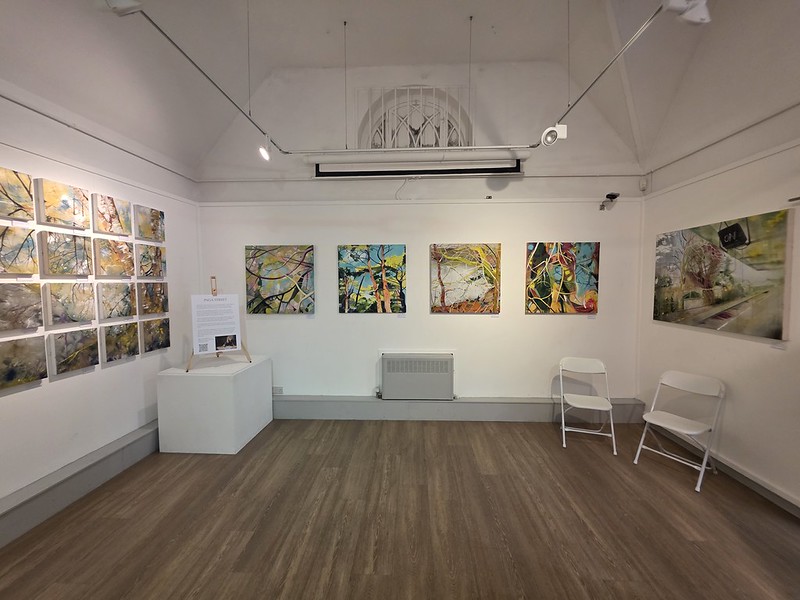
Attached on a building to the side of Red House Museum, there’s a regularly changing gallery section. At the time of our visit, it was featuring the works of local artist Inga Street.
The artwork is varied and it seems to be an opportunity to both display the pieces and also put them up for sale at the same time. This seems a sensible way of the museum having something to offer in its gallery, whilst still being something very useful for the artist.
I’m not sure that I’m the target market here, and Ross (who is a well-known art critic) declared that he thought he could have painted some of them. But, variety is important and the artist is popular locally, so this feels like another reason for the venue staying open. I mention that as the volunteer suggested when we left that we left a positive review for the museum to ensure that its survival was assured given the challenging finances in local Government at the moment.
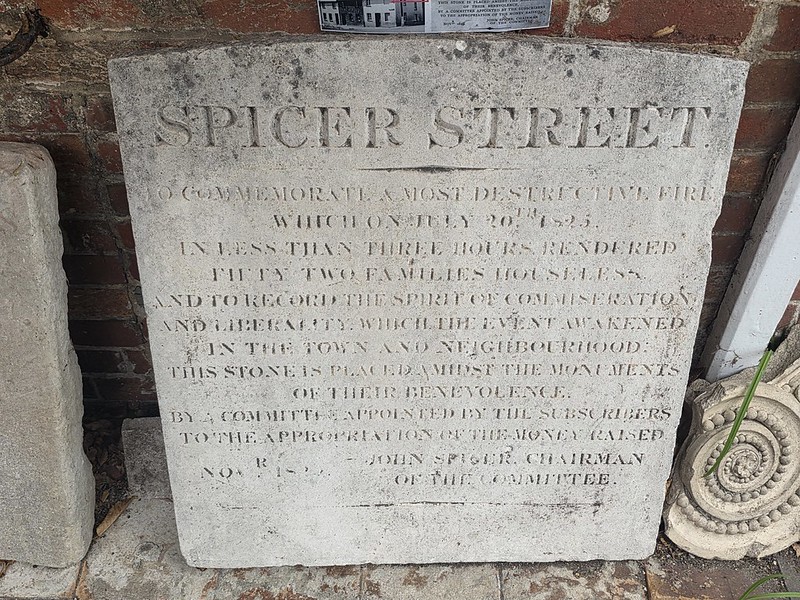
This stone memorial is located in the garden of the Red House Museum in Christchurch and it reads:
“SPICER STREET
To commemorate a most destructive fire which on July 20th 1825 in less than three hours rendered fifty two families houseless, and to record the spirit of compassion and liberality which the event awakened in the town and neighbourhood this stone is placed amidst the monuments of their benevolence.
By a committee appointed by the subscribers to the appropriation of the money raised.
Novr. 1825 John Spicer, Chairman of the Committee.”
The house that this memorial was attached to was demolished in the late 1930s, so it has made its way here. The day after the tragedy, a national newspaper published a letter written by a local:
“As you will hear of the distressing fire which happened this morning in this town, I think it best, to prevent your uneasiness on my account, to state the case as far as it has at present proceeded. The fire broke out at about eleven o’clock, in the New Town, a little above Mr. Aldridge’s, and had the wind continued as it then was, the destruction of the whole town it appears would have been inevitable; but very providentially the wind took the direction of the fields, and thereby is is hoped many houses will be saved. Some time since I heard there were at least 50 houses burnt down, and the fire, though much subdued, is still burning in various parts. You can scarcely think with what rapidity it spread, the houses being chiefly thatched, and many of mud walls—the intense heat of the weather, and the dryness of the buildings, no doubt contributed to the work of desolation.—What renders it very afflicting is, that the sufferers are chiefly poor people, who, although it is hoped they have saved many of their things, will still be great losers. The bellman has just been through the town, calling a meeting of the inhabitants this day, at four o’clock, to take into consideration what will be the best mode of providing for their present relief. They will, I should think, have to sleep to-night in the fields, which are strewed with beds, &c. that are saved. It is on this account a happy circumstance that the nights are so hot. I hope something will be done to reinstate them in their dwellings, and that the destructive element will be shortly subdued. Some person in each house will no doubt sit up all night, for there is a general alarm.”
The museum has a photo of where the commemorative stone was once placed, seemingly blocking up the view from Mrs Preston’s window. Anyway, it’s marvellous that the stone has been kept so that at least the memory of what happened 200 years ago isn’t forgotten.
Red House Museum and Gardens is located near to Christchurch Priory and is a volunteer led venue which doesn’t have an admission charge.
As the signage notes, the building was constructed to be a workhouse. The museum itself adds about the history:
“The building dates from 1764 and was the parish workhouse for Christchurch and Bournemouth. In 1886, as a result of the increasing population, a new union workhouse was built in Fairmile and the old house was sold to the vicar of Christchurch Priory, the Reverend T. H. Bush. Reverend Bush named the building ‘The Red House’ after the colour of the bricks and he demolished the women’s wards in 1887 to construct the stables, now the temporary exhibition gallery. Later, the building became the private museum of Herbert Druitt, an avid local collector. It was his passion for textile and fashion, bygones and archaeological material that created the Red House Museum collections. In 1951, the Red House Museum became a charitable trust and our doors have been open to the public ever since.”
There was a friendly welcome from the volunteer at the front desk who explained about the museum, with this being the ground floor that was once the living and dining area of the workhouse.
The displays are a little eclectic, but this is a provincial museum and it is trying to cover a lot of ground. It’s more quirky than formal, but there’s a place for museums like this.
A display on fusee chain making and this was part of the clock and watch making process. It’s explained here that someone living in the workhouse might be required to complete this task for over seventy hours a week. They wouldn’t have been paid directly for their efforts, but they would have living accommodation and meals provided, so they were at least safe if hardly living in great comfort. Although the Victorians often decided that there were benefit fraudsters and so conditions in workhouses often declined towards the end of the nineteenth century.
A display about architectural finds in the local region.
An old menu board from the workhouse.
And an example of the culinary delights that were served up.
A plan of the workhouse from an old Ordnance Survey map.
The rear of the museum.
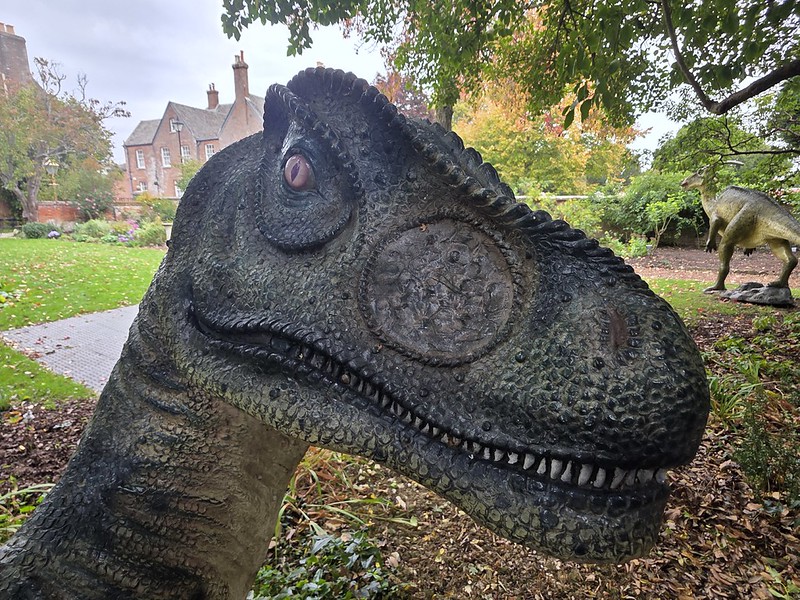
There’s a small dinosaur garden to the rear of the museum and a path which winds around so that visitors can see them all.
To be fair, this is a great idea for kids to want to come to the museum. Well, and Ross liked them. The plan seemed to work, there were numerous families looking around the museum and although a visit isn’t likely to take more than an hour or so, it’s definitely worth a little pop in.
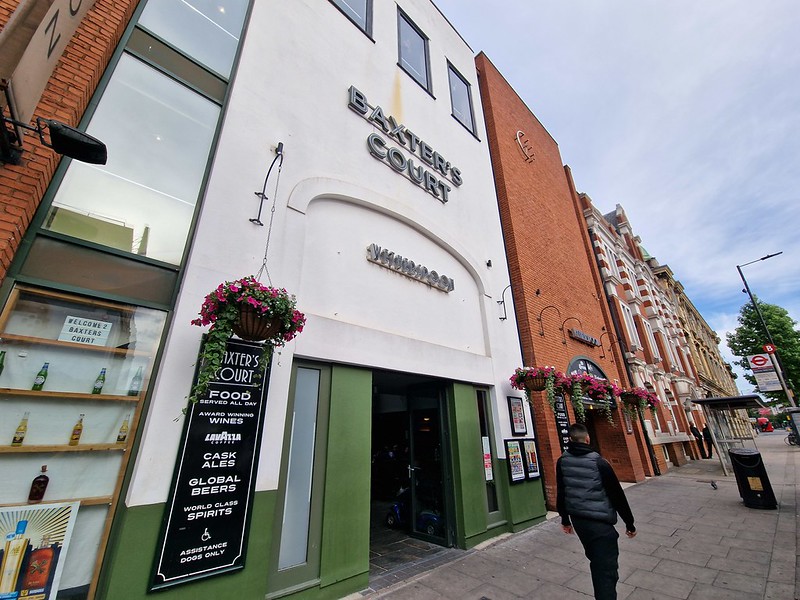
I’ve trawled to see what old photos I’ve taken of Baxter’s Court, a JD Wetherspoon pub that they’re closing this week. The venue notes about its history:
“This pub stands, more or less, on the site of an old alleyway, known as Baxter’s Court, which dates from at least 1700. Jerusalem Square also dated from this time, but both were swept away when Valetta Street (once Jerusalem Passage) was developed.”
They add:
“This Wetherspoon pub takes its name from a “lost alley” approximately on this site. Sir Thomas Marsh’s White House, also stood here until it was pulled down around 1869. In the late 17th century, Marsh used his house as an academy for training nonconformist ministers.
The bank next door occupies the former site of the Hackney Pavilion, an ornate 1100-seater cinema built in 1914. Defeated by television, it closed in 1973.
The building immediately to the south was at one time used by the Salvation Army, whilst next to that is the former Methodist Central Hall, opened in 1925.
Hackney’s first council housing was built in 1902 in Valette Street, which runs behind this pub. Valette Buildings, dating from 1905, stands on the site of the former Jerusalem Square, a development dating from around 1700.”
The chain has been making a large investment in more substantially sized pubs, including some new openings at railway stations in London.
The chicken bites basket with Mexican rice that I acquired here in 2022. I can’t remember what it was like, but I’m sure it was entirely adequate.
This is the Session IPA from Three Sods Brewery, a local set-up which closed in August 2022, a few weeks after I purchased this beer. I say purchased, it was given to me by the pub as they had started to pour it and realised I had ordered on the app the BoHo Bitter from the same brewery. I liked this arrangement.
ø;
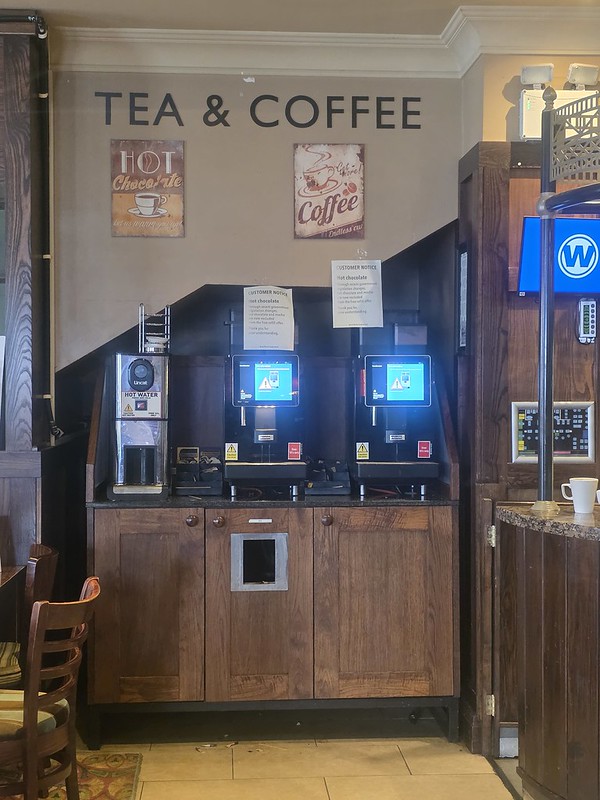
Deep in my digital archive, here’s a little throw back from the pub from 2012. Coffee back then was served by the staff, this was before the self-service unlimited hot drinks arrangement which I very much like. As I like things such as this, I had a look at how much this costs today in the pub:
Eggs Benedict – £5.29
Regular Cappuccino – £1.81
Large Pepsi – £2.05
So, a total of £9.15, which isn’t too much of an increase from the £6.24 of 13 years ago, especially as the coffees are now unlimited. Anyway, I digress, so I thought I’d have a quick look at the reviews of the venue and they’re quite low for the chain.
“Very bad … They Refused to serve me because I had a dog.. Dogs are not allowed which is okay But… Why I couldn’t Even drink my beer Outside? It doesn’t make sense at all!!!”
The obligatory complaint from a dog owner and the policy makes sense to me, they don’t want dogs in or out of the pub.
“I really struggle to give it 1 star. I went in there on Saturday 11/12/21 and manager tried to fiddle me. She overcharged me for a mixer for a whisky (I didn’t want or have) and when challenged asked me if I supported ‘Black lives Matter’… When I replied ‘no’ was told I was barred…. Watch out for her guys…. Still have receipt with date and time on!!!”
Without doubting the story, there must have been more to this exchange than just this.
“Horrible table service.. I ordered two glasses of wine at 5:00 pm it came to my table at 5:20 pm. I give them a negative 10”
This is the entirety of the review because two drinks took twenty minutes to arrive at the table….
“Absolutely disgusted just been in and ordered a pizza and asked for no chilli peppers as I’m allergic to them, sent the pizza back as they still came out with them on, new pizza arrived they just took them off and missed a few, staff didn’t care either when I took it back even when I explained I was allergic to them”
This is a bit sub-optimal….
“This establishment refused to accept a Clydesdale bank £5 note.”
They don’t have to….
“No John Smith what’s going wrong with this pub”
No wonder the place is closing if they couldn’t get that right….
Below is the sales document, it seems that the building has been acquired for over £2 million.
The pub has been trading as a JD Wetherspoon venue for around 25 years, I suspect that it’ll be missed by the local community, however many faults it might have had.
Yesterday (Wednesday 29 October 2025) was the third and final day of the Waterfront part of the beer festival, although it now moves to Castle Social in the Castle Quarter.
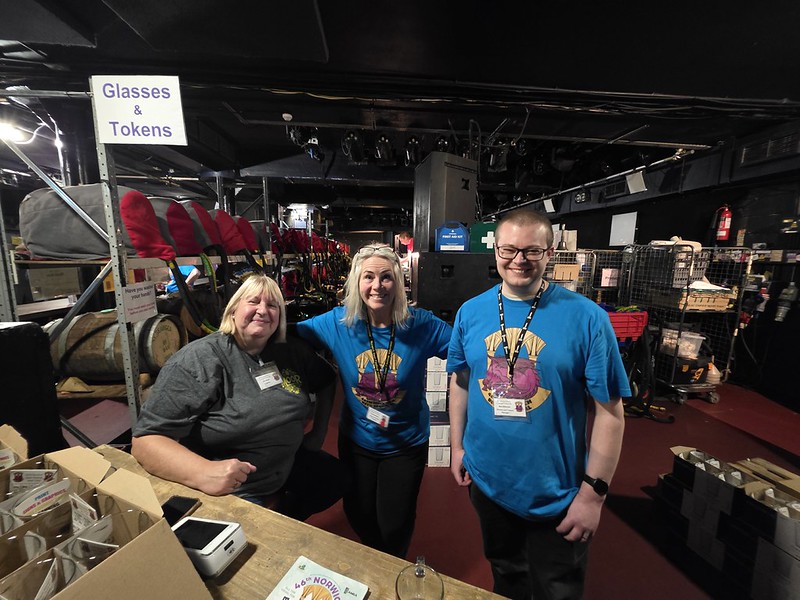
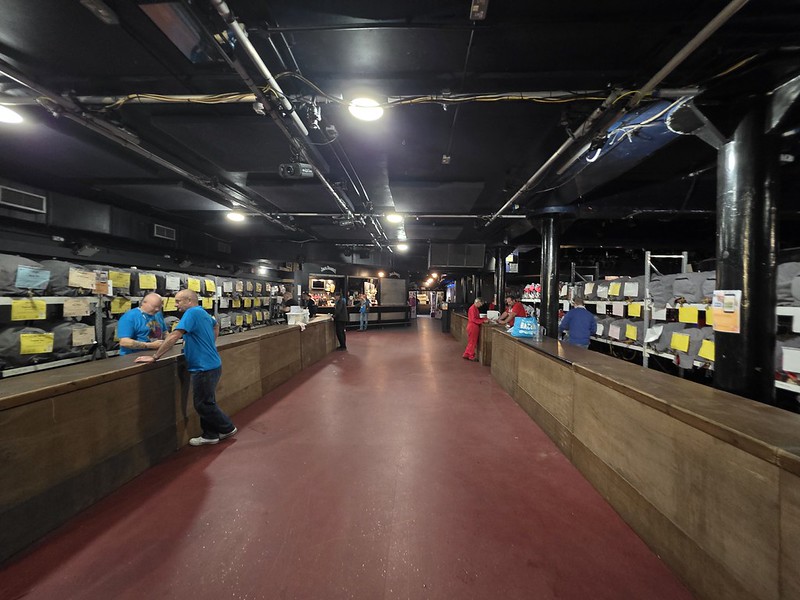
For this final day, I moved to the ticket desk for a bit to staff operations (this area was a remote operating ground for glasses & tokens, away from our central base), with Martin ably assisting me which was very noble as he had a cold draft rushing towards him. He is a former festival organiser and what he doesn’t know about CAMRA isn’t really worth knowing.
Sue never stops working, here she is checking the glasses and planning her next toffee.
It was thought easier just to move the beer nearer to me, this was the end of the Wiper & True Sunset Dreams Rhubarb Margarita.
And some Kriek. That’s not my spelling could I just mention here.
Here is Andy looking longingly at me, he was one of our glasses team earlier in the week who was back as a customer. He’s another one that Roy and I will let come back next year, we’ve had that discussion. There isn’t actually anyone we won’t let back to be fair.
Ivan was on top form once again and I say this primarily as he brought me sweets and crisps, it’s that kind of attention to detail that gets so much praise. Here he is offering his latest suggestions to Sandy.
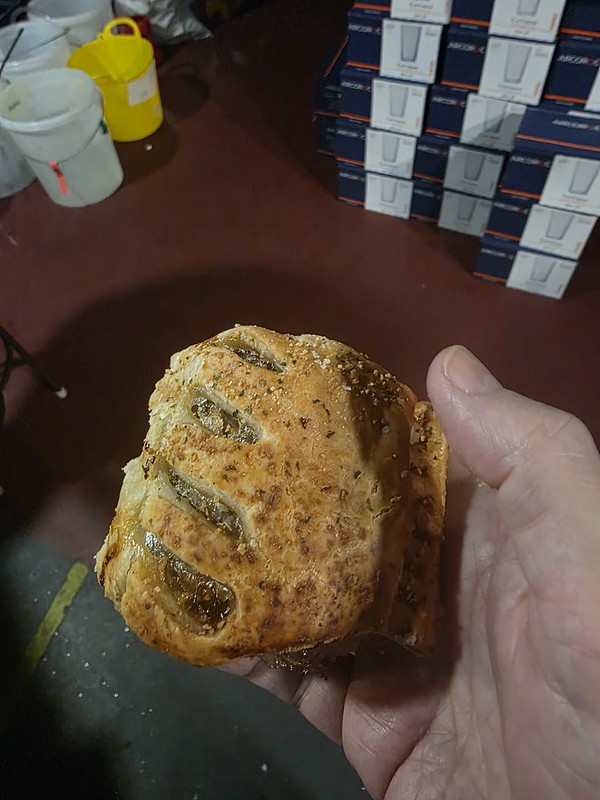
I heard a rumour that there were free sausage rolls available at the cider stand. I think I was the first there…. These were quite delicious but I wouldn’t have wanted more than 17.
And on the same theme, the free food option was pie and I was delighted at this. Here’s the steak and ale pie, with chips and gravy. Very lovely.
Some of the wooden casks.
Roy and Chris busy sign removing as the takedown began.
I don’t interfere with the cellar team, which is unofficially headed by Ivan (I don’t know if the cellar team know this), but I did take some cooler jackets off. This is the limit of my cellar competence, so I withdrew quickly after this in case I broke something. Or myself.
And that was then time at the bar. I might have some videos of Ivan calling time to surprise and delight my loyal blog readers. Both of them.
The takedown begins in earnest. Now everything gets moved back to the beer store or to Castle Social.
I’ve already written about days one and two at the Waterfront, and also at Redwell, so now it’s time for me to list my favourite beers from the last few days. So that’s anything I’ve rated as 4 or above on Untappd (and hello to my new Untappd friends this week!). Ooooh, beer friends…
This Circle is You from Pentrich Brewing (soft, hazy and fruity)
Mango Unchained from Elephant School Brewing Co (lots of mango, fruity and robust)
Berry Sour from Five Points Brewing Company (delicious, raspberries, fruit, gently tart and just a bit decadent)
Stupid & Contagious from Liquid Light Brew Co (very agreeable, stone fruit, hazy and delicious)
Imperial Stout from Lacons (smooth, rich and decadent)
Chicha Sour from Hammerton Brewery (gently sour, fruity, fluffy and delicious)
Lord Wimount from Moon Gazer (caramel, malty and sweet)
Lamanva from Verdant (malty, biscuity, fluffy)
Mild from Penzance Brewing Company (a very decent milk, creamy, chocolate and biscuity)
Knock the Corners from Howling Hops (toffee and biscuit, nicely rounded)
Stay Rad from Nene Valley Brewery (citrusy, dry and good with chocolate)
Peanut Butter Stout from North Riding Brewery (chocolate and peanuts, smooth and nearly decadent)
Dia De Los Muertos from Hammerton Brewery (a lot of chilli on this, but chocolate as well and interesting)
Cherry Porter from Mr Winters (cherry, chocolate and smooth)
Many thanks to Craig and the volunteer team for having so many delicious beers, and I will continue to ignore his comments about my not liking beer that tastes of beer 🙂 I’m not volunteering this weekend but I’ll likely go and annoy someone by popping in to see the event at Castle Social.
Hopefully next year we’ll be back at the Halls, but the Waterfront team were very helpful throughout, with the venue proving to be a really decent back-up.
I didn’t mention some elements of the beer festival at the Waterfront, but the venue has been a really handy location with the Halls out of action. Here’s the cider bar on the second of the three days at the venue.
The outside of the venue with the food stand on the left.
Some very reasonable prices for a festival.
There’s the JD Wetherspoon over the river and the Waterfront on the right hand side.
The upstairs seating area.
The Waterfront is a live music venue and they have boards of these tickets from past events on display.
Ready to go and scan tickets in the queue.
The formidable and wonderful Sue.
Ivan was on top form today, so I have no complaints about him which might come as a surprise. He was busy serving customers at the Waterfront and also went to help with the set-up at Castle Social where the festival moves tomorrow. I hope it won’t disappoint him, but I was very impressed with how agreeable he was. And he got me crisps so that boosted my opinion of him further.
Chris alerted to this new beer going on and it did indeed surprise and delight.
Team glasses of Sue, Paula and Roy. It was another lovely evening, wonderful customers and lots of positive comments about the organisation of the beer festival.
I had rather set my heart on pie, but the food kindly provided was sausage and mash, which is much appreciated. Roy and I briefly mentioned to Craig that he could perhaps acquire us some pies, but we didn’t want to cross the line into being annoying so we left the matter.
I didn’t take a photo of Craig yesterday, but I didn’t forget today. He of course is just part of the volunteering team that has put this event together, but without him and others this event wouldn’t have taken place, so many thanks to him and everyone else.
I was delighted that there were no complaints about my summary of the first part of Norwich Beer Festival, so I thought what would happen if I started writing a daily update about the second stage at the Waterfront (it’s on the Waterfront from 28 to 30 October 2025). Here’s the pre-opening set-up of Ivan, offering advice, Roy, who doesn’t need advice, and Andy, who is quite demanding.
The state of affairs before the trade session.
In terms of the amount of beer, the Waterfront is the main event for the beer festival this year. Although there will be lots at Castle Social as well.
Some of the cellar team visible, they’re part of a large volunteer effort which makes all this come together. It was at this point that Roy decided that he wanted to rearrange quite a lot of the glasses and token stand, which Craig was delighted to hear but everything was moved efficiently and effectively. Apologies I didn’t get any photos of Craig, our brilliant festival organiser, but he once again delighted me with the beers that he had purchased. He even went completely rampant at the end and had a 3.9% beer, so I hope he’s OK today.
It looks simple from the front, but there’s a lot of cooling going on here.
Ivan, ready for action but just having a little break.
Whilst I was looking for a real ale, I actually stumbled upon the curiosity bar with its exciting keg options. Chris had read the first part of this blog series about Redwell and I was surprised and delighted to find someone so competent with regards to what beers he likes. I’ve decided that Chris seems to be as talented as the glasses & token team, so anyone coming to the beer festival should perhaps head towards his section for at least one beer. And pastry sours are absolutely proper beers.
And my friend Mark, a director of CAMRA and one of the most knowledgeable people in the world of saving pubs. He’s up against a lot, but he battles on tirelessly and we need more campaigners like him in the organisation.
After letting in the customers for the main session, I went for my pie which today was chicken and mushroom. Very lovely with the chips and gravy. Thanks also to the staffing team for looking after my supply of crisps and cheese straws for the day. I’m looking forwards to the pies on days two and three, I don’t get bored of such fine cuisine.
Ivan on his break.
Behind the bars during a quieter period.
It’s like Rodin’s ‘the Thinker’.
Sue came to help at the glasses and token stand and she’s been helping at Norwich Beer Festival since around 1984 she confirmed. She’s really growing in confidence recently and has been declared by Roy and myself as a team member of great competence. We don’t do that lightly.
Ivan on a break with Oli, Ian and Mark in the background.
And that’s it for the first day. It was lovely as ever to see Oscar, the shy landlord of the White Lion, or it was until he jumped on me. Nathan has got him on a new health and fitness regime for the last few games of the bar billiards series (Oscar doesn’t know this yet) so we’ll see how that goes.
I stayed late on this one as it’s not an onerous walk home. This was a really marvellous first day, lots of happy punters and some great volunteers to work with.
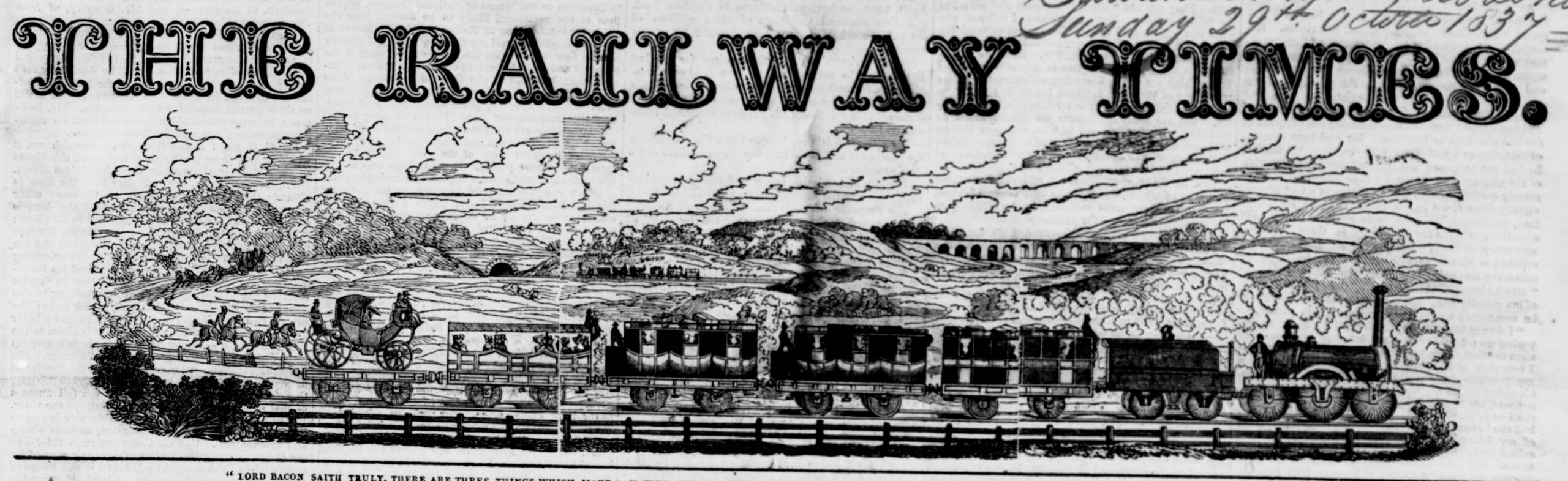
I’ve now reached November 1837 with my reading of the Railway Times, as that’s just how interesting I am…. It’s a little bit like a soap opera already with some lines struggling, some land owners moaning and some railways charging ahead.
An article in the newspaper read:
“CHELTENHAM and GREAT WESTERN UNION RAILWAY.
The second half-yearly Meeting of this Company was held at the Masonic Hall, Cheltenham, on the 3rd instant, William Henry Hyett, Esq., in the Chair.
The report of the Directors stated that, as many of the Proprietors desired the operations of the Company should be limited in the first instance to the completion of some portion of the line which would yield an adequate and certain return for the capital expended on it, during the progress of the remainder, they recommended the construction of that part between Swindon and Cirencester, on the following grounds—The main object of the undertaking was to effect a Railway communication between Gloucester, South Wales, and London; that on the opening of the Great Western to Swindon, and this line being completed to Cirencester, 95 contiguous miles of that communication would be established; that as Cirencester is easily accessible by excellent turnpike-roads from Stroud, Gloucester, and Cheltenham, the portion of the line between Cirencester and the Great Western would carry all the London traffic, while the remainder of the line was in progress; and that though this part of the line would yield a much less income than any other, when the whole should be completed, it would, nevertheless, in the meantime, yield a greater profit than any other portion which was not contiguous with the Great Western.
That Mr. Brunel having been desired to revise his estimates, and report the cost of the line between Cirencester and Swindon, had reported that the cost with all improvements suggested by further experience adopted on the Great Western Railway, and which he strongly recommends as productive of future economy, would be £249,500.
That the Directors had also caused the traffic to be ascertained on the same portion of the line, and that this would yield a net annual income of £25,000, after deducting the costs of maintenance.
That an arrangement had been under consideration with the Great Western Directors, which had led to an offer, sanctioned by their Proprietors at a special General Meeting, to rent the line when completed from Swindon to Cirencester, at £17,000 per annum, the lessees maintaining the way for a term not exceeding ten years.
That the Directors of this Company considered that rent would involve a serious sacrifice of income, but had secured the option to this Company of accepting or rejecting the offer till within six months of the opening of the line, as it might be satisfactory to distant Proprietors, who might not be so well acquainted with the details of the probable traffic, to know that they may rely at the least on 7 per cent. for their money.
That calls to the extent of something more than 30 per share would be required for the completion of this part of the Railway, the whole of which would not be required under two years and a-half, and would be called for by easy instalments, and that no further call would be necessary for some months.
The Meeting was numerously attended by a highly respectable class of Shareholders, who testified their unanimous approbation and adoption of the report.”
The Cheltenham and Great Western Union Railway (C&GWUR) was a railway company, authorised in 1836, which was intended to create a broad gauge link between Cheltenham, Gloucester and Swindon, connecting to Isambard Kingdom Brunel’s Great Western Railway (GWR). And it was Brunel himself that was engaged with this railway setup as well.
However, the company faced significant financial difficulties and was unable to complete its ambitious plan. It only managed to open a short initial section of its line between Swindon and Cirencester in 1841, which is what was suggested in the 1837 meeting. Despite some attempts to operate as a partnership, the vital section between Cheltenham and Gloucester was actually built and opened by the competing narrow gauge Birmingham and Gloucester Railway company after the C&GWUR defaulted on its obligations.
GWR eventually bought the ailing railway up as apparently the directors were exhausted by trying to operate this line. They managed to open the stations of Purton, Minety and Cirencester in 1841 and the line is still partly still in place, but all of these stations were closed in 1964. The rather lovely Brunel designed railway station at Cirencester is standing empty, now miles away from the nearest track at Kemble. British Rail had the great idea of cutting the double track from single track at the same time in 1968, but this was returned to double track again in 2014.
There is vague talk about putting some sort of rail line into Cirencester, but it doesn’t look likely. Anyone wanting to go from Swindon to Cirencester today by public transport has to use the number 51 bus which takes around an hour, instead of a lovely shiny train which I imagine would today by operated by GWR. I’m not sure Brunel would have been pleased at his efforts being reduced to a bus service….
I was en route to Bournemouth Airport and so I thought that I’d visit a JD Wetherspoon venue that I hadn’t been to before. This is the Parkstone and Heatherlands and I’ll use the chain’s history of the pub name:
“This building is better known to Winton’s older residents as the long-standing Co-op, the original of which (on this site) was a branch of the Parkstone and Heatherlands Society. Following a public meeting attended by 100 people, in May 1903, the society’s new store opened for business the following September. Molesworth House, as the store was then called, was replaced by a high, domed building, which became a familiar landmark. The dome was later removed and the building refaced.”
It’s a relatively small venue from JD Wetherspoon opened a large number of venues like this around twenty years ago.
This is from the other end of the pub, with the bar being located on the right hand side. I ordered at the bar and was served in turn by a friendly team member, so positive first impressions.
I only went for a coffee here, although they had around six real ales available at the chain’s usual low prices. The new signage telling people not to have multiple hot chocolates was in place, although not enforced.
As I like to have a little look for JD Wetherspoon venues, the online reviews for the pub are towards the lower end of the scale for the chain.
“Bad food cooked by unqualified people. Scruffy staff that need tidying up. Seems that certain staff dictate to the manager who they like & don’t like. Ban men for looking at the opposite sex, but when I’m not there men chat my girlfriend up & she doesn’t complain”
Hmmmm.
“Called in for a couple of pints on the Saturday evening. Bell rang for last orders, didn’t even make it to the bar within 60seconds to get my last drink of the night before being told no more serving. Was told within two minutes of that to drink up. Other obvious regulars given plenty more time to savour their last drinks of the evening. Will choose a better establishment to drink in with more patient staff from now on. Would rather pay more for my pint and enjoy it than pay cheaper and be rushed to empty my glass”
Julian the elder is the expert on this, it’s a shame he wasn’t there, but he seems to know exactly what to get and when to avoid annoying bar staff. Well, generally.
“Customers generally not adhering to social distancing with lots of handshakes.”
The venue gets a 1 out of 5 review for this. May these days never be repeated….
“The food and service was great. However within half an hour or so I thought I was in a kindergarten. There were no less than half a dozen women and screaming children who took the place over. Not somewhere I would go for a coffee and a chat, couldn’t hear myself think!!”
I’m very tolerant of course, but I can feel this person’s pain….
“Have just come in to the Parkstone and Heather lands with my 13 year old son one of the members of staff have told me my son can sit how he was. Which was lent over basically with his head in his phone like most teenagers. im absolutely fueming. Disgusting behaviour. Usually this pub if fine I’m literally shocked”
I’m not sure that I even understand what’s happened here.
“Terrible, table next to us ordered food and they gave it to us instead, we ate it as anyone would do and then said you either have to pay or leave! Your fault you ordered it to the wrong table.”
No, nearly nobody would eat the food that was put on the wrong table.
“It’s cheap and not chearful, only place I know where they make you pay up front.”
I feel that someone might be new here.
“Worst wheaterspoons pub ever”
Interesting spelling. But, I digress and in terms of the cost, the price point here was the same as their two more centrally located pubs in Bournemouth.
There are also about twenty reviews complaining that the chips are being microwaved and numerous photos of soggy chips. Seems a bit odd. Anyway, I rather liked the pub although it feels more old-school Wetherspoons in the way their smaller pubs outside central London used to feel. They were a bit more focused on serving regulars and more wet-led, but this pub seems to be an important part of the community.
And I got several coffees (and obviously no hot chocolates as I don’t want to break the law) for £1.81 so that was rather lovely.
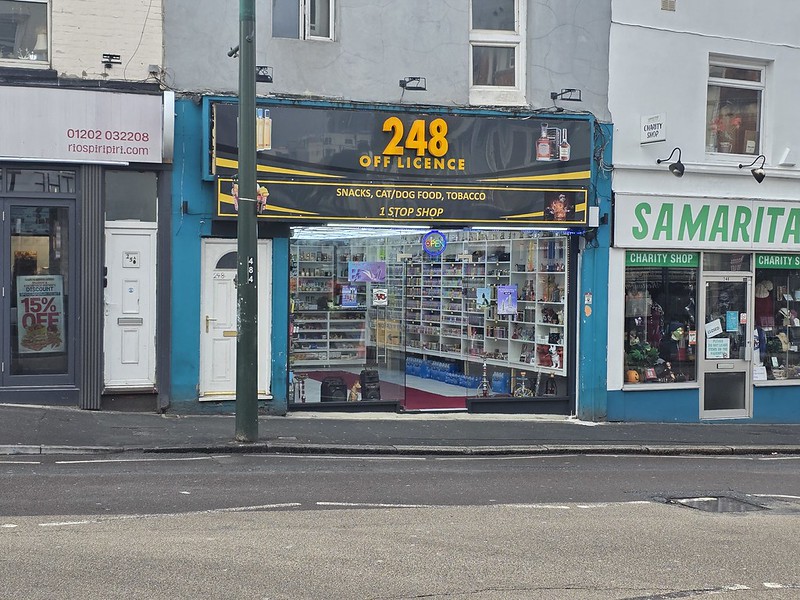
I was quite intrigued by this shop as they had decided the things they wanted to promote were snacks, cat/dog food and tobacco. I’m not suggesting that there’s anything wrong with selling any of those three, but I’m not sure that it’s a combination that I’ve seen before in terms of a shop’s focus. The 248 relates to the street number, they must have been slightly disappointed that they weren’t at 247 though.