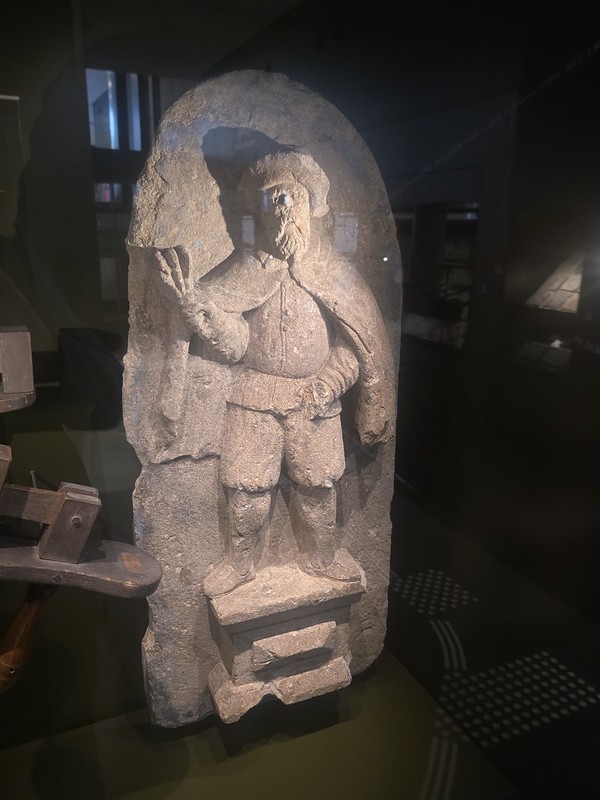
Melaten is Cologne’s great cemetery, but before it became a nineteenth century burial ground, the area was associated from the twelfth century with a medieval leper hospital and the communities pushed to the edge of urban life. This relief from around 1629 is a small but rather direct reminder of that older rather hidden history, as lepers were not at all welcome in the city centre. As is visible in the relief, any lepers who were potentially getting close to others were expected to shake a rattle to alert everyone as to their presence. Seems rather less than ideal for those with leprosy, especially as it isn’t actually that contagious.
Leprosy was not just a slightly sub-optimal medical condition in the medieval imagination, but a moral and communal category as well, wrapped up in ideas of sin, contagion and charity to try to mitigate the guilt. It’s something of a reminder that although the inhabitants of the leper hospital were to be helped and prayed for, they were also going to be shut away.
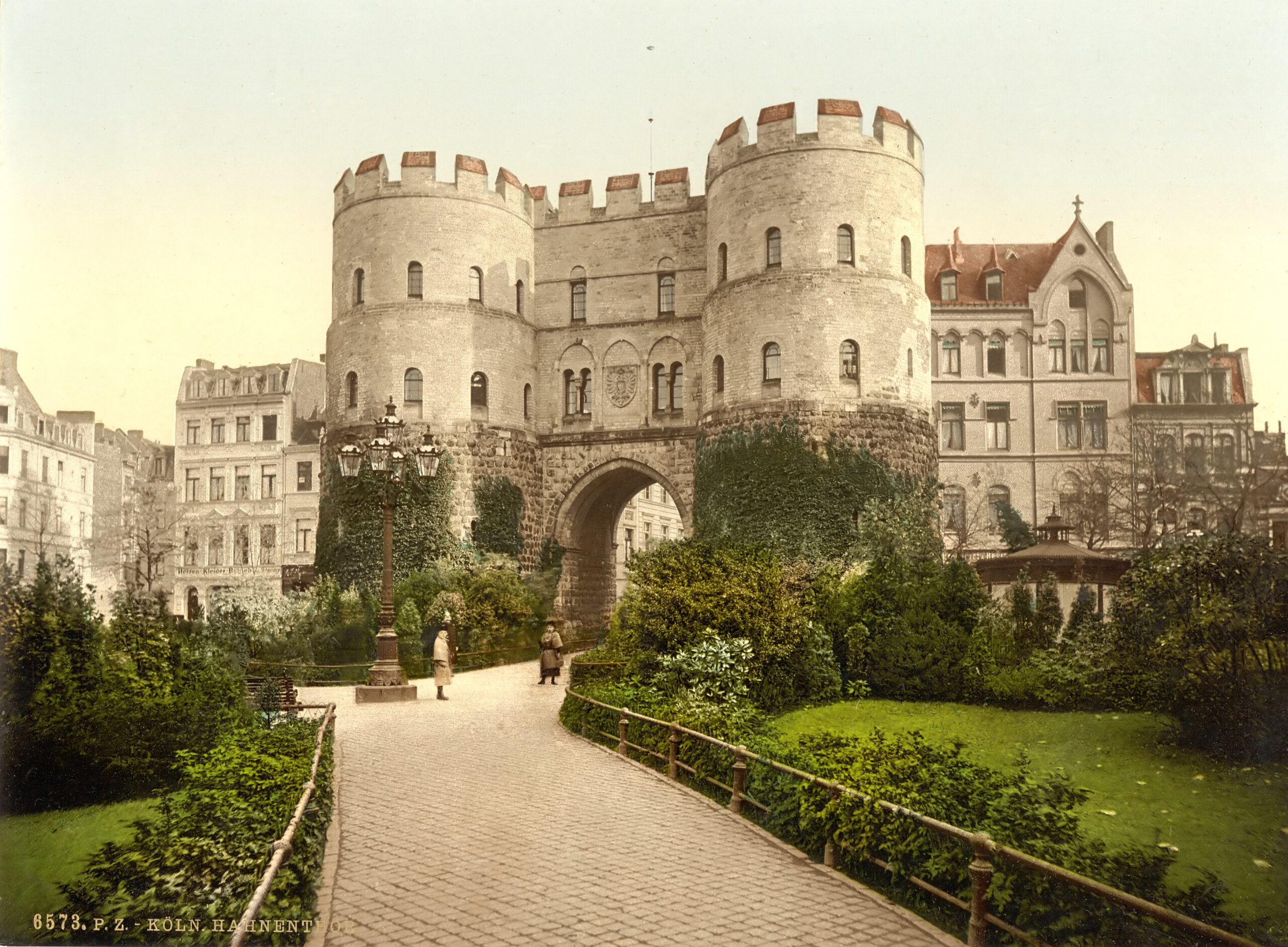
The Hahnentorburg is one of the surviving medieval city gates of Cologne and it does look quite impressive from this side. It was built in the thirteenth century as part of Cologne’s vast defensive wall and it once marked the western approach to the city. The twin rounded towers and heavy basalt base do suggest strength, but the gate is today looking a little adrift in the landscape.
I think it’s fair to say that this postcard showing the gate at the turn of the twentieth century does make it look rather more impressive. Unfortunately, the gate was badly damaged during the Second World War, so the whole arrangement is today somewhat less decadent.
This is the other side of the gate today, it has very much lost its former glory. But, it has stubbornly held on when other city gates have been entirely lost and it’s a useful reminder of the street layout that Cologne once had, somewhat now battered by post-war developments.
This news article appeared in the Norwich Mercury 200 years ago this week, although it had evidently taken them some time to hear of the news.
“In August last, on board the Honourable Company’s ship, Vansittart, on his passage from Bombay to China, John Hammont Cooper, aged 17, youngest son of T. H. Cooper, Esq. late of North Walsham, most sincerely lamented by his family and friends.”
In situations like this, I find it intriguing what a young man from the North Walsham area would have been doing travelling from Bombay to China at this time.
The Vansittart was a merchant ship owned by the British East India Company and at the time, although for not much longer, they had a monopoly in terms of their UK trade with India and China. The ship had launched in 1813 and John Hammont Cooper went on its seventh voyage.
The ship left Downs (a shipping area of the North Sea) on 9 January 1825, bound for the Cape, Bombay, and China. The ship reached the Cape on 13 March, and Bombay on 31 May. It left Bombay on 11 August, and arrived at Whampoa, Hong Kong, on 1 October 1825. That was the section of the journey that Cooper didn’t complete.
John Hammont Cooper had been born on 24 December 1807 and was baptised on the following day which was quite festive. He was the son of Thomas Hammont Cooper and Mary Vernon. The family don’t appear to have been hugely wealthy, although they did own some land in North Walsham.
Thomas Hammont Cooper was a Captain-Lieutenant in the Norfolk Militia Western Regiment, a rank now abolished and this was more of a Dad’s Army type set-up in case the French invaded North Norfolk. However, Thomas wrote two books on infantry and military work, so he must have had some military knowledge.
One thing I’ve never much thought about, as this doesn’t impact on my daily life, is how many people would be on one of these ships. It seems that they might have a crew of 100 people and would take 50 or so passengers, although the numbers varied widely. Unfortunately, the crew and passenger lists aren’t available for this journey, so it’s not clear to me whether Cooper was a passenger on some commercial trade, whether he was crew or whether he was some sort of military presence on board.
But, either way, this must have been some considerable adventure…..
Just a random article in the 5 October 1905 about the then landlord of the Artichoke pub in Norwich.
“At the same Court, Frederick Sinclair, the Artichoke, Magdalen Gate, Norwich, was summoned for working a mare in an unfit state.—Inspector Adams said the mare was very lame and not fit to be driven. The animal was suffering from sprained tendons.—Defendant admitted that the mare was not in a fit state to be driven when the Inspector stopped him, but he contended that he (defendant) saw the lameness as soon as the Inspector, and was then about to turn round. He sent the animal home by train.—After further evidence, the Chairman said the Magistrates believed there was a doubt about the case, and defendant would have the benefit of it. The case was therefore dismissed.”
So many questions….. I’m disappointed that it’s not clear in the newspaper article where this mare was discovered. Just popping it on a train home seems like something off a faff and it’s certainly not a service offered by Greater Anglia at the moment. There’s sometimes not enough space for bikes, let alone mares with sprained tendons.
And which railway station? Maybe the now closed Norwich City railway station which would have been the nearest to the pub. And I can imagine that Frederick Sinclair would have been most annoyed by the intrusion into his day, especially as the case was dismissed when he went to court.
– as I became intrigued by this case, I looked into it more and it transpired that Sinclair wasn’t with the mare when it was stopped and he claimed that it hadn’t been in pain when he had last seen it. And the mare had reached Great Yarmouth, so that resolves which train it was….
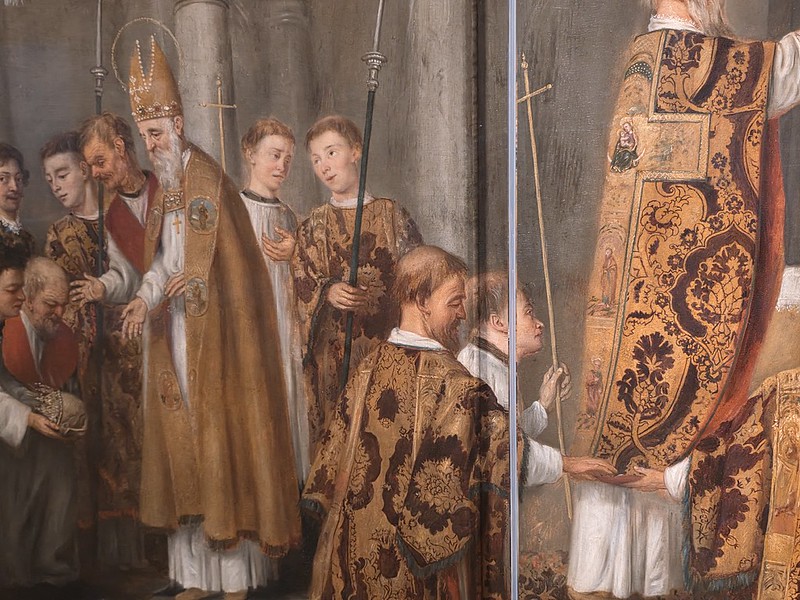
In the centre of this painting is Cunibert, or Saint Kunibert, who was a seventh century bishop of Cologne and one of the more important church figures in the Frankish Rhineland. He was bishop from roughly the early 620s until his death, usually dated to around 663, and he also seems to have played a political role at the Merovingian court. That was seemingly quite common for senior bishops of the period across Europe, who were expected not merely to pray and look solemn, but also to help hold together the fragile early systems of governance.
I was a bit muddled up at the museum as I couldn’t work out which one was Cunibert, but the artist has done a bit of a job lot of Cuniberts here, so he’s in the artwork twice. This time he’s looking pleased having discovered the tomb of St. Ursula in the church of the same name, which is where this painting is on loan from. There was a medieval story that Ursula walked about with 11,000 companions, but this story isn’t taken particularly seriously by anyone today. I can’t imagine why…. The artwork was painted for the church in around 1640 and perhaps it is the skull of Ursula that has been discovered which is exciting and delighting them.
That seemed to me to be the most interesting thing about this arrangement, a reminder of two of the most important saints in the city, asserting the power of the church and its reason for existence. And this was at a time when work had been stopped on Cologne Cathedral, religious continuity was not guaranteed…..
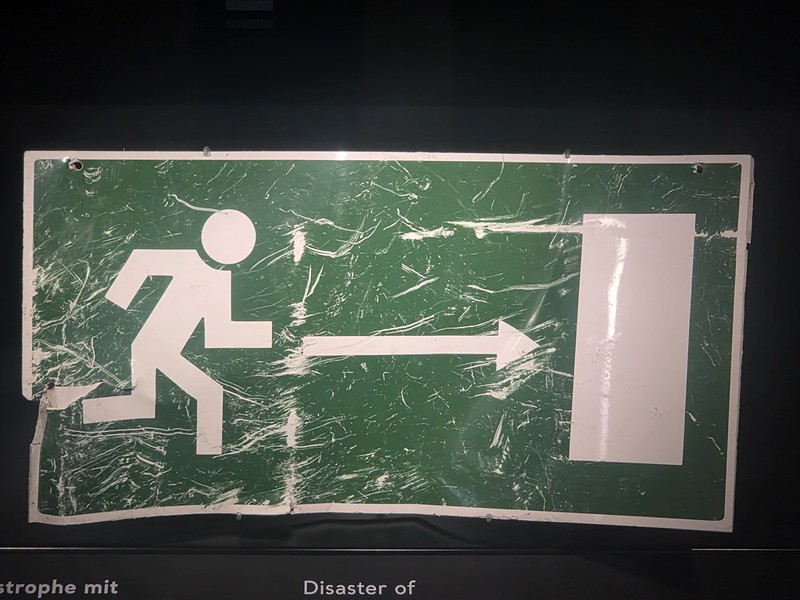
The collapse of the Cologne City Archive in March 2009 was let’s just say, sub-optimal. The building full of the archives came down during construction work on the city’s north south light rail tunnel, killing two people in the neighbouring houses and burying one of Europe’s most important municipal archives under rubble and mud. This was not some little local records office containing a few damp parish newsletters, but a vast collection preserving nearly a thousand years of Cologne’s documentary memory, including medieval charters, manuscripts, personal papers and administrative records of extraordinary value. Few cities manage to mislay their own past quite so dramatically and this was especially unfortunate given that it had survived the ravages of the Second World War.
What followed was a long and expensive salvage operation, with archivists, conservators and volunteers working to recover, freeze, clean and identify damaged material piece by piece, which is in my humble opinion very much heroic work. Millions of items were rescued, though often in fragmentary or filthy condition, and the restoration effort has taken years, with the city slowly rebuilding both the archive and its reputation after a catastrophe that became a byword for civic embarrassment.
The work to fix the archives is not yet complete, over €400 million has already been spent and restoration and the rebuilding of the collection will take decades more yet. However, all of the most important pieces of the archive have been saved and the losses have been minimised, but it’s not really an ideal situation.
I like the museum’s exhibit on this, it’s a fire exit sign from around 2000 which was salvaged from the collapsed building. It is beautifully understated as a representation of the disaster that took place here.
The first bridge on this site was the Dombrücke, opened in 1859, a two track bridge built at a time when railways were transforming the city and when placing major infrastructure beside the cathedral was apparently considered an entirely reasonable little arrangement. By the start of the twentieth century the Dombrücke could no longer cope with growing traffic, and plans were drawn up for something larger, more decadent and more in keeping with Cologne’s enthusiasm for doing importance at scale. The present bridge was built between 1907 and 1911 and opened by Kaiser Wilhelm II, replacing the earlier crossing at essentially the same location and preserving that dramatic line towards the cathedral.
When the Hohenzollern Bridge opened in 1911 it carried not only railway traffic but also a road, with three adjoining bridge sections and an arrangement that tried to reconcile engineering necessity, imperial grandeur and Cologne’s urban awkwardness in one steel composition. It was named for the Hohenzollern dynasty, because the German Empire rather liked putting ruling family’s name on prominent things. This section here is part of the old infrastructure of the bridge, which is no longer used.
And the same section on the other side of the bridge, which now also goes nowhere.
The Second World War, in the usual considerate manner, interrupted all this rather badly. The bridge was blown up by the Germans in 1945, but it was rebuilt after the war, first reopening for rail traffic in 1948, with later rebuilding and widening phases in 1959 and 1987 helping to create the six track railway bridge seen today. The road element never returned, leaving the structure as a railway and pedestrian bridge instead, with 1,200 trains going over the bridge every day. The bridge is something of a tourist destination now and it’s likely for the best that the number of cars ploughing straight through the middle of the city has been reduced somewhat.
Incidentally, there is also, on the Deutz side, a public climbing facility maintained by the German Alpine Association, which is perhaps something that my friend Richard might want to have a go at now that he’s a climbing professional.
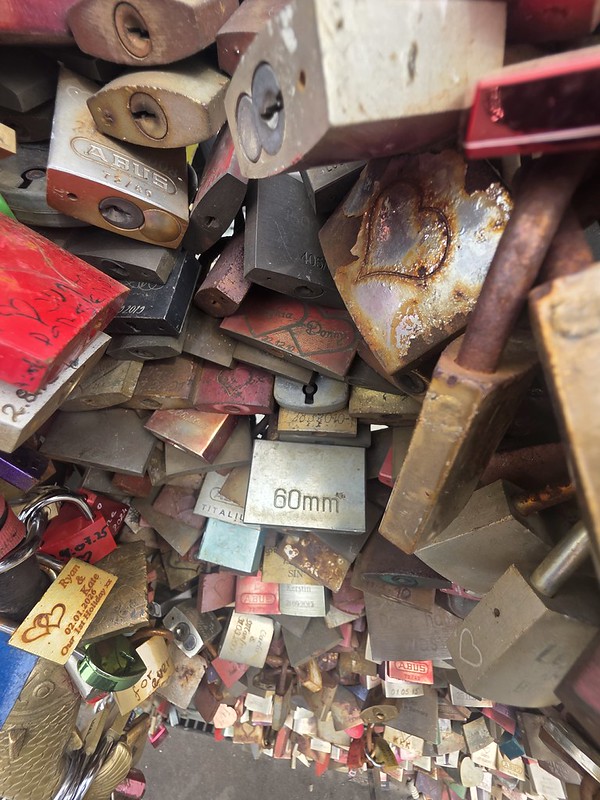
And then there are the love locks, which have turned the bridge into a giant metal archive of optimism since the custom took hold in 2008. The authorities don’t know how many there are now, but it’s likely around 700,000 sort of number. Counting each one individually would be a deeply unfortunate and sub-optimal way to spend an afternoon, so it’s unlikely the total number will ever be known. Deutsche Bahn has said the locks do not threaten the bridge’s structural safety, which is reassuring, because it would be a grim little twist if the bridge fell down because of them.
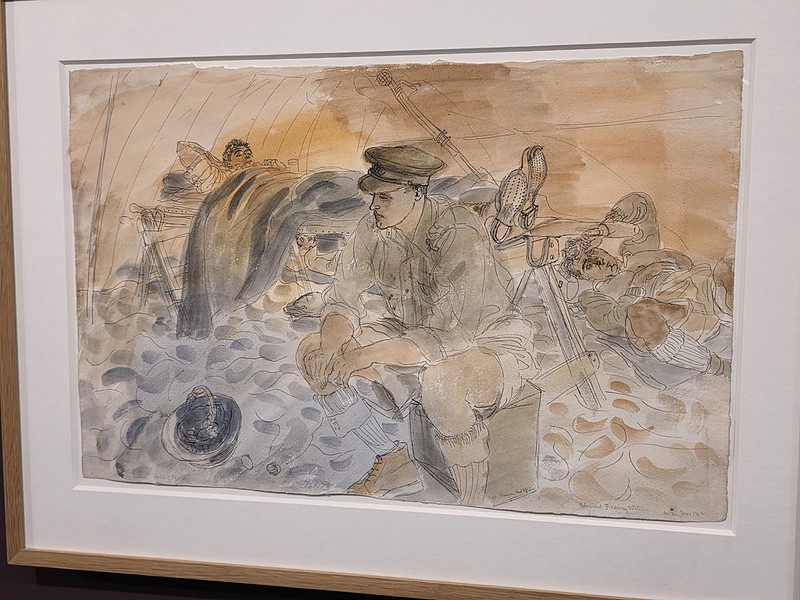
Anthony Gross (1905-1984) was not so much interested in the glamorous end of war, which is probably just as well, because glamour tends to be in rather short supply in a medical facility, known as the advanced dressing station. His 1942 watercolour ‘The Battle of Egypt – Advanced Dressing Station Interior’ shows men waiting, resting and enduring, with one figure seated in the middle of the picture while others lie around him in a scene of fatigue and exhaustion rather than triumph. These are the human consequences of war, just a waiting room of pain and I’m still not sure that I can really comprehend how frightening this whole process must have been.
In early life Gross lived in Dulwich and Camberwell, apprenticed at the LCC School of Photo Engraving and Lithography, then studied at the Slade and in Paris, which gave him a rather serious artistic grounding before the Second World War arranged more urgent subject matter for him. The information panel at the museum notes that he was one of four official war artists commissioned to record the Middle East theatre of war, in this case focusing on the people patching up the wounded in conditions that look deeply sub-optimal, while everyone tries not to think too hard about what comes next.
And, something which interested me more than it probably should have done, but it was Anthony Gross who created the artwork for the first edition of William Golding’s Lord of the Flies.
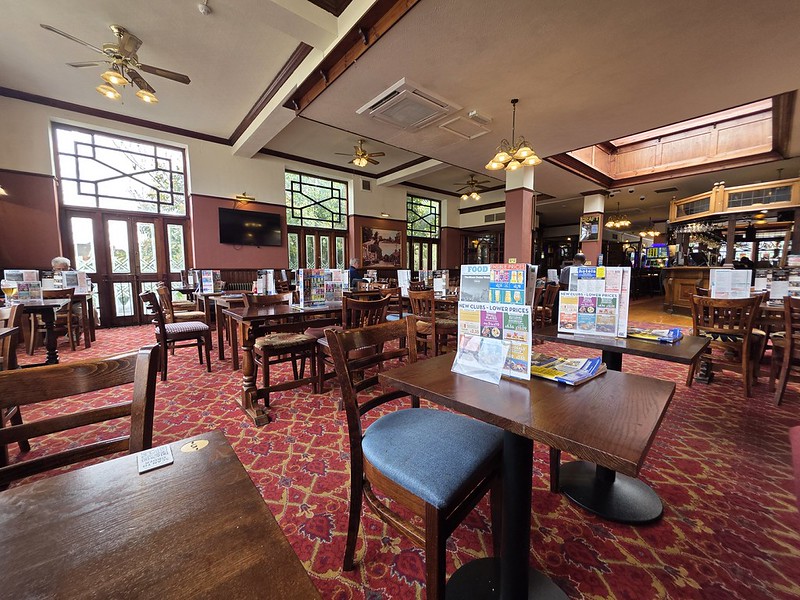
Apologies for the slightly sub-optimal image quality here, but this is the Moon Under Water in Colindale, which is also listed in the Good Beer Guide. Using the venue’s own history:
“Several Wetherspoon pubs have ‘moon’ in their name, linking them with the ideal pub described in detail by George Orwell. The highly regarded author named his fictional pub ‘Moon Under Water’. This one was purpose built as a branch of the Woolworths chain. It opened in early summer of 1939, serving a fast-growing suburb. Woolworths traded here at Varley Parade for 45 years, closing in 1984.”
This is the rear area of the pub, which feels more like the dining area. The service was friendly and timely, with the venue having a laid-back and comfortable feel to it.
This venue is on the cheapest price band which made this meal and drink under £6, which feels very reasonable to me. Although goodness knows what they did to the eggs. A perfectly decent arrangement with the non alcohol Guinness.
My now obligatory carpet photo.
This is the more lively front bar and as I was in the venue for quite a time and they had a special offer on the curry, I accidentally ordered one of those as well. Anyway, this was hot and tasted as expected, alongside my non alcoholic Erdinger.
I like looking at the reviews of JD Wetherspoon venues and I was once again tempted by that here. The venue is rated towards the higher end of the scale nationally and I must admit, I rather liked it here and didn’t rush to leave. But that’s evident as I had two meals.
“After driving 4 hours from Belgium with my 17-year-old son, we came here for a proper meal. I ordered a beer for myself and gave him a tiny sip with his meal — perfectly legal under UK law. The manager (pictured) didn’t even approach us himself — instead, he sent a waiter to tell us we had to leave. When I asked him directly why, he offered vague excuses and no real explanation. Our meals were shoved into cartons, and we were shown the door with no respect or courtesy.”
This reviewer has decided to post photos of the team member which seems entirely out of order to me. And he gave alcohol to an underage person which is against the policies of JD Wetherspoon and he wondered why he got thrown out?
“Shocked when I had to speak to this branch manager this evening. My 18 year old ordered on the app for a Manchester Moon under water – correctly selecting the Manchester location 0.3 miles from her. The app sent her order here??? 155 miles away Why no one knows?”
I think everyone knows, she ordered it to the wrong venue. The downside of JD Wetherspoon having about thirty pubs with this name.
“Awful experience, the assistant ‘manager’ who barely looked 21 took great pride in saying as two of our party did not have their IDs that they could not stay past 9pm. He then tried to say it’s the law, which it clearly is not and when asked to provide proof it was the law, he was unable too, then said it was the branch policy. Probably made his night being spiteful and nasty to customers. Thing about Wetherspoons, there is little point in complaining as they specialise in being cheap and could not give a monkeys about their customers.”
Challenge 21 is almost certainly in their licensing requirements, but might as well mock how old the team member looks.
“Need to retrain the chefs. Went in twice for tea as we was working away from home. Both times the food was terrible. Everything was over cooked. Even the fried eggs. If a chef cant cook an egg then its time to give up.”
I have some sympathy with the egg comment.
“Typical moons pub, grotty and full of Not trendy people, I only went because it was a works drink. Had one drink and had to leave.”
Hmmmm, those blasted non trendy people…
I was slightly disappointed to discover that there weren’t any negative reviews from customers who weren’t allowed to bring their dog in.
Anyway, I liked it here and it’s the first time that I’ve visited. There were six real ales available as well as a number of craft beers, all enough to justify their place in the Good Beer Guide.
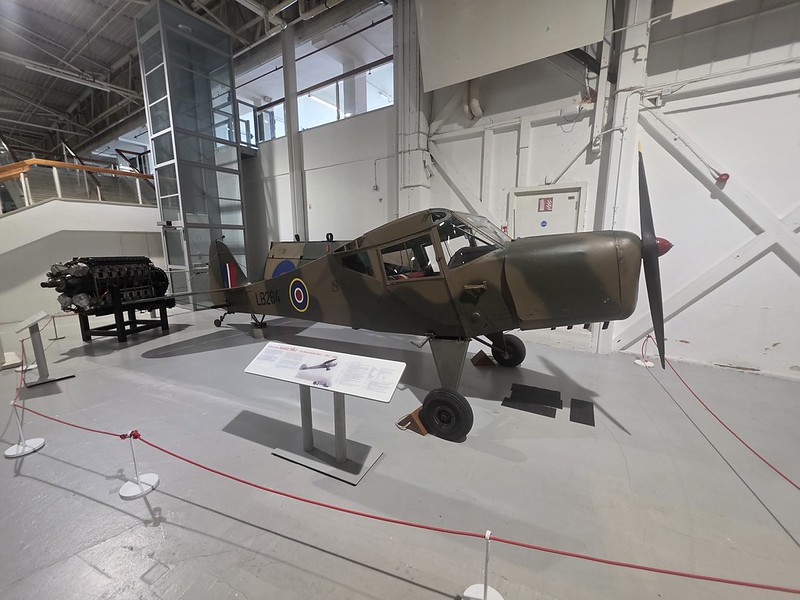
The Taylorcraft Auster Mk1, used as an Air Observation Post from 1942 to 1946, seems like a practical little machine. Its intentions were simple, get into the air, find things on the ground and help artillery hit them with greater accuracy than might otherwise have been the case. It rather feels like the drones that are currently being used in Ukraine and Russia.
Around 100 of them were built and in 1944, the Royal Air Force trained members of the British Army to fly them. I’m not sure whether that was because they weren’t exotic enough for the RAF pilots or were just incredibly easy to fly. There are a fair few of the later versions of the aircraft still about, but it seems there are only a couple of the Mark 1 versions, this one and another at Historic Army Aircraft Flight charitable trust. I think I like understated things, so this was one of my favourite aircraft in the museum, as who needs huge firepower?