Author: admin

  • Dachau – Dachau Concentration Camp (Walk of Horror)

    Dachau – Dachau Concentration Camp (Walk of Horror)

    20250821_102746

    This walk at Dachau might at first seem quite pleasant and peaceful. Formerly in a walled off part of the compound, this is now known as the ‘path of death’, it was laid out in the 1960s when the site was turned into a memorial and museum.
    20250821_102748

    However, it isn’t, it’s located near the site’s crematorium and this is the former pistol range where inmates were executed. There were numerous places around the camp where people were executed and it’s not known how many prisoners died here.

    20250821_102821

    The execution range with the blood ditch.

    20250821_102959

    Where ashes were stored.

    20250821_102836

    The little memorial garden where the ashes of thousands of people were placed.

  • Munich – Fisch und Schlüssel Sculpture (Fish and Key)

    Munich – Fisch und Schlüssel Sculpture (Fish and Key)

    20250821_143421

    Fisch und Schlüssel’ (Fish and Key) is a punchy public sculpture in Munich’s Maxvorstadt district, standing on Ferdinand-Miller-Platz directly in front of St Benno Church. It was created by the sculptor Iskender Yediler and installed in 2005, with the artwork being an aluminium cast showing a fish carrying a key. In the photo, I think I’ve managed to capture the key element beautifully, although I accept that the fish element isn’t entirely visible.

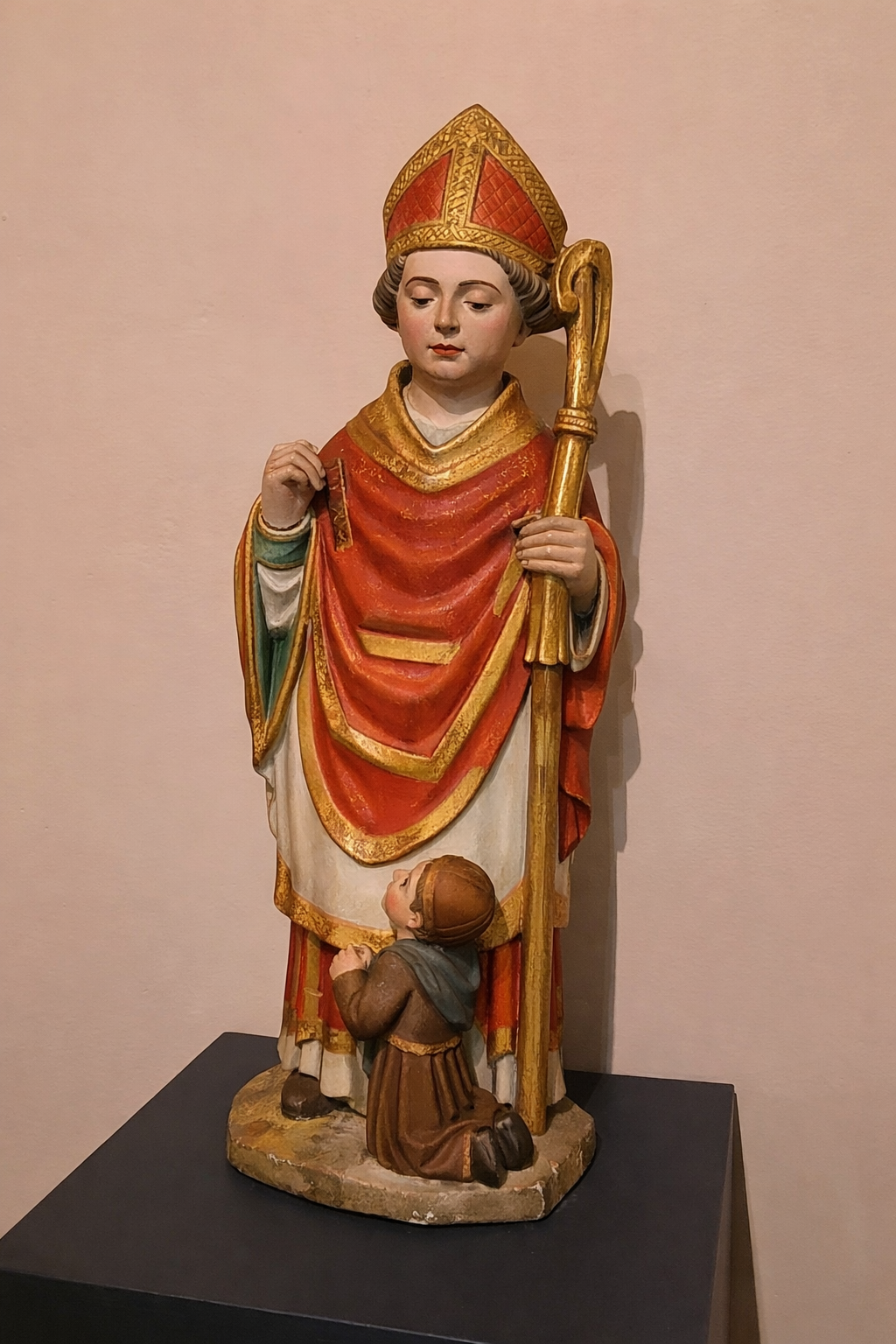
    The motif comes from the legend of St Benno, Munich’s patron saint, who was banished during a conflict over the ex-communication of Henry IV and so Benno told his canons to chuck the cathedral keys into the River Elbe. The key was found inside a freshly caught fish a few years later which surprised and delighted a lot of people…. Angry Protestants desecrated Benno’s tomb in Meissen in 1539, so the Wittelsbach dynasty (perhaps known best in the UK because of Sophia of Hanover, who is an important figure in the family tree of the British monarchy) promptly elevated him to become the patron saint of Munich.

  • Munich – Führerbau

    Munich – Führerbau

    20250821_150646

    This is the former Führerbau, which is where the Munich Agreement was signed on 30 September 1938. This deal was agreed by Nazi Germany, Britain, France and Italy, handing the Sudetenland, which was Czechoslovakia’s fortified and industrial border region, to Hitler. Czechoslovakia weren’t at the table to discuss the matter and the British Neville Chamberlain and French Édouard Daladier accepted the transfer to avoid immediate conflict. Germany occupied the Sudetenland in October 1938, stripping Czechoslovakia of key defences and heavy industry and leaving it strategically crippled. Chamberlain also signed a brief Anglo-German declaration with Hitler expressing the wish for peaceful relations, hence the famous “peace for our time” line on his return to London.

    20250821_150257

    The peace agreement didn’t hold, but Chamberlain perhaps didn’t really have much choice here. There was a chance in his mind that the peace agreement might work, but with hindsight it was inevitable that it would fail given Hitler’s evil intent. The document was signed in Hitler’s office, which is still there and used by the University of Music and Performing Arts Munich who now occupy the building. The building had been constructed between 1933 and 1937, part of the Königsplatz project that was part of Hitler’s architectural vision for the city.

    20250821_150641

    The city authorities would have ideally liked to have demolished all of the Nazi era buildings, but they already had a shortage of usable structures post-war and there was nothing wrong with this one other than its association with evil. But, for me to see this building was sobering, it’s not that long ago that Chamberlain turned up here in the hope that he could avert a war. There’s no obvious connection with the past other than for this subtle sign which is in German, Czech and Slovak, a gesture towards the attack on their nations that was agreed here.

    20250821_151057

    And the side of the building which was used by the US after the war as the central point to return artwork and cultural items stolen by Nazis back to their owners. It was given to the University of Music to give it a more positive use and to try and free it from its past. The more modern building to the right of the photo is the NS-Dokumentationszentrum, which during Hitler’s time was known as the Brown House.

  • Munich – BMW Welt

    Munich – BMW Welt

    20250821_124151

    As we were driving by, we thought that we’d pop into BMW Welt to see what the hype seemed to be about given the very positive on-line reviews. This is effectively a decadent car showroom which is free of admission, located opposite to the BMW Museum. This is the heart of Bayerische Motoren Werke and their global HQ, despite huge efforts being made by Dereham Town Council to get them to relocate to the centre of Norfolk.

    20250821_124338

    Some BMW cars.

    20250821_124333

    I was surprised just how busy this whole arrangement was.

    20250821_124426

    An old BMW car. I don’t think I’ll start a blog about cars if I’m being honest.

    20250821_124615

    The Rolls Royce Spectre, which apparently retails in the UK for a third of a million pounds. That’s a lot of Greggs.

    20250821_124634

    You can personalise your Rolls Royce should you wish.

    20250821_124543

    Richard didn’t like it as it wasn’t British enough.

    20250821_124747

    The Rolls Royce Cullinan, which is a little cheaper, but it still seems a lot of money for a car to me. Not that I’m in the market to buy a car, but I wouldn’t dare leave it anywhere in case it was scratched, vandalised or just stolen.

    20250821_124918

    This was Richard’s favourite car.

    20250821_125234

    Looking over the ground floor of the building.

    20250821_125212

    A BMW motorbike.

    20250821_125941

    We didn’t have time to go in, but this is the BMW Head Office on the left and the museum building on the right, both of which are located opposite to BMW Welt.

    BMW Welt is an impressive building insomuch as it’s clearly a popular place to visit. They had a few cafes, but they had rather forgotten to provide sufficient seating, but I’m sure anyone actually wanting to buy a car would be given a free hot drink. I did wonder whether if Richard bought a Rolls Royce whether they’d buy us lunch, but then he declared he didn’t like the designs and so that plan went out of the window. I suspect that I would be more engaged with this if I knew anything about cars of motorbikes, but it was an interesting place to see and especially as it was free.

  • Dachau – Dachau Concentration Camp (Gatehouse at Dachau)

    Dachau – Dachau Concentration Camp (Gatehouse at Dachau)

    20250821_093707

    The gatehouse at Dachau is the building which every prisoner had to pass through to enter the main compound of the concentration camp. The SS called it the ‘Jourhaus’, literally the guardhouse, and it sat on the boundary between the SS administration area and the camp proper. The current structure dates from 1936 when the site was rebuilt in stone and concrete using prisoner labour. That rebuild turned Dachau into the model for many later camps, and the Jourhaus became the set-piece entrance through which every new arrival marched onto the roll-call square.

    Architecturally it’s a two-storey, hipped-roof block with a central vaulted passage for the gate and small rooms to either side that once housed guards and clerks. In front of it ran the camp ditch and a narrow bridge and beyond it the space opened immediately into the Appellplatz, the vast parade ground where prisoners were counted for hours in all weather. The gate grid itself carries the infamous and deceitful phrase “Arbeit macht frei” and was made in the 1930s by a prisoner under Nazi orders, although the original is now stored internally after someone pinched it.

    20250821_093905

    This is the side of the building that the prisoners could have seen from their barracks and the gatehouse controlled every movement and because the Jourhaus stood exactly at the choke point between the SS zone and the prisoner compound, nothing and no one crossed without it being noticed. When the site became a museum in the 1960s, the Jourhaus remained the main entrance so that visitors would trace the same line of movement as prisoners once did.

    20250821_093951

    A plan of the building.

  • Dachau – Dachau Concentration Camp (Sculpture by Nandor Glid)

    Dachau – Dachau Concentration Camp (Sculpture by Nandor Glid)

    20250821_094456

    This sculpture sits on the wall marked “1933–1945” in front of the former maintenance building, which now houses the main museum at Dachau. The monument was created by the Yugoslav sculptor Nandor Glid (1924-1997), a Jewish partisan whose father was murdered at Auschwitz, and it was chosen through an international competition organised by the committee of former Dachau prisoners. It was unveiled in September 1968 and from a distance the work reads like fencing, uprights and strands that echo the camp’s perimeter but it’s then evident that it resolves into emaciated human forms entangled in barbed wire. The design is to allow the visitor to see the fence as more than infrastructure and the bodies as more than symbols. It is deliberately spare, without heroics or narrative scenes, so the viewer is left with the simple geometry of a system and the people it consumed.

    20250821_094507

    The main monument is large, roughly sixteen metres wide and over six metres high, and it anchors the roll-call square where prisoners once stood for hours in all weather. Nearby is this low relief showing interlinked prisoner triangles, the coloured badges used by the SS to classify inmates by category.

    The whole arrangement is powerful, especially the way in which it faces the parade ground where the ridiculous roll-calls would take place, designed to humiliate and exhaust the prisoners. I quite like these hefty sculptures, but there doesn’t seem much point trying for subtlety here when the focus needs to be on confronting what happened at Dachau.

  • Dachau – Dachau Concentration Camp (Arland Musser Photo of Attacked Guard)

    Dachau – Dachau Concentration Camp (Arland Musser Photo of Attacked Guard)

    20250821_110141

    This is one of the photos that Arland Musser took when the Americans liberated Dachau on 29 April 1945, showing prisoners beating an SS man who had disguised himself as a camp inmate. It must have been traumatic for the Americans to know quite what to do, their forces had been shocked at what they’d found and would normally want to protect everyone, but here they found a site where inmates wanted revenge for the horrors which they’d gone through. There was chaos as the American military lost control and started joining in on the attacks on the German guards, it took the strength of Felix L. Sparks, the American military leader, to regain control. He later wrote:

    “As I watched about fifty German troops were brought in from various directions. A machine gun squad from company I was guarding the prisoners. After watching for a few minutes, I started for the confinement area. After I had walked away for a short distance, I hear the machine gun guarding the prisoners open fire. I immediately ran back to the gun and kicked the gunner off the gun with my boot.

    I then grabbed him by the collar and said: “what the hell are you doing?” He was a young private about 19 years old and was crying hysterically. His reply to me was: “Colonel, they were trying to get away.”

    I doubt that they were, but in any event he killed about twelve of the prisoners and wounded several more. I placed a non-com on the gun, and headed toward the confinement area.”

  • Dachau – Dachau Concentration Camp (Stolen Sign – Arbeit Macht Frei)

    Dachau – Dachau Concentration Camp (Stolen Sign – Arbeit Macht Frei)

    20250821_093754

    In 1936, the Nazis made camp prisoners forge the gate to the site which said “Arbeit Macht Frei” or ‘work makes free’. This signage was replicated at other Nazi controlled concentration camps, giving an impression that the sites were somehow educational and beneficial when the reverse was true. Unfortunately the original gate was stolen in November 2014, just a few years after the Auschwitz one was stolen. The one that is in place today is a replica made to replace the stolen one, a completely sub-optimal state of affairs and a sinister theft which was likely done to order.

    20250821_111259

    Fortunately, in December 2016 the original gate was recovered under tarpaulin in Bergen, Norway after an anonymous tip-off. No arrests were made, but the museum was no doubt pleased and delighted to be able to have the original back. In the same way that the recovered Auschwitz sign was placed in a secure museum area after it was returned, the same was done at Dachau to prevent a recurrence of the incident. The museum carefully notes that the original lettering was removed by the Americans following the liberation of the camp, so this element dates from the 1970s.

  • Dachau – Dachau Concentration Camp (Overview)

    Dachau – Dachau Concentration Camp (Overview)

    20250821_113007

    I’ve been meaning to visit Dachau for some time to see the concentration camp, one of the earliest that opened during the Nazi regime and its purpose evolved over the years. This aerial photo was taken a few days before the Americans liberated it and it shows the scale of the site. The area marked in red is the section is the camp area that was used by the prisoners, which is also roughly the area of the site that remains open to visitors today. The former area used by the camp guards, the commandant and some of the workshop areas have since all been demolished.

    20250821_112933

    A model of the site.

    20250821_105629

    The site in 1944.

    20250821_111211

    A US army map of the site from 1946.

  • Munich – Munich Documentation Center for the History of National Socialism (Knife and Fork from the Brown House)

    Munich – Munich Documentation Center for the History of National Socialism (Knife and Fork from the Brown House)

    20250820_102347

    This is one of the exhibits at the museum which questions what the visitor thinks about them being present, noting “what kind of feelings do these traces of the past trigger in us?” as they’re cutlery from the Brown House which was formerly on this site. The Brown House (Braunes Haus) was the Nazi Party’s headquarters in Munich, set on Brienner Straße between Karolinenplatz and Königsplatz. The building began life in 1828 as a neoclassical city palace, later known as Palais Barlow, designed by Jean-Baptiste Métivier. In May 1930 the NSDAP bought it, financed in part by donations and loans from industrialists such as Fritz Thyssen and Friedrich Flick and they then had architect Paul Ludwig Troost refit the villa into a suitably imposing party HQ. It opened for business in early 1931 and served as the movement’s nerve-centre until the end of the regime. The house was badly damaged in wartime bombing, effectively destroyed, and its ruins were cleared in 1947. For decades the plot remained an empty scar in a quarter that had also included the Führerbau and other party buildings framing Königsplatz, a showpiece space the Nazis had reworked for rallies and ceremony.

    The Munich Documentation Center for the History of National Socialism (NS-Dokumentationszentrum) opened here in 2015, bringing a more positive use to the previous empty space. This seems the ideal place for exhibits such as this to be displayed, they’ve survived for nearly a century now and they may as well be on display in locations which explain the war and the reasons for it. It’s an intriguing survival and the Brown House is where the Blutfahne, or Blood Flag, was stored and Hitler had offices, the centre of where the Nazi movement grew in the early 1930s. If forks from the Brown House can trouble us, it is because they expose how the regime embedded itself in rooms that felt safe and respectable.