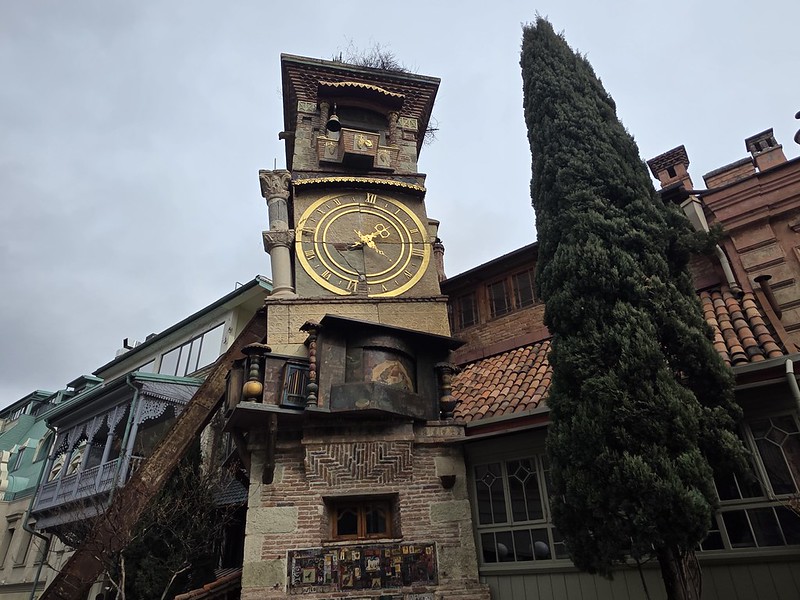
This was an interesting little arrangement in the centre of Tbilisi, but it’s not something ancient that’s being propped up, it’s the clock tower of the Rezo Gabriadze Marionette Theatre. It was completed in 2010 by the renowned Georgian artist and puppeteer Rezo Gabriadze, who designed the tower to look intentionally precarious. To add to the whole set-up, he utilised a large rusted iron beam as a prop to enhance the sense that the building is barely standing up.
We didn’t see it, as we weren’t aware to look out for it, but twice a day a screen at the bottom opens up to reveal a puppet performance representing the journey of a human life from birth to death. Also, every hour, a small mechanical angel emerges from a door at the top to strike a bell with a hammer, which explains why we saw people hanging about waiting when we walked by. I like a bit of quirkiness.
After a traditional meal we walked the 45 minutes or so to Batumi Central railway station, even though it’s not really very central.
I had high hopes for this train, it’s a double-decker that’s relatively new to Georgian Railways.
Georgian Railways, operating since 1872, with their first passenger service operating between Poti to Tbilisi.
The train was already at the platform, so I had a little look at the front (or back, I can’t remember) whilst waiting for the doors to open. One illogicality of the train was that although we had a compulsory seat reservation, they hadn’t marked what carriage was which from the outside.
Oooh, Stadler, like the Greater Anglia trains I’m now so used to. With that, it was time to board and there were document checks when boarding on, with the staff member pointing us where to go. He seemed cheerful and helpful, as did all the staff on board the train.
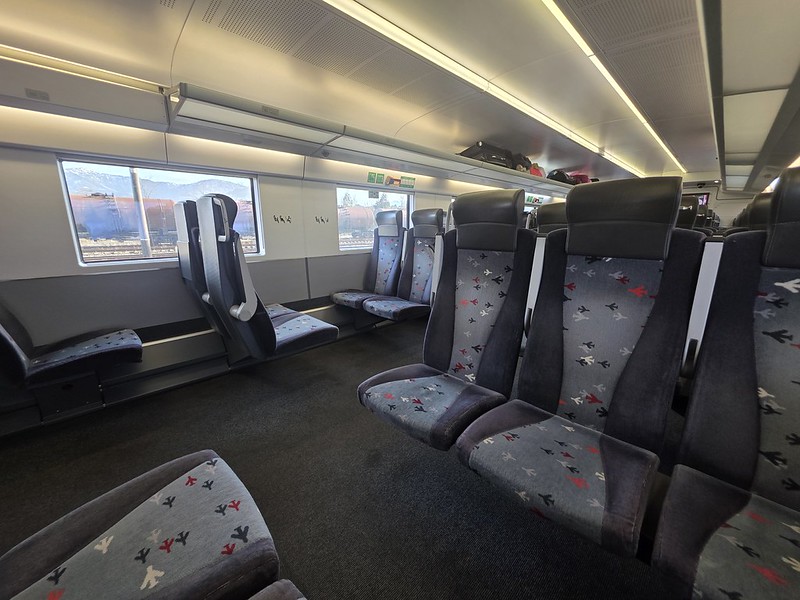
This interior is, broadly appalling and was something of a disappointment. Five seats across really don’t fit here, so there’s no comfort available when the train is full. They’ve also crammed so many seats in that passengers will have their knees hitting each other, with no table seats. There are power points but they’re in an odd recessed location, although the wifi worked well. And why have they decided to have planes on the seats of a train?
The internal signage was good, but I wonder why they’ve had Stadler build trains to a high build quality and then demanded from them a cramped interior? Ironically, the older trains looked like they were falling apart, but they were more spacious. But, the train was clean and tidy throughout, with even the toilets being in reasonable condition.
However, the train wasn’t very busy and so we had more than enough space and I was able to enjoy the rather beautiful view as the train went by the Black Sea at the beginning of its journey.
There are videos of this, and much else, to come….
There’s no buffet car, but there’s an affordable vending machine which was a more than suitable replacement.
I haven’t done a proper Jet Lag Snack Zone (a YouTube channel that I think is inspirational!) element yet, that’s something else that’s coming up, but these beef flavoured crisps from the vending machine were a bit chunky but provided a solid snack. 7/10.
Back to interior photos, here’s the upstairs of the train.
I’m pleased to note, that unlike the train in Turkey that was delayed for 12 hours, we arrived into Tbilisi on time. I very much enjoyed this rail journey and it was reasonably priced, but we were fortunate that it wasn’t busy. It’s a shame that they’ve packed so many seats in here, the train is a beautiful thing and the internal decor is bright and cheery.
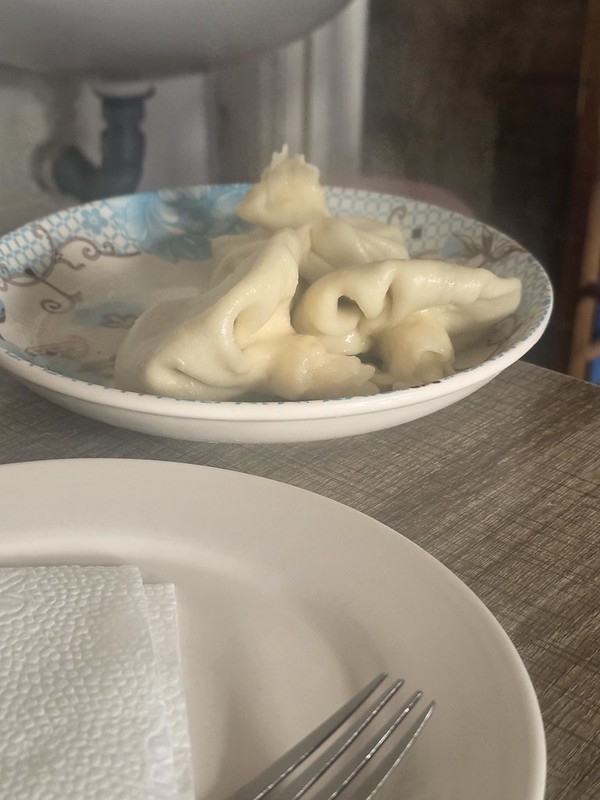
Jonathan had an idea to visit a back-street khinkali restaurant which seemed like something of an adventure. Khinkali are traditional Georgian dumplings that consist of pleated dough parcels typically filled with a spiced mixture of meat, such as beef, pork, or lamb along with aromatic herbs. The defining characteristic of the dish is the savoury broth trapped inside the dough, which is created as the meat juices release during the boiling process. Eating them is a specific ritual in Georgia, they are held by the ‘kudi’ (hat) or thick dough knob at the top, which remains uncooked and should be discarded, while it’s expected the diner makes a hole in them and drinks the soup. It all sounded like a right faff.
This wasn’t a shiny chain restaurant, it was very much a traditional and basic food option that has likely been serving locals for decades. There was a friendly welcome and an inviting atmosphere, so it all looked positive. The restaurant was full for most of our visit, so this was a fast service venue that was obviously popular, with the shop next door selling uncooked versions of them to take away.
That’s the entirety of the menu there, you can have beer and khinkali. There is nothing else.
They are not presentationally great if I’m being honest. I discovered later that they can be fried or steamed, just like the similar Polish gyoza, with the fried versions always looking better. I was quite suspicious about these before tasting them, but I had one and they were really rather lovely. No-one else in the venue seemed to be piercing a hole and drinking them, so I just cut into them and the liquid had a depth of flavour and some spiciness to it.
It was Jonathan’s turn to deal with the bill. I did try some of Jonathan’s beer, but it was, er, a little basic. But, it’s hearty stuff and I don’t think they’re trying to compete with my craft beer bar diet of sours with a chicken schnitzel. Definitely a recommended experience and the service really added to the whole arrangement.
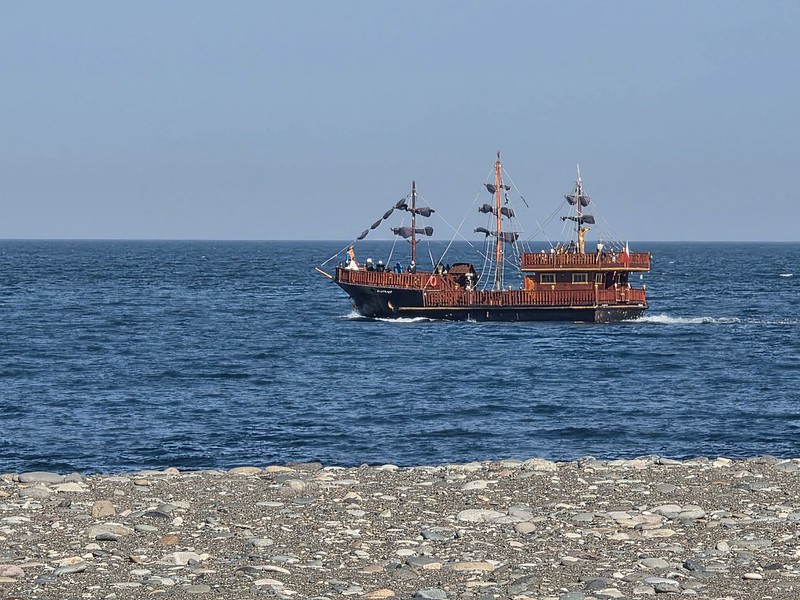
Whilst looking out onto the Black Sea, the pirate ship Eldorado came into sight.
It might just be a tourist ship now taking interested visitors around the coast to have a look at Batumi from the water, but it must have been quite something for those who lived here to see invaders approaching by boat. There have been pirate boats on the Black Sea for hundreds of years from the times of the Goths and, in not a dissimilar way, there is still military action in the waters of the occupied territories of Ukraine.
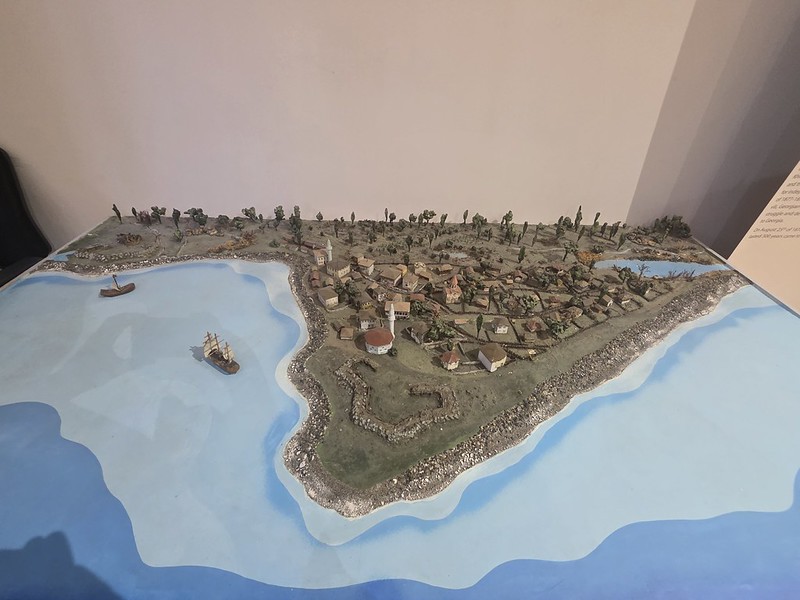
In my last post I showed a map of Batumi from the very end of the nineteenth century, but this is what it looked like in 1870. This is from a time before the railways reached (they got here in 1883) and before much of the development that took place later in the century was even thought of. A few years after this more defensive structures were added by the Ottomans, fearing a Russian invasion, and it was all likely relatively peaceful.
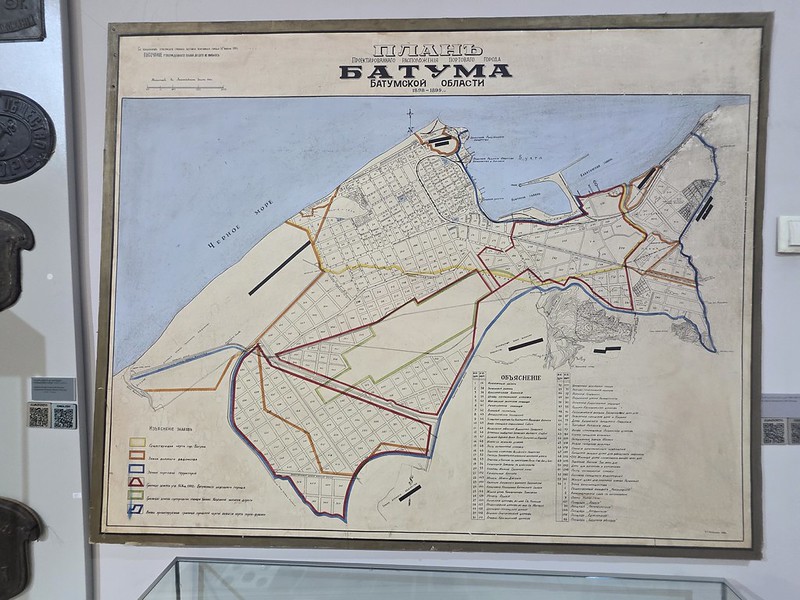
Our second museum of the day was the Museum of the State of Adjara, a wide ranging affair which had this interesting map of how the city looked in 1899. The seafront area is only half developed here, with the old city and port being the most built up at the time.
The current railway station, of which more soon, is currently located around two miles outside of the city. In this map, the original railway station is visible, in a more convenient central location. It reminds me a little of the early maps of Las Vegas that were split up into these smaller plots.
I get the impression that in twenty years the city of Batumi will be hard to recognise because of all of the residential and commercial developments being built. The residents of Batumi live in interesting times (which may be good or bad)……
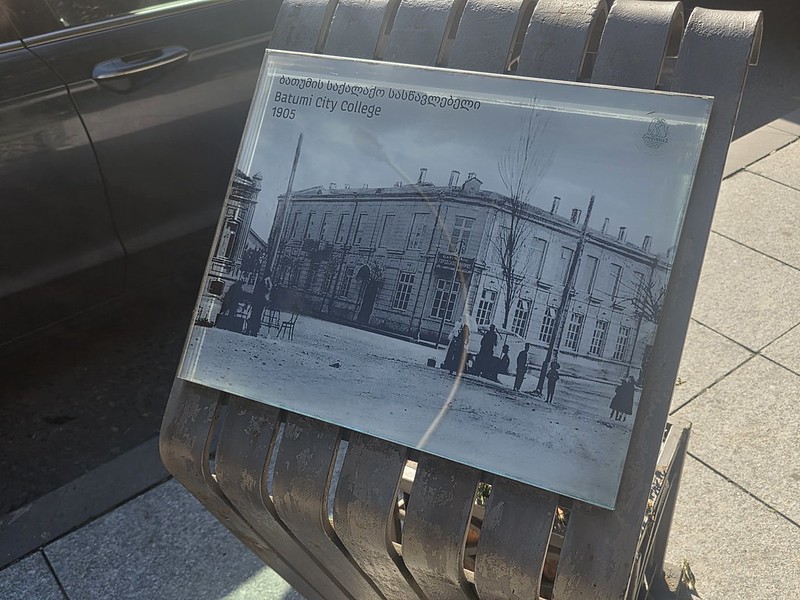
There were a few of these around Batumi, showing what the city once looked like. In a city which is as fast changing as this, I really like that they’ve done this to try and get an understanding of how things once looked.
The building has changed somewhat since the original photo was taken in 1905, it seems to have gained a floor now and also changed its function.
And the last painting for the moment as I’m conscious that this blog is still in Batumi and I’m Prague ready to come back to the UK, so it’s not what might be called live blogging…..
Anyway, this is another artwork by Richard Sommer (1866-1939) who I’ve already mentioned went missing at the outbreak of the Second World War. The city of Samarkand, in Uzbekistan, seems interesting because of its long history, although I suspect it’s going to be a while before I get to visit it.
The element that I was most interested in here is that AI mentioned it thought that this was likely purchased by a wealthy member of the Russian nobility. This was apparently a time, just before the First World War, when Russian nobles were running this area of the world and they wanted an artistic depiction of the cities that they were governing. I’ve never really thought of the Russian elite being sent to this region, in the same way as the British sent their elites to India, but I’m attracted to the thought that this painting was a link to that.
Perhaps the frame was an addition to that feeling of decadence and ostentation, a period of time when Russia felt its international strength growing. I am perhaps overthinking these things, but I like distractions….
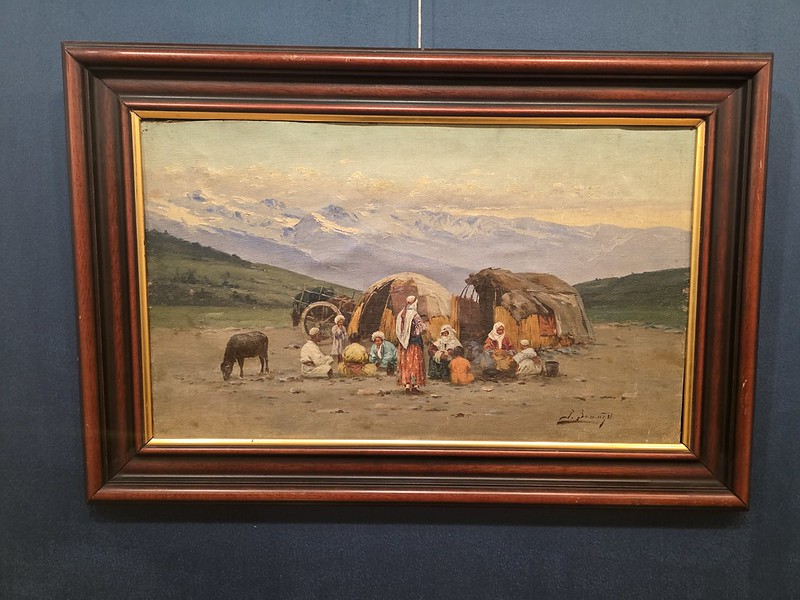
This oil painting is by Richard Sommer (1866-1939) who was a German who studied in St. Petersburg and became an influential artist in Russia. He then travelled extensively around Georgia, Armenia and Azerbaijan, although the Second World War came around and he disappeared. This was a melting pot of people at the best of times before the conflict threw everything into the air, so anything could have happened to him.
The painting itself is of two yurts, now more commonly used by the middle class in fields across England as some glamping project, with some nomadic people. In the background are the Transcaucasian mountains, which we didn’t cross on our two week trip to the area (not least as they’re on the Russian border) but we can close to them at times.
Not being an expert on frames, I’ve gone to AI to date that, and it tells me that it’s a utilitarian picture frame from the late 1800s that was functional and decorative. And that fits into this being something likely painted for the home market, a little bit of culture that was on the wall of someone’s house once…
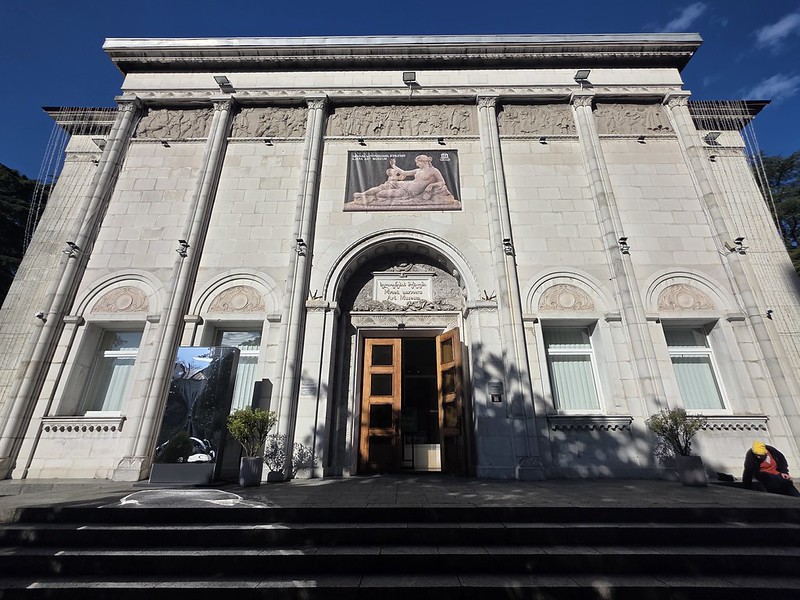
We decided on our final day to visit two museums in Batumi before making our way to the train to Tbilisi. So, expect a few more posts about those before I move on…..
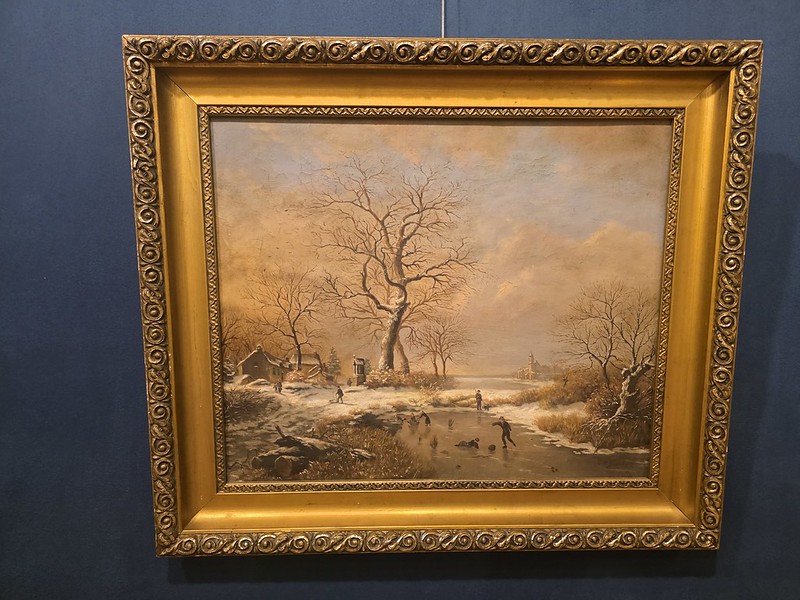
The gallery notes that this painting is entitled ‘Winter Evening’ and was painted by Charles HJ Leickert (1816-1907). I’m finding ever more use for AI to tell me about paintings and artworks, including to what to look for, which might seem a retrograde step for some, but it does add layers of complexity to me.
Put straight in, AI thinks that this was painted by a Dutch artist in the eighteenth century. Although it has the date of painting wrong by a century, it has correctly identified the nationality of the painter. But I’m less concerned about that, as I like the reasons for why it has come to the conclusions that it has.
The twisted tree in the centre was a clue to AI, it claims that this was a common Dutch artistic ‘trick’ to draw the eye to the heart of the painting. It then mentions that Dutch artists liked to draw in figures skating on the frozen ice, to show the resilience of the population and how they came together in times of poor weather. And, finally, it noted that the church in the background showed a religious connection and the small houses a rural connection which all came together in community.
I don’t know whether AI is right on its logic, but I think there’s something magical about being able to get another perspective on an artwork. It also makes a guess that the heavy frame signified that it was likely part of a wider collection of paintings, rather than just one or two that a private owner might have.