
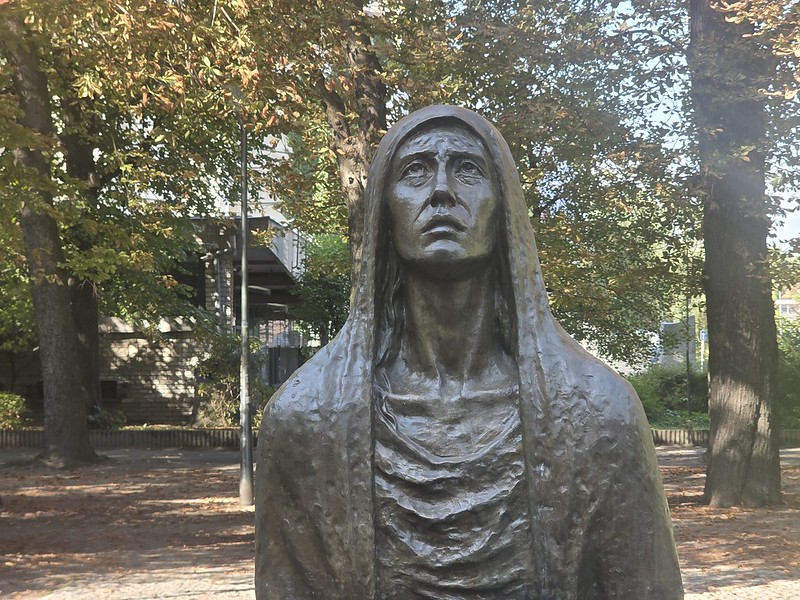

This is the memorial to the massacre at Katyn, or to give its full name “the Memorial to the Victims of Katyn, Kharkov and Mednoye Massacres and Camp Prisoners in Kozelsk, Starobelsk and Ostashkov.” It commemorates the 1940 massacre of thousands of Polish officers and intellectuals by the Soviet NKVD, one of those bleak moments of twentieth-century history where humanity was entirely and completely absent. It was a desperate attempt by the Soviets to destroy the Polish military leadership and an attempt to erase statehood. The Soviets had been humiliated by the Poles in the years after World War One with the Polish-Bolshevik War and I can understand their complete terror about needing to face another conflict.

The memorial, which is rather substantial, was erected in Juliusz Słowacki Park in 1999 and the official unveiling was on 22 September 2000. At the rear of this photo is the representation of the Angel of Death.

This represents the Mother of the Polish state cradling an executed prisoner who has a bullet hole in the back of his head and his arms tied together behind his back.

A small plaque notes that Tadeusz Tchórzewski was the sculptor. The monument is now under the care of the Lower Silesian Katyn Family Association which comprises of family members and descendants of those who were murdered. Wrocław was still Germany during the Second World War, when it was Breslau, so the impact in the city during these years were very different from other parts of Poland.

Powerful. There’s an information board nearby which reads:
“In the spring of 1940, on Stalin’s orders, 22,000 Polish officers, policemen and other prisoners of war from the Kozelsk, Ostashkov and Starobelsk camps were murdered with a shot in the back of the head in Katyn, Mednoye, Kharkov and in unknown places in the former USSR. In tribute to the murdered, this monument was founded by the compatriots of Wrocław in 1999 on the initiative of the “Lower Silesian Katyn Family” association.”
The Soviets covered up evidence of their executions after the end of the Second World War as they sought to bring Poland under their control. After 1990 and the collapse of the USSR the truth outed and evidence of the war crimes became much clearer after a series of exhumations. It’s evident that this powerful sculpture was needed in the 1990s to start spreading information about Katyn, something that had been kept from the Polish population by the Soviets. The Soviets never really convinced the Polish population that they were somehow their protectors in the post-war period, the collapse of the communist state in Poland was perhaps always inevitable and it’s maybe surprising that it lasted as long as it did.