

Carrying on from the first part of my post, this is Kościół św. Wojciecha or the Church of St. Wojciech. St Wojciech parish in Warsaw’s Wola district was established in 1927, though plans to build the church itself began in 1898.

It was heavily damaged in September 1939 and during the Warsaw Uprising the Germans used it as a transit camp for civilians expelled from the city, where clergy tried to help those imprisoned there and some were killed. The church was rebuilt following the end of the Second World War and it’s hard to imagine the terrors, such as those in the above photo, that took place here.

This is a German photo from around 1941 showing the damage which had been done to the church in 1939.

The grotto outside of the church.

This memorial reads:
“At this site, during the Warsaw Uprising from 1 to 5 August 1944, German forces murdered and burned many residents of nearby homes. Among those killed from 7/9 Syreny Street were members of the Korzeń family: Bolesław, 69; Ludwik, 65; Piotr, 60; Artur, 33; and Hanna Niewiadomska, 21. Unveiled on 1 August 1995.”

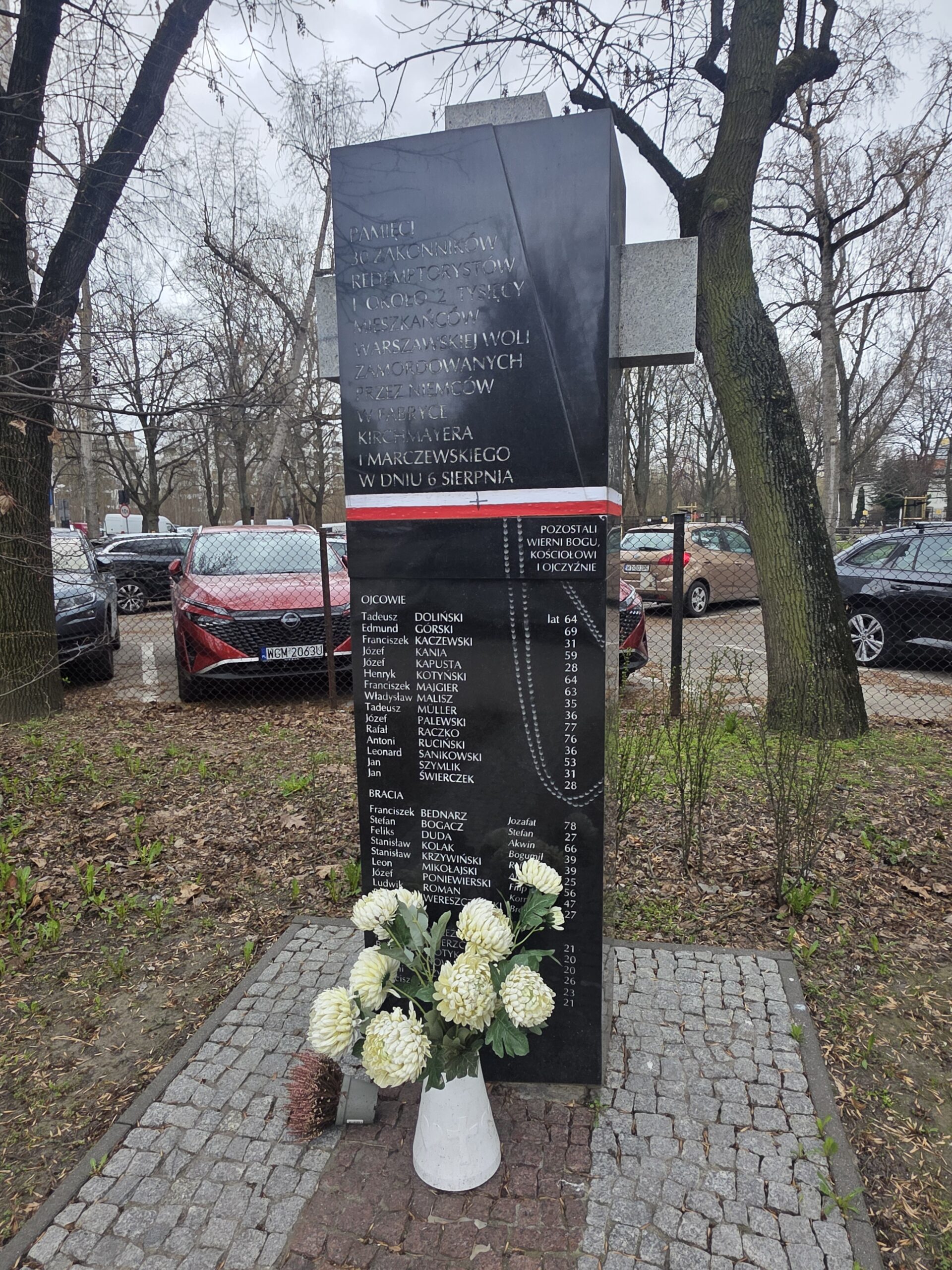
This memorial reads:
“In memory of 30 Redemptorist monks and about 2,000 inhabitants of Warsaw’s Wola district who were murdered by the Germans in the Kirchmayer and Marczewski factory on 6 August. They remained faithful to God, the Church and their homeland.”
When I was taking this photo, an elderly lady came up to talk to me. She was putting flowers down and telling me something in Polish about her family, but unfortunately that was the limit of my understanding. Realising I was British, she pointed to other monuments, thanking me several times for what I assume she thought was my interest in the heritage of the city. If it’s the case that this monument represents members of her family, that would have been something of a privilege, so I’m going to assume that it’s that.

This memorial reads:
“This place is consecrated by the blood of Poles who died for the freedom of their country. Here, on 6 and 8 August 1944, German forces shot around 4,000 Poles, including participants in the Warsaw Uprising and residents of nearby homes.”
The Wola Massacre was one of the worst war crimes of the Second World War. I’ll leave this with a quote from a mother who lost her son as part of the murders.
“We were halted, ordered to stand facing the square where the machine guns were positioned, and immediately the first bursts were fired. Hit people fell, shrieking and screaming.
I saw my husband and children go down and I collapsed myself, unhurt; already on the ground, I got a bullet in my left arm. Lying motionless on the corpses, I played dead.
After a while, the bursts died down; both nearby and farther away, I heard heavy steps and single shots. I understood that it was soldiers walking among the bodies, looking for survivors and finishing them off with handguns.
I lay there, quietly, for a long time, maybe two hours, and when I opened my eyes, I saw that the ‘Ukrainians’ were still in the square. My little son crawled up to me, wounded. I begged him to lie still and be silent, but he’d been shot through a lung and was in too much pain. An untimely move gave him away.
I heard heavy steps and a shot, and after that, my boy did not move anymore. From the town hall building a burning window frame fell to the street, and I saw the clothes on my son’s dead body catch fire.”
That little boy could well still be alive today if not for the German massacre.

And some street art near the metro station to bring a little positivity to proceedings.