

I haven’t forgotten my plan to visit every station on the Warsaw metro project, it’s just taking me a little longer than expected to actually finish it…

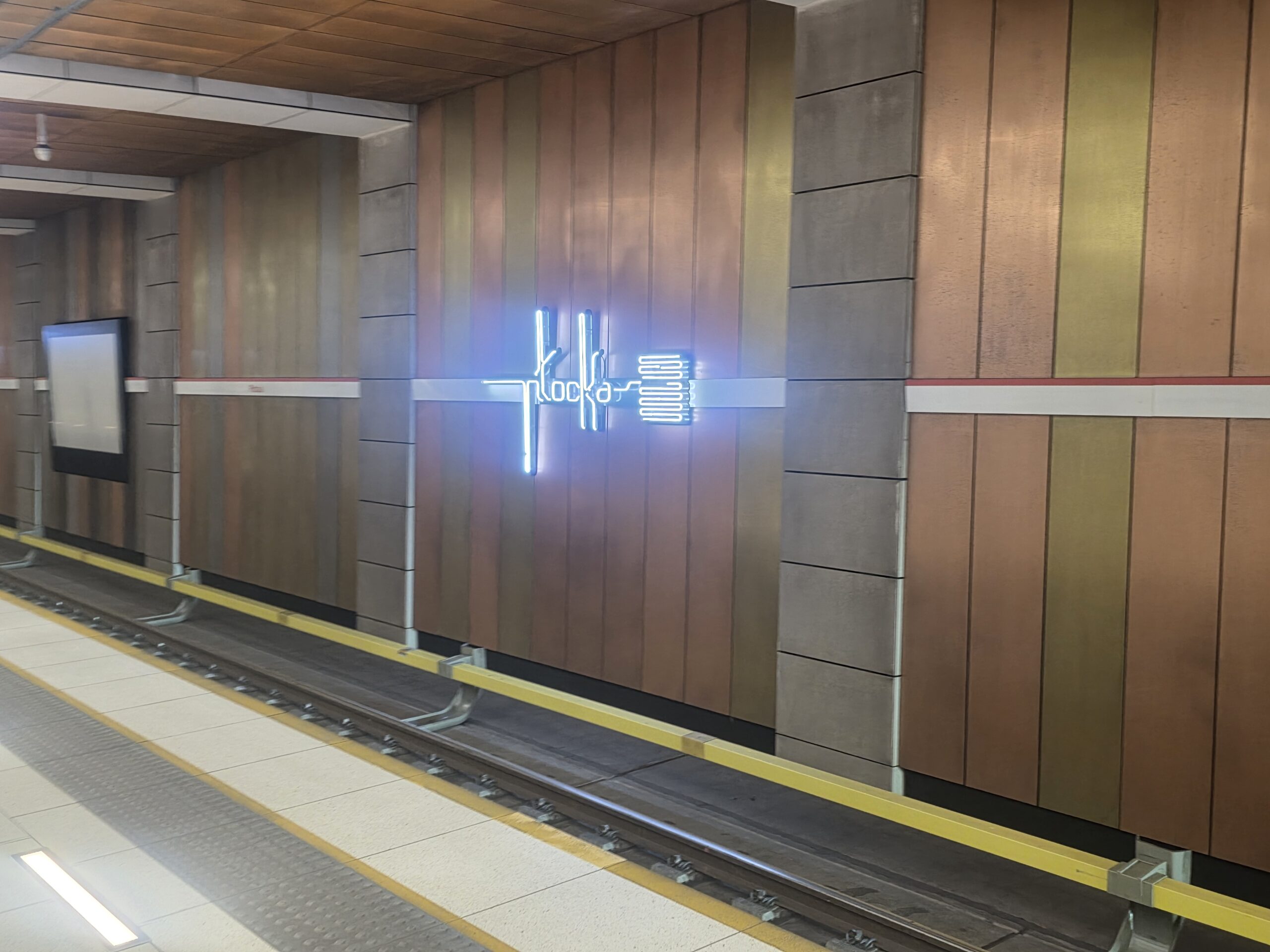
A very jazzy sign on the platform of Płocka, which is located on the M2 metro line. It’s all relatively new, the station opened on 4 April 2020 and is the first station of the extension to the existing line.

It’s not immediately evident what this is in the floor near the entrance, but it’s actually a copy of forest elephant bone that was found here during the construction of the station. The bone that was uncovered dated back around 130,000 years and this was the European elephant which was twice the size of the existing Asian ones.

The whole station feels modern and clean, with the usual lack of visible staff anywhere. But ticket prices for public transport in Warsaw are very cheap, just a fraction of London, and the network feels efficiently run.

My plan for writing about each station is to find elements that are interesting nearby, but there are so many for Płocka that this is something of a challenge to narrow it down. As such, I’m going to have to split this one into two separate posts. There are plenty of residential properties here, which is in the Wola district of Warsaw.

The National Centre of Culture building.

This area was very badly impacted by the German atrocities during the Second World War, particularly towards the end of it. This memorial reads:
“Here, on 5 August 1944, on the grounds of the Ursus factory, at a site of mass execution, the Nazis shot about 7,000 prisoners.”
This is part of what became known as the Wola Massacre and was a response to the hugely successful Warsaw Uprising which shocked and terrified the German high command. The Polish resistance and insanely brave locals fought back and made the situation in Warsaw almost unmanageable to respond to. The Germans responded with mass killings. Now is the time to mention Heinz Reinefarth (1903-1979) who was one of the most evil war criminals of his time, but was shockingly allowed to get away with his crimes after the war. Poland hasn’t forgotten him and his involvement here.

This is the Ursus factory at 55 Wolska Street where the massacres took place of thousands of local residents. Local men, women and children were rounded up and shot, sometimes after being tortured or sexually assaulted.

On 10 August 1944, the Germans murdered around twenty Poles here, outside where the pasta and instant coffee factory was located known as ‘Bramenko’.

When I first came to Warsaw, getting on for 15 years ago now, there were many more derelict buildings like this, but most of them have now been developed.

This memorial on Wolska Street was a little obscured, but it notes the mass killing of many Poles on 23 December 1943 with the full text reading:
“The place sanctified by the blood of Poles who died for the freedom of their homeland. Here, on 21 and 23 December 1943 in mass executions, the Hitlerites shot many Poles”
The plaque commemorates the victims of the street executions conducted in the period completed on the orders of SS-Brigadeführer Franz Kutschera (1904-1944). It’s been noted that following further research that the dates on this are slightly wrong, but that takes nothing away from the murder.
To be continued as they say…