
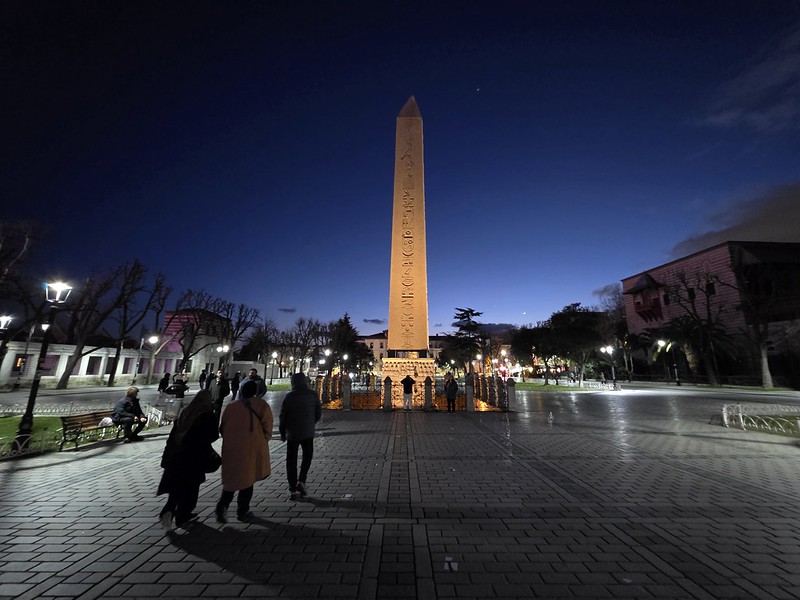

The Obelisk of Theodosius originated in Ancient Egypt as one of two monuments commissioned by Pharaoh Thutmose III to stand outside the Temple of Karnak in Luxor during the 15th century BC. Carved from red granite, it commemorates the Pharaoh’s victory during a crossing of the River Euphrates. The monolith remained in Egypt for centuries until the Roman Emperor Constantius II had it transported down the Nile to Alexandria in 357 AD to celebrate his twenty years on the throne. I mean, it’s either that or you build yourself a nice ballroom, although I suspect the engineers responsible were probably a bit stressed by traipsing this thing about.

Perhaps the engineers couldn’t be bothered by it as it lay on the docks for decades until Emperor Theodosius I successfully moved it to Constantinople in 390 AD to decorate the middle bit of the Hippodrome. During the transition, the obelisk was shortened to nearly two-thirds of its original height to facilitate transport which sounds like something my friend Liam would do to make things easier. Then I would discover that my precious obelisk has arrived with a chunk missing.
It was eventually mounted on a marble pedestal featuring detailed bas-reliefs that depict the Emperor and his court watching chariot races. Despite surviving numerous earthquakes and the fall of empires, the monument remains in its original Byzantine location today in what is now Sultanahmet Square. Incidentally, those bronze cubes act as shock absorbers in case of more earthquakes.

The sheer age of this is something of a joy to behold, the history that it has now just in its creation, but its moving about by Roman emperors and then in the heart of Istanbul for centuries.

And here it is at night.