

This is the beautiful Metekhi Church, built in the late thirteenth century and early demolished by the Soviets. It’s thanks to people such as Dimitri Shevardnadze that this building was saved, as so many other churches were lost during the occupation. Although the church itself was saved, the fortress that was built up around it was demolished.

The view looking out from the front of the church.

I like the quirky porch way with evidence of some fine stonework and some rather time damaged stone.

Some tombs in the floor.

Some of this graffiti does look quite old, it’s suggested that it might be from the prisoners that were held here in the nineteenth century when the fortress complex was used as a prison.

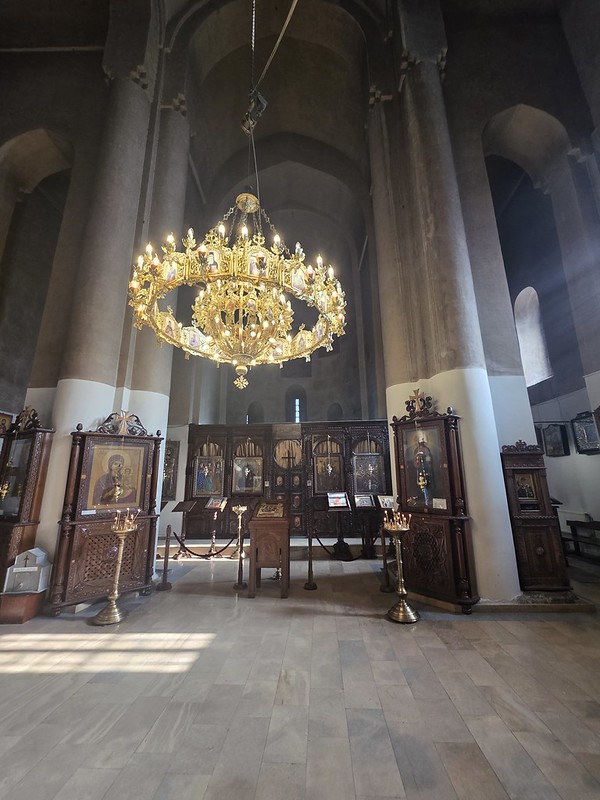
The interior wasn’t as decorated as some of the other churches that we visited in the city, but it felt spacious and warm. The slight difficulty that they have here is that it’s become something of a tourist destination, which must make operating it as a working church as something of a challenge.

This is an icon of Saint Seraphim of Sarov, one of the most revered figures in the Eastern Orthodox tradition. This specific depiction illustrates a well-known period of his life where he spent 1,000 consecutive nights praying in the forest. He is shown kneeling with his hands raised in prayer, a posture that represents his intense devotion and spiritual struggle. In the upper right corner of the icon, the Virgin Mary is depicted, referencing the numerous visions the saint is said to have received from her throughout his life.
During the post Second World War period, the building was used as a depository for artworks from the National Museum of Art with a large stone wall built across it. This was later demolished in 1974 and the building became a youth theatre. Following political changes, the building once again became used as a church at the end of the 1980s. It’s positive that that the church has survived at all, but the constant changes of usage, including an earlier period when it was used as a gunpowder arsenal, have meant that much of the interior decoration has been lost.