

The Timișoara Orthodox Metropolitan Cathedral, something of a soaring landmark at the edge of Victory Square, stands as one of the most iconic symbols of the city and the wider Banat region. Built between 1936 and 1941, the cathedral was designed by architect Ioan Traianescu in a distinctive Neo-Moldavian style that harmoniously blends Byzantine, Ottoman and late Renaissance elements. Its silhouette is defined by eleven towers, the central spire reaching an impressive height of 90.5 metres, making it one of the tallest religious structures in Romania. The exterior is notable for its vibrant polychrome facades, featuring intricate brickwork in shades of red and orange, complemented by glazed ceramic roof tiles that form traditional Romanian mosaic patterns. Because the cathedral was constructed on marshy ground, it rests upon a massive concrete slab supported by over 1,000 reinforced concrete pillars driven 20 metres deep into the soil.

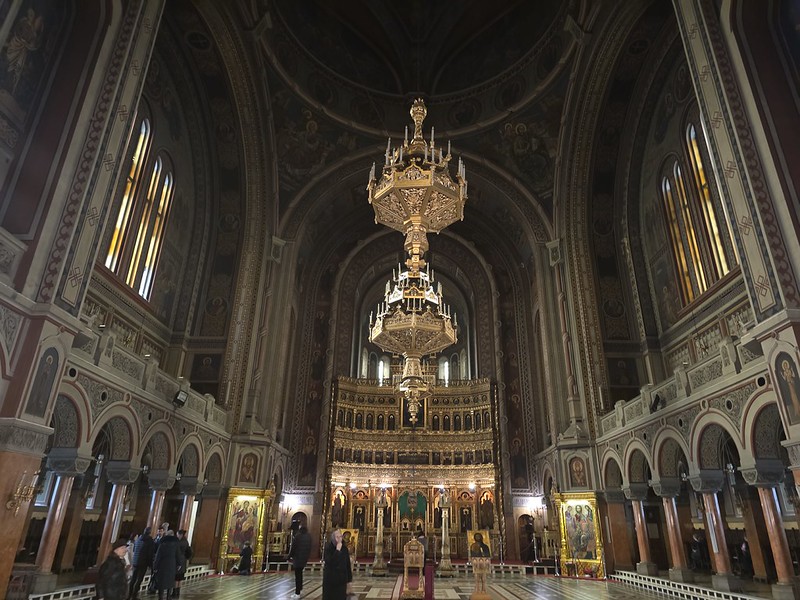
I decided to only take one photograph as this was a place of worship and I was evidently the only tourist, not that anyone looked at me or said anything. This is a deeply impressive cathedral, not because of its decoration or design, but because there was something else going on. There were acts of devotion all around me, but there were also people sitting in the seats to the side reading and thinking, this was a place for true reflection.
The interior of the cathedral is clearly grand, designed to accommodate up to 5,000 worshippers within its expansive, cross-shaped plan, although I’d suggest that this would be somewhat packed. The walls are adorned with elaborate frescoes by the renowned painter Anastase Demian, though the completion of these works was significantly delayed by the onset of the Second World War. The iconostasis is magnificent and was carved and gilded in 22-carat gold by the sculptor Ștefan Gajo. There’s a link between the building and the 1989 Romanian revolution, but more of that in another post.