Tag: Westerplatte

  • Gdansk – Galleon Tour to Westerplatte

    Gdansk – Galleon Tour to Westerplatte

    [I originally posted this in June 2018, but have reposted it to fix the broken image links]

    It was my final day in Poland and Łukasz’s suggestion to go on a pirate galleon to Westerplatte didn’t seem like a bad idea. It required very little energy and involved sailing the high seas. Well, the Baltic Sea.

    20180626_115025

    The company operating the trip has two boats that they use, which are quite different in design, but both look the part. We got to go on both of them, the Czarna Perła (the Black Pearl) and the Galeon Lew (the Lion Galleon).

    20180626_150234

    They had live music with a man playing sea shanties, he was surprisingly good.

    20180626_135945

    We had a little visit to Westerplatte, with the monument in the background. We only had an hour there which would have been insufficient to actually see the entire historic site. It was certainly much busier than when I had gone before in November 1996.

    20180626_142858

    Our galleon arrives into Westerplatte, ready to sweep us back into Gdansk. We enjoyed watching some of the visitors trying to barge their way up the gangway to ensure that they got first entry to the boat…..

    20180626_152010

    Gdansk harbour area.

    20180626_151113

    Watching the other galleon go sailing past us as we headed back into Gdansk.

    20180626_152200

    The final trip was over as we arrived back into Gdansk.

    20180626_151537

    I’d never noticed this sign before, but it’s on the entry to the central harbour area.

    20180626_144718

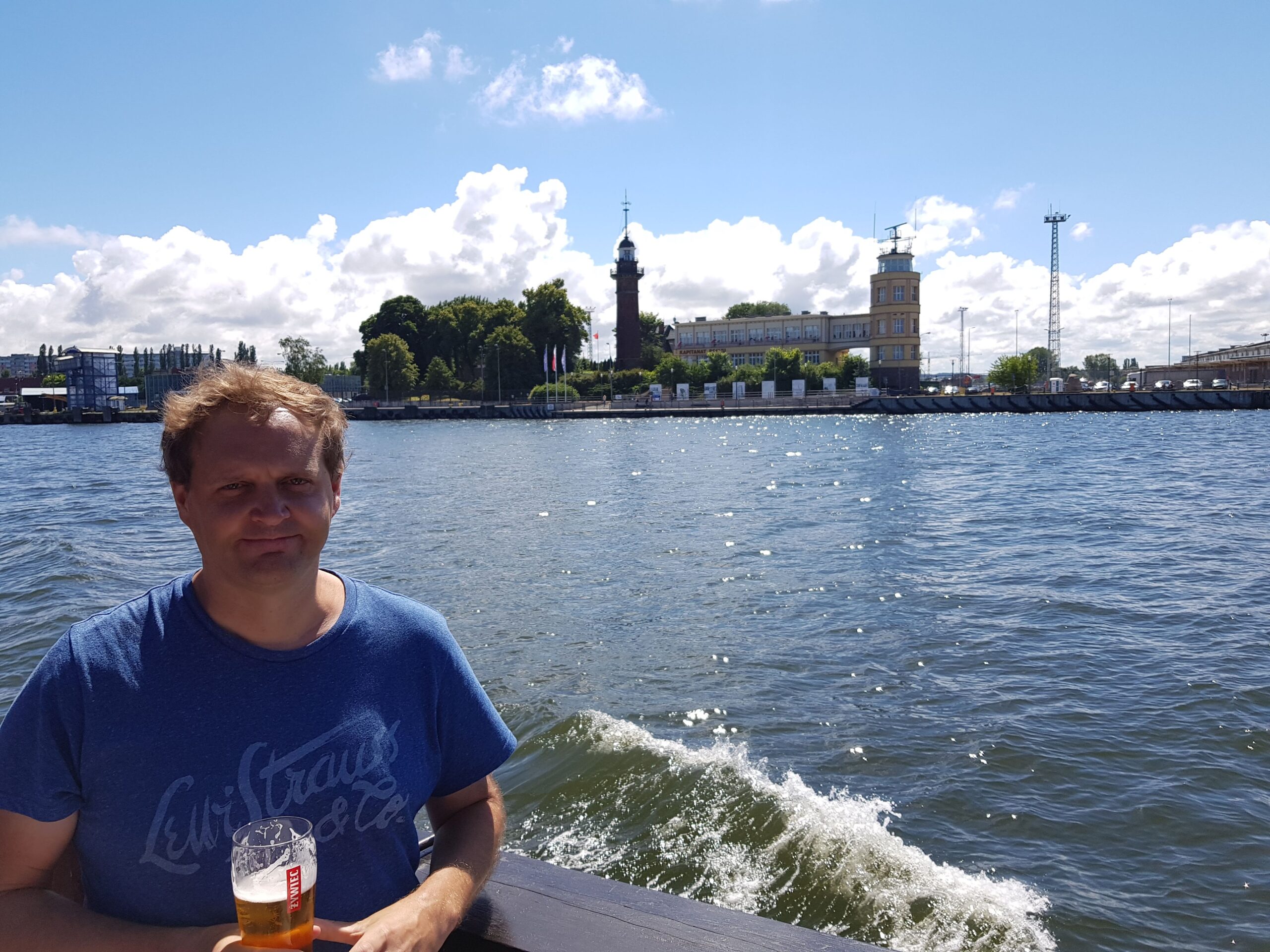
    Łukasz, surveying the high seas and wondering what life would have been like as a Polish naval commander.

    20180626_144314

    Me, wondering what free gift Greggs will be sending me this month on the app.

  • Gdansk – Westerplatte

    Gdansk – Westerplatte

    [I originally posted this in June 2018 regarding a visit to Gdansk in November 2016, but I’ve reposted it to fix some broken image links]

    Back to November 2016, when I visited Westerplatte which is where the first military conflict of the Second World War took place. Of all the places that I visited on that trip, this is the one that stayed with me for the longest, as the area is now so serene and peaceful that it’s hard to imagine the horrors of what happened there.

    20161119_125735

    For such an important historical site, it’s not particularly easy to get there. There are buses which go to and from the site from Gdansk city centre, but they’re not that frequent. The buses were though quite busy, so perhaps in time the frequency of the buses might increase. For the moment, buses 106 and 138 go the site and they’re the standard bus ticket price.

    20161119_124403

    The site is substantial in size and it contains a large memorial to the battle, as well as numerous buildings in various states of repair. Some of the buildings are nearly entirely destroyed, a few are still standing, but most are badly damaged. There’s no entrance charge to enter the site and there are numerous information boards placed around the location to allow visitors to interpret the site. My investigation of the area took just over two hours, although I could have done with just a little more time, but was constrained by the bus timetable.

    20161119_124622

    Back to the importance of Westerplatte…. Gdansk was at the time known as the Free City of Danzig and was technically run by the League of Nations to ensure that it was protected. However, the League of Nations wasn’t a particularly effective or strong organisation, and it was soon railroaded into positions which weren’t in the interests of Poland or its people.

    Danzig had a majority German population, so it found itself as a bastion of empire in what was now an area surrounded by Poland. The compromise agreement of being managed by the League of Nations was never really tenable, as German nationalists wanted it back. With the rise of the Nazi party in Germany, that desire of seeing a German Danzig became an important point of principle for Hitler.

    20161119_131138

    On the 1 September 1939 the German ship Schleswig-Holstein fired upon the Polish troops at Westerplatte and the war had begun. The Polish resistance surprised, and I think horrified, the Germans. The Poles were also holding other locations in Gdansk that the Germans were to attack, and the strength of the defence was respected by the German troops. However, the Nazi control saw it as a substantial threat, and so perhaps took a much more aggressive line to how they treated the Polish military.

    Eberhardt_et_Sucharski

    The defence of Westerplatte did delay the Germans by many hours, which was the initial point of building these defensive structures. Around 15 Poles were killed during the battle, but around 250 Germans lost their lives. The Germans soldiers at the site were so impressed at the bravery of the Polish defence that when the Poles surrendered, the commander of the site was allowed to keep his sword.

    20161119_132723

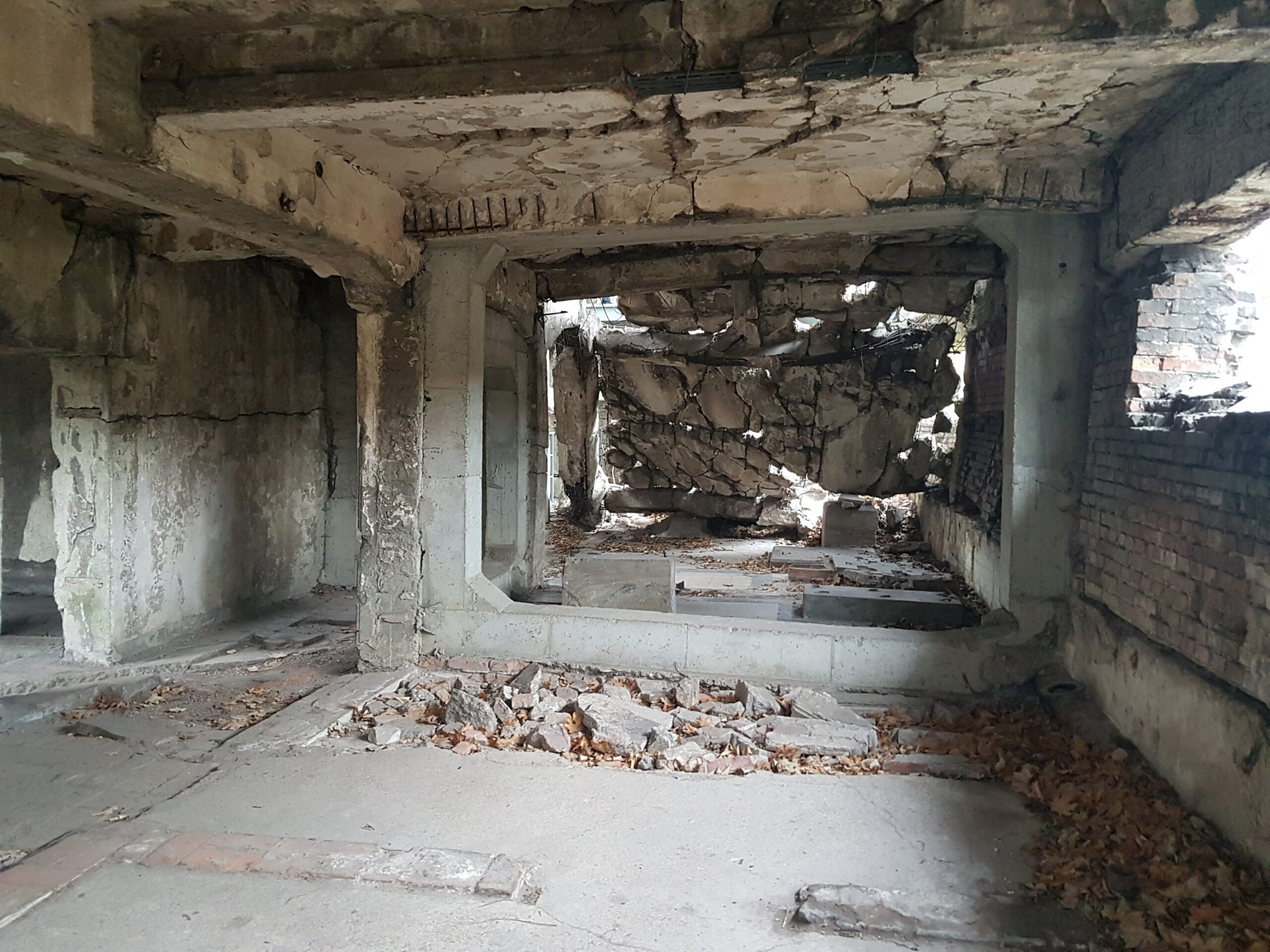
    One of the badly damaged buildings which the Germans attacked. It was impressive to me that the building still stayed standing, let alone they had managed to secure it so that visitors could walk around it. They must have done complex civil engineering things to strengthen and support parts of the collapsing concrete and masonry. Or they just left it and hoped for the best…..

    20161119_130823

    20161119_130609

    More photos of the interior of the same building. There are ramps which have been added to the structure to get in and out of the building, but none of it was closed off to visitors. I didn’t like to explore too closely though, just in case random bits of building fell on me.

    20161119_130513

    The exterior of the above building, with the ramp to access it visible on the right hand side.

    20161119_125133

    Another damaged structure at the site.

    20161119_123816

    This today is the bridge at the end of the main street that so many tourists walk over and the Żuraw (or crane) building is visible on the right hand side of the photo. It’s rather haunting to be reminded that the Nazi party was so warmly welcomed into Danzig by the mostly German inhabitants.

    20161119_134201

    The Westerplatte Memorial which was contributed to mark the bravery of those Poles who defended this site, and to all of those who defended freedom.

    20161119_134813

    The flags of Poland and the European Union fly at the site. Freedom prevails.

  • Gdansk Group Trip – Day 3 (Westerplatte)

    Gdansk Group Trip – Day 3 (Westerplatte)

    20230512_143912

    We enjoyed our galleon trip to Westerplatte and we had a couple of hours here to explore the area. I’ve visited a couple of times before and this peninsular of land is important because it is where a Polish military garrison was established in the 1930s and also where the first fighting of the Second World War took place.

    20230512_144513

    Rather unusually for Poland, a number of the information signs have been vandalised. There is a previous post about Westerplatte on this blog, but unfortunately the links to the images have become broken, so that’s something else that I need to fix.

    20230512_144755

    A map of how the area once looked.

    20230512_144951

    There are some remnants of defensive buildings with the coastline being off to the right of this photo. Some of the party wanted to go and look at the sea, but my firm leadership meant that the group had to wait until the walk back.

    20230512_145230

    The remains of Polish Guardhouse No. 5 which the Germans attacked on 2 September 1939. Seven Polish soldiers, including Corporal Adolf Petzelt, were killed, with the surviving soldiers restoring the break in the defensive line by 7 September 1939. I’ll return in a later post to the bravery of these soldiers.

    20230512_145432

    The cemetery for Polish army soldiers which was unveiled in July 1946. The resistance from the Polish soldiers at Westerplatte surprised the Germans, with the German commander Friedrich-Georg Eberhardt allowing the Polish commander Henryk Sucharski to keep his sword when he was finally captured. Those were the days of at least some honour amongst soldiers, the Nazi regime wanted to treat the Poles as sub-human and any such basic courtesies were soon lost.

    20230512_150122

    Into one of the bomb damaged buildings. It’s not the most inviting of signs to be fair.

    20230512_150133

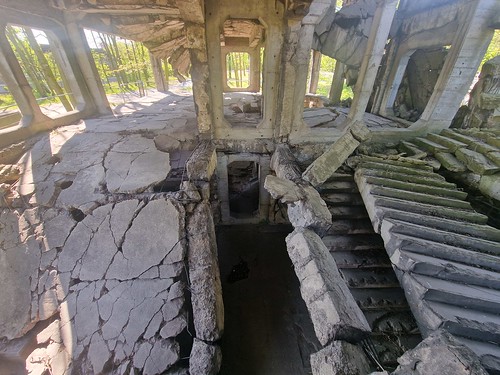
    Unfortunately, since my last visit, people can’t go downstairs into this basement. The building was designed to collapse if bombed, but not to damage the cellar area which needed to be protected as it was a shelter. Despite the huge damage caused, the design worked and the cellar area was protected.

    20230512_150348

    An amazing structure, I think the others in the group would have been interested in being able to access the whole building. I imagine that it was just all too dangerous though.

    20230512_151506

    This memorial, the Westerplatte Monument, to the Polish soldiers who defended the coast was constructed between 1964 and 1966, using earth from the Gdansk docks renovation to build the mound. There was a plan to incorporate a museum into the structure, but this wasn’t ultimately added. The communist authorities at the time had no interest in promoting anything that might be anti Soviet, but this got through as they wanted to show how strong the local people were against the Germans.

    20230512_152053

    The view from the top of the mound.

    20230512_155301

    After some complaining from the others that they wanted to see the sea, we walked back to the galleon this way. The sand is fine and soft, but Bev refused to go into the water saying that it was too cold. It meant that I had diverted back this way and no-one wanted to make sandcastles or anything. Although the recent history of this area is military, it once had a leisure element with it being something of a spa area.

    20230512_161123

    Whilst waiting for the galleon to take us back to Gdansk, we indulged in some ice creams and drinks. Bev had a coffee and spent five minutes complaining about it, whilst Richard had a tea and complained about that because it wasn’t served with boiling water. They’re a tough bunch to work with, but the rest of us were happy with our acquisitions. With that, we were ready to wait for our return galleon journey and Bev had promised again that she wouldn’t sing loud sea shanties.