Tag: Railways

  • Greater Anglia : Norwich to London Liverpool Street

    Greater Anglia : Norwich to London Liverpool Street

    As this is a journey that I often take, I wasn’t going to write about it, but Greater Anglia’s choice of train annoyed me. So, I have.

    Norwich railway station on a Wednesday lunch-time in February, it’s getting busier, but I’m sure that passenger numbers aren’t there yet. Shame that West Cornwall Pasty, which was to the left of Starbucks, has closed, but that unit could perhaps be turned into a Greggs…. The M&S at the railway station is still closed, it’s been like that for two years now.

    Here’s the train, all shiny on Platform 2.

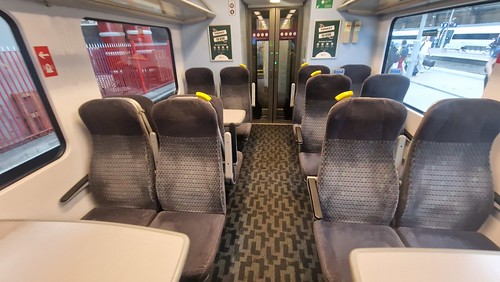
    And then I realised this. It’s the bloody Stansted Express train they’re using again. I thought to myself just how not ideal this was.

    I have no idea why Greater Anglia keep using these Stansted Express trains, they were never designed for this route. They don’t have tables, they don’t have first class (not that that much matters to me) and they don’t have a buffet car (actually, that doesn’t much matter to me either). Other customers have asked Greater Anglia why they use these trains on social media, but it’s seemingly a mystery to customers and Greater Anglia alike. Two groups came walking by me on the train on a hunt for tables, but their search would have been forlorn. The conductor, who was friendly and helpful, made an announcement saying that a last minute train change was required, but this train continually goes up and down the Norwich to London mainline so it’s not a rare occurence.

    A lack of table is annoying when using a laptop, although the power points worked. It’s quite hard to sit at these seats without wanting to put your feet on the chairs opposite, because that would make using a laptop much easier. However, I consider that to be a crime against humanity, although it’s possible to put one foot on the heating panel below the window. Greater Anglia have also decided they’d like their trains to be like rolling furnaces along the track in some sort of commemoration of the heat of steam engines, and there’s no way for a customer to cool the carriage themselves.

    We arrived into London Liverpool Street at the unusual platform 4 (unusual as in this train doesn’t usually stop there, it’s otherwise a normal platform) which I guess is because they’ve decided that the Stansted Express train was going to be used to go to Stansted.

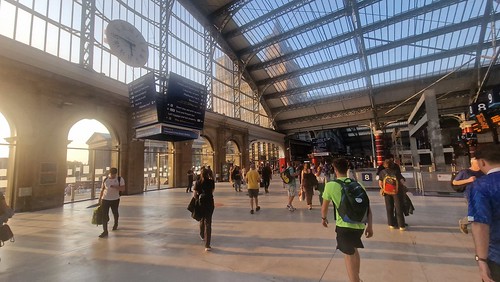
    London Liverpool Street is definitely looking busier. All of the e-tickets were failing (again) so the gate guard was busy checking tickets manually, which I’m not sure is how the system is meant to work.

    As an aside, I went to the rear of the station and this is all looking much tidier.

    I don’t know when this was landscaped, but the whole area around London Liverpool Street appears to be being modernised, it’s all a clear improvement.

    I suppose it’s hard to complain with a fare that’s only £10 from Norwich to London (although, as is evident here, I’ve had a good go), but this would be a nicer journey if the train was more comfortable. But, the staff on board were friendly and conversational, although the train was rather hot, but everything ran to time and was efficient.

  • Crossrail : London Paddington to Reading

    Crossrail : London Paddington to Reading

    One thing that I have realised is just how confusing the rail pricing is from London to Reading, with the rail fare being at least £20 if looking to use rail booking web-sites. I discovered, to my surprise and delight, that it’s a little over £11 if travelling off-peak on the new Crossrail service, which is much more realistic. It’s not ideal though that this train journey pricing isn’t on the rail matrix for those trying to book tickets, another failing of the whole Crossrail set-up. Anyway, complaining aside, the signage at London Paddington is clear and I caught the train with just a minute to spare.

    Inside the Crossrail train carriages, this really could do with power points, but they decided early on that they weren’t going to bother with that burden. Nor does the train have toilets, despite the length of the journey and they had to bend the rules as a train service of this length would usually require toilets on board. I suspect they’ll retrofit power points at some random time in the future, it’s rare for services not to have them now. But, to be fair, these decisions were made by Boris Johnson when he was London Mayor, so it’d be unkind to expect them to be any good. Anyway, enough politics.

    At the moment the train is departing from London Paddington to get to Reading, they still haven’t quite finished the testing of the middle section between London Liverpool Street and London Paddington. This whole line was meant to open in 2018, just as an indication of how messed up the entire project has become, billions over budget. However, it is a very useful line to cut across London and it increases capacity as well as speeding up many journeys. Unfortunately, the Crossrail 2 project which would have been equally useful was scrapped by Boris Johnson in his Prime Ministerial role in 2020. It will probably be reinstated in the future, although the earliest opening date would now be in the late 2040s at very best according to TFL.

    It wasn’t a particularly packed service, but it was clean throughout.

    There’s the journey section between London Paddington and Reading. Hopefully this signage will all be removed this year as the entire line should be formally opening in late 2022.

    And getting off at Reading, on time and as expected.

    I didn’t linger at Reading station as the weather was quite stormy, but the railway station feels quite modern with a new section added onto the older building.

    This proved to be an easy way into Reading from London, with the journey taking under an hour. The facilities have actually been downgraded since GWR ran this line, as they offered more comfortable seating, power points and toilets. But, there has been an increase in capacity and for any passenger wanting to go through to east London, this is a much more efficient service than changing at Paddington and then switching to the underground and then another train.

  • PKP – Tczew to Gdansk

    PKP – Tczew to Gdansk

    After a week of visiting a number of towns in Northern Poland, it was time to go back to Gdansk. As mentioned when I arrived in Tczew, this is a modern railway station but it’s a bit soulless and lacking in much character.

    The main foyer area isn’t as grand and historic as the one in Malbork. There’s a fair amount of seating dotted around the station, both in this area and in the corridor above the platforms, although it was warmer in this bit.

    The usual sheet of train times, mine was the 11.25 into Gdansk.

    It’s not easily visible from this photo, but the train was delayed by 15 minutes, which was far from ideal. The train going to Vienna is listed above the train to Gdynia and it was apparent to me that it was unlikely to come in on the same platform as listed here, as the trains were coming from different directions. My train knowledge is sufficient to know that two trains due within one minute of each other and coming from different directions is a problem for signallers.

    As an aside, this train on another platform belongs to http://shortlines.pl/ who were an open access operator with high hopes, but their services have been dramatically reduced over the last few years.

    I’m not sure what the police (I think these are the equivalent of the British Transport Police) were doing with their big dog, but it looked quite friendly and was safely muzzled. This is the Vienna train coming in and it’s by now apparent that the train I want is coming in shortly and they’re going to have to use another platform. And that’s what happened, in Polish only (I mention this as in Gdansk there would usually be an announcement in English as well) there was a last-minute announcement that they shifting the Gdynia service to platform 2. So we all rushed over there…..

    I have to add, this travel can be a bloody nuisance and public transport operators don’t make things as easy as they perhaps could as they must have known some time before there was a platform change needed. There was a fallback that I could see a train to Gdynia with the regional network was leaving soon if I missed my booked service, but it’s all quite challenging to work out where to go.

    Apparently this is steam engine TKh 5699, in use on the Polish rail network between 1961 and 2002, when it was brought here to sit on the concourse.

    On board the train, I frankly couldn’t be bothered to find my reserved seat as I was getting off at the next stop and this group of chairs was empty. The screen gives updates on the service and that it’s running 15 minutes late.

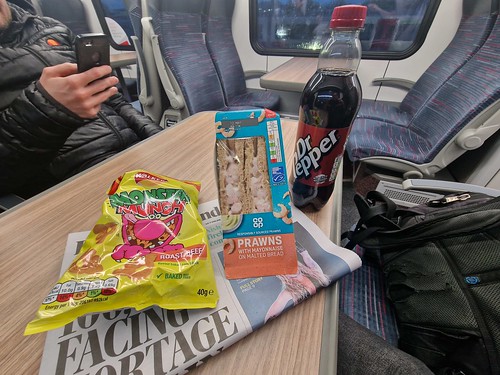
    They’re quite a comfortable arrangement, the table extends for those wanting to use a laptop of spread out their bakery purchases, with power available under the seat.

    My ticket wasn’t checked during the journey, and there’s the train to the right and Gdansk railway station (still under modernisation) on the left.

    And back into Gdansk….. The journey was a nuisance in terms of trying to board the appropriate train, but everything was comfortable enough after that. The cost of the journey was about £2 and I purchased my ticket on-line in advance, although there are ticket machines at the railway station.

  • PKP – Malbork to Tczew

    PKP – Malbork to Tczew

    Moving a bit closer to Gdansk again today by going to Tczew, this is the railway station in Malbork which dates from 1891, with a previous building serving the railway from 1852.

    This was a Prussian railway station until the end of the Second World War and the decoration is certainly quite Germanic. This was the railway station that the Poles managed to stop the Red Army from setting on fire in 1945 and they did well to protect it given its heritage.

    The grand entrance foyer, with a shop to the left, a waiting room straight ahead and a ticket machine to the right. It really is a beautiful building and money was deliberately spent on it so that it could be the pride of Malbork. It was also a border railway station between the two wars, so the Polish and German trains used this as a changing point.

    The inside of the large waiting room, with several rows of wooden seats and a television for some entertainment. It was rather cold today, but this waiting room had been heated to ensure passengers didn’t have to endure the Arctic outside conditions.

    The entrance foyer again, from the other side to the previous photo. The ticket desk is visible in the background and there is a change visible just above it, they changed the Prussian emblem to the Polish eagle after the war.

    There’s the train I was getting, the 11:15 to Tczew. I hadn’t realised that this is also the train that comes from Krakow and Warsaw, before going to Gdansk and Gydnia.

    The very wide platform at Malbork, the reasons for which I haven’t worked out.

    I’m not really sure those narrow chimney things at the railway station are entirely ideal, although most are now propped up with metal supports.

    This was another short journey, so safely into Tczew within twenty minutes or so. The train, which is on the left, was quite busy and there were numerous school parties on board. I had carefully reserved a window seat this time so that I could video Tczew Bridge when going over it, but more about that in another post. Unlike many stations, such as Malbork, there’s an overhead corridor between platforms at Tczew rather than an underground one.

    Tczew railway station, not as glamorous as the Malbork buildings and its interiors, but it was functional and organised. As it was on the same line then as well, this railway station first opened in 1852, just as in Malbork. Tczew is a railway junction town which means that the station is relatively important, being the 32nd busiest in the country, which is proportionally much more than the town’s population. The fare was just under £2, so again, another comfortable and efficient journey with PKP Intercity.

  • PKP – Elbląg to Malbork

    PKP – Elbląg to Malbork

    Back to Elbląg railway station, this time for the twenty minute journey into Malbork, which is another new town for me.

    I didn’t look too much at this before, but it’s the grand hall at Elbląg railway station. There’s a little shop and waiting area to the left, with the ticket office on the right. I don’t buy tickets at the railway stations, it’s easier for me to do that on-line and just have the ticket on my phone.

    Mine was the 11:17 train, but there were fewer trains than I expected leaving from the station, roughly one per hour.

    Looking back at the station’s main hall from platform 2.

    And on time, my train pulls into the station, with something like 12 carriages. It was busier than I expected, but it’s an Intercity service rather than a regional train. An elderly Polish lady barged me and two other passengers out of the way, before realising that her large bag was too big to fit by her seat, so she caused a queue of people to wait whilst she shuffled back along the carriage with her excessive luggage. That sort of behaviour is unusual in Poland, but I’d have waited for her to board anyway, I was unsure of her desperate rush.

    The seat reservation system on Intercity trains has always been respected when I’ve been on Polish trains, something that the British system fails to achieve. The carriage was fairly full, but my seat was available without an issue. My ticket wasn’t checked, but there wasn’t much time for the staff to perform those checks given the short length of the journey. The view was mostly just countryside, this is a rural part of Poland, and unlike the regional trains, this Intercity train didn’t stop at the smaller railway stations en route.

    The train arrived into Malbork two minutes early.

    Rather wide platforms I thought…. The train fare to get here was £2 and everything ran as expected this time, unlike my journey to get to Elbląg.

    It’s a cold day in Malbork, it’s something of a temperature shock to go from the warmth of the train to the cold surroundings of Poland in January. The very Germanic looking building was constructed in 1891 and it survived the Second World War, but only because the Polish authorities were able to save it from an arson attack led by the Red Army.

    As an aside, the town (then known as Marienburg) voted in 1920 to join Eastern Prussia rather than Poland, so this was a German run railway station until the end of the Second World War. Although railway stations in Ireland were once operated by Great Britain before the country gained independence, this concept of places changing their names and being in different territories is still one that fascinates me, as it isn’t something I’ve needed to think about when in England for example.

  • PKP – Gdańsk Główny to Elbląg

    PKP – Gdańsk Główny to Elbląg

    This was meant to be a straightforward rail journey of just under one hour from Gdańsk Główny to Elbląg, using a PKP Intercity service.

    I’ve mentioned before that I find this to be the easiest way of seeing rail departures and arrivals, regularly updated yellow and white sheets. It’s far better than the UK system, with every stop listed so that it’s easy to understand where the trains are departing from and at what time. It’s surprisingly hard to get such clarity about the rail times and options when at a railway station in the UK.

    As an aside, this was the train to Berlin, which I had expected to be a little grander.

    And then to my slight disappointment, my 09:41 train started to show as delayed for nearly an hour. But just under it is a 09:44 train which is going to the same destination of Elbląg, it just takes a little longer. This gives me a dilemma as I don’t understand the Polish rail system well enough to know if I can transfer trains to that one, as I have a ticket for a specific train. It’s also a rural train (Przewozy Regionalne  or PR) which used to be part of PKP, but they’ve been given to the regional governments to operate, so it’s not the same company or set-up.

    As everyone got on the platform got on the train, I guessed that I could likely use this service. However, I’m not taking risks like that, so I went and asked the guard if I could get on his lovely train. He was friendly, grinned and pointed to get on. I was concerned whether he was grinning because he was excited that he could fine a passenger, but it transpired he was just keen to help. That friendliness seems to be path of the course in Poland, so it didn’t come as a complete surprise.

    What didn’t help was having my ticket checked a further two times by different guards, although they seemed satisfied with my ticket for the wrong train. The train itself was clean and modern, running to schedule and the signage on board was clear and timely.

    And safely into Elbląg, on time and without being fined or being told that I had the wrong ticket.

    It’s not the most glamorous of railway stations, but I was pleased to get there. There has been a railway station here since 1845, but it was rebuilt in 1937 and then repaired again following the end of the Second World War. On May 26, 1916, the German Emperor, Wilhelm II, arrived at the railway station on a visit to the city. Back then, the city was known as Elbing and was the second largest in East Prussia, the section of Germany which wasn’t connected to the rest of the country because of the Polish corridor.

    And the frontage of Elbląg railway station. Fortunately, everything went well, although I could have done without all of the confusion with the train delay. But I’m glad that I didn’t wait for my heavily delayed service, Gdansk railway station is undergoing modernisation and there’s not a great deal to do there at the moment.

  • Chiltern Railways : Warwick to Royal Leamington Spa

    Chiltern Railways : Warwick to Royal Leamington Spa

    Off on a little day trip to Royal Leamington Spa, which cost just over £2 return, which seemed a fair price for the rail journey. This is Warwick railway station, opened in October 1852 on the Oxford to Birmingham rail line, which is a surprisingly basic and tatty arrangement at the moment (the station, not the rail line). The railway station isn’t a listed building and there’s little to excite anyone in terms of the architecture.

    Not much has changed in the area over the last 120 years, although the footpath that meandered across the railway tracks has now been replaced by a tunnel.

    The delightful (well sort of) tunnel under the railway track.

    This is the main set of buildings on the Birmingham side, but there were once station buildings on the London platform side as well, but these have been demolished for customer comfort (or whatever excuse they used) and replaced by a rickety old outdoor waiting room area. The buildings on the Birmingham side are reduced from when the railway station was reconstructed after a fire in 1894. That fire was substantial and had been caused by the overheating of a stove in the booking office, with the fire brigade being able to save some of the structure. The staff were able to smash down some of the internal wooden partitions in a bid to save paperwork and a large stock of railway tickets. The local press noted:

    “During the time that the fire was raging, Police Inspector Hall and a staff of constables preserved admirable order, and effectively prevented the quickly gathering crowd from interfering with the efforts of the Fire Brigade and station officials”.

    I slightly wonder what they through the crowd were going to do. The press also added that the debris was quickly removed and that:

    “The old station was built from designs by Brunel and was principally of wood. It is is hoped by the townspeople that the Railway Company will now take the opportunity of erecting a handsome station, with every convenience for the travelling public”.

    They did get a new station, but I’m not sure it had every convenience….

    Welcome to Warwick for a great day out.

    It’s about a ten minute walk into the Warwick town centre.

    An old milestone noting that it was 108 miles to London Paddington, although this is a little irrelevant now as the trains don’t go to Paddington.

    There are nearly no facilities at this station, there’s a taxi office, a very small waiting room and not much else, with no proper shelter on this side of the lines. There are no toilets either, which seems an omission for what should be a relatively important station.

    A Great Western Railways bench, probably from the 1930s.

    The train came creeping into the station on time.

    The train was comfortable for the four minute journey…. There’s little of note really about this service, other than the train was clean, there were plenty of seats and there was power available (I managed to get my phone charge up by 2%). Everything was on time, although I didn’t see any staff during my four mintes.

    And after my long four minute journey, here’s Royal Leamington Spa, or just Leamington Spa in the eyes of the railway network.

    One of the waiting rooms at the station, this was restored in 2011 and is a useful space, with power, heat and doors that keep opening randomly. Unlike Warwick, there are toilet facilities at this station.

    It’s fair to say that Royal Leamington Spa railway station is much more architecturally impressive than the one that Warwick has. The first station here was also built in 1852, at the same time as the one at Warwick was constructed, but this grand Art Deco construction dates from between 1937 and 1939. But more on this another time as I’m back in Royal Leamington Spa in a few weeks for the LDWA AGM weekend.

    As a rail service, all was well and everything ran on time. I wonder though about what they can do with Warwick railway station, as the facilities are very poor compared to Leamington Spa. I know that Leamington Spa gets nearly five times as many passengers as Warwick, but something a little more exciting would be nice here. Anyway, I was once again entirely satisified with Chiltern Railways.

  • Chiltern Railways : Wembley Stadium to London Marylebone

    Chiltern Railways : Wembley Stadium to London Marylebone

    And another in my niche series of rail journeys around the UK, which are primarily for me to remember what rail companies I’ve travelled with, primarily with an interest in how they do things differently.

    Wembley Stadium isn’t the most exciting of railway stations and the history of railways around here is confused, as there was a different station with the same name at one point. This station opened in 1906 as Wembley Hill, was renamed Wembley Complex in 1978 and took its current name of Wembley Stadium in 1987. Incidentally, the Wembley Complex isn’t what I would consider to be a traditional way of naming British railway stations (and sounds more like a psychological conjecture) so I’m pleased that it was changed. The railway station is around a five minute walk away from Wembley Stadium, so the naming is appropriate.

    In the above photo, at the back is the White Horse Bridge, opened in 2008 and replacing the old concrete footbridge which was built for the British Empire Exhibition in 1925.

    The railway station is solely used by Chiltern Railways on their mainline to Birmingham and it’s a fast connection into the city centre as it gets into London Marylebone in only around ten minutes. I stood here and then realised that the train stops a little back way, with the platform being longer than it needs to be as occasionally they bring in longer trains when there are matches or events taking place at Wembley Stadium.

    The train was about a third full, not overly busy. I don’t know if there was a guard on board the train, but if there was, I didn’t see him or her at any stage of the journey. Legroom isn’t ideal and the interior of these trains probably need a more modern refit soon with a return to 2+2 seating rather than 3+2 which doesn’t really fit.

    And here we are ten minutes later in London Marylebone. There are usually two services which operate between Wembley Stadium and London Marylebone every hour, so the service is relatively frequent.

    As I’ve written about before, Marylebone is the smallest London mainline railway station, and also the last one to be completed.

    And the station’s frontage. Everything ran to time, the train was clean and the service was easy to get a ticket for as it just uses contactless at each end. Looping back to the start, there’s not a lot that Chiltern Railways seem to do differently of particular note, especially for a short journey such as this, but they’ve invested considerably in the infra-structure of this route over the last couple of decades. Only a few weeks ago a new franchise was given to the company to operate this route and this lasts until the end of 2027, but with the proviso that the contract might change with the introduction of Great British Railways in 2025ish.

  • Greater Anglia : Norwich to London Liverpool Street

    Greater Anglia : Norwich to London Liverpool Street

    I’m used to the journey from Norwich to London Liverpool Street, but it’s rare for me to be getting the 07:00 train as that’s normally an expensive commuter service. Today though, it was £12.50 which I thought was reasonable all things considered (namely how expensive some other Greater Anglia services are which are of a much shorter destination).

    Norwich railway station wasn’t packed with people, but there were a few services about to leave, including the service to Liverpool Lime Street, so it wasn’t entirely quiet.

    Here’s the London thunderbolt that would hopefully get me into the city at 08:51. I boarded and had a carriage to myself, which was rather lovely. I then had a woman come up to me and she said that I looked strong (can’t fault her logic there) and could I open her bottle of water for her. This sort of scenario isn’t ideal, as if I can’t open it then I look ridiculous. Fortunately, I gave the impression of huge strength since I opened the bottle immediately. That’s a decent start to a journey.

    What wasn’t a decent start was seeing that the train was marked as delayed, with no announcements made about it. I’m not sure what caused this, as the signs soon lost their delayed status and the train was ready to rock and roll at 07:00 as expected. The announcements made by the staff were all friendly and informative, with a guard checking tickets. This process didn’t exactly take him long and to my slight disappointment (as I like watching drama unfold) everyone seemed to have a valid ticket.

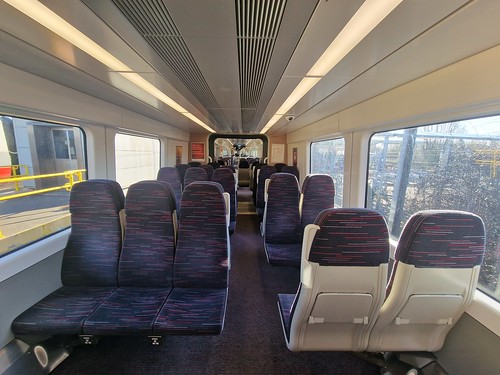
    Here’s the packed carriage. I also managed to sit at the only block of seats on the train that didn’t have working power, so had to move to the seats opposite. This wasn’t the only technical problem on board, as the shutter at the cafe had broken and jammed, so the staff had to walk up and down the train with the trolley. The service though arrived into London on time, so no complaints there. It didn’t get much busier either, just a handful of people on the entire train.

    This is London Liverpool Street at commuter time, but on a morning between Christmas and New Year’s Day, which is perhaps never going to be packed with hordes of travellers. Nonetheless, it was still quieter than I expected.

    And outside London Liverpool Street station, with a calmness in the air.

  • Northern Rail and LNER : Keighley to London King’s Cross

    Northern Rail and LNER : Keighley to London King’s Cross

    After what I thought was a successful LDWA groups’ weekend I meandered down the hill into Keighley to get the train back to London. Here’s the delightful railway station, with the main entrance to the centre of the building (which is entirely logical), but the gateway to the right leads to the Keighley and Worth Valley Railway, a heritage line which goes from Keighley to Oxenhope via towns such as Haworth. There has been some talk of trying to bring the line back into commuter use, since it is entirely complete and linked into the current network, but no real progress had been made on that.

    I went to the ticket office to collect my ticket from the machine, but there was a queue and so I asked the man at the empty ticket desk if I could collect it there. He helpfully answered:

    “Well, we can do that, but we prefer not to”.

    Really bloody helpful. Anyway, he did print out the ticket and seemed otherwise friendly, but the failing here is the operator Northern not putting in enough ticket machines (I only saw one).

    This station was built in 1883 and replaced a previous station constructed in 1847 which was a short distance away over the road.

    My ticket was to leave Keighley at 17:33 and get into Leeds at 18:05, before going from Leeds at 18:15 and arriving into King’s Cross at 20:28. I’m quite risk averse when travelling so arrived into Keighley railway station early and saw an earlier train arrive which was going into Leeds. I decided I’d go and ask the train guard if I could get on the earlier one to prevent a misconnect (although the real reason is that I wanted to ensure I got a seat on the London train). He answered:

    “Yes and no”.

    I love precision. He said that if I had got on and not asked, the answer was no and I’d be charged a penalty fare. However, he thanked me for asking him and said that I could board and I had his permission to use that service. That caused a slight commotion later on when revenue protection got on, but the guard was true to his word and confirmed my ticket was valid.

    Anyway, they’re clearly very hot on fare avoidance on Northern, they seem to regularly check tickets and I’d advise definitely checking with a guard before doing anything slightly different…..

    This meant that I got into Leeds a good hour before my train to London departed and I was pleased to discover the train actually departed from Leeds, so this would be the first stop.

    Around 30 minutes before the departure time, the Intercity train slides into the platform.

    I then stood outside the train door for ten minutes waiting to be let in. I spend a lot of my time standing outside the doors of public transport.

    Full marks though to LNER for actually having logical carriage letters. Sometimes they’re something similar to A, Z, H, 5, 9, G, P and my ticket says carriage C. This time though I was in carriage E and that was easy to find, not least as I had plenty of time waiting for the doors to be opened.

    And here we go, I boarded first at my end of the carriage and got my reserved seat at a table. A nice guy mentioned that he had a seat next to me on the table for four, but he’d sit opposite so that we had more space and we could both use the power points (which are annoyingly two for every table of four). We were both going from Leeds to King’s Cross and no-one else sat at the table during the journey, so it was comfortable. Incidentally, I’d have problems getting a suitable seat if I hadn’t of caught that earlier train, so I was pleased I had boarded an earlier service.

    The seating reservations had gone wrong though and was effectively just suspended, which seems to happen on nearly every service that I’m on. Other customers, especially those boarding later on, were getting quite distressed at the whole situation with groups broken up and no on-board train staff were seemingly available to help. If LNER can’t cope with seat reservations they’d just be better off scrapping them, but I think even their managers would agree that this sort of thing is low down their list of priorities.

    There were a couple in the four seats opposite us who pretended that the other two seats at their table were taken, which I thought was pretty unimpressive and another case in point of how the current set-up just adds stress to customers rather than making it a smooth experience.

    The ‘let’s eat at your seat’ service which I was surprised to see was working. That is until it broke at Peterborough and an announcement was made that the service was now being withdrawn for the rest of the journey.

    We arrived into London King’s Cross on time, but there were no ticket checks on the train and the gates were left open.

    A slightly blurry photo, but I didn’t want to spend too long outside King’s Cross at night with my phone trying to take photos…. I was entirely happy with the journey for my purposes, with the trains on time and as I boarded early I got my seat reservation at a table and with access to power. Other customers had a less exciting experience split up from their friends and family despite having seat reservations and this whole set-up has to be improved by the rail network if they want to increase usage. Perhaps it needs to be as radical as if the rail company can’t provide the seat booked by the customer then it has to refund the entire ticket in a similar manner to delay repay.