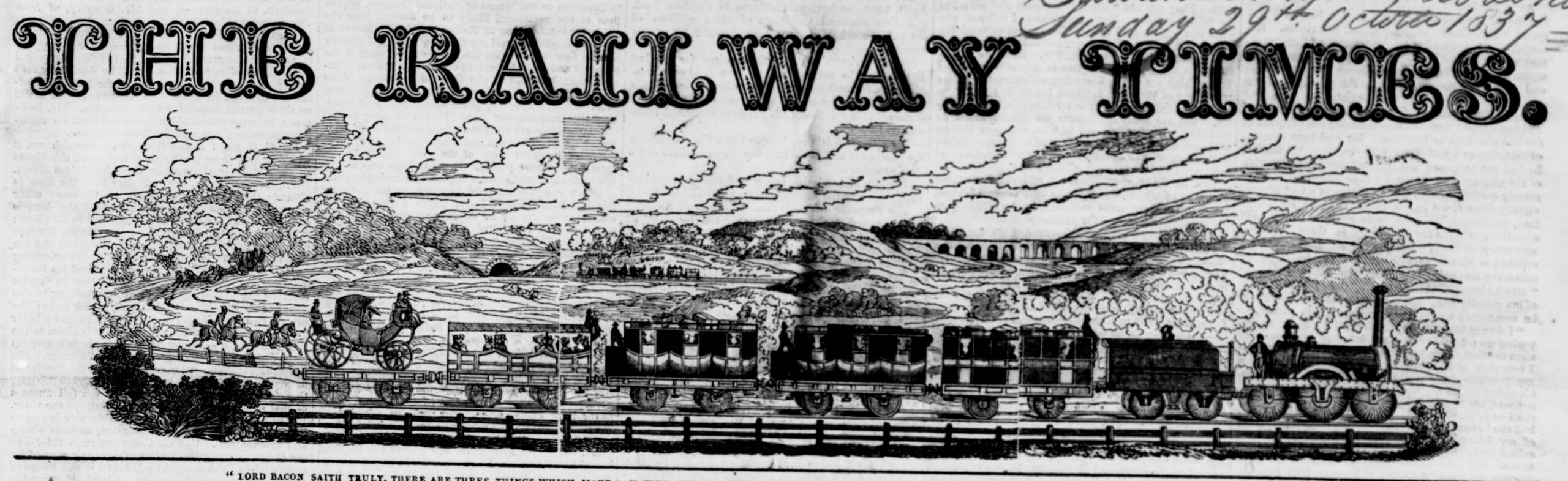
As another random aside, back to my reading through old back issues of the Railway Times…. There was an article in December 1837 which gave progress on the line between Birmingham and Gloucester.
“We have much pleasure in being able to inform our readers that considerable activity is displayed on this line. Fourteen contractors are at work—four in the Birmingham division, and ten in the Gloucester—five are engaged in earth-work, one brick-work and masonry, four fencing, and the remainder stone suppliers. Four miles of earth-work, and twenty miles of fencing are in progress.”
What amuses me is reading that the route of the line had been planned by Captain William Scarth Moorsom (1804-1863) who had worked with Robert Stephenson. He delivered a route which was economical, efficient and well planned, but unfortunately, it was economic as he had missed out nearly all the towns en route to save money. This displeased residents of numerous towns, including Cheltenham. The compromise was that Pearson Thompson (1794-1872), a member of a key committee of the railway and resident of Cheltenham, paid for much of it so that was a handy arrangement for the railway.
The whole project was successful, it was decided not to build a new railway station in Birmingham and instead they decided to share Curzon station. This building is interesting, it opened in 1838 but ceased to be used for rail purposes in 1966. It is very visible now amid all the civil engineer works when arriving into Birmingham as it is being integrated into the new Curzon HS2 railway station which should be open in around three to four years.
As for the towns that they missed, the railway network decided to build a series of branch lines, including to locations such as Tewkesbury and Worcester. That seemed to be a very reasonable compromise although Tewkesbury lost its rail connection following the Beeching cuts. Eventually the whole arrangement became part of the Midland Railway which then in turn became the London, Midland and Scottish Railway in 1923.
This has nothing whatsoever to do with the railways, but the Railway Times of 1837 certainly found itself with quite a lot to say about the world around them.
It’s some stretch to suggest that Germans speaking German in the United States, at a period of substantial migration, was “evil”, but it clearly concerned those speaking English. It’s also an interesting sign of the times that there was an opinion that it would be English and Spanish that would be the two major global languages.
“The Germans in America.—The German newspapers inform us, that according to the most recent intelligence, “German life and civilization,” develop themselves more and more at Saint Louis in the United States, and apparently will in time predominate in this part of the Union. A German Library is established there, a German Annual published, &c. In two of the German newspapers printed in America, a proposal has recently been made to found a German University in the States, and is said to be likely to meet with support. We hope that the friends of progressive civilization in America will not allow this evil to advance too far before they oppose a check. It has always been considered a cheering point in the future prospects of the world, that, in all probability but two languages, the English and Spanish, would prevail over the vast continent of America, among a population of hundreds of millions, whose influence would be of such weight as to spread those languages pretty generally among the whole human race, every person of education knowing both, and almost every individual knowing one or the other.
The common languages of Europe would then be eclipsed by the superior importance of these two, in the same manner as Welsh or Wallachian now by French or German. All this vast improvement in the condition of mankind will be prevented or obstructed, if another language is suffered to gain ground in America. The Portuguese is there already in Brazil, but that may be considered as hardly more than a dialect of the Spanish; the French is there already in Canada, but on the decline before the advancing influence of the English. Dutch, Russian, &c., are spoken at a few points, but have never attained sufficient importance to excite any apprehension that they will offer resistance to the gradually overpowering march of Spanish and English. But if the practice gain ground for natives of the different nations of Europe to emigrate in bodies, and carry their language and habits with them, we shall have an America as much cut up into small divisions as Europe, and the difference will be a fruitful source of dissensions and wars.
While the future mischief to be apprehended is so gigantic, the present inconvenience is by no means small. Lieber, the editor of the Encyclopædia Americana, himself a German, but who, since his emigration to America, not only speaks but writes in English, complains that the little knots of Germans scattered over the States, are full of ignorance and prejudice; not knowing the language of the country, they are shut out from intercourse with their neighbours.“
As a brief interlude between my posts about Italy and other assorted European countries, back to the Railway Times of 1837.
Firstly, the word superabound is a loss from the English language, no longer in use it meant something in abundance. The newspaper was at this time annoyed at Charles Poulett Thomson, 1st Baron Sydenham, the President of the Board of Trade, who also happened to become the First Governor General of Canada.
I think I’m with Thomson here, as although in 1837 the number of Acts of Parliament to build railways was low, the number soon increased to ridiculous levels. In 1846, there were 263 Acts of Parliament, so more pledges to build railways than could possibly be met.
The result was known as the Panic of 1847 and what became called railway mania, as large sums of money were lost. This is what Thomson had warned about and had prevented whilst he was President of the Board of Trade in the 1830s.
Here’s the long article from the Railway Times.
“We take the earliest opportunity, upon the re-assembling of Parliament, of adverting to the Standing Orders which were passed by the House of Commons in the recent Session, and very shortly before its close, with respect to future Railway Bills. Foremost among those enactments, and the most to be condemned, is that most unjustifiable and oppressive one, by which it is required, not only that “ten per cent. of the estimated capital shall be subscribed and paid,” before the parties promoting any Railway Bill shall be at liberty to proceed with it,—that is, long before it is required for the actual execution of the work,—but that the money so paid shall be lodged in the Bank of England, where it is well-known no interest is allowed on deposits. A greater impediment to the progress of the Railway System could not by possibility have been invented. Indeed, the author of the measure did not hesitate to avow, that it had for its express object “to check speculation” in Railways. The Premier had set the fashion to his colleagues of giving “heavy blows” and “serious discouragements”; and this was the President of the Board of Trade’s heavy blow and serious discouragement to a class of undertakings fraught with greater benefit to those interests, which it is his special duty to protect and promote, than any dozen other improvements or discoveries of modern times.
Now, without entering into the question of the merits or the demerits of many of the lines of Railways which have been projected within the last two or three years, we purpose to dwell in preference upon the right of individuals to judge for themselves as to the propriety of employing their money in any speculation which to themselves may appear good, and upon the fitness of the people of England being no longer treated as children, who have not the capacity to understand their own interests, without the interference of Mr. Poulett Thomson, whom we have never understood to be in any great degree wiser in such matters than other folks. True, it may be, that very grave errors have been committed in some of the projects which have been set on foot; but then it is to be borne in mind, that the Railway system was new in England but a few years back, and that a great deal of experience has since been acquired, which must go far to prevent the repetition of such errors—experience arising undoubtedly from some memorable failures, but from many more instances of the most triumphant success.
Why, moreover, should excess in Railway speculations alone be checked? Why not in other speculations as well? Is it simply because the House of Commons is possessed of no power over other fields of enterprise? And if so, what are we to think of the wisdom of a system of restriction which is necessarily partial in its operation, and has might alone (not right) for its basis! It is clear there is a great mass of superabundant capital in England; that the possessors of this money find it useless, unless invested in some commodity or public work or funds, which will yield an annual return. Although, therefore, Mr. Poulett Thomson be determined that the people shall not speculate in Railways, it is certain that he cannot prevent them from speculating in cotton, corn, wool, tea, silk, indigo, and a thousand other articles, all of which are forced up in consequence, and rendered dearer and less accessible to the great mass of the people. To allow Railways to be constructed, is to allow the agricultural labouring population to be employed; to allow the iron manufacture to flourish; to allow a thousand varieties of artificers to earn a good livelihood, in woodwork, brickwork, steam locomotive-engine building, and the like; whereas, to turn aside the current of capital from these works, is to force it into other and less beneficial, if not decidedly injurious channels of speculation; to raise the prices of cotton, silk, wool, hemp, and other raw materials of manufactures; by which rise the price of the finished article is raised, consumption diminished, and the manufacturing population, in a corresponding degree, left unemployed. This is precisely the present position of affairs. Money superabounds, because the employment of it in public works has been “checked;” and hence the many millions which would otherwise have been giving employment to the population in raising embankments, building bridges, and hammering out rails, is employed in forcing up the Cotton Market of Liverpool, and the Wool Market of Yorkshire, to prices which render the extremest caution necessary on the part of the manufacturer, to protect himself against the chances of a re-action—should spurs instead of checks happen once more to come into vogue.
Again, if Mr. Poulett Thomson be so bent upon checking speculation in Railways in England, how will he check the speculations in similar undertakings in various countries abroad? As he has not the power to prevent the English capitalist from sending over his money for investment in Railroads from Paris to Havre, Brussels, or Rouen,—or in Railways from New York to Philadelphia, Baltimore, or Boston,—it is clear that those places will attract the capital that is denied the opportunity of investment at home; that Railways will, therefore, be constructed with British capital in foreign countries, whilst no more Railways will be constructed in Britain itself; so that, in fact, by “checking speculation” in this country, we are preventing our own population from obtaining employment in preference to foreigners, and are assisting foreigners with our own money to gain the start of us in that which is the greatest of all auxiliaries to commercial and manufacturing industry—cheap and quick communication.
So far from “checking speculation” in Railways, there is no branch of enterprise from which the checks already existing should be so sedulously removed. As it is, they have quite enough to contend against in the high price of land in England, and the exclusive and stand-still spirit of its aristocracy; whereas, in the United States, the comparatively small value of land, and the absence of privileged castes, of legislative difficulties, and of artificial restraints, give that rising Republic advantages of so important a kind, that money alone is there wanted—that capital which Mr. Poulett Thomson is kindly doing his best to drive thither—to enable it to go immensely a-head of this and all other countries in the race of national improvement.
On referring to the Parliamentary Notices, we observe that there is scarcely one new Railway line to come before the House of Commons during the present session of Parliament; and on conversing on the subject with those most intimate with this branch of Parliamentary practice, we find they are unanimously of opinion that the compulsory payment of a large part of the capital—for no purpose whatsoever, save that it may lie dormant in the coffers of the Bank of England—is the principal reason why the progress of the system has been so deadened at the present time. Let us hope, therefore, that this most absurd and impolitic provision may be forthwith rescinded. There is room for the employment of many millions of capital upon new lines of Railway, of the success of which there can exist no reasonable doubt, and only Mr. Poulett Thomson, with his nonsensical checks and crotchets, stands in the way.”
After a lovely few hours in Padua, it was time to get the train back to Venice. The city’s railway station opened in 1842 and around 450 trains stop here every day. The bit in the above photo is the post-war extension.
The departures hall.
This is all in the more modern extension that has been added to the station. There are plenty of ticket machines available, but there’s a customer service desk for anyone who is still confused.
I bought my ticket using the rail company’s app which saves all that faffing about validating it. I found that the platform numbering was a little confusing as they have a sensible system of I to X (well, there’s no number IV, but that’s a different matter) and they also have 2M and 3M for some Venice services. My train was scheduled to depart from platform II, so I just had to guess that they meant the usual platform numbering and, fortunately, that worked out.
The platform floor has numerous little trip hazards along it.
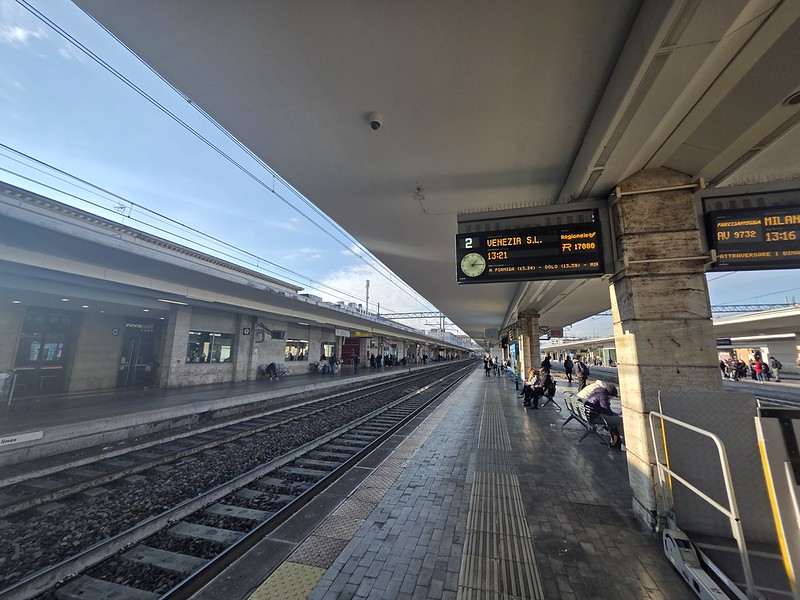
I was pleased to see my Venice train appear on the signage.
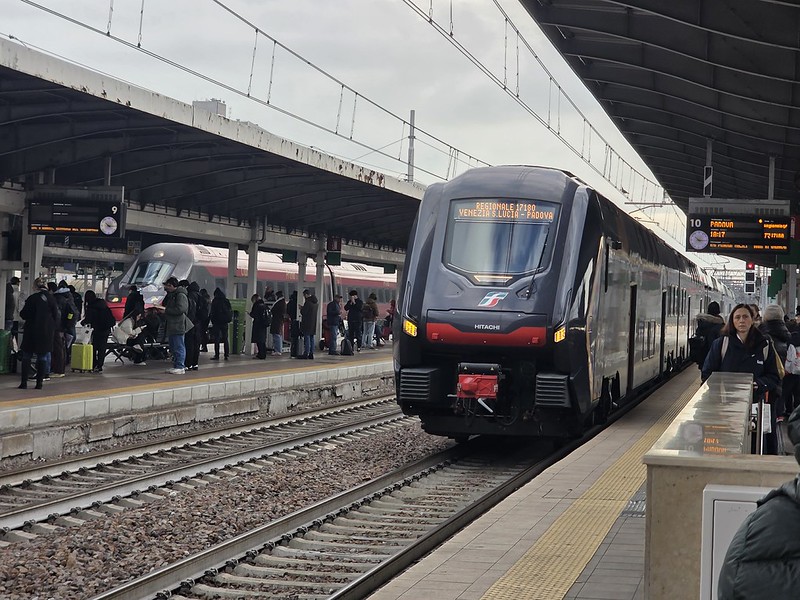
Back on the Hitachi Rock train…..
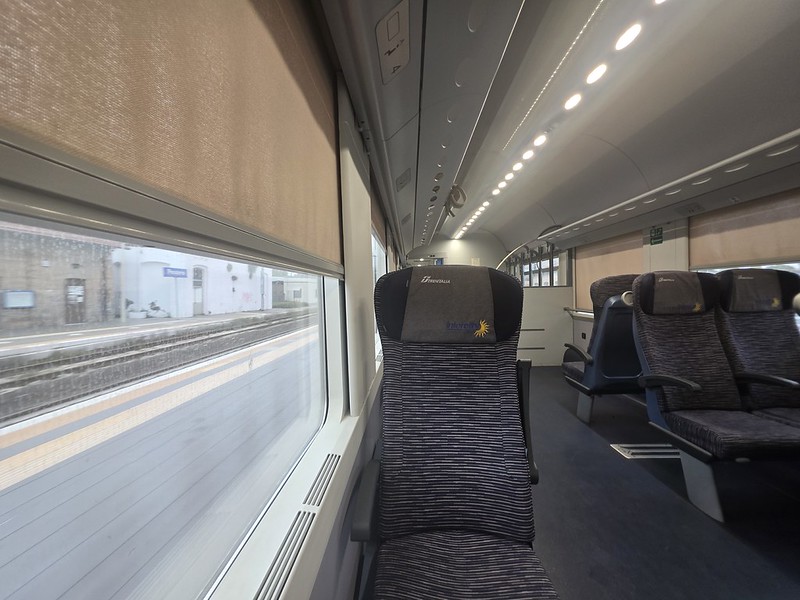
The Vivalto train which is a rather decent arrangement for long-distance services.
The train got very busy towards Venice, not least because a group of what appeared to be Chinese people boarded. When I say a group, I mean around 80 people, but they were going to the old city and I was getting back off at Venice Mestre.
I think that’s the last Italian train that I’ll take for a while, having used them around fifteen times over just a few weeks. I’ve been very impressed, they’ve been reliable in terms of operation, they’ve been clean, comfortable and I don’t have to mess about with seat reservations.
For anyone trying to follow this blog, my apologies for all of the jumping around (not literally, I’m too old for frivolity like that). I had a couple of weeks away to celebrate my birthday and then went back to the UK and thought I needed another little trip away. The one I decided on was to Italy and Venice, and I have already written about the movingseatgate flight…..
This means, here I am at Venice Mestre railway station as I fancied going to Padua. The station first opened in 1842, although the current and rather cramped station building opened in 1963.
The train journey cost me around £4.50 and I used the app to purchase the ticket. I deliberately boarded a regional train, even though there were quicker ones, as I like these double-decker trains and I don’t have to faff about with seat reservations.
I’m getting very used to these trains now, lots of space and power outlets are readily accessible.
And safely in Padua.
One of the Frecciarossa 1000 high-speed Italian trains which are in operation. These trains can fly around Europe at 400 km an hour, although the speed restrictions in Italy slow them down a bit.
After my brief one night stay on Wednesday, I decided to head off to Trieste as I had to meet the others on Friday in Ljubljana. Constructed after the Second World War, the current railway station is one of the modern buildings with river frontage in this part of Venice.
I had a little wait for my train, so I went off to look around the railway station. The first Venice Santa Lucia railway station was constructed in 1861 and it takes its name from the church of Santa Lucia which they pulled down to allow for the new station building.
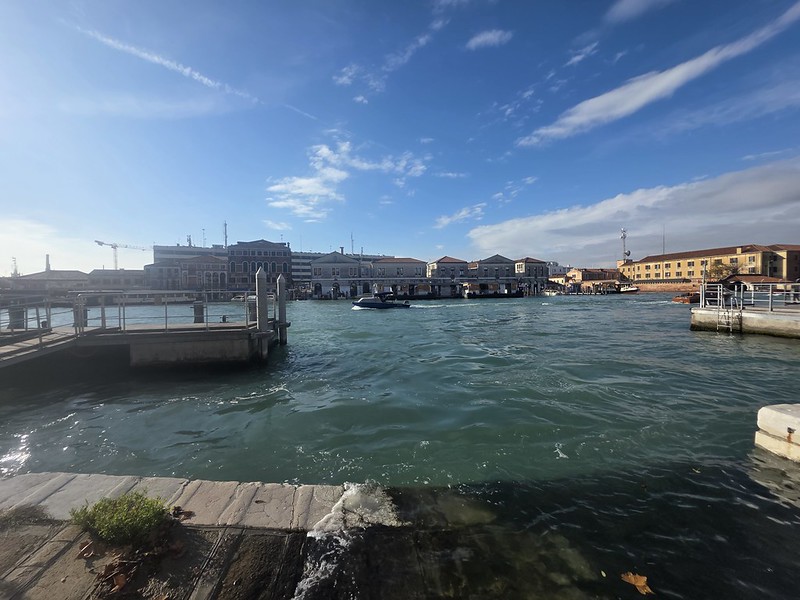
This is the view from the side of the railway station, this is one beautiful city. I have seen anything as beautiful as this since Lowestoft railway station flooded.
And here’s the train, departing from platform 1.
Regular readers of this riveting blog will now be familiar with the interior of Hitachi’s Rock trains. This is the top deck.
And the lower deck.
I’m very grateful that the signage on these trains is clear.
Leaving the beautiful city of Venice.
They might not be easy to take photos of, but there are some lovely views from the line near to Trieste as the train entered the Istrian peninsular.
The long platforms of Trieste railway station.
And back in my favourite Italian city of Trieste and it appears that there’s some work being done in the main departure hall.
Following my rail journey from Rimini to Bologna, the next part was to Venice which is a city that I’ve never been to. I’ve wanted to see it for many years, but I’m aware of how busy and touristy it is, so have never quite made the journey to visit.
The main departures hall in Bologna.
I had twenty minutes which wasn’t enough to go into the centre of Bologna, but it was enough time to get a KFC. So, I did and very nice it was too.
Boarding the train, which was on time, something which I’ve been fortunate with on the Italian rail network.
The interior that I’m used to now from Hitachi, which is their Rock train. It was marginally busy initially, but then much quieter on the second half of the journey. We went through Padua and I decided that I wanted to go there, but more on that soon.
Disembarking in Venice and I was unusually excited to see the city. I visited at a time when there was no charge for visitors to enter as well, which is always handy.
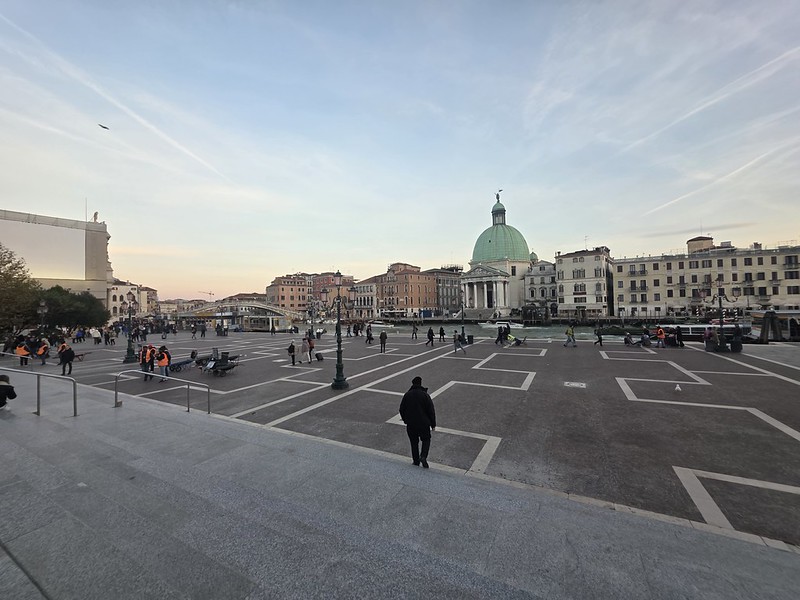
This is Venice’s Santa Lucia railway station, the one which is located on the island of Venice itself.
Leaving the railway station and getting my first view of Venice.
After a few hours in Rimini, which I decided wasn’t really enough and so I’ll have to come back, it was time for the next part of my rail journey which was to Bologna. I was changing trains there, so I only had a short period there, although I did spend a week in Bologna a few years ago. I remember lots of tall towers….
Mine was the 12:43 train and I was pleased that everything was on time. My plan was to travel to Bologna and then from there, I’d go to Venice.
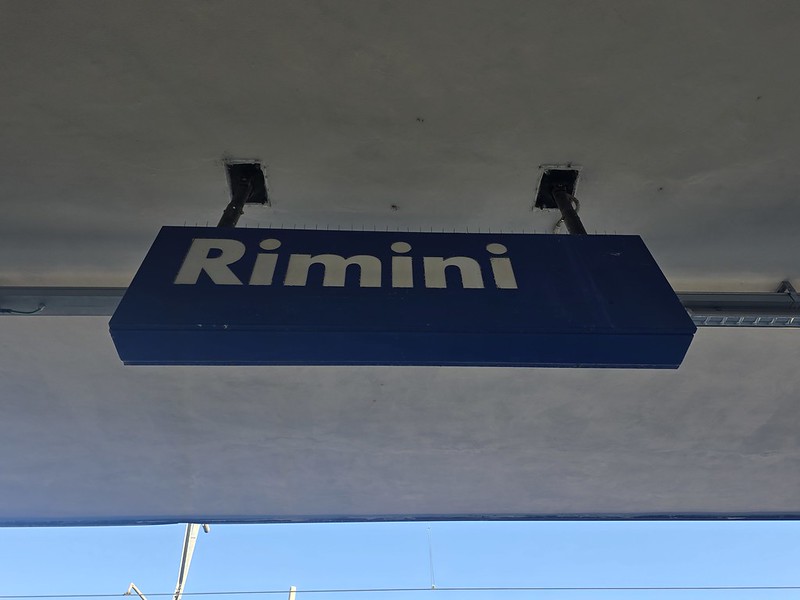
The railway station opened in 1861 and it has survived, albeit damaged, bombings from the Austro-Hungarian Navy during the First World War and from allied aircraft during the Second World War. There aren’t many facilities at the railway station, there’s a bar, shop and paid for toilets. This is something that annoys me about most railway stations in Italy, they don’t have the UK approach to matters that they really should be free of charge. Well, in my view anyway.
My Hitachi Rock train gliding into the platform.
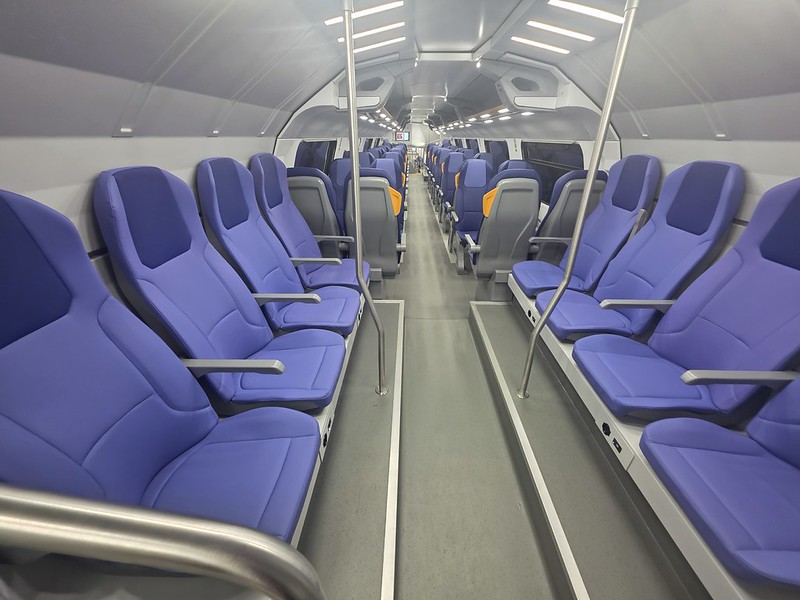
It was a little busy, but there were still plenty of seats. As I’ve mentioned numerous times on this blog recently, I like these clean, open and modern double-decker trains. I’ve yet to have a problem getting a seat on one of these trains and the prices are towards the lower end of the scale.
After an uninspiring time spent in Orte, I returned back to the railway station before it fell down. There was a station cleaner doing a remarkable job, but this railway station does perhaps need a modernisation.
A war memorial. The station itself first opened in 1865 and it was briefly a terminus before the line was extended.
There’s currently no waiting room at this railway station and there’s not much seating anywhere. It was all a little bleak. There’s a cafe which doubles up as a little shop, but I decided against getting any snacks at that point.
It was actually Trieste that I needed to get to, but that is a very long journey and so I decided just to get to Rimini and then work it out from there. By this point I still hadn’t had any sleep since leaving Luton Travelodge early the previous morning, so I was just pleased to get as far as Rimini.
The train came sweeping into the platform. There are three types of trains in Italy, the high-speed intercity, the long distance trains and the regional trains. This was the middle one of those, but it’s the regional trains that I like the most.
There are compulsory seat reservations on the train and it was relatively busy. There was an elderly lady who was insistent that a foreign passenger (I assume foreign as she didn’t speak Italian) should move. Unfortunately, there were some translation issues and the women sitting in the wrong seat didn’t move for about twenty minutes. On the third try, she got the hint.
I mentioned that I like the regional trains the best and that’s because they’re double deckers, they’re spacious, they have power outlets and you don’t get manacled by seat reservations. To be fair though, this one did though have power outlets and I liked having the table.
It’s quite a beautiful journey with the Adriatic Sea easily visible along the coastal stretch.
It all got quieter as we neared Rimini. This photo was taken near to Pesaro, currently in the centre of a Pavarotti statue debacle.
And safely into Rimini, on time and quite relaxed by now. I had another little nap on the train just to entirely catch up on sleep and I found the sea view quite entertaining. I suspect that the ticket check took place when I was asleep as I woke up and was the only one in the carriage who had their ticket checked. Well, I was either asleep or looked completely dodgy and like a fare evader, but I like the former.
Anyway, an enjoyable journey and that meant my travels were coming to an end for the day other than for a walk to the hotel and a little evening walk around Rimini.
My plan was to get from Rome Airport across to Rimini during the day, where I had booked a hotel. The first part of that was from the airport railway station to Orte.
This meant amusing myself for a few hours overnight, so I decided to eat some crisps which is always a sensible thing to do to pass some time.
I went to look where the airport’s railway station was as I thought that might kill some time as well. It took up about three minutes.
It’s not difficult to find and they’re also building a new underpass to get there.
Mine was the 06:57 train to Orte. By this time it was 03:15 and I was starting to feel I had explored all that needed exploring at the airport.
I sat near the entrance to the railway station waiting and I then realised, at about 05:40, that it was possible to change my rail ticket for free to any train on the same day. With the digital tickets, you can do this until just before the train, but at that point, you’re committed. What this meant is that I could catch an earlier train, so the 05:57 train to Orte. This seemed a sensible plan as I didn’t have much else to do.
Here’s the train, all clean, shiny and well presented.
There was lots of space and I’ve come to really like these Rock trains (or Hitachi Caravaggio) that they use on regional routes. They’re modern, they have power outlets, they’re double deckers and they’re comfortable with clear signage.
I changed seating styles to have a little nap.
Getting there….
And safely in Orte for a little exploration. Although this transpired not to be very exciting, but more of that in the next post….