
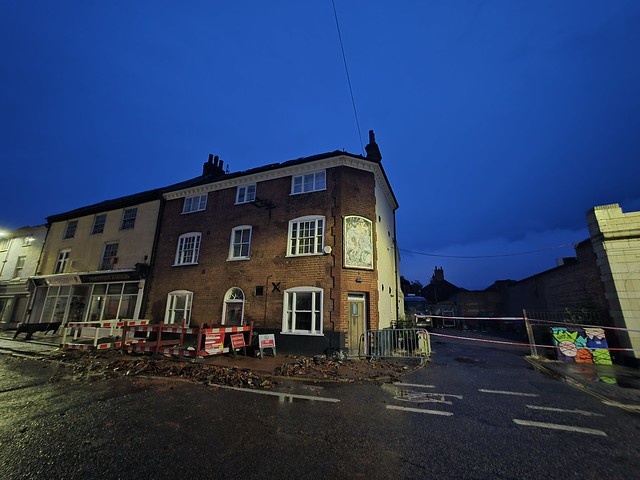

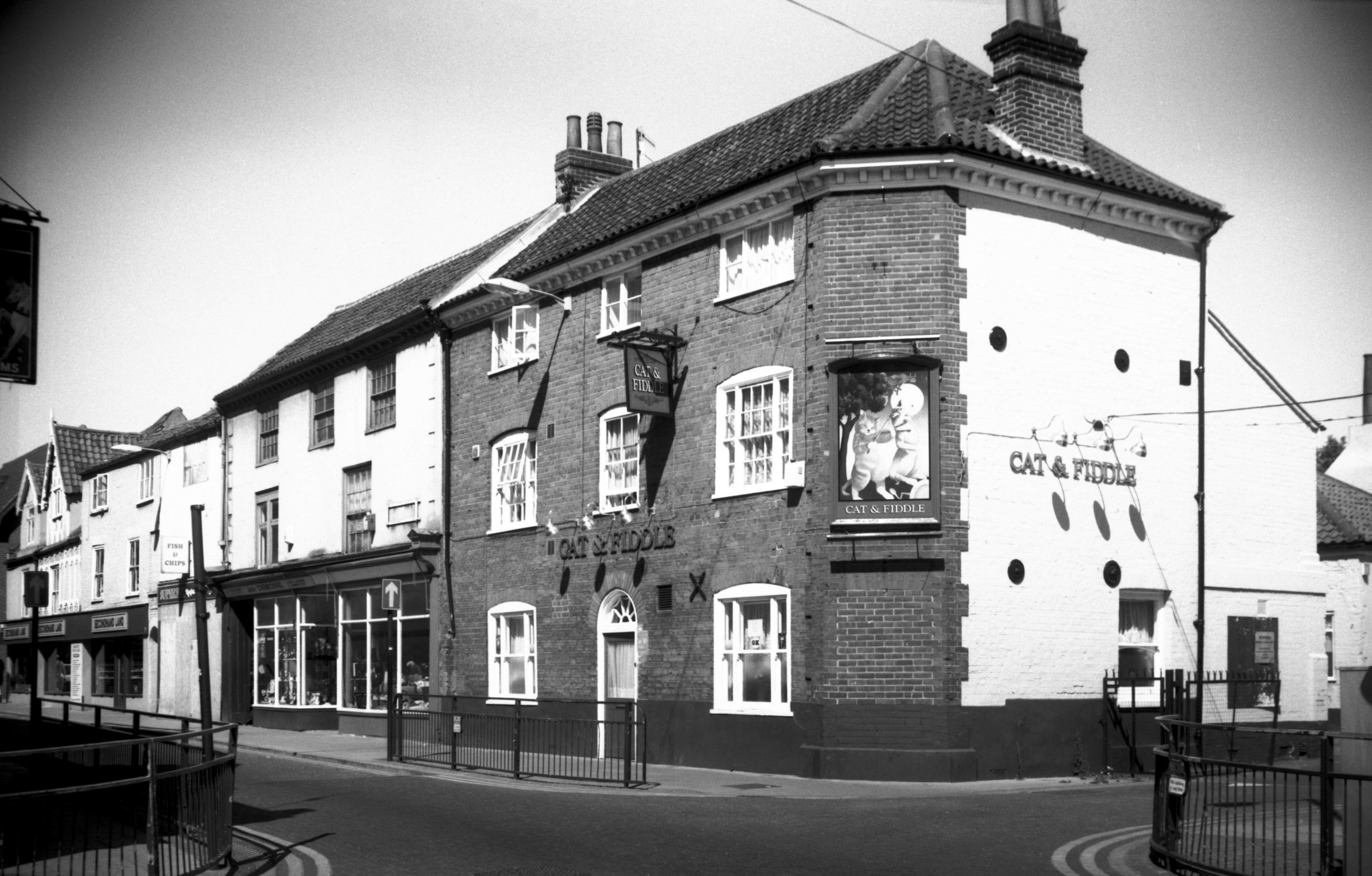
The scene at the Cat & Fiddle last week after a fire, caused by a cannabis farm getting a little over-heated on the top floor, caused significant damage to the former pub which had closed in 2011. It had been a pub since 1760 and, a little ironically perhaps, a few years after closing it found itself in the craft beer quarter along with the Malt & Mardle, the Artichoke, the Leopard, the Plasterers and the King’s Head. George Plunkett has a photo of the pub as it looked in 1997.
In terms of the pub name, there was a letter in 1902 sent to the media regarding the pub’s name.
“THE CAT AND FIDDLE.
Sir,—In “The History of Signboards,” by Larwood and Hotter, the following account is given: ” . . . The only connection between the animal and the instrument being that the strings are made from the cat’s entrails, and that a small fiddle is called a kit and a small cat a kitten. Besides, they have been united from time immemorial in the nursery rhyme,
Heigh diddle diddle,
The cat and the fiddle.
Amongst other explanations offered is the one that it may have originated with the sign of a certain Caton Fidèle, a staunch Protestant in the reign of Queen Mary, and only have been changed into the cat and fiddle by corruption; but, if so, it must have lost its original appellation very soon, for as early as 1589 we find, ‘Henry Carr, Signe of the Catte and Fidle, in the Old Chaunge.’ Formerly there was a ‘Cat and Fiddle’ at Norwich, the cat being represented playing upon a fiddle, and a number of mice dancing round her.”
—Yours, etc., J. C. BURLEIGH.
13, Plynlimmon-terrace, West-hill,
Hastings, Nov. 30.”
Well, there are some views on the history and it must be noted that the pub had a rather impressive sign, still visible in my photo at the top. There have historically been four pubs with the name Cat & Fiddle in Norwich (although nearly nothing is known about two of them), including one on Botolph Street which lasted until 1867, but the Cat & Fiddle Yard lasted until 1967. This map from the 1880s shows the confusion here that there must have been and indeed still us in trying to identify which pub is which when they’re referred to in the media.

Towards the bottom centre-left is the Cat & Fiddle Yard, although the pub here had closed a few years before. The pub on Magdalen Street is visible towards the centre-top of the map, with the Phoenix Brewery visible located opposite. Anyway, back to the Cat & Fiddle on Magdalen Street which is what I should be focusing on here.
The building doesn’t look it from the exterior, but it was likely built as a residential property in the early eighteenth century and was then used as a pub from around 1760. The rear range of the pub is older though, perhaps as early as 1600. Until the early twentieth century the pub was often referred to as the Cat & Fiddle Inn, because accommodation was available on the two upper floors. In the early nineteenth century, the pub advertised itself as a postal house, meaning that they kept horses that could be rented out, which transpired to be the forerunner of Post Offices. The pub was also the location for the annual meeting of the Taverham Association for Prosecuting Felons in the early 1830s and that sounds like an interesting little arrangement.
In 1859, there was an auction in the pub for the Phoenix Brewery which was located pretty much over the road, although the brewers didn’t own the pub itself. The brewery continued to trade for some time, before the building became the Phoenix Shoe Factory and was then knocked down when they decided to build Anglia Square. In 1886, the pub was something of a hub for the Conservative Party at an election with numerous posters up, something the other Julian would no doubt be thrilled about. There were numerous allegations of treating voters and the whole matter came to the attention of the courts.
The pub landlord between 1882 and 1900 was James Alfred Morris, with his son, Leonard James Morris, taking over and announcing in the local press that the pub was under new management. The advert adds:
“The Cat & Fiddle Inn, livery and bait stables, with ample accommodation for horses and traps, wagonettes and brakes. Traps of every description available for hire, special attention given to all orders for cabs and weddings.”
Alfred Morris was though summoned to court for driving a horse and cab on St. Benedict’s in May 1904 without using a light, for which he was fined 2s 6d and warned never to do it again. The pub does appear in the media as something of a taxi company, including doing the transport for the Whippet and Terrier Coursing Club when it met out at the Blue Boar in Sprowston. In the 1930s, the pub was used as the headquarters of the Norwich Excelsior Cage Bird Society and earlier in the century, it was the home of the Piscatorial Society (I had to look that up, it’s a thing for fishermen). In 1932, George William Penny of Blackpool, using the pub as his home address, attempted to hold a fair on the street which would include a cake walk and music, but the magistrates were having none of it as the previous time bits of coconut ended up in someone’s garden and the local headteacher was most upset at the whole arrangement with kids running amok.
There’s a problem today in many hotels where tradespeople leave their van outside whilst they stay overnight, only to find that their tools have been pinched when they get back to go to work. There seems to have been an equivalent in 1912, when it was reported in the Cromer & North Norfolk Post that the warehouse of R Clarke who was the Hickling Carrier based at the pub, found that he had been broken into. He lost linen drapery, handkerchiefs, stockings and a firkin of butter. I was quite intrigued by butter being stored in the firkin, but this is a separate term for a small container of butter rather than my thought that they were using firkins of beer to shove butter in. That did sound like a lot of butter.
For most of its history, the Cat & Fiddle was owned by Steward & Co or later on Stewart & Patterson, before it was all purchased by Watney Mann. There were once numerous rooms internally, including a snug, but in 1983 these were all ripped out to create one large open space and a bar at the centre. I recall Julian telling me before that this arrangement was required by the magistrates, keen to ensure that the person behind the bar could see all of the premises from where they were standing. Convenient most certainly, but it must have significantly altered the character of the pub. It seems that at this time they changed the door from the corner of the building to something more central, along with some covering up of the fireplaces.
In 1997, the pub received national attention when Roger James Foster died of injuries which he received whilst in the pub. The pub landlord was arrested and charged with his murder along with a customer, but as they were found not guilty due to insufficient evidence I won’t name them. In the years after that, Tager Inns took the building over and I’ve noted before what happened to this company. In short, they built themselves up as an operator and they were then purchased by London Inn Group, who got themselves into trouble soon afterwards and went bust in some spectacular fashion with the administrators struggling to even work out what pubs they owned. Sub-optimal really.
Julian has likely visited many times as he’s spent a lot of his many years in pubs, but I visited it just once with my friend Ross, likely nearly around twenty years ago now. I recall that it had something of a reputation for being a vibrant venue and we were offered drugs, but that sort of thing is wasted on me, unless someone comes up with a load of Mullermilch and then I’m the buyer, although that isn’t really a drug and I’m not sure that a flavoured milk based drink from central Europe is usually pushed and touted around Norwich pubs. In June 2011, the pub shut its doors for the final time, by then the building was in need of substantial repair internally and the reputation really wasn’t the best.
Anyway, I digress. This was a sad loss as a pub, not least because of how the area has since improved and had it stayed open there would have been an opportunity for more custom when the new residential properties open at whatever replaces Anglia Square. I imagine that if it was still trading, this might have become something of a craft beer bar, all rather on-trend. I assume that they will be rebuilding the structure soon enough, but I can’t imagine that it will have a pub on the ground floor again, although I think it’d be rather nice if they did.