
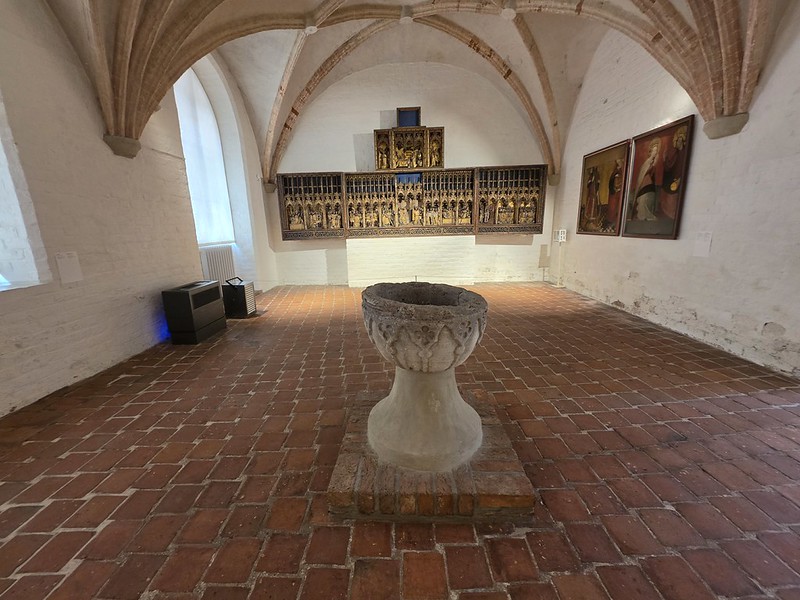
This font came from St Aegidien in Lübeck, or St Giles’s Church in its English form, and it dates from the early thirteenth century. It was made in Gotland, so very much part of the whole Baltic trade route arrangement. It’s solid, chunky and another marvellous survival over the centuries. It’s been given central billing in one of the museum rooms to add to the whole impact.
I do like the heritage of these things, which is why a lump of carved rock gets a blog post to itself and there’s another font with a similar history in a neighbouring room. It’s a link to the medieval past of Lübeck and it has outlasted all of the infants who were baptised in it. The church itself is still standing, a little dented from the 1806 Battle of Lübeck and the Second World War, but still there.
I’ve never really, until now, pondered when fonts became something of a thing in church, so now seemed to be a good time to find out as if I haven’t got anything better to do…. Anyway, baptisms initially took place in rivers or in other bits of water that the church found, but then there started to be a plan to construct pools within churches. This proved to be a bit of a hassle, as every church was starting to need its own swimming pool (although perhaps this might have ensured more people went along if they had continued that tradition) and so they changed the rules from immersion to just having water poured over the head. By the twelfth century, there had been a shift to fonts such as the one in the museum, although there was a new challenge as the churches frequently had to put font covers on as people kept stealing the holy consecrated water to protect themselves from witchcraft or similar such side projects.