
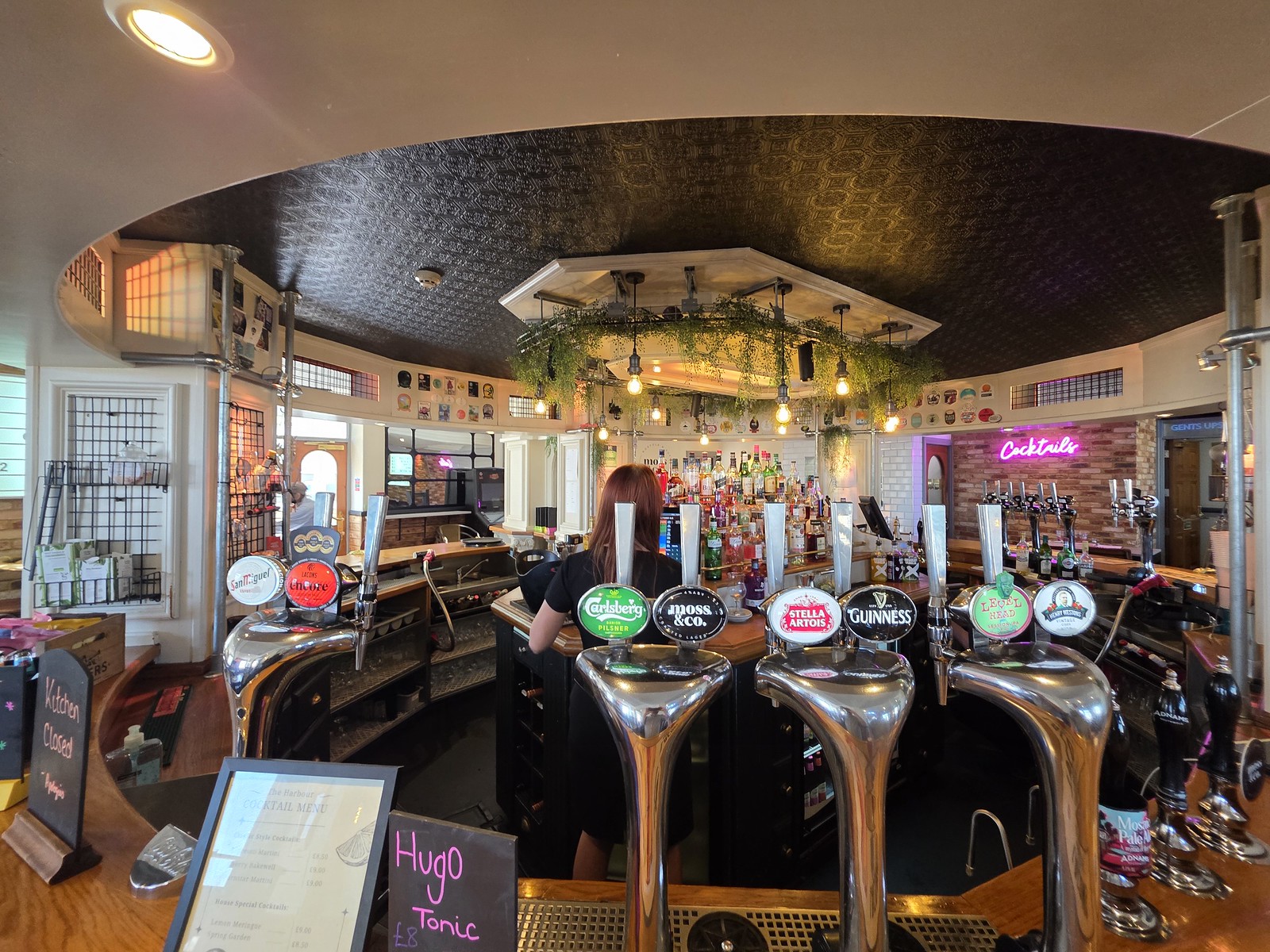

Second on our Lowestoft pub list for the day as the Harbour, which I’ve always known as the Harbour Inn, although I don’t think that they’ve offered accommodation for a long time. It’s located by the town’s bascule bridge in what I would call the southern part of Lowestoft.

The venue opened as the Harbour Inn, also referred to as the Harbour Hotel, as a coaching house in 1849 and became known for its decadent wine selection as well as its lodging options and ales. Samuel Howlett was recorded as being the innkeeper in 1855, likely the first landlord of the venue. As is visible in the above advert, I rather like that the venue was helping with the supply of 4.5 gallon casks, that’s a pin and they’re currently rather in favour.
In 1862, the Suffolk Mercury reported about a serious crime that had taken place in the pub, the text of which I’ve copied below.
“STABBING AT LOWESTOFT.
John Small (23), sailor, was charged with feloniously wounding W. Toby, at Lowestoft, on 13 February, with intent to maim, and Martin McDonough, with aiding and assisting the same.
Mr. Phear prosecuted; the prisoners were undefended.
William Toby: I am a smack owner, and on 13 February was at the Harbour Inn. I was playing cards when the prisoner came in, in company with their master, the Captain of the schooner Enterprise. Prisoner wanted to play with me, at all fours, the captain, myself, and the two prisoners, making up the party. Shortly after they had an altercation with the master, and the landlord ordered them out. I went to the door with them, shook hands with the captain, and while doing the same with McDonough, Small knocked me down. I rose, and at once stood up in my own defence, when they both attacked me. The landlord asked me to go round to the back door of the Inn, and he would let me in, so that I might get away from the prisoners. While there I saw McDonough come round the corner. He called out, “Come on, Jack, here is the b—––,” I then tried to run away, but they both chased me, and when they got up to me fell on the top of me. The landlord pulled the men off me. I looked round for my hat, and went into the Inn to seek it, not finding it outside. I went home and said to my wife, I am hurt, and shortly after I fell down in the kitchen, and the blood flowed from my side. I had only one wound.
Edward John Thomas: I manage the Harbour Inn, Lowestoft. On the evening in question I remember Mr. Toby and prisoners leaving the house. They were in the act of shaking hands when Small struck prisoner. They then began fighting, after which I took Toby round to the back door, in order to get him away from them. I ran to the front to enter the house to let Toby in. I met McDonough coming round as I made my way to the front. I called out, “he is not here, he is gone round the other way.” I said this in order to mislead them. McDonough, however, got to the corner of the house, and called out, “Jack, here he is.” They then rushed at Toby again, and Small struck him a body blow on the side. I assisted again in pulling McDonough off Toby, who at once entered the house. I then led the prisoners over the bridge. As we walked to the bridge, Small remarked, “I have lost a good knife.” Small ran back to resume the fight, but was prevented. I left McDonough in charge of the Capt. A knife was afterwards brought to me, picked up by Mrs. Adams, outside the house.
Mary Adams: I was standing so that I could see Mr. Thomas into Mr. Toby, some round the house. Small ran passed me, and as he did so, he drew his knife from his side, and called out “Here he is, Jack.” I afterwards picked up the knife produced. I saw the three men all fall down in front of the knife immediately afterwards. I picked up the knife just where Mr. Toby was lying.
P.C. Simpson: From information I received I went on board the schooner Enterprise, and searched the prisoner Small, when I found him with the sheath produced suspended to his waist. I said, where is your knife? He said “I have not got one; although I carry a sheath, I never carry a knife.” I apprehended him stating the charge. He asked me whether it was a bad case. I said it was a bad stab. He was very anxious to know what punishment he would receive, and said “he hoped to God Toby would not die.”
Mr. Chubbe, surgeon, deposed: I found Toby in his house shortly after he was wounded. I found the wound to be 1.5 inches long, and 1.75 inches in depth, and was just below the left hip, striking downwards. I dressed it, and judged Toby to be bad.
His Lordship in summing up, said: Gentlemen of the Jury, the prisoners at the bar are charged with feloniously wounding Wm. Toby, with intent to do him serious bodily harm. It is quite clear that he received his injury from one of the prisoners; which, you will have to say. It appears the parties had been playing at cards at the Harbour Inn, at Lowestoft, after which, when Toby was shaking hands with McDonough, Small struck a blow at him, which led to a fight, in which McDonough joined. Mary Adams saw Small pull out a knife. Small himself afterwards said he had lost a very good knife; and Mary Adams found a knife. When apprehended Small had a sheath suspended to his person, but no knife; concerning which, he said, when questioned, that he never wore one. Small was also seen to strike Toby in such a way as might produce the wound in question. It was evident that two parties could not be convicted in a crime of this sort. But one individual could inflict such a wound: therefore, in my judgment one of the prisoners should be acquitted. You must, however, decide whether Small was guilty of inflicting the wound or not. There is no evidence to show that McDonough had any notion of what was done, or that such a felonious attack was premeditated. He was engaged in a quarrel in which no agreement had been come to, to use a knife. With these observations the case must rest in the hands of the jury.
The Jury at once returned a verdict of Guilty against John Small, and Not Guilty against Martin McDonough. The last prisoner was at once liberated, and despatched to Lowestoft by first train.
His Lordship, in sentencing the prisoner, said, if the case had terminated fatally there could be no doubt your worst fears would have been realised, and that you would have been found guilty of wilful murder. It must be borne in mind the knife was drawn for attack, not for defence. As it is you are only amenable to the county and I think it likely you were at the time somewhat advanced in liquor. If I thought you had been quite sober I should have passed upon you the severest penalty the law would allow. As it is I wish to protect against a knife being pulled out in such quarrels as that brought under my notice, and, therefore, the verdict of the Court is that you be imprisoned and kept to hard labour for 12 calendar months.”
As the judge suggested, this was nearly a murder and that would have meant the death penalty for the attacker. It was probably rather more excitement than Edward Thomas, the landlord, needed for the evening as well.
The venue disappeared from the newspaper record in the late nineteenth century and I’m not entirely sure if it was renamed at this time. Later in the twentieth century, the venue was operated by Trumans until 1978 and then renamed the Oakwood, shortly after becoming known as Bridge House. By the late 1990s, the venue was operated by Inntrepreneur, but in 2003, there were new owners and they sensibly restored the former Harbour name. I do wish pub owners would stop faffing about with pub names, just keep it the same…..

When we entered, there was signage noting that food is no longer served at the venue, although it seems that this only stopped a few days ago. It’s owned by Moss & Co, a small pub operator in this area, who acquired it a couple of years ago. The service was timely and friendly, with the pricing being reasonable for the beers that they had.

There was a shuffleboard available to add some excitement to proceedings. There has historically been a nightclub upstairs, but this has apparently now closed. The pub was clean and tidy throughout, perhaps a little formulaic in the design as it looked like something Stonegate had been faffing around with, but the atmosphere was welcoming and comfortable. It wasn’t particularly busy when we were there, but it was a Thursday afternoon in extreme heat and I think plenty of Lowestoft denizens were looking to sit in the sun.

The draught options, which didn’t entirely whet my appetite if I’m being honest.

The two real ale options, which were Mosaic from Adnams and the house bitter from Moss & Co.

I went for the house bitter and it tasted like something Greene King would make. It was punchy for its low ABV, but it was very bitter, not well rounded and had something of a muddy flavour. After my announcement that it tasted like a Greene King beer, Julian did go and ask at the bar which brewery made the beer, but they didn’t know but thought that it might come from Greene King. We weren’t surprised. Julian went for an Adnams Mosaic, a beer he’s been drinking since before the war, and was suitably pleased that it was well kept and tasted as he expected.
I rather liked this pub, it was sizeable, clean, organised and welcoming. The venue is well reviewed on-line and it all feels professionally managed. The beer selection was perhaps a little sub-optimal and a little narrow for my liking, but the beers were well kept and the house bitter was memorable. There’s no food at the moment, which is something I understand that the owners are looking at, so perhaps the pub doesn’t have much of a niche at the moment, but I’m sure they’ll develop something to surprise and delight the locals.