
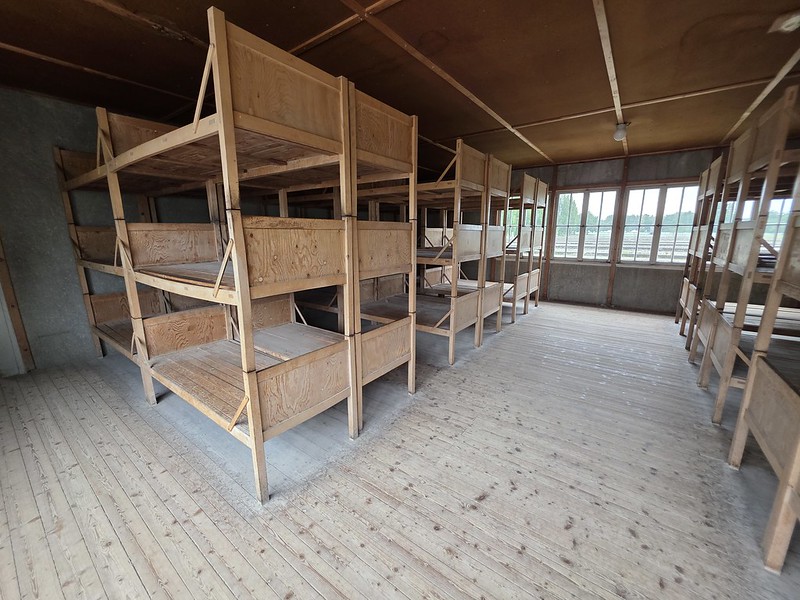

There’s one accommodation block at Dachau, although it’s not original but it still tells a harrowing story. The first set of barracks built in the 1930s have long since been demolished, erased as part of the camp’s post-war dismantling. What stands in their place was put up in the 1960s as part of the memorial site’s efforts to give a sense of the living conditions without pretending that the wood and nails themselves date back to the darkest years. It is, in other words, an interpretation based on plenty of evidence rather than an untouched relic.

The decision to rebuild was controversial at the time, not least because it risked accusations of falsifying history. But the curators argued, and still argue, that leaving the ground bare would rob visitors of any real sense of what life looked and felt like inside. The result is a set of reconstructed barracks, faithful to the original dimensions, where one can move from one dormitory style to another and see how the regime altered living space over the course of the war.


Inside, there are three types of dormitory arrangement, staged in sequence. The first represents the early years of the camp, when conditions were already harsh but still allowed something resembling order with neatly aligned beds, lockers, and a sense of regimented, almost military discipline. It wasn’t comfortable by any modern measure, but it was structured, a vision of a barracks meant to break individuality but still keep the veneer of control. At the time the intention was still to operate as a form of prison and although the Nazis strongly disliked their political opponents and weren’t afraid of killing some, the arrangement wasn’t designed to be a mass killing machine.


The washroom facilities.


The second reconstruction shows how the accommodation degraded as prisoner numbers grew. Here the beds are closer together, storage space has vanished, and the atmosphere is more obviously oppressive. It is a space designed not for discipline but for crowding, with privacy and dignity stripped back even further. The physical closeness illustrates what documents and testimonies often describe, namely overcrowding that was deliberately allowed to spiral.

The third dormitory shows the final stage, when conditions collapsed entirely into rows of bunks crammed together with little more than straw and blankets. It is the starkest of the three, stripped of any pretence of order and with no living space supplied as had previously been the case. This space is meant to demonstrate the extreme overpopulation of the camp in its later years, when disease and exhaustion became as much a part of the environment as the walls and ceilings. The contrast between this room and the first is brutal, and that is very much the point.
The reconstructed barracks are not there to trick anyone into thinking they are standing in untouched history. Instead, they function as a visual and spatial narrative, walking visitors through a steady decline in living conditions, from rigid control to chaos. By building them in the 1960s, the memorial’s designers created a tool to teach rather than a relic to worship. They remain one of the most immediate, unsettling parts of the site, not because of their authenticity, but because they distil the story of degradation into something that can be seen and felt in the space of a short walk.