Category: UK

  • Honing – Church of St. Peter and St. Paul (Roll of Honour)

    Honing – Church of St. Peter and St. Paul (Roll of Honour)

    The roll of honour, or the list of people who fought in the First World War, in the Church of St. Peter and St. Paul in Honing. It’s notable just how members of the Flaxman families went to fight in the conflict and there were 54 men in total who served. Sadly, 11 of those died and more about these in some future posts….

    The 11 who died are:

    Donald Beck

    E. Randell Cubitt

    Victor M Cubitt

    Eustace H Cubitt

    Archibald Flaxman

    Charles Flaxman

    Herbert Flaxman

    William Hannant

    Robert Jarvis

    John Meek

    Reginald Riches

  • Honing – Church of St. Peter and St. Paul (Tomb of Andrew Chamber)

    Honing – Church of St. Peter and St. Paul (Tomb of Andrew Chamber)

    The tomb of Andrew Chamber is located in the aisle of St. Peter and St. Paul Church in Honing.

    Andrew Chamber was born in Walcott on 24 July 1690 and he died on 24 December 1743 and was buried just two days later. The Latin on this tombstone reads ‘The noble human remains, son of Andrew and Susannah Chamber of Walcott. He left three children, Bevill, Andrew and John. Died on 24 December at the age of 53, AD 1743’. I don’t know how Bevill translates, I can’t imagine that’s the correct name I’ve translated there.

    It’s evident that as Andrew has this tomb in the centre of the church that he had some money or influence. And indeed, his son who was also known as Andrew, built Honing Hall in 1748 and he had made his money from Worstead weaving. I’m not entirely sure, but I’d imagine the Andrew Chamber buried here would have also been a weaver (and Honing church is near to Worstead), who had managed to build up some wealth.

  • Honing – Church of St. Peter and St. Paul (Interior)

    Honing – Church of St. Peter and St. Paul (Interior)

    Pleasingly, the Church of St. Peter and St. Paul in Honing was open when we visited on a Sunday early evening.

    It’s a bright and airy church, although the boxed pews that might have added some extra charm were replaced in the early part of the twentieth century. I accept some people don’t think boxed pews do add character, but there’s something about these almost secretive looking boxes that I find historically attractive.

    The chancel was shortened in 1795 when the church was reconstructed, so there is now very little left of it.

    Looking back towards the west end of the church. The wooden roof is from 1795, although there was a ceiling underneath it originally, which has since been removed.

    I like the flooring, which adds some character, with the tower section closed off with a wooden partition. There was a substantial restoration recently and this does allow members of the public access to the top of the tower, albeit only as part of a pre-arranged guided tour.

    The top section of the font is made from Purbeck marble and dates from the thirteenth century, with the lower section dating to the fifteenth century. It’s thought that there has been a church here since the thirteenth century, with the bulk of it being reconstructed during the fifteenth century. That would fit with the dates of the font, so the older part is likely contemporary to the original church that was here and the rest is from the rebuilding.

    These are some of the narrowest aisles that I’ve seen in a church and I can’t imagine that this was the original construction plan. It’s likely another one of the changes that were made in the 1795 reconstruction and it does feel out of proportion. There are two possibilities, one is that the walls were rebuilt and pushed inwards and the other is that the arcade has been moved outwards towards the wall.

  • Honing – Church of St. Peter and St. Paul

    Honing – Church of St. Peter and St. Paul

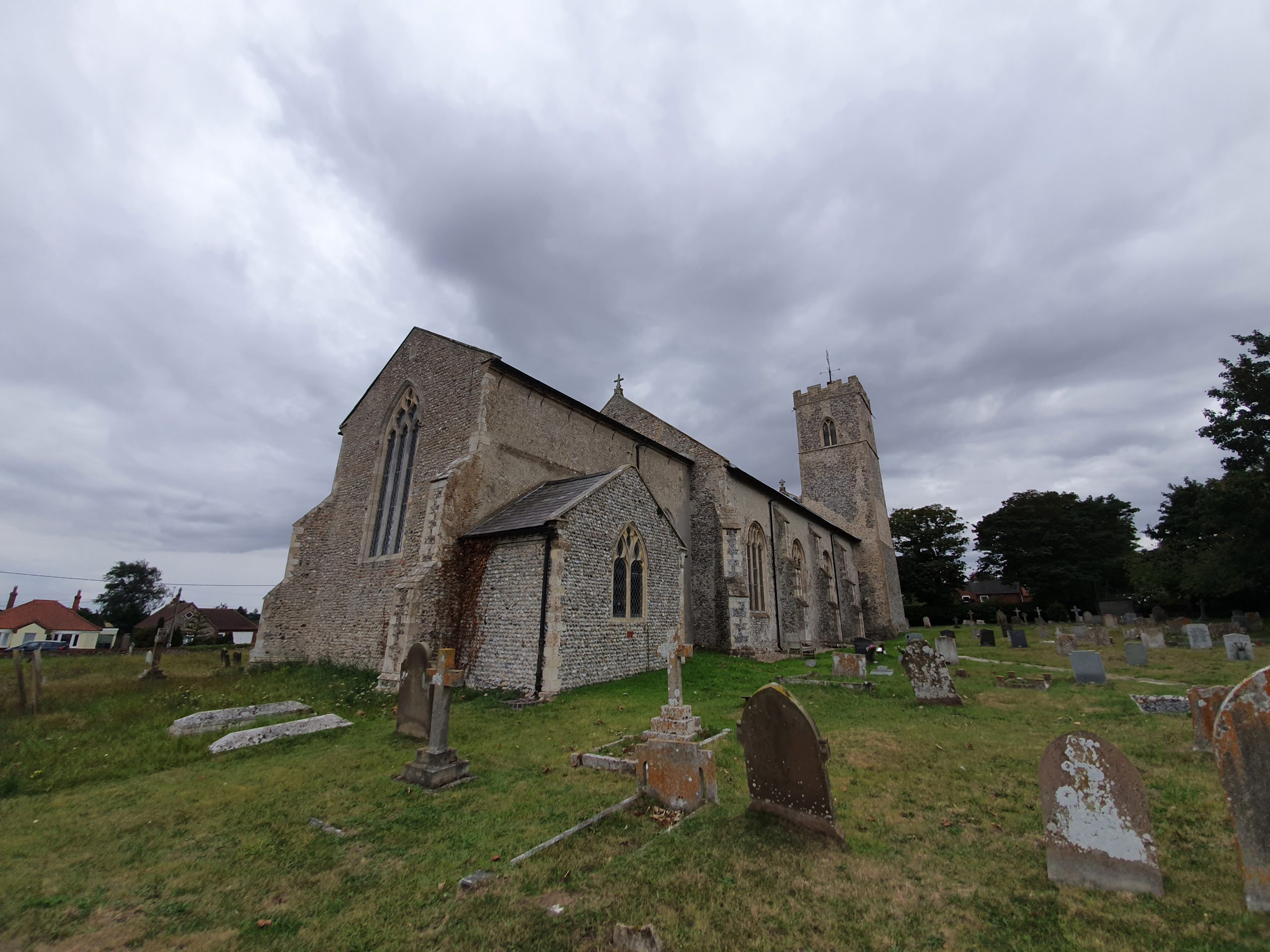
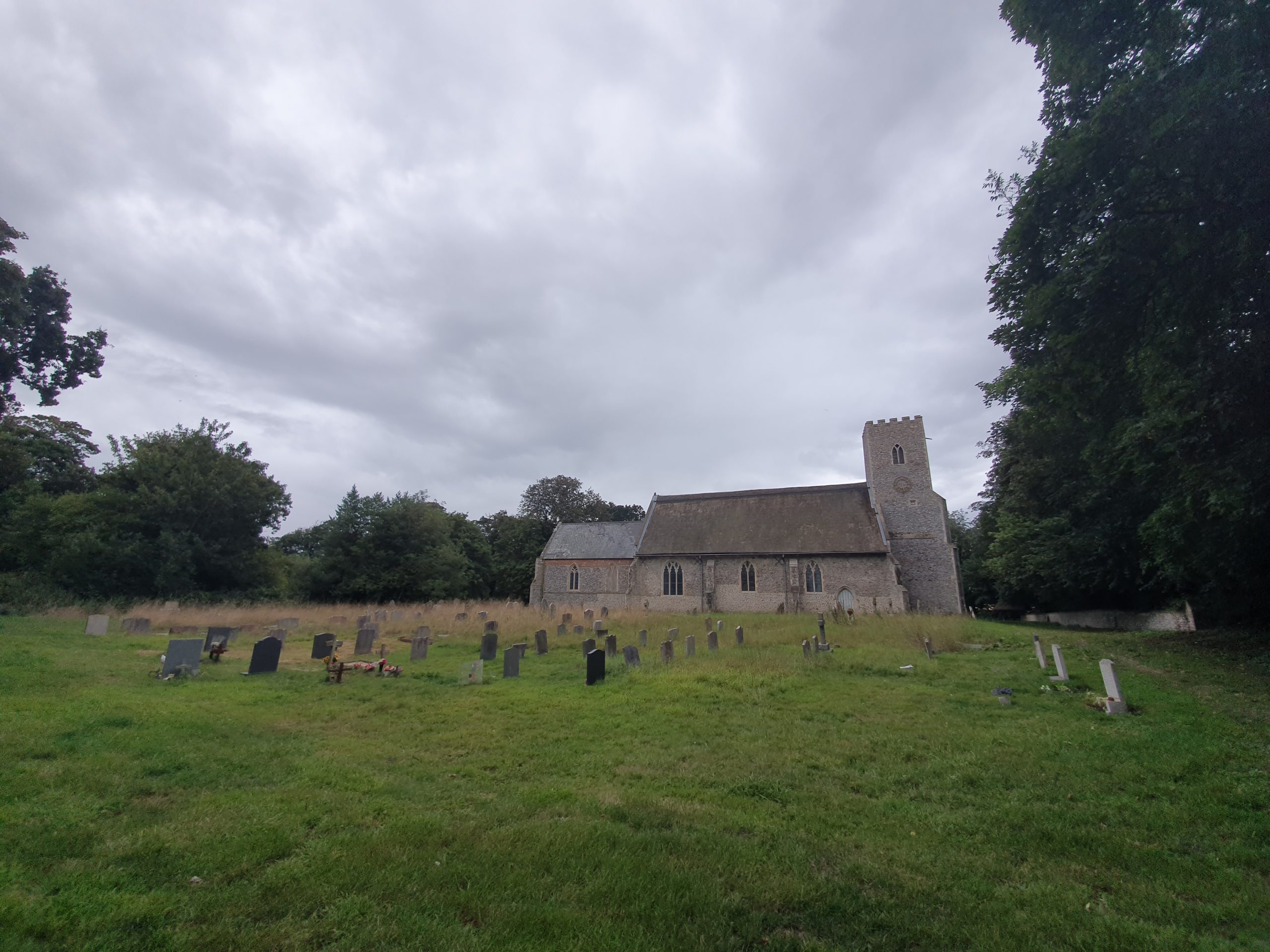
    St. Peter and St. Paul is a fifteenth-century church which was substantially changed in 1795, something highly evident both internally and externally. It’s a peaceful location and there’s a long churchyard, which was extended in the early twentieth century. There has though been a church here since at least the thirteenth century, and a few elements of this have been incorporated into the nave.

    The most obvious external change to the church is the chancel, which has been almost ludicrously cut short. There is an area with iron railings around it and this marks the consecrated area of where the chancel once stood. It’s not known what caused this rebuilding, but one historian has suggested that the church caught fire and this was the best repair that could affordably be made.

    The new chancel end.

    The nicely proportioned tower is contemporary in age to the rest of the church. There was a relatively large-scale restoration of the building completed recently, coupled with the hope of encouraging more people to visit the church. The tower is also now climbable, although only as part of a pre-arranged guided tour.

    This is the west doorway on the tower, with the original door having been closed off during the 1795 restoration and a window added. The large window half-way up the tower is from the late fifteenth century, so may have been added after the church was originally constructed, but was likely part of the original design.

    We were able to have a look inside the church, so more about that in another post.

  • Dereham – Church of St. Nicholas (George Dunn)

    Dereham – Church of St. Nicholas (George Dunn)

    There was no particular reason that I photographed this gravestone at the Church of St. Nicholas in Dereham, but it’s of George Dunn, who died on 12 December 1861 at the age of 50.

    The probate record remains for George, which noted:

    “Effects worth under £450. The will of George Dunn, late of East Dereham, in the County of Norfolk. Shoemaker, deceased who died on 12 December 1861 at East Dereham, aforesaid was proved at Norwich by the oath of George Jackson of East Dereham, aforesaid carpenter and sole executor”.

    The effects value were in bands, of which £450 wasn’t the lowest, and very roughly (and relying on the National Archives currency calculator), it was probably around £25,000 in today’s money. George wasn’t likely a poor man, although that’s relative in this period, during his life as he was a registered elector due to being a freeholder property owner.

    George was born in April 1811, the son of John Dunn, and he was baptised at the Church of St. Nicholas. He married Susan Clarke on 30 October 1844, again at the same church. The 1851 census gives a picture of what life was like for George, when he was living on Norwich Road in Dereham. He was aged 40, working as a shoemaker, married to Susan Dunn (born in Thetford), who was aged 37, as well as living with his children William R (aged 5) and Anna J (aged 4). He was also living with his father, John Dunn, who had been born in 1782 and worked as a tailor, by this time aged 69 and widowed.

    By the 1861 census, they lived in the same property as in 1851, with John and Susan still living with William and Anna. William was by this time working as a watchmaker and Anna was still at school. Still teenagers, it must have been a difficult life for the family when George died a few months after the census was taken.

    It was evident just how common theft was in Victorian Britain, with George being a victim of crime when in July 1855 a pair of wellington boots was stolen from his shop. Maria Barlow, an eighteen-year old bootmaker, was found guilty of the crime and sent to prison for six months.

    The church in Dereham clearly played a great part in George’s life. From when he was baptised with his family present, excited about the future, to when he got married to what I assume was more excitement and then to his funeral service and burial.

  • King’s Lynn – Westgate House

    King’s Lynn – Westgate House

    This is 42 Chapel Street and I had thought when taking this photo that the building was a little older, but the southern section (to the right-hand side of the photo) is from the eighteenth century. The northern section was added in the early nineteenth-century when the entire building was given a new facade to unite the new addition.


  • Dereham – Church of St. Nicholas (Richard Peacock)

    Dereham – Church of St. Nicholas (Richard Peacock)

    This is another in my series of wanting to find out whatever stories are possible from gravestones, for no real reason other than being intrigued about how much information still remains about a person.

    This is the grave of Richard Peacock, who died on 28 April 1856, at the age of 36. The burial record remains and gives his full name, Richard Henry Peacock, buried on Sunday 4 May 1856.

    That gives us sufficient information to find Richard on the 1851 census, where he was listed as living with his wife Mary Ann and his 1-year old son, Henry William Peacock. Richard was working as a machine maker and he had been born in Warham (a village in North Norfolk), whilst his wife who was also born in 1820 came from London. At this census, Richard and family were living on Theatre Road, which I assume is the same as Theatre Street in the town today.

    Going back to the 1841 census, Richard was living in Binham with his parents, Henry and Ann, as well as numerous siblings. Richard and Mary Ann (nee Roper) married in the church in Dereham in 1848.

    The Norwich Mercury reported in January 1856 that Jeremiah Oakley, a machine maker, had been arrested and charged with the theft of two match planes, three chisels and one gouge that belonged to Richard Peacock of Dereham. Given that these were tools used by machine makers, this is likely the same Richard Peacock. In March 1856, the trial took place and more information came to light, which was that Oakley worked with Peacock, who had been ill in late 1855 and noticed the missing items. The court wasn’t convinced and Oakley was found not guilty, although this does now give some background to the illness that may have caused Richard’s death in the April of 1856.

    Richard’s grave also notes “also two of his children”, suggesting that they died young. Henry William Peacock, Richard’s son, did survive and was married in 1873, living in Dereham with his family until his death in the first few years of the twentieth century. So, that’s as much as I can find, it’s a life which sounds like it was challenging and led to a relatively early death. It is also sad that the last few months of Richard’s life were mired in part with the court case of some of his items being stolen.

  • East Ruston – Name Origin

    East Ruston – Name Origin

    The church in East Ruston isn’t in the geographical heart of the community, but it is the oldest building in the village. And, this is what The Concise Oxford Dictionary Of English Placenames has to say about it:

    East Ruston, Norfolk. Ristuna in the Domesday Book, Ristone in 1129, Riston in 1198, Estriston in 1405. From Old English Hristun, meaning brushwood.

    That might not be the most exciting of all name origins, a settlement in a bushy area. The evolution of the village name also explains why it’s called East Ruston, as there isn’t any such place as West Ruston. But, the old word was Riston and there is a place in Norfolk called West Riston.

  • East Ruston – St. Mary’s Church

    East Ruston – St. Mary’s Church

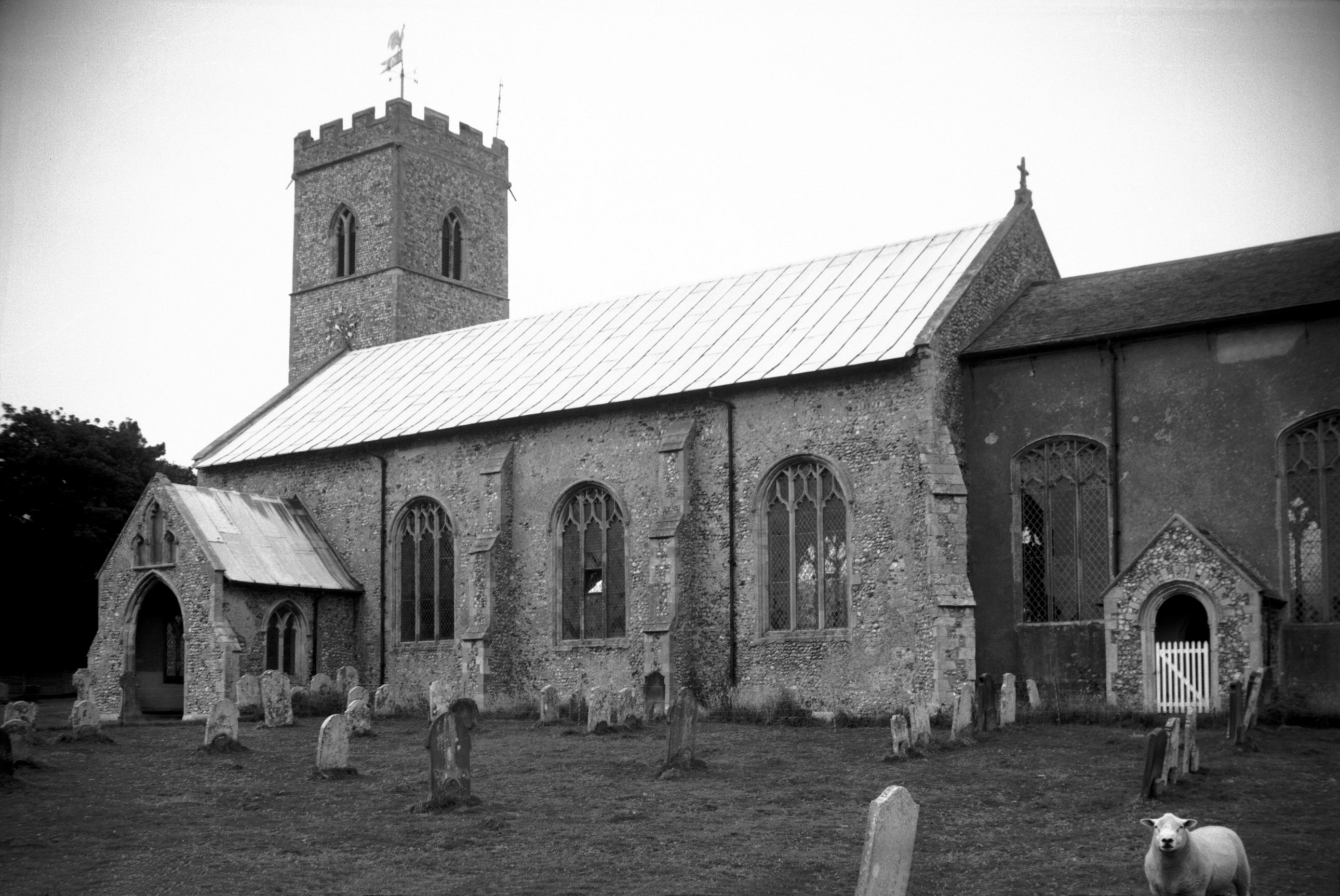
    One of the first obvious things of note about St. Mary’s Church in East Ruston is that it’s not really in East Ruston. It instead has a rather precarious position by a main road and is one of the few churches that looks entirely different depending on which side it’s viewed on.

    The main part of the churchyard has been turned (perhaps not deliberately) into a large wildlife garden, making it rather difficult to take photos of the church from some angles. The foliage is quite high and I could just sense the snakes that were lurking in the undergrowth, so I didn’t intend to charge in.

    So, I’ve used this photo (by John Salmon, https://commons.wikimedia.org/w/index.php?curid=13001263) to show what the church did look like before the foliage surged in height.

    And this is the church from the other side, the nearest I could get to it. It looks like a completely different church, but it’s because the north aisle was removed in 1778. It’s an interesting question of why bricks were used in this transformation given the rest of the church was made from flint, were people at all concerned about the aesthetic appearance of the building then?

    There is record of one of the vestry meetings which was held before the north aisle was removed, and there was a problem because a decision was made to use bricks, but no-one at the meeting knew how many would be needed. They tried to work this conundrum out, but failed, so they instead sought the assistance of the young Richard Porson, a local boy who became a well-respected mathematician.

    Another view of the north side of the church, as best I could get, with a strange wall at the front of the photo which is underneath the tower. I have no idea what that’s there for.

    The tower is contemporary with the main part of the church, which is fourteenth-century, although there was likely a previous church on the site from an earlier date.

    The church once had a spire, but it was either taken down or fell off. The almost inevitable Victorian restoration came to this church late, financed in the mid-1880s with funding from Maria Atthill, the wife of the former churchwarden. Before this money came in, the church had fallen into a state of some considerable disrepair.

    The south porch is a little later than the rest of the structure, being added in the fifteenth century. As the church is redundant, the building is now under the care of the Churches Conservation Trust, but the interior is currently closed until they can complete a risk assessment. There is apparently a chancel screen inside which is worth seeing, as well as a fifteenth-century font, so I shall hopefully meander along again to see the interior.

  • Dereham – George Hotel Milestone

    Dereham – George Hotel Milestone

    I’ve never noticed this milestone near to Dereham marketplace, located outside of the George Hotel, which was once a coaching inn. It’s a simple enough bit of stone, marking that it’s 100 miles to London (that reminds just how far the LDWA 100 challenge is) and 10 miles to Watton. It also reminds people that they’re currently in Dereham, which is probably quite handy for the weary traveller. But, there’s a long heritage to this stone, it has been here since around 1770, which makes it one of the earliest of the 360 or so milestones in Norfolk.