Category: Norfolk

  • Coltishall – Great Hautbois Holy Trinity Church

    Coltishall – Great Hautbois Holy Trinity Church

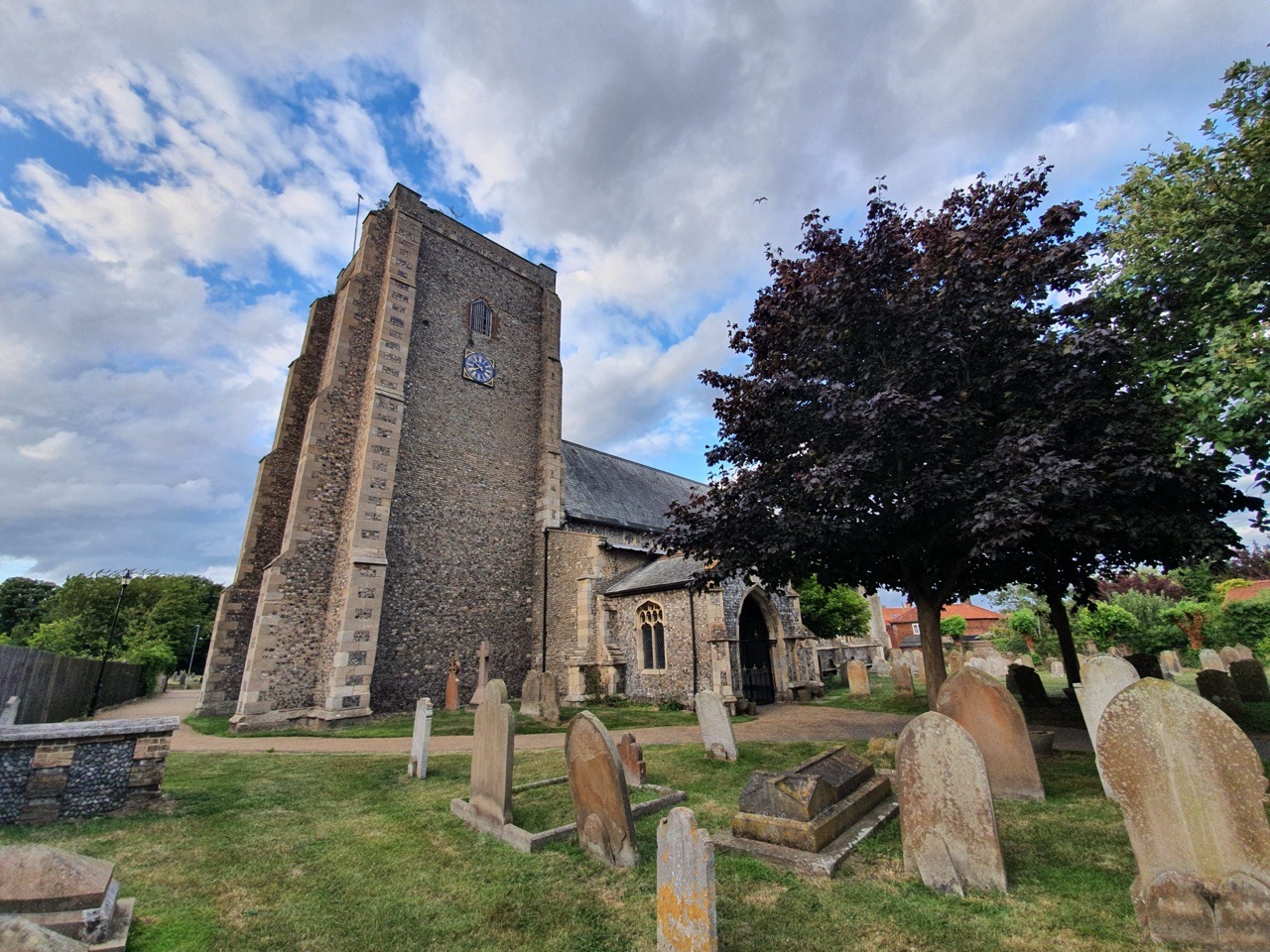
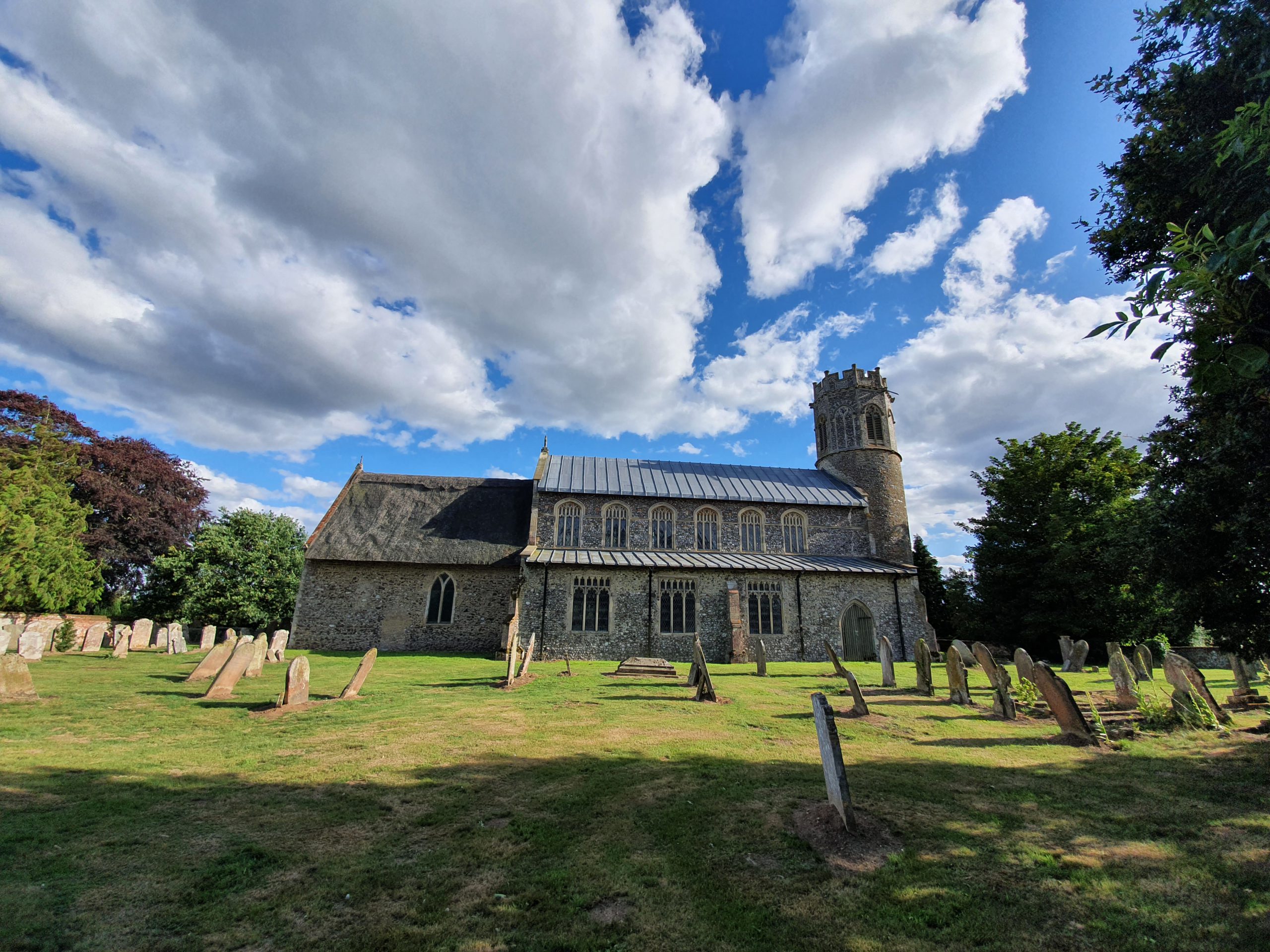
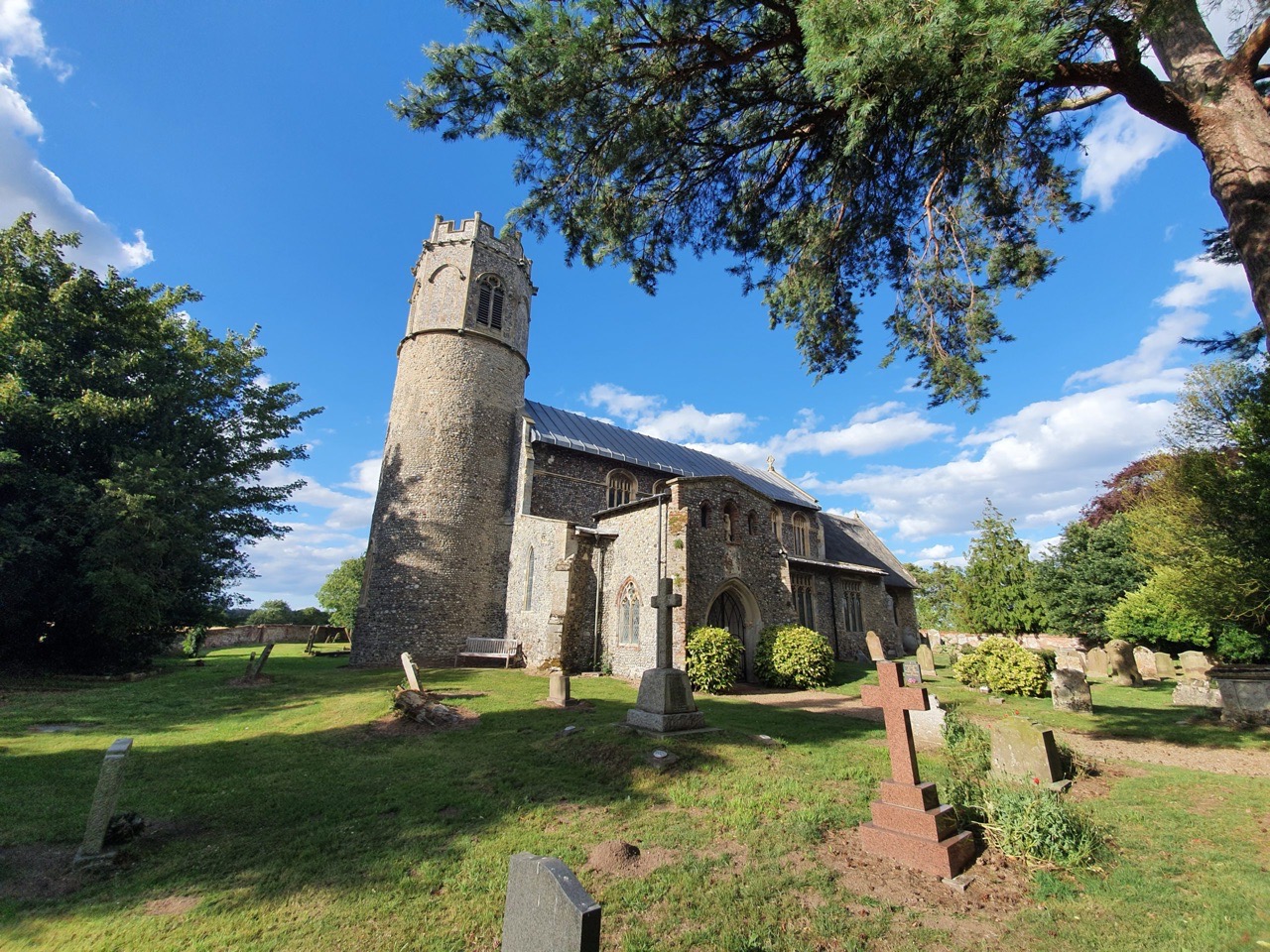
    This slightly quirky church is located on Great Hautbois Road, a short distance from the centre of Coltishall.

    The church dates from the late nineteenth century and is unexceptional, but is in keeping with its rural environment. The church is apparently usually closed, although it is inevitably at the moment given the health situation, but it does have inside the twelfth-century font that was from St. Theobalds, a nearby ruined church. The building was designed by Thomas Jeckyll and although there’s a churchyard there are no burials in it, other than for a very small number of cremated remains.

    The chimney and the bell tower add some charm to the church, which seems a little misproportioned to me. The church has in some of its windows the only transfer glass left in Norfolk, with the images laid onto the glass using the transfer method in the 1880s. Incidentally, I didn’t notice any of this glass, the listed building record helped me out there.

    We wondered why there was no sign at the entrance with the church name on, but then we saw this near to the church door, so it looks like a repair is being planned. There was a newspaper article in 2017 saying that the girl guides, who have a large base opposite, were looking to take over the building as the Church of England congregation had fallen to just four people. There aren’t any signs at the site that this takeover has happened, but I can’t see much religious future for the church with such a low congregation.

  • Walking Photos from Around Coltishall

    Walking Photos from Around Coltishall

    Just photos, but a pleasant evening in Coltishall and there were no shortage of people sitting by the river.

  • Hardley – Hardley Mill

    Hardley – Hardley Mill

    Hardley Mill is located off of the Wherryman’s Way and was constructed in 1874 for Sir Thomas Proctor Beauchamp.

    The 1874 construction date is visible on the stone tablet, with Beauchamp residing at Langley Hall, which is now used by Langley School.

    The mill was used until 1950 and at that time the Internal Drainage Board abandoned the building and it might have easily become derelict and lost. The mill was saved by Peter Grix and other volunteers who in 1981 were able to save it from falling down, slowly restoring it and making it operational once more.

    The sign notes that this is one of the original doors from the top of the turbine well.

    The windmill looks quite graceful on the Norfolk Broads, with the cap being added back to the top in 2009 as the previous one had effectively fallen off. Although the ongoing health issue meant that it was closed when we walked by, the mill is often open for tours and there’s a visitor centre here as well which can provide snacks and drinks.

  • Great Yarmouth – Name Origin

    Great Yarmouth – Name Origin

    Since I’m on a roll with these name origins, and I want a relatively complete list for Norfolk, back to The Concise Oxford Dictionary Of English Placenames.

    Great Yarmouth, Norfolk. Gernemwa in Domesday Book, Gernemuta Magna in 1254. The mouth of the River Yare.

    The Magna means great, which is solely to avoid confusion with Southtown on the southern side of the river, formerly known as Little Yarmouth. The word origin is different from Yarmouth on the Isle of Wight, but the word Great has probably persisted to differentiate those two towns. ‘Garienis’ is the Saxon word for the River Yare, so it started with something like ‘Garmud’ and that ‘d’ at the end was pronounced as ‘th’.

  • Brundall – Name Origin

    Brundall – Name Origin

    Brundall was on our third training walk for the LDWA 100, so here’s a quite meander over to The Concise Oxford Dictionary Of English Placenames.

    Brundall, Norfolk. Brundala in Domesday Book, Brundale in 1180 and Brundhal in 1257. Perhaps a compound of Old English bromede, or broomy, and Halh.

    The ‘halh’ bit is usually a secret place, a tucked away area or some land which is separate from its administrative area. The word ‘broom’ is an old English word for a bramble and by coincide (I assume) there’s also a boat company called Brooms of Brundall. All sounds a bit convoluted and unlikely to me, but I like the idea of Brundall meaning ‘the secret brambled area’.

  • Langley – Name Origin

    Langley – Name Origin

    And, since I’ve written about the origins of the place name of Hardley, here’s Langley since they share a village sign. Back to The Concise Oxford Dictionary Of English Placenames.

    Langley, Norfolk. Langale in Domesday Book, Langeleg in 1201. 

    This one is easy for the dictionary to define as there are Langleys up and down the country, all nearly certainly derived from the old English ‘long leah’, or long wood, both of these words having Germanic roots. Confusingly, later on ‘lea’ came to mean an open area of land, just to make things complex.

  • Hardley – Name Origin

    Hardley – Name Origin

    Moderately intrigued following seeing the village sign, I went back to The Concise Oxford Dictionary Of English Placenames. I certainly know how to have an entertaining afternoon…. Anyway.

    Hardley, Norfolk. Hardale in Domesday Book, Hardele in 1115, Hardeleygh in 1268. Hard clearing, perhaps referring to hard soil. Some forms have halh.

    The ‘halh’ is the old English for cave, closet or corner, which has apparently slipped into the settlement’s name over time. Some of the area around Hardley is today marshland, so a hard clearing would make sense in this context.

  • Hardley and Langley Village Sign

    Hardley and Langley Village Sign

    I’m not sure that I’ve seen a village sign with two different village names on it, but this is the sign for Hardley and Langley. The two villages have somewhat merged together and their formal name is now ‘Langley with Hardley’, which were both historically separate parishes.

    According to the village’s own web-site, both parishes had their own council in 1894, but they were amalgamated in 1928. There was some debate about dropping the name of Hardley, but the residents of Langley must have been a vocal bunch, and so their parish wasn’t forgotten. The school districts had already been merged in the 1870s, so it looks like harmony prevailed in the end.

    The Hardley side of the sign has Hardley Church on it, along with birds and sweeping views of the landscape, whilst the Langley side of the sign has Langley Abbey and a wherry on it. All colourful and bright, a rather lovely village sign and it’s also been placed pretty much on the official boundary between the two villages.

  • Buckenham – Name Origin

    Buckenham – Name Origin

    Further to my visit to Buckenham this week, this is the origin as given by The Concise Oxford Dictionary Of English Placenames. To confuse things just slightly, there are three Buckenhams in Norfolk, Old Buckenham, New Buckenham and what is mostly now just called Buckenham, but has historically been known as Buckenham Ferry.

    Buckenham, Norfolk. Buchanaham in Domesday Book, Bokenham Ferye in 1451. From Bucca’s Ham.

    Ham is a village or settlement, with Bucca being one of the early leaders of what became known as the Anglo-Saxons, a similar word origin to Buckingham, as well as the other Buckenhams in Norfolk. Unless he meandered around a lot between Buckinghamshire and Norfolk, I assume this was some related group of people who came to Norfolk in the seventh century. Incidentally, the ferry at Buckenham operated until the 1940s, but more on that another time….

  • Buckenham – St. Nicholas’s Church

    Buckenham – St. Nicholas’s Church

    This is the secluded church of St Nicholas in Buckenham. Unfortunately, the churches are currently closed given the ongoing health issue, but it’s possible to peer inside at the boxed pews and otherwise quite empty interior. There’s not much else in the area of the church, although it is a short walk from Buckenham railway station for those who can navigate themselves onto one of the few trains which stop there.

    The Norman tower, which was originally round and was later reworked to make it octagonal. That’s also an original Norman doorway and is in situ and probably wasn’t moved here from elsewhere in the church.

    The entrance to the stairs within the tower.

    The nave, which is the oldest part of the church and dates to the eleventh century.

    The fourteenth-century chancel.

    The north side of the church.

    The east window, and this tells a story of its own. The church was deconsecrated in 1968 and was just left by the Church of England to a slow abandonment. Fortunately, it was taken over by the Redundant Churches Fund around ten years later, but there had been vandalism and destruction during that time. One of the oldest bells in Norfolk was stolen and much of the Victorian stained glass had been smashed. The Churches Conservation Trust gathered up what glass they could and they’ve reset it in the upper part of the window, but the lower part is now just plain glass. This could though have very easily had a different fate, perhaps something more like what happened at Bixley.

    It’s difficult to know whether this is a deliberate wildlife garden approach to their graveyard, or whether they just haven’t been able to cut the grass recently. The village of Buckenham depopulated over the centuries, so there hasn’t been much of a congregation to support it for some time. The church was remodelled in the 1820s, which gives it a different feel to the much more brutal and comprehensive restructurings of the later nineteenth century, although a guide from the beginning of the twentieth century called the changes “fitful and destructive”. Numerous Roman remains have been found in the area, suggesting some form of Roman encampment locally, likely because there was a ferry site nearby.