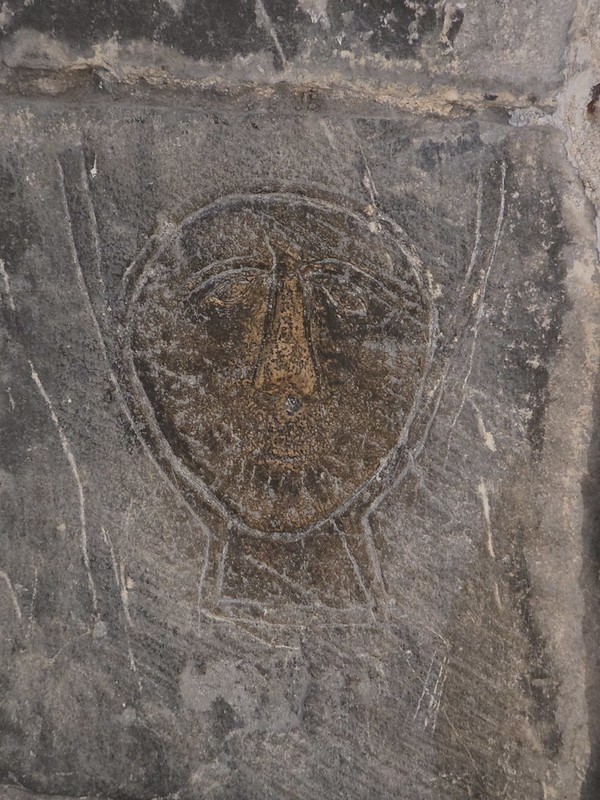
This is a carving in the stone near to the new entrance of Norwich Castle Museum’s redesigned keep. The museum notes that it dates to the thirteenth century and has been retouched many times, so although they don’t know who it was, they suspect it was a revered local religious figure. I assume that there’s a possibility that it’s the Virgin Mary, but it’s quite possible that no-one will ever know. It’s nicely preserved though and very visible to visitors to the museum.
One huge improvement here at Norwich Castle with the extensive works is that the battlements have been opened up permanently, rather than only accessible for certain tours. The lift was already broken, which is entirely sub-optimal for those with accessibility needs, with no indication on when this will be resolved. One thing I find a little odd is that they’ve put glass between the battlements so it’s quite hard to look through clearly unless you’re tall, there’s a fair few negative reviews about that already.
I very much enjoyed looking over Norwich, there’s Rose Lane towards the bottom of the photo on the right, with Norwich railway station in the centre-right.
Norwich railway station.
Rose Lane and this was a useful time to test my phone’s zoom. At maximum zoom, I could read the Hollywood Cinema sign clearly on the soon to be demolished Anglia Square, so it’s fair to note that there were excellent views.
Mousehold Heath towards the rear.
The soon to be demolished Anglia Square at the left on the rear, and the white building is where I was able to zoom in on the cinema sign.
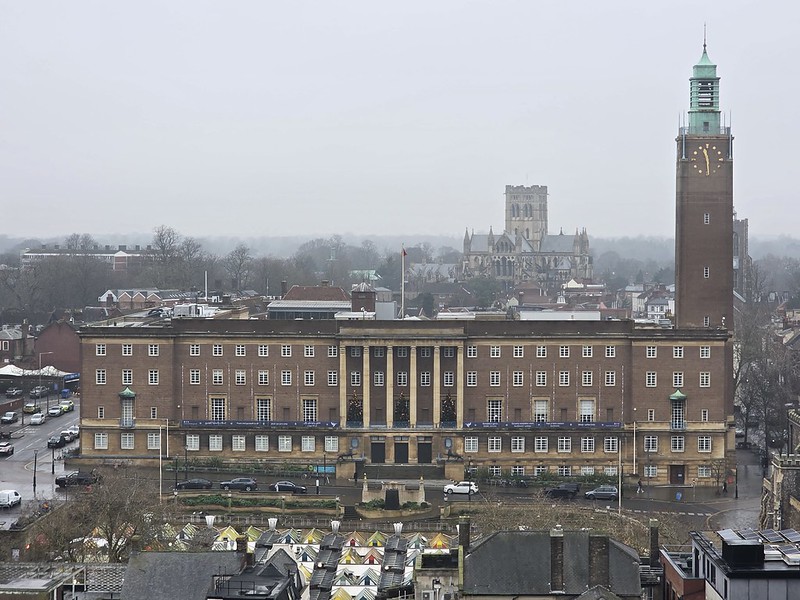
Norwich City Hall.
Looking from Castle Meadow at the front through to Norwich Market.
Norwich Market.
I’ll return to the museum a few more times in the year I imagine, hopefully to get more photos across Norwich when it’s a bit brighter. But, I am impressed at the work they’ve done to open up the battlements, that feels a real positive and I hope they can make it fully accessible again soon.
As I’ve managed to get an Art Fund pass at a discounted price, there will now be a year’s worth of posts about places that I can get in for free. One of them is Norwich Castle, recently re-opened following a substantial refurbishment and renovation. More on this later, but the changes weren’t as bad as I expected and there are some definite positives about the investment that has been made here.
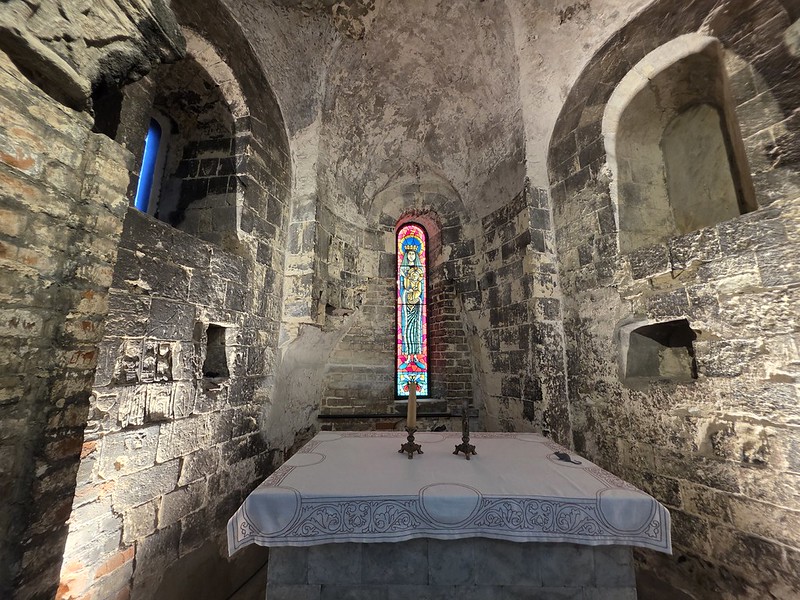
Having noted that, this room seems to me though as something of an incoherent mess in terms of the history, it’s unclear to me what they’re trying to show here. They’ve put a throne into the chapel and the relatively undamaged original sanctuary is in the corner. I’m struggling to believe that the chapel would have once had a large throne looking at the window and no other furniture or religious paraphernalia other than a lectern. I know that we wouldn’t have had rows of pews in here, but the layout seems odd to me.
I’m also unsure why they’re suggesting that the Caen stone was painted white so it would have had the appearance of Victorian toilets. Unless this is their interpretation of what new Caen stone would have looked like, but that seems aspirational in terms of the brightness. In other locations it was just left as it was, it’s an off-white or cream coloured stone anyway and so why would they paint an interior wall with what I assume the castle is suggesting is limewash? They might have wanted to use bright colours in the way that Norwich Cathedral was decorated, but I’m not convinced they chose white. But, I’m sure they’ve done this for a reason, but it’s a shame they haven’t explained anyway (either in the room or online) their logic here.
The museum might have been better trying to use graphics to show what the room might have looked like, I just find it unlikely the Normans made their chapel in Norwich different to everywhere else. AI can be very over-rated, but I ran the images of this room through Gemini and ChatGPT, both of them concluded that this was a medieval function room where visitors would have been welcomed by the gentry. This is what it looks like to me, I’m very much struggling to understand this as a chapel layout.
Anyway, that aside.
This is the sanctuary, so the original Norman architects were using this as the chapel’s altar although it’s at an odd angle. But, when you’re the King, you have the option to do things as you want.
I can’t find out whether this is entirely new stained glass for the new project, but it’s rather beautiful.
What the project has delivered is some beautiful lighting so that graffiti is easily visible, here’s what I assume is Mary.
There’s certainly a variety of graffiti here, the museum thinks these date from a period of over several hundred years.
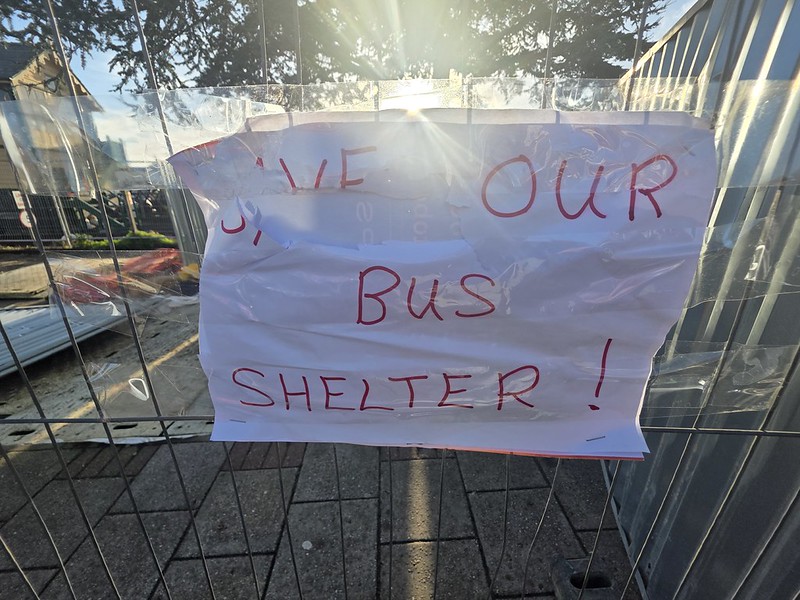
This is a rather nice 1950s bus shelter that has sat next to Sheringham Railway station from when it was actually part of the national network and not a heritage railway. It’s not staggeringly beautiful and its glass has fallen out, but the council decided that it was too near the pavement. I tend to find bus stops near the pavement are helpful, but I don’t suppose I fully understand these modern methods that the council like.
In a botched consultation operated by Norfolk County Council they consulted with the locals about how they were going to do mostly what they wanted anyway. The locals were allowed some minor ideas, but this was not a consultation that was designed to consult, it could be argued that it was solely done to tick some boxes.
Was there an easy solution? Of course, put in a new accessible bus shelter, complete the works and maintain the former bus shelter for some other purpose or use.
Paul, a brave and courageous campaigner.
The council could have responded to local opposition by coming to look at what was happening to try and resolve the issue. Well, they could have done, but they didn’t. They did this.
Here is local money being spent for the people.
Sheer incompetence from the council saw metal barriers put up around the site and putting pedestrians at risk. It was only locals warning the council of the sheer danger that led to the council providing fencing.
The town council, as the owners of the bus shelter, had a vote and told the county council to withdraw their bailiffs. This annoyed the council, so they’ve decided to dump the chaos they’ve caused on the local community and scrap the rest of the project. The cost of this work was scheduled to be £580,000, although much of this was ring-fenced from Government funding for bus improvement schemes.
Brave locals fighting for their community have ensured that the bus shelter has been saved. Keir Starmer, the Prime Minister, has become involved and suggested that perhaps the county council should resolve the mess that now exists. We’ll see what happens now.
The excitement of my birthday weekend (the first of two, which is perhaps overly decadent) began on Friday with the trip from Norwich to Cardiff. After Liam had picked me up in his rather lovely car, of which much more on later, we collected Ross and headed to Greggs.
I get a free Greggs drink every week and I went for the Mint Mocha and it didn’t disappoint.
Liam had secretly planned the Saturday activity, but it was evident that it was likely to be heavily amended due to the rain. He went off to make his secret call and came back with a hamburger for me, which was suitably delicious. He’s a very good friend.
Safely into Banbury and the first charge of the weekend.
We were meeting up with Richard at Gloucester Services and that proved to be just a little too upmarket for some of us, but Richard enjoyed his coffee as nothing is too upmarket for him.
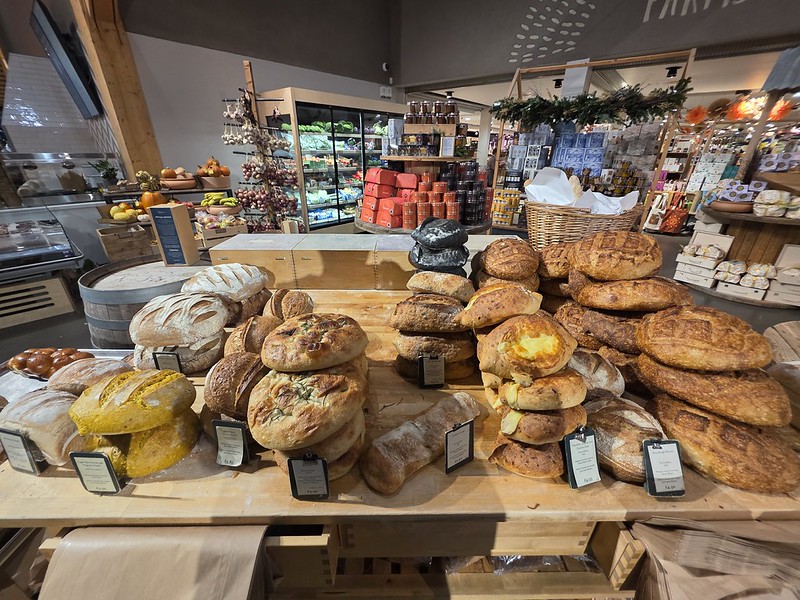
I like services with a Greggs as I have simple tastes, but for those who want to buy artisan bread, there’s that option here.
We then drove to Tiny Rebel (by we, I mean Liam and Richard) which I’ve already written about. With that we arrived at Mercure Cardiff North hotel, but more about that in future posts….
After the bravery that Liam and I showed at the mud run, I partially limped to the beer festival as I’m brave like that.
Ivan, once again, demanded to be in a photo. But, he’s the Social Secretary of the local CAMRA group, he loves the publicity. And I can remind my loyal blog readers that he leads coach trips for members (and non members) to see pubs around Norfolk and not just those in Norwich.
It had been a busy Saturday and they’d taken the decision to stay open throughout the day, rather than having two separate sessions. There was also the surprise and delight to the glasses team that the credit card machines stopped working. I picked an opportune moment not to be there….
And thank you to the lovely Paula for sorting out food for me.
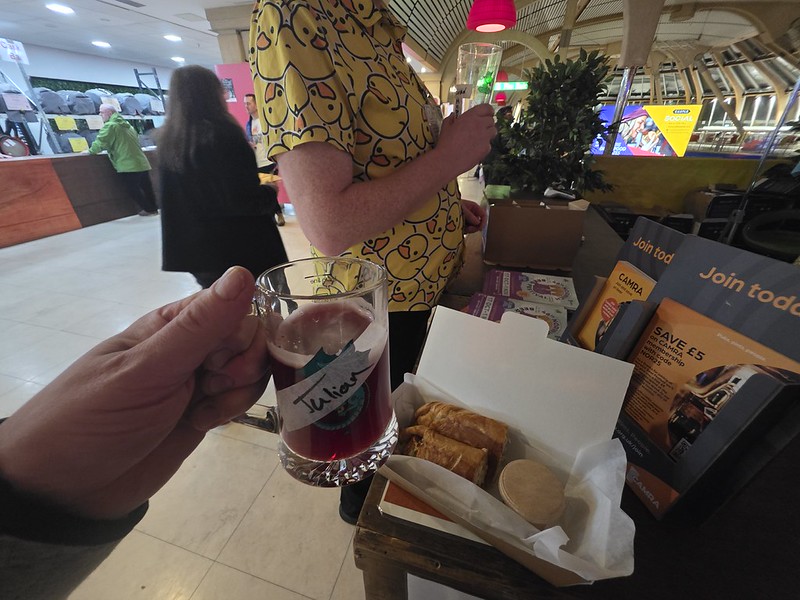
Thanks Paula! The turkey Yorkshire pudding wrap with gravy on the side, very nice. And paired marvellously with the Electric Currant from Mikkeller, a gentle, blackcurrant and smooth little sour.
There’s the cider bar set-up, although I didn’t manage to actually have a single cider during any of the beer festival. Next year I hope to do better in that regard.
Ivan, making farmyard animals out of blu-tac, with the wonderful and formidable arm of Jen to the right hand side.
And really is the end of Norwich Beer Festival 2025 now, unless there are some fringe events still lingering on that I don’t know about. It was a marvellous volunteering experience, I enjoyed it all and it was wonderful to meet some new people as well as old friends (literally old in some cases). Hopefully we’ll be back at the Halls next year as I hear that there will be some exciting changes, so I must actually get to some of the planning meetings.
After my volunteering efforts at Redwell and the Waterfront, I wasn’t going to go down to the third part of the beer festival at Castle Social. However, when I was sent a photo of Roy’s badge, I couldn’t not go down and visit…..
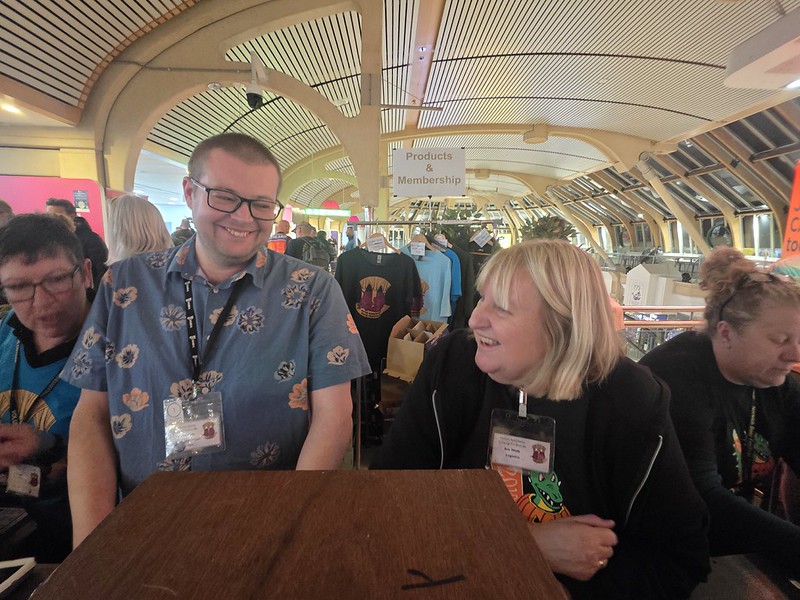
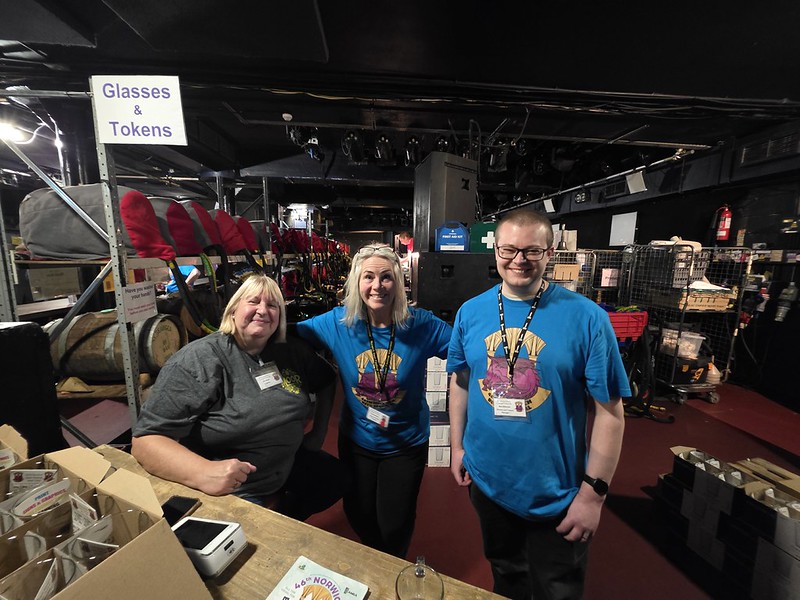
And there is the lovely Roy and Sue.
All looked well organised and calm, but glasses & token is a very well run area.
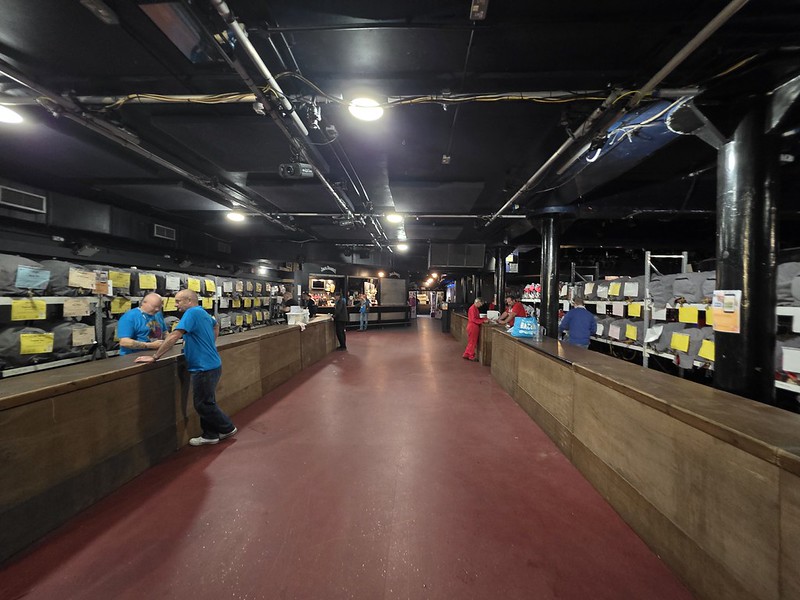
This is usually the only bar at Castle Social, but for three days only, there were tens of cask and keg beers available from Norwich Beer Festival. I heard several people mention that they didn’t know that this floor was here, so hopefully the whole event boosted Castle Social a little.
I thought that I’d pop to the Curiosity Bar to see what delicious keg beers were available.
And Ivan rushed over as it’s always lovely for him to see me.
Cheers!
I only stayed for around 45 minutes, but it was suggested that I might pop back the following evening. Which I did, so that means another post is coming shortly…. Oh the anticipation! And once again, a marvellous effort from all the volunteers who had to have this venue all ready the day after Waterfront closed. It’s all been quite a logistical challenge, but all the months of planning paid off.
Yesterday (Wednesday 29 October 2025) was the third and final day of the Waterfront part of the beer festival, although it now moves to Castle Social in the Castle Quarter.
For this final day, I moved to the ticket desk for a bit to staff operations (this area was a remote operating ground for glasses & tokens, away from our central base), with Martin ably assisting me which was very noble as he had a cold draft rushing towards him. He is a former festival organiser and what he doesn’t know about CAMRA isn’t really worth knowing.
Sue never stops working, here she is checking the glasses and planning her next toffee.
It was thought easier just to move the beer nearer to me, this was the end of the Wiper & True Sunset Dreams Rhubarb Margarita.
And some Kriek. That’s not my spelling could I just mention here.
Here is Andy looking longingly at me, he was one of our glasses team earlier in the week who was back as a customer. He’s another one that Roy and I will let come back next year, we’ve had that discussion. There isn’t actually anyone we won’t let back to be fair.
Ivan was on top form once again and I say this primarily as he brought me sweets and crisps, it’s that kind of attention to detail that gets so much praise. Here he is offering his latest suggestions to Sandy.
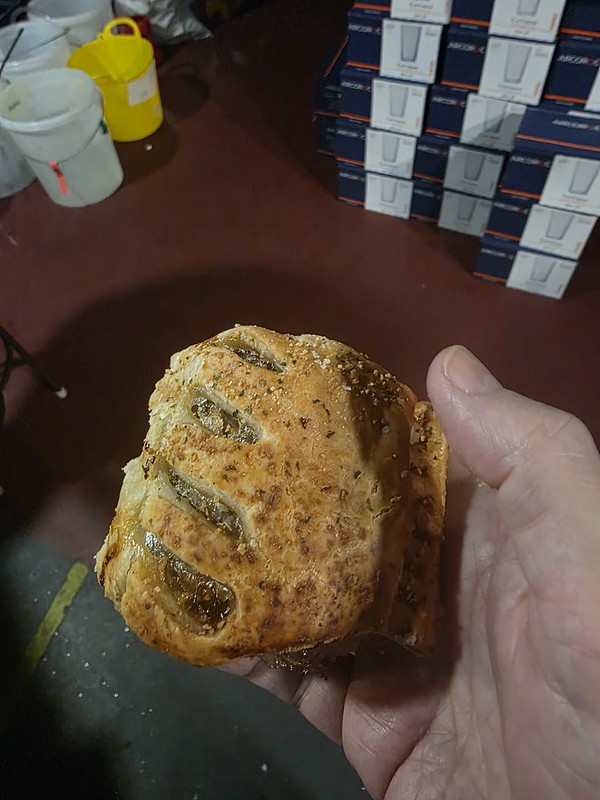
I heard a rumour that there were free sausage rolls available at the cider stand. I think I was the first there…. These were quite delicious but I wouldn’t have wanted more than 17.
And on the same theme, the free food option was pie and I was delighted at this. Here’s the steak and ale pie, with chips and gravy. Very lovely.
Some of the wooden casks.
Roy and Chris busy sign removing as the takedown began.
I don’t interfere with the cellar team, which is unofficially headed by Ivan (I don’t know if the cellar team know this), but I did take some cooler jackets off. This is the limit of my cellar competence, so I withdrew quickly after this in case I broke something. Or myself.
And that was then time at the bar. I might have some videos of Ivan calling time to surprise and delight my loyal blog readers. Both of them.
The takedown begins in earnest. Now everything gets moved back to the beer store or to Castle Social.
I’ve already written about days one and two at the Waterfront, and also at Redwell, so now it’s time for me to list my favourite beers from the last few days. So that’s anything I’ve rated as 4 or above on Untappd (and hello to my new Untappd friends this week!). Ooooh, beer friends…
This Circle is You from Pentrich Brewing (soft, hazy and fruity)
Mango Unchained from Elephant School Brewing Co (lots of mango, fruity and robust)
Berry Sour from Five Points Brewing Company (delicious, raspberries, fruit, gently tart and just a bit decadent)
Stupid & Contagious from Liquid Light Brew Co (very agreeable, stone fruit, hazy and delicious)
Imperial Stout from Lacons (smooth, rich and decadent)
Chicha Sour from Hammerton Brewery (gently sour, fruity, fluffy and delicious)
Lord Wimount from Moon Gazer (caramel, malty and sweet)
Lamanva from Verdant (malty, biscuity, fluffy)
Mild from Penzance Brewing Company (a very decent milk, creamy, chocolate and biscuity)
Knock the Corners from Howling Hops (toffee and biscuit, nicely rounded)
Stay Rad from Nene Valley Brewery (citrusy, dry and good with chocolate)
Peanut Butter Stout from North Riding Brewery (chocolate and peanuts, smooth and nearly decadent)
Dia De Los Muertos from Hammerton Brewery (a lot of chilli on this, but chocolate as well and interesting)
Cherry Porter from Mr Winters (cherry, chocolate and smooth)
Many thanks to Craig and the volunteer team for having so many delicious beers, and I will continue to ignore his comments about my not liking beer that tastes of beer 🙂 I’m not volunteering this weekend but I’ll likely go and annoy someone by popping in to see the event at Castle Social.
Hopefully next year we’ll be back at the Halls, but the Waterfront team were very helpful throughout, with the venue proving to be a really decent back-up.
I didn’t mention some elements of the beer festival at the Waterfront, but the venue has been a really handy location with the Halls out of action. Here’s the cider bar on the second of the three days at the venue.
The outside of the venue with the food stand on the left.
Some very reasonable prices for a festival.
There’s the JD Wetherspoon over the river and the Waterfront on the right hand side.
The upstairs seating area.
The Waterfront is a live music venue and they have boards of these tickets from past events on display.
Ready to go and scan tickets in the queue.
The formidable and wonderful Sue.
Ivan was on top form today, so I have no complaints about him which might come as a surprise. He was busy serving customers at the Waterfront and also went to help with the set-up at Castle Social where the festival moves tomorrow. I hope it won’t disappoint him, but I was very impressed with how agreeable he was. And he got me crisps so that boosted my opinion of him further.
Chris alerted to this new beer going on and it did indeed surprise and delight.
Team glasses of Sue, Paula and Roy. It was another lovely evening, wonderful customers and lots of positive comments about the organisation of the beer festival.
I had rather set my heart on pie, but the food kindly provided was sausage and mash, which is much appreciated. Roy and I briefly mentioned to Craig that he could perhaps acquire us some pies, but we didn’t want to cross the line into being annoying so we left the matter.
I didn’t take a photo of Craig yesterday, but I didn’t forget today. He of course is just part of the volunteering team that has put this event together, but without him and others this event wouldn’t have taken place, so many thanks to him and everyone else.
I was delighted that there were no complaints about my summary of the first part of Norwich Beer Festival, so I thought what would happen if I started writing a daily update about the second stage at the Waterfront (it’s on the Waterfront from 28 to 30 October 2025). Here’s the pre-opening set-up of Ivan, offering advice, Roy, who doesn’t need advice, and Andy, who is quite demanding.
The state of affairs before the trade session.
In terms of the amount of beer, the Waterfront is the main event for the beer festival this year. Although there will be lots at Castle Social as well.
Some of the cellar team visible, they’re part of a large volunteer effort which makes all this come together. It was at this point that Roy decided that he wanted to rearrange quite a lot of the glasses and token stand, which Craig was delighted to hear but everything was moved efficiently and effectively. Apologies I didn’t get any photos of Craig, our brilliant festival organiser, but he once again delighted me with the beers that he had purchased. He even went completely rampant at the end and had a 3.9% beer, so I hope he’s OK today.
It looks simple from the front, but there’s a lot of cooling going on here.
Ivan, ready for action but just having a little break.
Whilst I was looking for a real ale, I actually stumbled upon the curiosity bar with its exciting keg options. Chris had read the first part of this blog series about Redwell and I was surprised and delighted to find someone so competent with regards to what beers he likes. I’ve decided that Chris seems to be as talented as the glasses & token team, so anyone coming to the beer festival should perhaps head towards his section for at least one beer. And pastry sours are absolutely proper beers.
And my friend Mark, a director of CAMRA and one of the most knowledgeable people in the world of saving pubs. He’s up against a lot, but he battles on tirelessly and we need more campaigners like him in the organisation.
After letting in the customers for the main session, I went for my pie which today was chicken and mushroom. Very lovely with the chips and gravy. Thanks also to the staffing team for looking after my supply of crisps and cheese straws for the day. I’m looking forwards to the pies on days two and three, I don’t get bored of such fine cuisine.
Ivan on his break.
Behind the bars during a quieter period.
It’s like Rodin’s ‘the Thinker’.
Sue came to help at the glasses and token stand and she’s been helping at Norwich Beer Festival since around 1984 she confirmed. She’s really growing in confidence recently and has been declared by Roy and myself as a team member of great competence. We don’t do that lightly.
Ivan on a break with Oli, Ian and Mark in the background.
And that’s it for the first day. It was lovely as ever to see Oscar, the shy landlord of the White Lion, or it was until he jumped on me. Nathan has got him on a new health and fitness regime for the last few games of the bar billiards series (Oscar doesn’t know this yet) so we’ll see how that goes.
I stayed late on this one as it’s not an onerous walk home. This was a really marvellous first day, lots of happy punters and some great volunteers to work with.