Category: Norfolk

  • Norwich – Augustus Jessopp and Vaccines 150 Years Ago

    Norwich – Augustus Jessopp and Vaccines 150 Years Ago

    150 years ago today, on 25 February 1871, the Norwich Mercury printed a letter from Augustus Jessopp, the Headmaster of Norwich School, about the matter of vaccinations. He was referring to the small-pox vaccination and he noted a report that said:

    “It is advisable that when small-pox appears in a neighbourhood, all persons who have not distinct well-marked scars of vaccination on their arms should be re-vaccinated. It is doubtful whether any ill effects ever follow careful vaccination from a healthy child, but if all that is said against it by its enemies is true, it cannot for one moment outweigh the benefits which can be traced as distinct results of its performances”.

    The Government had enforced a compulsory vaccination programme for children against small-pox in 1853, but this was fought against a backdrop of those who didn’t support vaccines as it was a myth, that it was unnecessary or that it would harm children. I wonder if anything really changes over the centuries…..

  • Felthorpe – St. Margaret’s Church (Major James Johnes Bourchier)

    Felthorpe – St. Margaret’s Church (Major James Johnes Bourchier)

    Major James Johnes Bourchier has this Celtic cross memorial in the churchyard of St. Margaret’s Church in Felthorpe. James was baptised on 24 December 1826 at St. Mary’s Church in Cold Brayfield, Buckinghamshire. He was the son of James Claude Bourchier and Maria Bourchier.

    The British had very much a gentleman soldiers approach to the military in the early nineteenth century, where the wealthy could purchase commissions to become officers. This ridiculous state of affairs, along with the quite disgraceful way that the rank and file were treated, wasn’t properly addressed until the long overdue Cardwell Reforms of the late 1860s. Anyway, James was able to purchase his way into the 52nd (Oxfordshire) Regiment of Foot on 28 June 1844. In 1847, James purchased himself the rank of Lieutenant, which doesn’t seem an entirely ideal way to run an army.

    I can’t find out much about James’s military record, although he was located in Limerick, Ireland between January and March 1851. There were much more dangerous periods to be in the British army, although there was the Crimean War of 1853 to 1856 as well as the Indian Mutiny in 1857. It’s quite likely James went to India during that period, as his regiment spent much of their time there and they were involved with the Siege of Delhi in 1857.

    James had some good news in 1852 when he was elevated to the rank of a Captain. And, of course, he purchased that, as he did when he became a Major in 1860. After this series of promotions, James decided to sell off his commission of Major in 1864, to Captain Honourable Ernest George Curzon. This was when he got married to Harrietta Anne Curzon (born on 25 April 1840) in Kensington in London and came to Norfolk to live in Felthorpe Hall.

    At the 1871 census, James was living at Felthorpe Hall with his wife Harrietta and their four year old son Cecil. Oh, and Elizabeth Baldwin, Maria Burton, Susannah Alderton, Mary Ann Adcock and George Hall, who were all servants which must have made things somewhat easier. Cecil, who was James’s only son, has a memorial inside the church as he died in Folkestone on 13 February 1919 and was buried in Felthorpe on 22 February 1919.

    James died in Brighton on 8 September 1886, at the age of 59. The press at the time reported that he left the sum of £47,000 to his wife which is, according to the National Archives Currency Calculator, around £3 million in today’s money. Harrietta has a memorial inside the chancel of the church, she died on 13 September 1924 at the age of 84.


  • Felthorpe – St. Margaret’s Church

    Felthorpe – St. Margaret’s Church

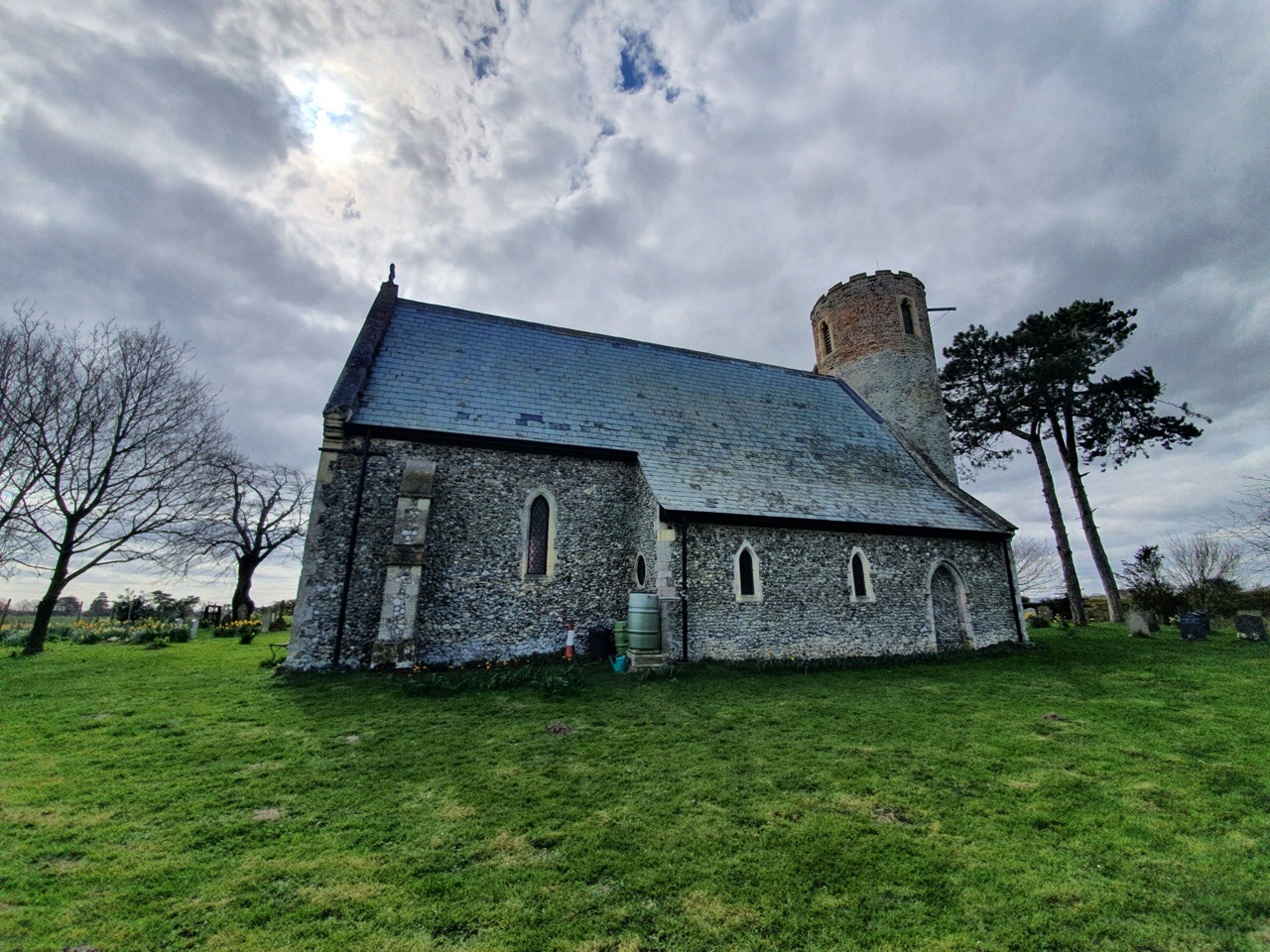
    The church’s own web-site mentions that Felthorpe is one of 58 Norfolk churches which were dedicated to St Margaret of Antioch, the patron saint of women and nurses. Although there has likely been a church here since the early Norman period, the current structure mostly dates to the fourteenth century, with a heavy restoration during the Victorian period.

    This is the south side of the church and the south aisle was added in the nineteenth century, but the assortment of windows that were in the south wall were moved so that they could be included in the new addition.

    I like that the Victorians have retained the windows that don’t match at all with their work on the south aisle, it feels less sterile. My usual source for older images, George Plunkett, doesn’t have any photos of the church from before the 1980s, but he has this one from 1986.

    The tower is mostly fourteenth century.

    It’s not easy to show in photographs, but the tower is rectangular and not square and it does look more mis-proportioned when anything that might be definable as cute. The buttresses that go into the church itself are also strange, they seem to be forcing the weight of the tower down on parts of the structure that I wouldn’t normally expect, although the tower isn’t as tall as some and so that burden isn’t as great. There is a bell in the tower, although only one due to lack of space, but it’s the one that they put there in 1634 and still use today.

    Located just inside the church door is this memorial stone from 1693.

    Some artwork around the door, and it looks like something that the Victorians would have done.

    The entrance to the church tower, although the base of the tower has now been converted into a toilet which is no doubt quite useful for the congregation.

    Looking back from the chancel to the tower.

    And looking from the rear of the nave along to the chancel. The arcading on the left hand side (the north of the church) is from the fourteenth century, whilst that on the right hand side is from the nineteenth century (the south of the church) from when the aisle was added. The fourteenth century side is made from stone, whilst the Victorian addition is made from brick and covered in plaster.

    The chancel was heavily restored in the nineteenth century, but that window on the right was maintained and is from the medieval period. The stained glass in the church is all much more modern, nearly all from the nineteenth century. It was paid for by the Bourchier family, who are from Felthorpe Hall, and there are numerous monuments in their name around the church.

    The font is Victorian, which always makes me wonder where the original medieval font has disappeared to. So many of them ended up as garden features which isn’t perhaps ideal.

    The glass was quite reflective here, hence the angle so I didn’t photograph myself. This is an interesting idea and I don’t see it very much and it’s photos of everyone from the parish who fought during the First World War, not necessarily those who died.

    The cart where coffins would be placed.

    There was a quite informal and welcoming feel to this church, although I’m not sure how I can define that since there was no-one there. The fact that the church was open was though perhaps testament with their desire to engage with the community. All rather lovely.

  • Norwich – St. George’s Church, Tombland (John Coppin)

    Norwich – St. George’s Church, Tombland (John Coppin)

    This stone tablet (clicking on the photo makes it larger) is located on the external wall of St. George’s Church in Tombland and it commemorates the life of John Coppin, who was born in 1630.

    John was the long-serving (probably from 1660 until 1711) rector of Winfarthing church, located near Diss, and he died on 23 November 1711 at the age of 81. It seems, slightly surprisingly, that John Coppin wasn’t a rare name at the time, so I can’t quite ascertain where he was born or died, nor what his relationship was with this church in Norwich.

    A short distance away from this church is Red Well, which is where in 1701 Francis Burges set up the Norwich Post, which is considered to be the first provincial newspaper in England. Unfortunately, very few copies of this newspaper remain, the earlier survivor being from 1707. I wonder whether John’s death would have been mentioned in the newspaper, although I think the aim of provincial newspapers was often a little more political than the more mundane reporting of local obituaries.

    Sometimes graves are moved onto the structure of the church at a later date, but it appears this was placed here following John’s death. A book of the city’s history written by Francis Blomefield at the beginning of the nineteenth century notes that the stone was in its current location in 1806. Much of the stone tablet is blank suggesting at some stage it was thought more might be added. Inside the church is (or was) a memorial to Dorothy Mettyer, the daughter of John, who died in 1722. It seems possible that perhaps it was initially planned to add her details to that of her father.

  • Norwich – St. George’s Church, Tombland (William Martin Seppings)

    Norwich – St. George’s Church, Tombland (William Martin Seppings)

    Tucked away at the back of the churchyard of St. George’s Church in Tombland, Norwich is the gravestone of William Martin Seppings. William was born in 1785 and lived in South Acre, a village located nearby to Castle Acle and he married Anne Squire (born in 1791) in 1811.

    The electoral register of 1835 notes that he held a freehold estate at Tombland which gave him the right to vote. He was also one of the first chairs of the East of England Bank following its establishment in 1836, a bank which got into financial difficulty in 1864 and was reformed as the Provincial Banking Corporation, later becoming part of Barclays Bank. In his various roles on the council, William served alongside Samuel Bignold, the general secretary of Norwich Union and son of its founder.

    At the 1841 census, William was living at Tombland (although no more precise address is given) with his wife Anne, along with Beatrice Ellis (aged 40), Elizabeth Jessup (aged 35) and Sarah Smith (aged 20). The ages at the 1841 census aren’t always perfect, and William was listed as being aged 50. I can’t find any evidence that the couple had any children.

    William died at his house at Tombland on 19 March 1846, at the age of 61. The death was reported by the local press, who noted that William had been one of the first batch of magistrates appointed by Sir Robert Peel’s administration after the Whigs had lost power. Perhaps more telling is the comment that “although he possessed no inconsiderable portion of eccentricity, he was an independent and honourable man and generally respected”.

    Anne lived much longer, she died in 1883 at the age of 92, having lived at a property at Castle Meadow with two servants for over three decades. Elizabeth Jessup remained as a servant until the late 1860s, having served the family for over thirty years.

    There’s not enough information that I can readily find to tell the whole story of William Martin Seppings, although we know he did well financially and was well respected. We also know that he was quite eccentric, thanks to his obituary, and that he was afforded a decent headstone which has lasted well. What he would think about being in the corner of the graveyard next to some bricks and compost I’m not sure. But the church remains in use, he’s near to Tombland where he lived and worked for much of his life, and so perhaps he’d be quite content knowing that not that much has changed here.

  • Norwich History by Parish : St. George Tombland

    Norwich History by Parish : St. George Tombland

    And a new little project that Jonathan and I are undertaking because this lockdown is clearly here for at least a few more weeks. It’s a bit niche (our project I mean, not the lockdown), I’ll accept that, but there we go. Effectively, it’s walking around Norwich, ancient parish by ancient parish and seeing what is there now compared to a map from the 1880s (the map above is from 1789, but the one from the 1880s is more detailed, which is why we used that). There’s a PDF of these boundaries to provide some extra background to this whole project.

    St. George Tombland is the fifth parish we’ve done this for and, again, there’s substantially more history than I can mention in this post, a reminder of just how much heritage remains in Norwich.

    The parish of St. George Tombland isn’t large geographically, but there are over thirty listed buildings in what is a relatively small area.

    A map of the area from the late nineteenth century.

    We started in Tombland itself, slightly challenging as there’s an extensive renovation of the area taking place at the moment. This area was the heart of Anglo-Saxon Norwich and was where their market was located. Its name origin is from the Viking word ‘tom’ meaning an empty space rather than a tomb as in grave. Tombland was also at the effective centre of the four Anglo-Saxon settlements of Coslany, Conesford, Norwic and Westwic. When the Normans took over the city they moved the centre of their settlement to be at Norwich Castle, although Tombland remained as a market area.

    There were until very recently underground public toilets here, although they’ve long since been closed, and the council’s plan is to open the area up with its renovation project. Tombland had, unfortunately, all become a little run down and wasn’t a pleasant place to sit. Visible in the background are the phone boxes, which are listed, and an old water fountain.

    The buildings on one side of Tombland have been built against the wall of the Cathedral Close.

    The parish boundary is to the right of this doorway, which leads to St. Mary the Less Church.

    For many years this has been Prezzo, although it was announced this week that the restaurant is now permanently closed in Norwich, meaning both the chain’s outlets in the city have gone. The building itself was a former residential property and it’ll be interesting to see what its future is.

    Looking towards the eastern side of Tombland.

    Today a Japanese restaurant, this is 6 Tombland which was built as a residential property in the eighteenth century.

    Turning the corner into Princes Street, of which the section further down is in the parish of St. Peter Hungate. The white-fronted building on the right is 26 Princes Street, a residential property built either in the late sixteenth or early seventeenth century. The building behind it, facing the churchyard of St. George, is 1 Tombland Alley and that was built in the seventeenth century, also as a residential property. Access to that property is now only possible by going through 26 Princes Street. George Plunkett took a colour photo of these buildings in 1936 and not much has really changed.

    The entrance to Plumbers Arms Alley, which I’ve written about before…..

    The parish boundary with St. Peter Hungate and there is a link on that page to a photo George Plunkett has showing that there were three of these markers here until not that long ago.

    Looking back down Princes Street towards Tombland, with nearly all the properties on the left hand side being listed.

    That bulging window (I admit that’s probably not the technical term) is delightful. It’s located at 18 Princes Street and the window dates from the eighteenth century.

    The small area of churchyard in front of the church of St. George, from which the parish takes its name. Not many gravestones remain here, but the soil is piled up a little, with no doubt many hundreds of burials having taken place in this small area until the practice was stopped in the middle of the nineteenth century.

    Inset into the church is this memorial to Mary Barber, who died in 1689. I find these are really useful ways of connecting with the past, people who lived and worked in Norwich over three centuries ago. Times were turbulent in the seventeenth century with civil war and the the battle over religion being major issues for the people of the country, there must have been great uncertainty. And life, as with Mary who died aged 32, was often short.

    Looking towards the south side of the church of St. George. It’s Grade I listed and there has likely been a church on this site since the late Anglo-Saxon period. The current structure dates from the fourteenth and fifteenth centuries, with the tower dating from 1445 and then having major repairs in 1645. There’s a monument of note inside from 1617 which commemorates the life of Thomas Anguish (more on whom further down this post).

    Unfortunately, the church is closed at the moment, but public entrance is usually allowed. This is the northern side of the church, where a path cuts across which is known as Tombland Alley. There were iron railings on the church side, but these were removed during the Second World War to be used as part of the war effort. The north porch of the building has been closed off and is now in use as a small chapel.

    The rear of Augustine Steward’s House which dates from the mid-sixteenth century. This is a substantial building, and quite a survivor, with three floors and a basement, stretching back some way from its frontage onto Tombland. The property takes its name from the man who commissioned it, Augustine Steward, who was the Sheriff of Norwich in 1526 and Mayor of Norwich in 1534, 1546 and 1556. It’s thought that the building was completed in 1549, although it was in a state of some disrepair towards the end of the nineteenth century and needed substantial renovation. The roof was also badly damaged during a fire which took place in 1944. There’s a George Plunkett photo of these properties which he took in 1935.

    Augustine Steward’s house is to the left and straight ahead is Tombland and Norwich Cathedral. There’s something quite delightful about the wonkiness of these buildings and how repairs have had to work around these little idiosyncrasies.

    This was once the house of Christopher Jay, the Mayor of Norwich, and he wanted something quite grand at the entrance to his residence. So, he installed statues of Hercules and Samson, likely in around the late 1640s. They have become something of a Norwich icon, but the two wooden statues there now are modern replacements. The originals were removed in the 1990s and were left to dry out by Norfolk Museums Service so that they could be restored and put on display. It was discovered that the statue of Samson was covered in sixty layers of paint and was original, dating to 1647, although Hercules was a Victorian replacement. The building which they’ve guarded has been used for multiple usages, including perhaps most famously a nightclub for some decades. There was some controversy, and perhaps quite rightly, when these statues were painted red when a restaurant took over the premises a few years ago.

    Next door is the Louis Marchesi pub, which has been a licensed premises since around 1770, when it was known as the Waggon & Horses. There was previously a fourteenth century building here and the crypts of that were retained when the newer structure was added on top and the Tudor effect is fake and dates to the early twentieth century. The pub was renamed the Louis Marchesi in 1976 and changed again to the quite drab name of Take Five in 2004, but since 2017 the Louis Marchesi name is back.

    Louis Marchesi (1898-1968) was a local man and he founded the Round Table movement, a charitable organisation for young men. Wikipedia notes that Marchesi was also the man who came up with the “There are things we must do, there are things we can do and there are things we should do”, although I haven’t checked that little bit of information….

    Today this is known as Waggon and Horses Lane, after the pub (before it was renamed to the Louis Marchesi), but it was previously referred to Elm Hill Lane and it connected to Elm Hill Street at its other end. This was all a bit confusing, so Elm Hill Street became known simply as Elm Hill, and this street was renamed.

    The Black Horse pub, the section on the left which until recently was the Black Horse bookshop and is now an Indian restaurant.

    This was Jonathan’s favourite discovery of the day and I must admit, I’ve never noticed it here. It’s the “Black Horse Skittle Saloon”, the former skittle alley of the Black Horse pub. There’s plenty more information about the Black Horse at the Norfolk Pubs web-site.

    The main part of the building is now an opticians, but the black horse remains.

    The parish boundary cuts across Wensum Street and includes the rear of the Maid’s Head hotel.

    The frontage of the Maid’s Head hotel, which claims to be the oldest hotel in the UK. I think that’s perhaps a little arguable (more on that on the Guardian’s web-site), but there’s certainly a long heritage to this building and a long history of hospitality. The hotel notes on its web-site:

    “The first Norman Bishop of Norwich, Herbert de Losinga had his original palace here, so we base our claim on the site’s continuous use for hospitality since the middle of the 1090s.”

    They also have some old images of the hotel, both internally and externally. The mock Tudor frontage on this section dates from the 1890s and George Plunkett has a photo of this side of the hotel which he took in 1934.

    This door is a modern recreation and it’s to note that Thomas Anguish (1538-1617), the Mayor of Norwich in 1611, lived here. Anguish left money in his will for a children’s hospital and this was founded in 1618, the year after his death.

    This is the rear of the Maid’s Head and the old map notes that there was a Bishop’s Palace in this area, which fits in with the information provided by the hotel itself. I feel that I need to learn more about this, as I didn’t know that such a building ever existed on this site.

    The Erpingham Gate isn’t in the parish, but the boundary reaches the wall.

    The statue of Edith Cavell, which was moved here a few years ago from the traffic island that was located a short distance away. It’s easier to see the statue in its current location, as there’s less chance of being run over, but George Plunkett has a photo from 1932 which shows its former position in front of the Maid’s Head.

    Edith Cavell (1865-1915) was the first of four children of the vicar of Swardeston and she worked in this area and in Brussels in a role looking after children. She then trained as a nurse and worked in London and Manchester, before moving permanently to Brussels, which would have been quite an adventure for the time. She decided to stay in Brussels to help British and French soldiers, which included hiding over 200 of them from the Germans. Someone betrayed her to the Germans and she was sentenced to death by a military court, being shot at dawn on 12 October 1915. She was buried at Norwich Cathedral on 15 May 1919 following a memorial service which took place in Westminster Abbey.

    Cavell’s death was used as propaganda by the British and the allies, to show the horrors of the Germans in shooting a nurse. There was significant international condemnation for the Germans and numerous attempts were made by countries to get the execution suspended. This wasn’t one of those decisions which was undertaken by an impulsive German soldier, this was a real dilemma for the German authorities who gave consideration to what they were doing. They didn’t want Cavell inspiring a wave of young women to offer resistance to the Germans, so they went ahead with the execution as a warning of what would happen to others who sought to repeat her rebellious efforts.

    This stretch of wall behind Edith Cavell’s monument had buildings that joined onto it in the past and although they’ve now been swept away, some of the marks are still visible.

    Most of the Edith Cavell branding has been removed from the pub, having been replaced by Prime Restaurant signage. The Norfolk Pubs web-site mentions that it was opened in the mid-nineteenth century when it was known as the Tombland Stores until 1879, then the Army & Navy Stores until 1981 before taking its current name (bar a short spell as Coles).

    The bottle and jug entrance to the pub, for those customers who wanted to take beer away with them, with what is likely Victorian etching which has survived the decades.

    And that’s another parish done, surprising me that there were a considerable number of historic bits and pieces that I hadn’t noticed before, not least some of the graves around the church of St. George and also the skittle alley at the rear of the Black Horse.

  • Marsham – All Saints Church (Mary Blyth)

    Marsham – All Saints Church (Mary Blyth)

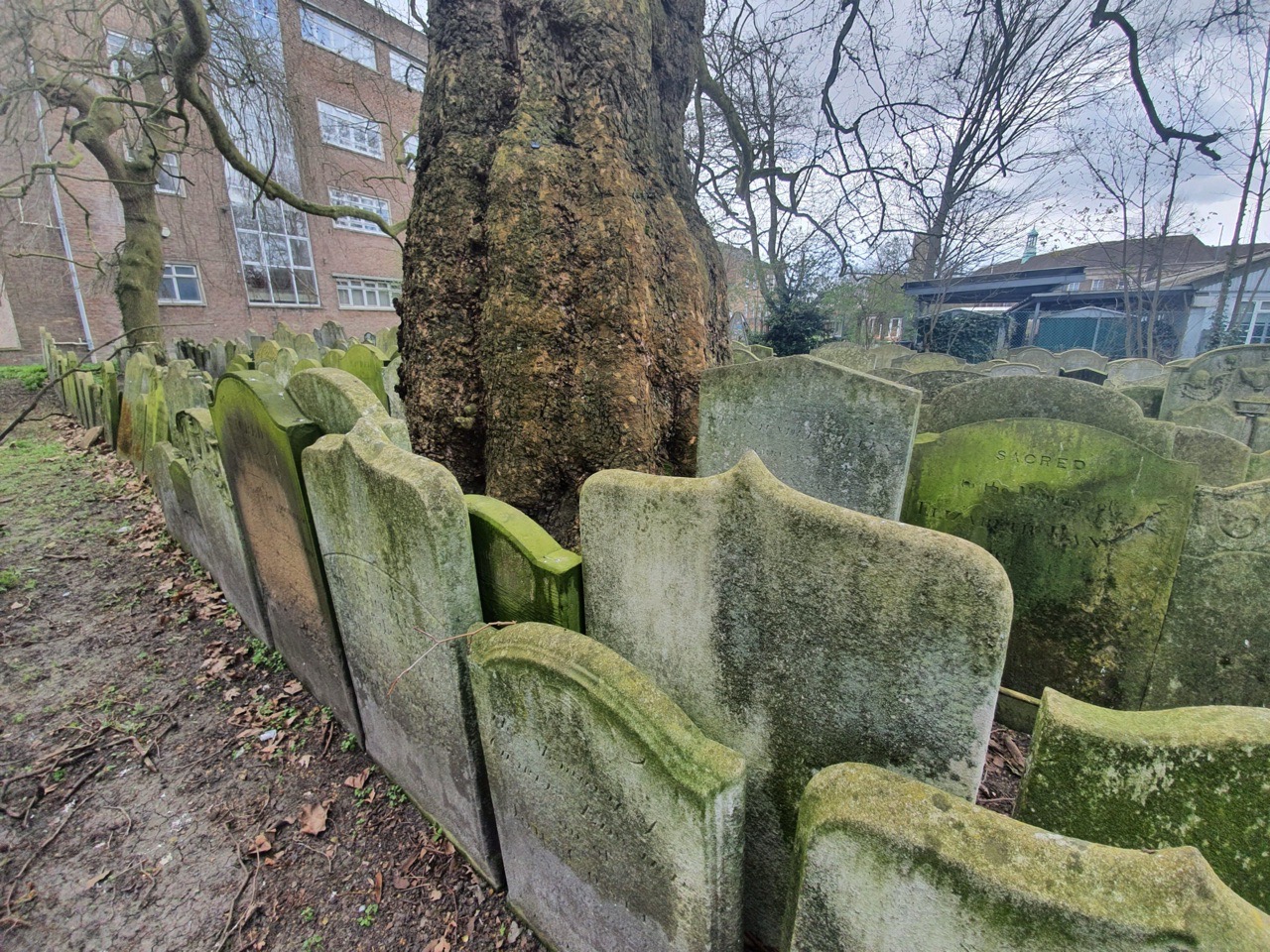
    I don’t often see gravestones disappearing into the ground, although I suspect that it’s been pushed in to stop it falling over. Either way, this gravestone in All Saints Church in Marsham commemorates the life of Mary Blyth.

    Trying to resolve family trees from the late eighteenth century is challenging (well, it is to me) given the gaps in the records. I know that Mary died at the age of 83 and that she was born in 1759. And there is a Mary who was baptised in Marsham on 21 January 1759 (fortunately, these records still exist at Norfolk Record Office) and she was the daughter of Isaac Blyth and Mary Blyth. The difficulty is that for this to the same person, Mary must never have married and that would have been unusual for the period.

    Mary was listed on the 1841 census, when she lived at Unicorn Yard in Aylsham with Thomas Hewitt and Mary Hewitt. It doesn’t appear that Mary was her daughter, as her maiden name was Eldridge and not Blyth, so I’m not sure that they were related. Unicorn Yard is still there today, located next to the Unicorn pub and Mary would have known it since it had been licensed since at least the late seventeenth century.

    Mary died at the age of 83 on 10 October 1842 and she was buried on Friday 14 October 1842. The level of documentation improves in the nineteenth century, so I know that her funeral service was led by Henry Asker, the church’s assistant curate. As for her life, I can’t find out anything, but perhaps there’s more story out there somewhere about Mary.

  • Marsham – Relief Landing Ground

    Marsham – Relief Landing Ground

    This is rather lovely, a memorial placed here in 2017 to mark that the field behind Marsham Church was used by the Royal Flying Corps between 1915 and 1916. The memorial is placed between the church and the new burial ground and I wouldn’t have known about the field’s past use without it as there are no other obvious clues that it was there.

    Here’s the field, apparently known as Whites when it was in operation. It was closed in October 1916, when the training ground was moved to Saxthorpe. There weren’t a great deal of safe places to be if serving in the First World War, but these pilots must have been especially brave as aviation was not exactly developed then and deaths were frequent.

    This map is from just before the First World War, the field is to the left of the church. The EDP has a report from the unveiling of the monument in 2017.

    Unfortunately, the enclosures maps aren’t available for Marsham which might have indicated if the field was called Whites back in the early nineteenth century. The tithe map above shows the field, but gives no further hints as to the name origin of the field. Although, I approve of more places just being called Whites…..

  • Marsham – All Saints Church (Robert William Claxton)

    Marsham – All Saints Church (Robert William Claxton)

    This is the only war grave at Marsham Church and is located in the new burial ground, located just behind the main churchyard, commemorating the life of Robert William Claxton.

    Robert was born in 1890 and he married Edith Mary Melton in 1913 and they lived at Turnpike Bungalow in Marsham. Robert joined the Grenadier Guards being given the service number 21587, joining the 13th Company of the 4th Battalion. This battalion was formed to fight in the First World War, but the war diaries at the National Archives don’t start until August 1915 when they went to France. So, at a best guess, Robert never fought overseas.

    Robert died on 28 January 1915 at the age of 25 and his burial took place on 3 February 1915. The relatively short period between death and burial also suggests that he didn’t die that far from home, but, unfortunately, his war records were lost in the air raid during the Second World War, and there are no news articles in the local media.

    The details of Robert’s grave at Marsham, which must have been one of the first in the new burial ground.

    This is another one of these lives which seems to have mostly been lost to history, especially the war record of Robert, which seems to have been relatively short.

  • Marsham – All Saints Church

    Marsham – All Saints Church

    This Grade I listed church in Marsham has a core which was built in the thirteenth century, with numerous fourteenth century additions and a Victorian overhaul.

    There’s a more modern vestry on the left-hand side attached to the church’s north wall. There are north and south aisles, perhaps indicating some level of wealth in this village during the medieval period.

    The south side of the church.

    A book of the parish’s history in the 1840s notes that “many of the ancient inhabitants remember the time when almost every window contained medieval glass and and can tell how it was removed by a so-called antiquary who was sometimes resident in the parish, and who was troubled by few scruples in satisfying his thirst for collecting antiquities. Dispersed by him at his various sales, it is impossible to say where most of these scrolls and coats may now be located”. Perhaps at the time the book couldn’t note that the individual was William Goodall, the church’s rector between 1787 and 1844.

    Theft wasn’t a one-off in this church either, the Norfolk & Norwich Archaeological Society was told in 1895 that the ornate cover above the font had recently been stolen during the restoration of the building in the 1880s. This font cover was known as the ‘laughing boy’, a figure which projected from the top of the second arch of the north aisle and which seemed to be looking at you and smiling wherever someone sat. This loss was blamed on an absent rector appointing a church warden who was willing to steal from the church and it seems likely that the record was William Goodall.

    The tower is likely also from the thirteenth century, with some damage evidence down the centre where some repairs have been made. There’s no large window, so it’s not clear what is causing the structural issue here, but it all looks quite solid so the repairs seem to have implemented some time ago.

    The chancel is mostly a Victorian rebuild, likely needed as the structure needed some repair.

    The side of the chancel and the stones set into the side of the aisle are those from the Howlett family.

    The church’s graveyard.

    The church was unfortunately locked so I couldn’t look inside, but that’s an original medieval wooden door. Inside the hammerbeam roof is of note, as is the medieval screen which it seems fortunate the church’s rector didn’t pinch.

    The bricked up priest’s door.

    This field by the church looks all rather peaceful, but it was once known as Whites’ and was used by the Royal Fighting Corps during 1915 and 1916 as a landing ground.

    The new burial area, located to the west of the church, which contains the one Commonwealth war grave that is located here, commemorating the life of RW Claxton of the Grenadier Guards who died on 28 January 1915.