Category: Norfolk

  • GeoGuessr (Norwich Version) – Walk 5

    GeoGuessr (Norwich Version) – Walk 5

    I already have a better explanation (well, longer explanation anyway) for this plan. In essence, whilst lockdown is on, I need to find ways of walking nearby to Norwich in quiet areas for my LDWA 100 training. So, I’m using GeoGuessr to pick out five random locations within a certain area which I’ve defined and then walking to them, to see what kind of story I can uncover.

    The five random locations, all fairly close to the city centre, so this ended up being a walk of just under seven miles. Nathan was helpfully understanding when I turned up late as I bumped into (not literally) someone I knew.

    It’s a little difficult to find anything new in the centre of Norwich given how much I’ve been traipsing around it, so the more mundane may become more predominant. But, perhaps there’s something just as magical about these old stones under the road surface than a building that was constructed at the same time. The paving here on Barrack Street is likely the best part of a century old and it was part of a long roadway down towards the River Wensum, although it’s mostly gone now.

    This was the first location, Whitefriars Bridge, which I’ve written about before…..

    This, until recently, was the Del Ballroom on Waggon and Horses Lane which was used until 2013 as a dance studio. Norwich City Council decided that as there was a dance studio nearby, this interesting and quirky building could be torn down, despite some local objections from nearby property owners. I suppose it’s not a hugely historic building, as it was only built in the 1930s, but it added some character to the local area. The seven new properties they’re cramming into the site don’t have car parking provided and no right to a permit, so it’s all quite environmental in terms of not adding cars to the roads of Norwich. Anyway, I digress……

    Our second location and this photo was taken from just outside the rather lovely Strangers’ Hall Museum. The Strangers were Dutch Protestants who were invited to live in Norwich by the city authorities and so many came that they eventually comprised a third of the city’s population. They did much to boost the textile trade in Norwich and also helped the local economic situation, with relatively little evidence of any animosity between locals and incomers. There’s a strong legacy in the city today of Dutch style buildings and it was the migrants that brought over canaries, which is the city’s football symbol today.

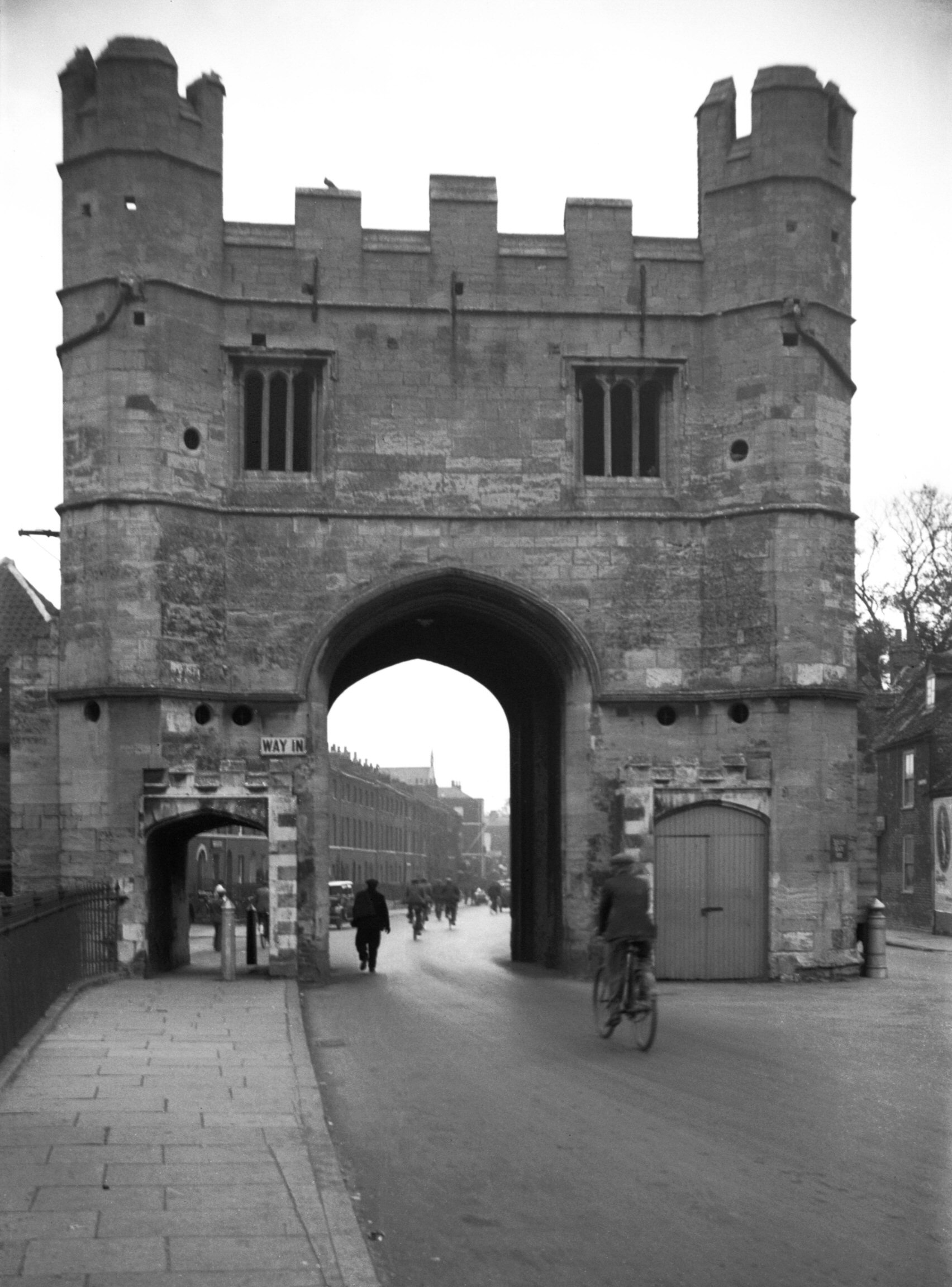
    This is the former site of St Benedict’s Gate, also known as Bennet Gate and Westwyk Gate, which was demolished at the end of the eighteenth century. A little bit of this gate survived until the Second World War air raids destroyed it, as can be seen in this George Plunkett photo. Today, the route of the city wall and the outline of the city gate is marked out in brick paving which is always a marvellous idea.

    The line of the wall looking up towards Grapes Hill.

    Our third location, the former Britannia pub.

    The pub was opened in 1975 and closed again in 2000, now being used for housing. It’s really not the most attractive of buildings, but I’m sure that the city council thought that this was marvellous when they approved it in the early 1970s. The pub was built to replace the Sandringham Arms, an interesting Victorian building which had been a licensed premises since the 1860s.

    The Rose Valley Tavern, or whatever name they’ve fiddled it about to now, which has been a licensed premises since the mid-nineteenth century.

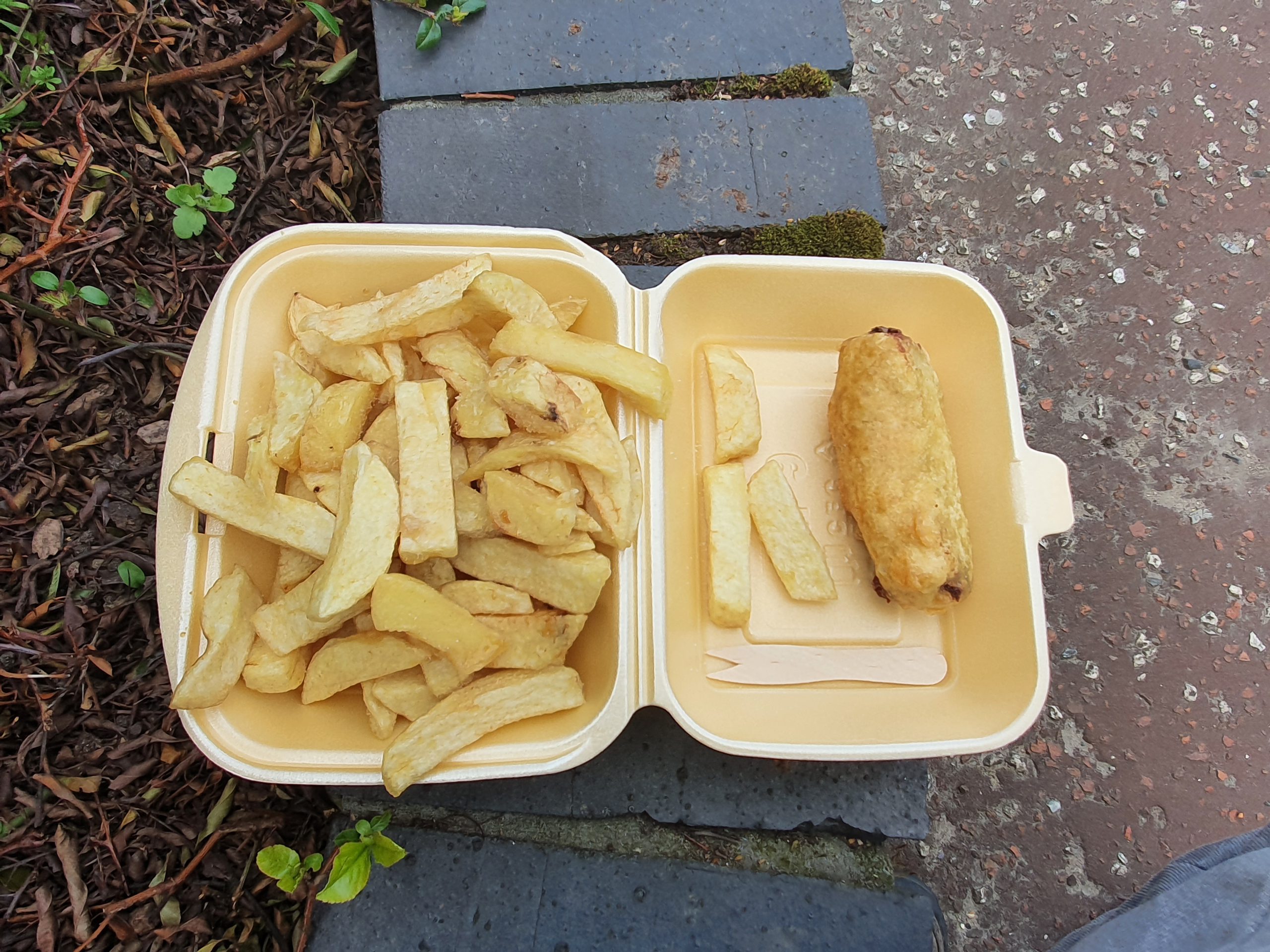
    And Nathan had put chips on the agenda for the evening’s walk, which was a most useful idea. I’ve never been here before, so another first, this is Lee’s Fish Bar on Chester Street.

    Full marks for presenting chips (and a battered sausage) like this, they were much easier to eat and this is proper innovation as far as I’m concerned. Also, I discovered that they had given me scraps with the chips, and I very much like them. I was in rather a good mood with Nathan for some time after this little meal. The chips were quite salty, but I liked that, indeed, they catered very well for me here.

    Fourth location, which is Leopold Road. I’m not going to comment on the history of this road as I didn’t pay any attention to it at the time, so that would be a bit fake….

    This is the railway crossing which goes under Hall Road, although the line isn’t there any more, it led into what was Norwich Victoria Station. This was a complete mistake IMO to remove, as the lines connected in, so the city could have trains running into the centre of Norwich, opposite the bus station. An integrated public transport policy. Although, it’s important to note that passenger services ended here over 100 years ago, in 1916, and the station was used primarily for goods transportation after that.

    Nathan was doing the navigation for the evening and he excelled himself (I hope he doesn’t read this, he’ll quote that for ages) in the choice of route towards our fifth location. This is the former city wall at Carrow Hill and George Plunkett took a photo here in 1934 when it was covered in rather more ivy.

    At this point it was dark and we were navigating by torch light down this hill Nathan had chosen, but it took us under Wilderness Tower. I promise that I won’t enter this photo for any photography competitions.

    There are some reasonable views of the city from up here.

    And then by Black Tower, although I accept that there’s not a great deal of detail visible in the photo. I’ll walk by here again in the day to take some more photos I think.

    And we dropped down to near Norwich City Football Club for our fifth location and I’m unsure why GeoGuessr keeps giving random locations around here. I have more photos of the side of Morrison’s than is healthy for someone in their late 30s / early 40s…..

    Anyway, this was an easy way to add a few more miles of walking in, as it’s really not long until the LDWA 100….. The weather was mild, which was fortunate, as it’s annoying to get drizzle when trying to get chips on the go.

  • Haveringland – St. Peter’s Church (Cecil Albert Mace)

    Haveringland – St. Peter’s Church (Cecil Albert Mace)

    This is the grave of Cecil Albert Mace, located at St. Peter’s Church in Haveringland. Cecil was born on 21 February 1907 and was the son of Henry Mace and Alice Mace (nee Hawkins). The family lived at 48 Canterbury Place, later moving to 61 Exeter Street, with Cecil going to Heigham Street Infants School and then St Stephen’s Infants School.

    At the 1911 census, the family were living at 61 Exeter Street, with Henry and his wife both being 31 and he was working in the boot trade. The children were Henry (aged 9), Ernest (aged 6), Cecil (aged 4), Walter (aged 2) and Alice (new-born). This census listed how many children had died, which was relatively high at the time, but Henry and Alice hadn’t lost any. I can imagine they were pleased with Alice to at least get a girl in the family, after four boys.

    At the age of 18, Cecil joined the Royal Tanks Corps on 24 January 1924, enlisting at St. Stephen’s in Norwich and being given service number 2208658.

    Cecil married Eva Mary Harrison in 1933 at St. Stephen’s Church in Norwich, although sadly his father had died by this time. Eva was aged 23, having been born in 1910, and she was working as a domestic servant, whilst Cecil’s occupation was listed as a motor driver. The couple were living at 28 Shadwell Street in the city and the marriage was witnessed by Albert Harrison and George William Hensley. As an aside here, I wrote briefly about Shadwell Street a few days ago.

    Cecil joined the Royal Air Force Volunteer Reserve, service number 902706, assisting the war effort given his previous military experience. Cecil died on 23 August 1947 at the age of 40. Unfortunately, none of the usual databases give any information as to what happened and it’s rare not to have a cause of death for an airman. There don’t seem to be any media reports of the death, which means it’s probably more likely a death from natural causes rather than being killed in a military accident. I’m also unsure why he was buried at St. Peter’s, which at the time was effectively the church on the airfield, given that he was married, but perhaps it all just felt more appropriate to the family.

    The grave registration form for Cecil and Jeffrey Edwards.

  • Haveringland – St. Peter’s Church (Jeffrey Neil Edwards)

    Haveringland – St. Peter’s Church (Jeffrey Neil Edwards)

    This is the military grave commemorating the life of Jeffrey Neil Edwards and it’s located at St. Peter’s Church in Haveringland.

    Jeffrey was born in West Ham (then in Essex) in 1922, the son of Arthur Edwards and Ethel May Edwards (nee Roberts), of Wanstead in Essex. He became a Flying Officer service number 172240, flying with the 157th squadron of the Royal Air Force. His home address was listed as 8 Cambridge Park in Wanstead, which was the residence of his parents.

    Jeffrey was named in Despatches on 5 February 1944 for his bravery, something for which his parents must have been enormously proud of. Sadly, Jeffrey was killed on the night of 22nd/23rd December 1944 when returning from an enemy raid in his Mosquito TA392 RS-K aircraft. He reported to Flying Control that he was having problems with the ailerons and the aircraft crashed at the airfield also killing his pilot Flight Lieutenant W Taylor. There’s a report of the crash at the Aviation Safety web-site.

    The military grave record, with Jeffrey dying at the age of just 22. The probate details were confirmed in 1946, with Jeffrey’s assets of £332 18s 6d being transferred to his father, Arthur.

  • Haveringland – St. Peter’s Church (Bithiah Howard)

    Haveringland – St. Peter’s Church (Bithiah Howard)

    This stone is located just outside the porch of St. Peter’s Church in Haveringland. It’s an interesting first name, I think it’s Bithiah, but there’s more on Wikipedia about this. Although the burial records survive at Norfolk Record Office, the actual church mostly doesn’t as it was rebuilt in the 1850s (other than the tower).
    I suspect that this stone was once above a tomb inside the church, which would explain why it has survived in good condition since Bithiah’s death in 1769 (or more precisely, she died on 31 December 1769 and was buried on 3 January 1770). Personally, I don’t think this stone should be outside, it’s part of the heritage of the church and so would be better off inside and protected.  I’m only guessing, but the stone was probably broken on lifting it in the 1850s and so they just removed it. It’s also missing from the comprehensive list of memorials which the church prepared in 1981.

    Bithiah was born in 1693, but, unfortunately, other than finding her name in the parish death register (and I had to search it manually as the transcriber couldn’t read it), I can’t find anything else. I think there are problems with the transcribing of that first name, there are all manner of variants out there. The nature of the stone suggests that the family likely had some wealth and was perhaps connected with Haveringland Hall.

  • Haveringland – St. Peter’s Church

    Haveringland – St. Peter’s Church

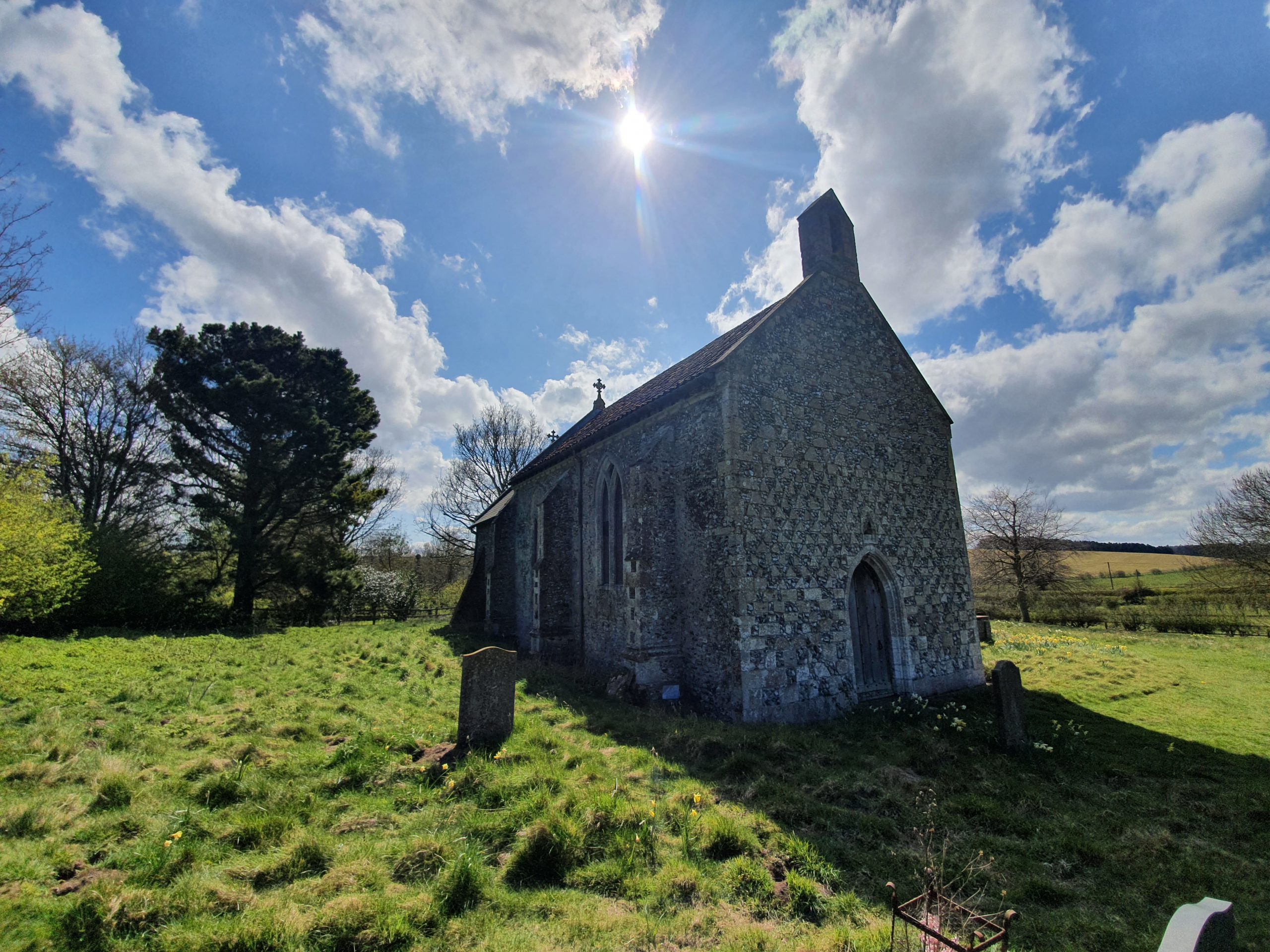
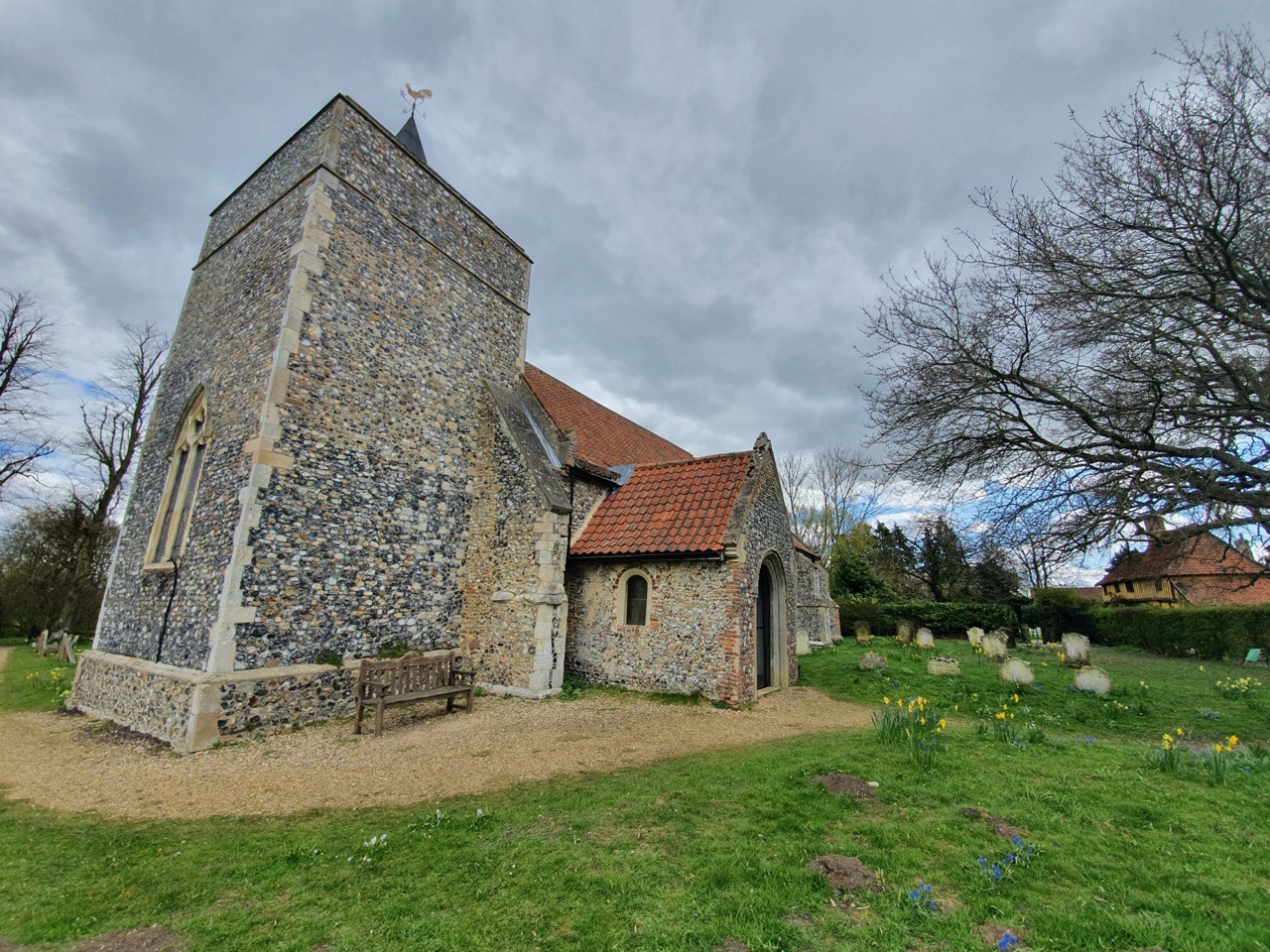
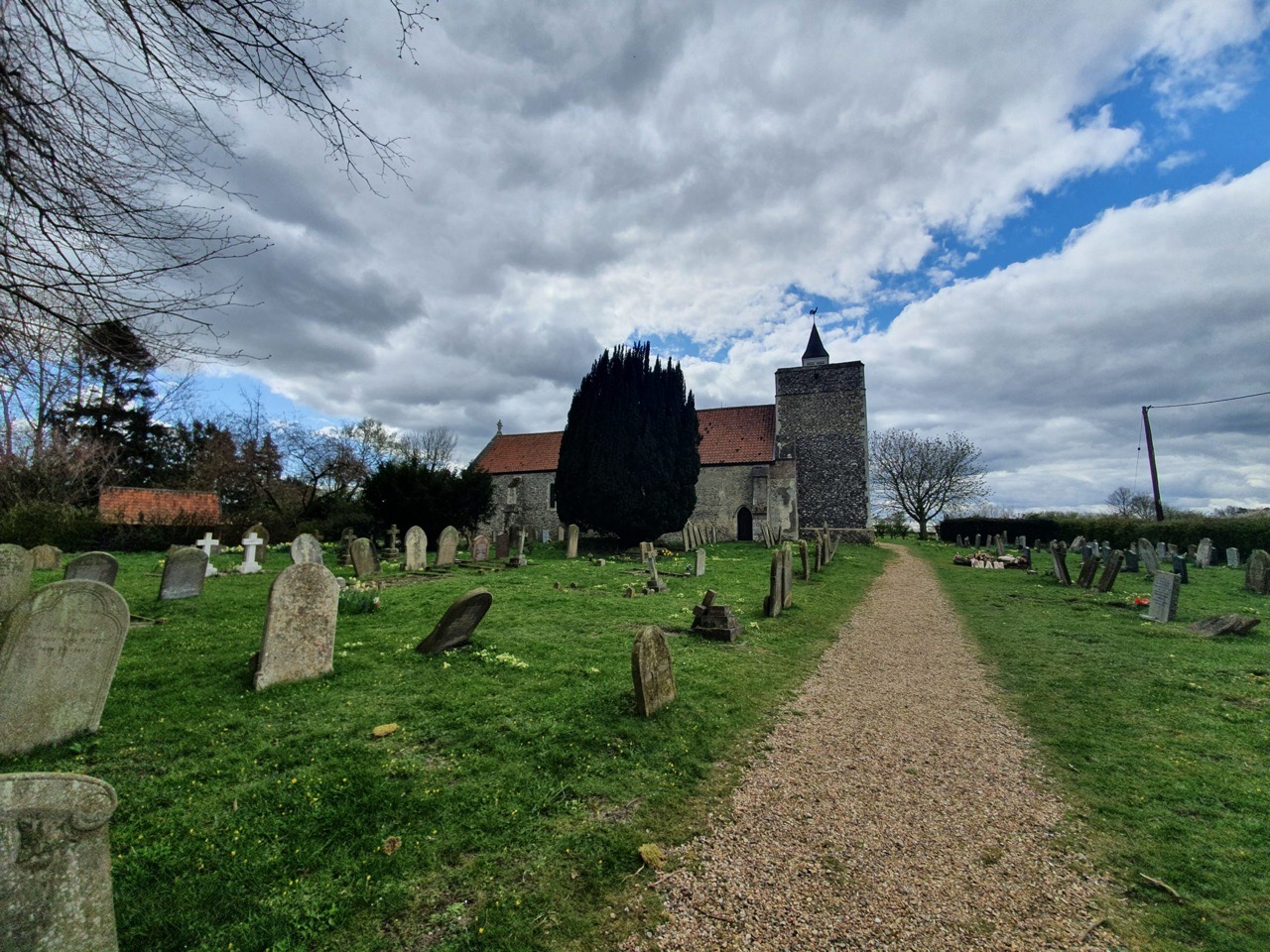
    Initially, not a lot made sense about this church as the road layout was illogical and the building was set back about 200 metres from the road. It’s not entirely normal for a church to be located at the end of a long concrete (or whatever it is) track and nor for there to be such a lack of road access.

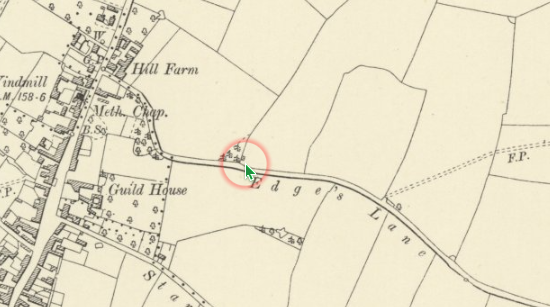
    This is though the answer, the airfield of RAF Swannington, which was in use between 1944 and 1947. There were plans to turn it into a larger airfield after this, but those plans didn’t come to fruition and the land was sold by the RAF in 1957 and the land returned to agriculture. The church is just visible on the above map (which is an Ordnance Survey map, just out of copyright) on the extreme right-hand side.

    We pondered whether this was wide enough to be a runway, it didn’t feel quite right in terms of the size, but it was the map which confirmed that this was the perimeter of the airbase. Sections of the runways themselves are still visible on overhead maps, but not to the size that they once were.

    Some of the memorials relating to the airbase.

    Onto the church, I saw this and was a little disappointed as it’s just Victorian (not that everything Victorian is bad, but it does mean the medieval heritage of the building isn’t going to be there). With the exception of the tower, the church was demolished and rebuilt in 1858 by the owners of the nearby, and now demolished, Haveringland Hall. The listed building record notes that the thirteenth century font has been kept, but everything else is Victorian. The church was locked, but I’m not entirely sure that there was much to see inside.

    Ignoring all the nearby concrete of the former airfield, it’s a remote and quite charming area.

    A gateway that has long since fallen into disuse.

    The porchway is Victorian, but that tower looks magnificent. It was noted in a newspaper article in the 1890s that the scale fern that was on the building had now been removed, a decision which was probably beneficial to the structure of the church. It’d have been a shame if that tower was covered in ivy, not just as it would be damaging to the stonework, but because it’d hide the beautiful round tower.

    Some of the Victorian stonework on the side of the porch.

    So, onto the round tower, which dates from the eleventh century. It’s one of the oldest surviving round towers in the country, although they faffed about with the top of it during the Victorian rebuild.

    I think that’s Roman brick.

    The window height has been changed on the tower and bricks placed under the new window, but it gives it all some character. Some of the tower has been rendered, likely in the 1850s, although some of that has since fallen away and not been replaced.

    I’m not quite sure what all of these metal attachments are to the church tower. Perhaps they were used to stabilise the tower whilst they were demolishing the rest of the building in the Victorian period, or as some sort of support for plants. Although the bulk of the historic church has been lost, at least this tower remains, having spent centuries looking over agricultural workers and then for a few years there were military aircraft taking off in its shadow. The tower at least is perhaps an unlikely survivor, but at nearly 1,000 years old it’s not looking in bad condition.

  • Norwich – Banger Stop

    Norwich – Banger Stop

    I haven’t paid much attention to Norwich Market in the past, for no obvious reason than I’m not sure I realised how wide a choice of food and drink they had there (to be fair, it’s near Grosvenor and so I hadn’t realised I needed to go elsewhere). Having meandered around the various chip stalls over recent weeks, I thought I’d pop to Banger Stop today.

    The city’s market has been in its current location for 900 years, which is a fair run I think it’s reasonable to say. George Plunkett has a photo of the market from 1939, not long before the war broke out, and Banger Stop is located roughly where the group of three people are in the photo.

    As someone who gets confused by too many options being available, I quite liked the precision here with the choices marked on the boards of:

    (i) The Classic – pork sausage with cheese, onion and homemade ketchup (£3.50)

    (ii) The Chilli Dog – as above, but with chilli sauce (£3.50)

    (iii) The Plain – just the sausage and onions (£3)

    There was a nice welcome, and I didn’t struggle to decide to go for the chilli dog, although I was initially concerned about how much of it I’d manage to drop on myself. Fortunately, some forward planning has taken place here with the packaging with the provision of a little box surround for the hot dog to avoid unnecessary spillages. I was charged £3, perhaps because I didn’t need any cheese, and the stall accepts cards which is rather handy. Everything was also clean and organised, especially important during these challenging times….

    I thought it was all entirely acceptable and sufficiently filling, the sausage is made just for this stall on the market and isn’t bought in, it was also hot without burning me. The red pepper chilli sauce wasn’t particularly hot in terms of spice, but added some texture to the arrangement and onions also bring a little extra taste. Definitely all rather lovely, and it’s worth having a little hunt for within the market.

  • Norwich – Thomas Want Abandoning His Family

    Norwich – Thomas Want Abandoning His Family

    200 years ago this week, the Norfolk Chronicle published a story about about how Thomas Want, a former school master in Norwich, had cleared off and left his wife and four children. This was certainly a problem as far as the city was concerned, as the Corporation would now have to fund these children and I can’t imagine they’d have been thrilled at that thought. So, the hunt for him started, and it appears that he had run off with this woman who had a hawker’s licence.

    I like a story and so I wanted to know more about this little arrangement, although the documentary chain of evidence was always going to be a little limited. Thomas had married Frances Oldman in St. Stephen’s Church in Norwich (the one in front of the Chantry shopping centre with a path leading to it through the graveyard) on 3 June 1806, so they had been married for fifteen years.

    Francis Arthur Want was born on 24 July 1810 and baptised on 17 August 1810 at St. Stephen’s Church. Frances Lucinda Want was born on 10 November 1811 and baptised on 17 November 1811, this time at St. George Colegate Church. Jane Pearcy Want was born on 21 June 1816 and baptised on 30 June 1816, this time at St. Martin at Palace Church. There should be another child, since the newspaper mentioned he had left four, but I can’t find details of that, although I imagine they were born some time around 1814.

    Francis Arthur Want married and became a railway station master in Burton upon Trent in Staffordshire, with none of his children being named after Thomas. Frances Lucinda Want never married, going to work as a servant cook, she died in Middlesex in February 1894. Jane Pearcy Want married Robert Newman in Cromer on 4 October 1841 and they lived in the town, with none of their children being named after Thomas. It is this lack of naming their children after Thomas that makes me suspect that the children didn’t have a great deal of respect for their father.

    Moving back to Thomas’s wife, Frances. There are no suitable candidates showing on the 1841 census, so I’m fairly sure she died before then. And there is a burial of a Frances Want at Old Lakenham Church in Norwich on 26 August 1822 and I’m going to assume that this was the wife that Thomas left behind. She died just a year after her husband left her and, perhaps not unsurprisingly, I can’t find any record of a gravestone. I can’t imagine that anyone would have had any money to pay for one.

    Back to Thomas, he was 42 when he went missing, so he was a fair bit older than Frances, having been born in around 1779. He was a schoolmaster from at least 1812 to 1815 at the academy on St. George’s Plain which was a boarding school for young gentlemen. As for his death, the only one I can find that fits anywhere in the country is the Thomas Want who was buried in Norwich on 17 September 1844. I have yet to discover what happened to Thomas after he went off with this woman with her hawker’s licence, but I don’t feel that he ever went back and his voyage of passion will perhaps remain a mystery to history.

  • Norwich – Thomas Edgar Stealing from the Coach and Horses

    Norwich – Thomas Edgar Stealing from the Coach and Horses

    Continuing with my theme of events that happened 150 years ago today, the Norfolk Chronicle reported in late February 1871 that Thomas Edgar had been charged and tried for the theft of a scarf from the Coach and Horses pub on Red Lion Street whilst the owner was playing skittles. I’d never realised that pub existed and it suggests an answer to a question I had of whether skittles was commonly played in Norwich in the past.

    Anyway, back to the details of the court case, although this was just the first hearing. Thomas Edgar, who lived at Crook’s Place (that unfortunate fact isn’t lost on me…..), visited the Coach and Horses pub and I suspect he didn’t plan any nefarious activity when he arrived. However, Frederick Leech (named as William Frederick Leach in another newspaper) who lived at Oxford Street, located off Unthank Road, had arrived with his expensive cashmere scarf. I’ve got a picture in my mind of what I imagine he was like, but others can draw their own mental image here….. Leech was enjoying a game of skittles and had placed his scarf neatly on his hat and put that on a table. After a while of enjoying his game of skittles (the paper didn’t mention the score) he realised that his scarf had gone missing and he then saw Edgar rushing out of the pub looking suspicious. Leech left the pub and tried to follow Edgar, but lost him and so he contacted the police. The police rushed out and found Edgar and the missing scarf at Crook’s Place, which sounds some rather excellent detective work. Edgar’s defence was that he was drunk, which doesn’t seem unreasonable as far as excuses go.

    For some more information about this, I had to jump forwards a month to late March 1871 when the full trial took place. More details came out, including that Edgar had offered to look after the hat and scarf, which doesn’t seem to be a very subtle way of pinching something. The detective work from the police was explained, a police officer and a man called Piggin had followed Edgar to his home and this wasn’t some brilliant piece of guesswork. Edgar’s defence was accepted, which was that he was so drunk he didn’t know what he was doing. These were ferocious times in terms of sentencing though, and when Edgar was found guilty, he was sent to prison with hard labour for six months. The additional reporting also noted that Leech (or Leach) was an ironmonger and Thomas Edgar was aged 21.

    Rolling back a little here, the pub itself, the Coach and Horses. This was located at 3 Red Lion Street and it’s still there today, although it’s now a Bella Italia having ceased being a public house in around 1984. The building was constructed by the brewery at the beginning of the twentieth century, on the site of an older building and the one where Edgar pinched the scarf from. And we also know that the pub had a skittle alley judging from the events of that night, and it also had a three dimensional bas relief panel by notable local artist John Moray-Smith. That is now sadly lost, although there’s one of his works remaining at the nearby Woolpack pub.

    Back to Thomas Edgar though. He was born in 1849, the son of Matthias Edgar and Mary Ann Edgar and at the 1861 census he had four older brothers and sisters. Mary Ann was from Devon and the two oldest children had been born in Plymouth, but Thomas was born in Norwich. The family at this stage lived at 44 King Street (probably not where most people would think this was, but more on this in a moment) and Matthias worked as a brush maker.

    The 1871 census isn’t entirely helpful about where he lived, since he was in the city gaol, which was at that time at the end of Earlham Road (or St. Giles’s Street at the time, before a bloody great road was built at Grapes Hill orphaning the end of it), which is now the site of the Roman Catholic Cathedral.

    We do know from the newspaper that he had been living at Crook’s Yard and this is where things got a little confusing for me, as I’ve now discovered that there were two King Streets in Norwich at that time. Not the Upper King Street and King Street that we have today, which are still really the same road. Some bloody idiot had built a King Street and a Queen Street (ignoring the fact that these street names already existed) near to where the Norfolk & Norwich Hospital was located in the city centre. This clearly caused complete confusion at the time as records from the time are all over the place, but wiser heads prevailed and King Street was renamed Shadwell Street and Queen Street was renamed Nicholas Street. In the above map, Crook’s Yard (or Crook’s Place) is the road leading off from the right. It’s possible that this name confusion meant that Thomas was still living with his parents at this time on King Street.

    At the 1881 census, Thomas was living with his mother at 44 King Street and he was working as a waiter. By 1901, Thomas was now married and living (alone, for reasons unknown if he was married) at 86 Shadwell Street and was working as a fruit-seller. Thomas died in the city in 1910, at the age of 61, and there is no mention of his death in the local press. At a guess, 44 King Street and 86 Shadwell Street were probably the same house, but either way, they would have been demolished after the Second World War.

    But, the element of all this that I quite like is the thought of the atmosphere in the Coach and Horses in the city 150 years ago. I’m not sure that skittles is played much anywhere, not least because it’s quite space consuming, but there’s an equivalence with bar billiards. And I can imagine a similar set of circumstances playing out, someone leaving their expensive cashmere scarf out (and I can think of a couple of friends who would turn up at the pub with something like that….) and finding that it was stolen. Thomas Edgar doesn’t seem to have been a particularly bad person, he certainly didn’t have a long life of crime after this incident. And I’ve tried to work out the route that he would have taken from the pub back to his house (I bet he went down St. Stephen’s, walking by where there is a Greggs today), perhaps testament to the reality that I need to get out more.

  • Norwich – William Rudling (the thieving butcher)

    Norwich – William Rudling (the thieving butcher)

    I’d add firstly that this isn’t some angry blog post about being short changed on a sausage roll, this is a story from the Norfolk Chronicle that was published 150 years ago today, in late February 1871.

    The newspaper noted that William Rudling was a butcher on Ber Street and he had rigged his scales to short-change customers. Samuel Sutton, the Inspector of Weights and Measures, had visited his shop and noticed that a piece of iron wire had been attached to the scales which found half an ounce against the purchaser. A second test was performed and the scales were still out, although now they were an ounce out.

    The case was heard at the Guildhall in the city and William decided that he wouldn’t turn up and instead he sent his wife Charlotte to deal with the matter. I can imagine she was really pleased with this little arrangement, although she then didn’t say anything in court, so that might not have gone to plan. With that lack of defence, William was fined £1 (something like £60 in today’s money) and was also ordered to pay costs of just over £1.

    At the 1871 census (which took place shortly after this, at the beginning of April 1871) William Rudling lived above his shop on Ber Street with his wife Charlotte, and his children, Charlotte, Elizabeth, Esther, Thomas and Emma, along with their grand-child Alice. At this time, both William and his wife were aged 53.

    Going back ten years to the 1861 census, the family lived at the same property on Ber Street, with the children William, Henry, Emma, Charlotte, Elizabeth, Esther, Alice and Thomas living with them, along with a servant, Sophia Poll. At this 1861 census William was listed as being a carpenter and builder, so his butchery skills were perhaps acquired after that, and he had also been listed in the 1851 census as living as Ber Street and working as a carpenter. As an aside, the younger William Rudling had taken up an apprenticeship as a stone mason which he ran off from on 12 April 1865. At the magistrates court it was decided that the matter would be dropped as the young William said that he would return to complete his apprenticeship.

    At the 1881 census, the household was rather quieter, it was just William and Charlotte, along with an Elizabeth Osborne who was listed as a companion. The husband and wife were now living at 4 Horns Lane in the city, with William being described as a carpenter again. Horns Lane is still a street in Norwich and it’s located off of Ber Street, so William didn’t really move very far in his lifetime. The property has gone though, the area was flattened by the council and the area is mostly now a car park.

    WIlliam died on 26 October 1890, and he died at the age of 73 having been born in 1817. His death was reported in the local paper, the Eastern Daily Press, and he was now living at 10 Horns Lane.

    Unfortunately, none of the trade directories tell me exactly where on Ber Street that William had his shop, but what I’m interested in is why he suddenly became a butcher. I’m guessing that he wasn’t perhaps doing very well, which is why he was sent to court for defrauding customers. There was in the 1860s a large increase in the demand for meat, with more people entering the butchery trade, so perhaps William was tempted by the financial rewards. I can’t imagine that some of the locals were too impressed after the court case, that might be the reason that William returned to carpentry.

    And would this sort of behaviour happen today? Indeed it would, as just two days ago there was a butcher in Willenhall, the Muddy Pig Butchers, where it was found that coins had been attached to the scales to short change customers by 40g. That’s about 1.4 ounces, so only marginally more than William defrauded his customers. This butcher in Willenhall was treated more severely than William though, he was ordered to pay costs totalling £1,798 and given an 18-month community order of 200 hours of unpaid work..

    Nothing ever really changes….

  • Norwich – The Old Barge and Henry Goulder

    Norwich – The Old Barge and Henry Goulder

    150 years ago today, on 25 February 1871, the Norwich Mercury reported that Henry Goulder of King Street had become “drunk and riotous” and had broken a square of glass in the window of the Old Barge pub. He had caused damage that cost 3 shillings to repair, and in a court hearing chaired by the Mayor of Norwich he was fined 1 shilling and ordered to pay 5 shillings 6d in costs.

    George Plunkett has a photo of King Street from 1935 where the Old Barge is visible, along the sign noting that ales and stouts were available. It’s also possible to see the sign noting that the pub was owned by Youngs, Crawshay & Youngs Ltd. The pub was damaged during air raids during the Second World War, but it re-opened and it continued trading until 1969. I quite like that the boot scraper from the pub’s entrance is still visible in my photo of the building today, although the door has been converted into a window.

    Sadly, this isn’t a pub today, it’s part of Dragon Hall, but a pub would be a fine way to allow the public to get access to the building now that the Dragon Hall museum has closed. Although I think lots of buildings would be better used as pubs, but rarely does that seem to happen at the moment.

    Back to the crime though, Henry Goulder worked as a waterman and had clearly got a little over-excited with the drinks sold by the pub. But it’s rare that in the Victorian period that someone committed one crime and then nothing more was heard of them. Goulder seems to have been a bloody nuisance to the community and to the police. He had been arrested by Constable Emms in 1848 and brought before the court and its chair Samuel Bignold, charged with riotous assembly on Mousehold Heath where he had to give sureties totalling £20. That’s around £1,600 in today’s money, so I take it that he annoyed Samuel, who was also the General Secretary of Norwich Union.

    This punishment clearly didn’t help, as in 1850, Goulder and two others entered the Prince of Orange pub on King Street and ordered beer which they then refused to pay for. Goulder hit the landlord, Thomas Adcock, and continued to beat him whilst he was on the floor, and he then attacked the landlord’s wife who came to help her husband. Goulder was fined £10 and told he would go to prison if he didn’t pay it. He was in court again for drunken behaviour in 1863 as well, but it was said that he was an industrious man when sober. It was clear that he had problems with alcohol and I can imagine he had a reputation on King Street for that.

    His demise was reported by the Norfolk Chronicle in July 1881, as Goulder had been swimming (and this was known as the media reported noted “he had his swimming drawers on”) and fell from the wherry Dart, which was moored against the quay on Fye Bridge. He was drowned and it was reported that he had had a seizure which had caused him to fall, with his address noted as being in the Lanes Buildings on King Street.