Category: Hertfordshire

  • Hitchin – St. Mary’s Church (Ledger Stone of Charles Nicholls)

    Hitchin – St. Mary’s Church (Ledger Stone of Charles Nicholls)

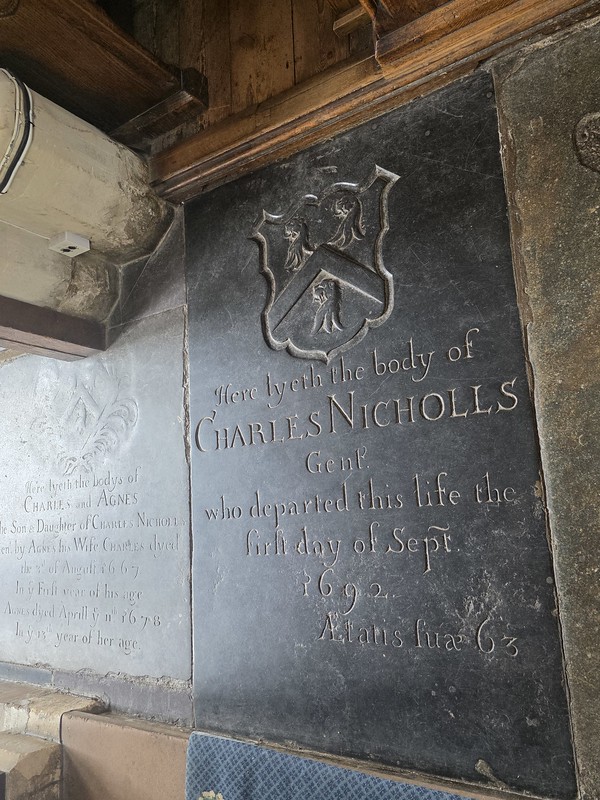
    This is the ledger stone of Charles Nicholls (c.1629-1692) which is located in St. Mary’s Church in Hitchin. I’m not sure why the “Ætatis suæ 63” bit is in Latin (a throw-back to the pre-Reformation maybe), but he died at the age of 63. I can’t find out much about him, but his son is interesting as Bedfordshire Archives have some of the family records in their collection and they’ve added some narrative about them:

    “(1) NICHOLLS FAMILY 1664-1746

    Charles Nicholls senior was a Hitchin gentleman who built up an estate round the borders of Bedfordshire and Hertfordshire over many years. He was survived by his two children, Charles and Mary, and his widow Agnes who had previously been Miss Peake, Mrs Greene and Mrs Rolf. Charles Nicholls junior became an attorney in Hitchin. He inherited his father’s estate in 1692 and added to it, mainly by lending money with property as security and foreclosing on the ‘mortgages’. These properties included a large estate in the Waldens, Hertfordshire, against which John Cripps had borrowed over 2,000 from Nicholls by 1708. When Nicholls foreclosed, Cripps called him a rogue, rascal and villain, and came near to killing him at Bendish, Herts, one November afternoon in 1709. Nicholls fled in fear of his life to London where he made a deposition about what had happened. The deposition has survived almost entirely and gives a fascinating glimpse of the speech, behaviour, manners and dangers of the period. In the end Nicholls’ foreclosure resulted in Cripps’ dying penniless in the Fleet Prison, London soon afterwards, leaving a widow and two infant daughters. Overall, Nicholls loaned at least 3199 which now, in 2003, would be equivalent to over a quarter of a million pounds.

    The period around the end of the 1600s and early 1700s was volatile in financial terms. From 1688, Parliament supplied monopoly rights to mercantile ventures including the East India Company, the Hudson’s Bay Company and later the South Sea Company. This led to great speculation in stocks and shares, with companies starting up and often failing very quickly. Before the South Sea Bubble burst in 1720, investors and speculators made fortunes. But fortunes were also lost as these documents show, although the cause is never stated here. Men like Charles Nicholls, who lent money to anyone who had over-reached himself, were the winners because a defaulting borrower seldom reclaimed his property. The estates in this collection acquired by the Nicholls family are : –

    1665 Pulloxhill Manor from Pigot and Hale (purchase)
    1684 Barton Bridge Closes from Edmund Castell (purchase)
    1692 Brotherhood House, Hitchin from Papworth (foreclosure)
    1706 Offley from Plummer & Shotbolt (foreclosure)
    1709 Stondon from Ansell
    1710-19 Hitchin & Ippollitts from Crawley (foreclosure)
    1711 Kings Walden & Pauls Walden, Herts from Cripps (foreclosure)
    1712 Henlow Grey cottage from Albone (foreclosure)
    1715 Pegsden from Ansell (foreclosure)
    1722 Pulloxhill leys from Pepyatt (foreclosure)
    1723 Foxholes, Hitchin from Draper & Runton (foreclosure)
    1729 Chibbley, Pegsdon & Shillington from Tapster & Ansell
    1744 Welwyn from Plummer”

    It’s an example of how wealth was built up, not necessarily ethically (although nothing changes there with some property owners), during this challenging period, much of it probably still resides in the hands of subsequent generations. Bedfordshire Archives also has this family tree tree for the Nicholls.

  • Hitchin – St. Mary’s Church (Adoration of the Magi)

    Hitchin – St. Mary’s Church (Adoration of the Magi)

    20250531_132338

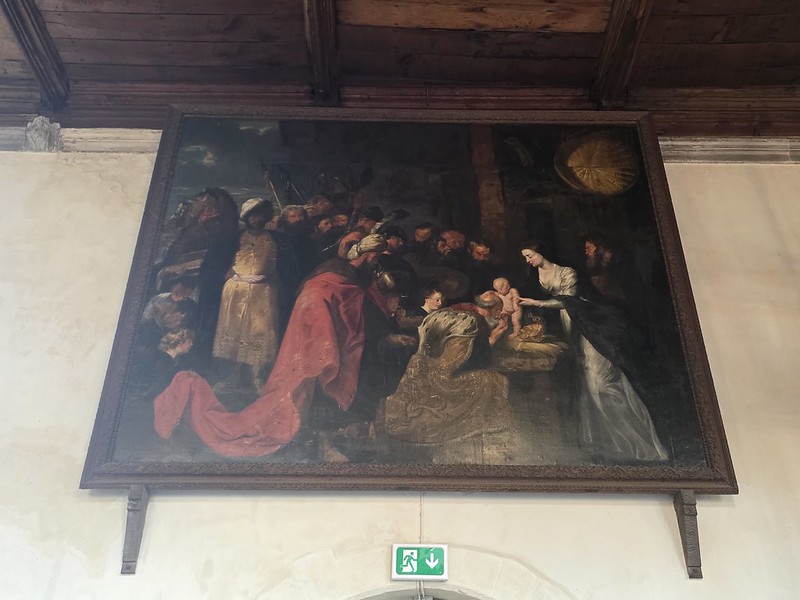
    Located above the north door of St. Mary’s Church in Hitchin is this large painting of the Adoration of the Magi. It occurred to me (and others will inevitably disagree) that it seemed just a little out of place, as if they had this painting and they weren’t entirely sure where to put it. And it has been moved around the church a little, although it moved to its current position in the early nineteenth century and I don’t imagine it’ll be on any travels in the near future. It was donated to the church by John Radcliffe (1738–1783) in 1774 and his family lived in Hitchin Priory so it was unlikely that a gift from the local gentry would have been declined. The painting itself is a copy of an artwork that came from Peter Paul Rubens’s workshop and it’s fortunate that it came after the Puritans had a little rummage about the church as otherwise this would have likely been destroyed. There’s some authenticity to having this religious imagery in a church, although it’s a little dark and hard to see when it’s high up on a church wall. Anyway, what really intrigued me is that no-one has ever taken it down, it would have only taken one vicar who didn’t like it and it would have gone, with the Victorians being particularly good at this wholesale removal of items.

  • Hitchin – St. Mary’s Church (Font)

    Hitchin – St. Mary’s Church (Font)

    20250531_132151

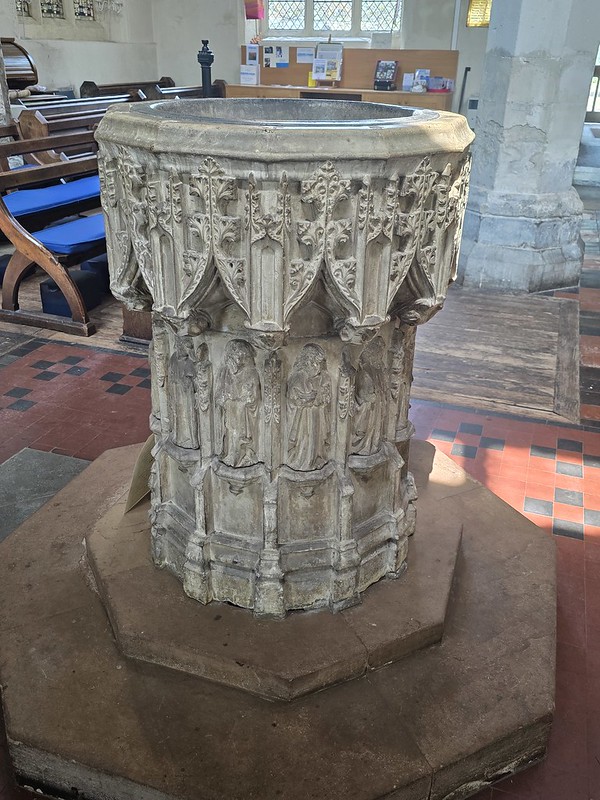
    This is something of an impressive font located at St. Mary’s Church in Hitchin. It’s made from Ketton stone and is thought to date to around 1470 and it has representations of the 12 apostles of Jesus. There was once an additional step here, but the Victorians decided that they’d remove that.

    20250531_132159

    And the font cover, which certainly couldn’t be said to be under-stated.

    20250531_132154

    The quality of the carving is high but then the Puritans came along in the 1640s and knocked the heads of the apostles off. I won’t compare them to any other recent political movement, but the Puritans decided that the Reformation wasn’t done properly and so they went full steam into a more extreme version of it. But, I like the history behind this, it’s something of a survivor and it retains its place in the centre of the church.

  • Hitchin – The Angel Vaults (JD Wetherspoon)

    Hitchin – The Angel Vaults (JD Wetherspoon)

    20250531_131821

    I had a spare hour in Hitchin whilst going to Luton Airport, the first time that I can remember actually visiting the town. It was rather more decadent than I expected, there were lots of artisan shops and outlets with lots of people about.

    20250531_131808

    Information about the pub’s history outside of the main door.

    “The Angel Vaults

    This Grade II listed building dates from c 1765 and was originally a “commodious family home.” In the yard behind the house was the brewery established by the Crabbe family in c 1885. Hitchin Conservative Party moved into the building, remaining here until it became the Angel Vaults. The name is from the medieval inn that stood next-door-but-one, on the site of 1–3 Sun Street. Until the 17th century, Sun Street had been named Angel Street for the preceding two centuries. The old Angel Vaults was an L-shaped, timber and plaster building, with a tiled roof and a coach arch. By the 1950s, it was in a poor condition and demolished, but its name lives on.

    These premises were refurbished by JD Wetherspoon and opened in December 2014.”

    I can’t unfortunately find any photos of the interior of the building before the conversion, but here’s a Google Street view image from early 2014.

    20250531_131454

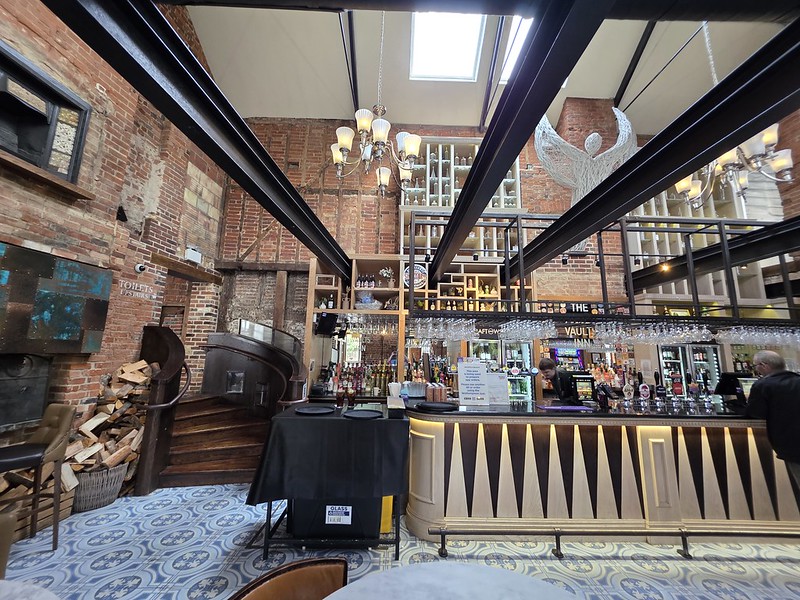
    JD Wetherspoon manage to transform buildings in a creative and sensitive manner, with the interior of this structure maintaining some of its original features.

    20250531_123733

    Not least that fireplace.

    20250531_114543

    There is seating at the front of the building, but the main bar is at the rear.

    20250531_115035

    And there’s this side area with the coffee machine and access to the beer garden.

    20250531_131741

    The unique carpet.

    20250531_120525

    I’m not hugely engaged with the muffins that Wetherspoons sell, but they’re so cheap that I decided to get the sausage and egg one, which tasted perfectly acceptable as my morning snack. The beer is the Urban Dusk from Redemption Brewing, which was maybe just a little thin but it was pleasant tasting with a caramel and toffee edge to it. The half pint of beer, unlimited coffee and muffin came to £4.24.

    In terms of the beer options available, there was some stuff from Greene King (who operate the pub in the building next door) that I ignored, alongside Thornbridge Jaipur, Adnams Mosaic, Redemption Urban Dusk and Stonehenge Great Bustard.

    20250531_123506

    The milk slightly scared me as it was left out for a long time and had a fly swimming in it. I’m not sure why they weren’t using the usual milk jugs, but the likely reason is someone has pinched it.

    As it’s a JD Wetherspoon, I like having a little look at the reviews and the rating is just a little towards the lower end of the scale for the chain.

    “Visited last Saturday and found that both coffee machines needed refilling. I waited until a member of staff, who was returning plates to the kitchen was passing and said ‘Excuse me, both the coffee machines need refilling please.’ She snapped back ‘Can’t you see we’re busy?’ Eventually the machines were attended to by another staff member. A little later I went back for a refill, one of the machines still needed refilling, but the other appeared to be working. I selected latte but only got hot milk. Had to go to the bar for a fresh mug, but the barman said there weren’t any so had to rinse it out for me. I returned to the machines, told another member of staff, who came back with supplies and I pointed out the problem with the machine only dispensing milk although apparently working just as the first one passed by again and repeated ‘Can’t you see we’re busy?’ Complained to Wetherspoons customer services who said the staff would be spoken to. I suggested a refund would be appropriate and they replied it wasn’t warranted. Very poor.”

    Having spent a lot of time at JD Wetherspoons, because they have cheap coffee and lots of space, there’s definitely a divide between customers. There are some who just wait until the team members fix the coffee machines pro-actively, which they nearly always do as they flash different colours when they’re broken (the machines, not the team members) and seem to accept that the £1.71 for unlimited coffees inevitably comes with some occasional delays as team members are often busy. Then there are those customers who feel the need to seek out team members already busy with other things to inform them that the machine is broken, which they will know. So take your side really, give team members time or demand what you’ve paid for, I suppose both options are acceptable….

    “Avoid if there is a concert on at the Hitchin priory. Ordered food via the app, food came in good time but drinks didn’t arrive for over half an hour. Waitress expressed that they were short staffed.”

    This is a common problem where the kitchen is quicker than the bar, but then customers end up with their meal and no drink to have with it. Sub-optimal….

    “Particular waitress had a very bad attitude and threw down cutlery when pointed out the order was wrong and stropped off in a huff, this was over a gluten free option. The manageress was less than sympathetic and was more than rude and ordered us to leave”

    Two sides to every story, I’ve never been asked to leave because I’ve mentioned an order is wrong….

    “Service is perfectly to the level you would expect 16 year olds”

    And the rest of the review is just more sneering about younger people. I imagine the pub won’t be too disappointed if the customer goes elsewhere.

    “Tried going for our breakfast today, we’re going to sit in the garden as it was so lovely and we had our small dog with us, we were just about to order and were told it was company policy NOT to allow dogs even in the garden. What a shame another customer close by it was a rediculas ‘company policy ‘. No social media either so could get a response from them as to why such a policy”

    So a one star review because a customer wanted their dog to be exempted from the pub’s long-standing company policy and wasn’t……

    “Cold food( 3 MEALS) with a row with assistant about taken it back And just been served a Bailey in a 25 ml shot glass went questioned staff I don’t know ( hate to tell you bailey is a 50 ml)not going back don’t bother going !!!”

    Ah, I’m with the customer, bar staff should know you can’t serve Baileys as a 25ml…. Although I think I’d get over it and go back.

    “What a sham for a restaurant. But then this is what I have been told to expect at Wetherspoons. I am an ex pat living in Canada where the service culture is king and the customer is looked after. I went in for Sunday lunch and ordered a pint and the ale pie and chips. The beer was great by the way. When the food came the pie and the gravy were stone cold. The chips and peas were hot. I could not attract a waiter’s attention so I walked the food to the kitchen area and found my waiter and told him my food was cold. The first thing he said to me was ‘would you like me to warm that up for you’, not something like very sorry I will replace that straight away. I asked whether I could have a whole new meal rather than warming it up and he said yes but again said we can also warm it up for you pushing me towards this option. At this point I asked to talk to the manager and walked my plate back to my table. A few minutes later a manager appeared who was very apologetic and did offer to refund me my bill so it did appease me but seriously, train the waiters to be more customer oriented. In north America I would have had a refund and a free meal. Clearly England and / or Wetherspoons has some catching up to do unless you want to be married to the classic English ‘fawlty towers` client service model.”

    A sham of a restaurant as a customer wasn’t given a free meal and a refund. Hmmmm.

    “No sports on the TV… waste of time going there.”

    Another plus point for JD Wetherspoon in my eyes.

    “Some of our party didn’t get their drinks, felt like I moved to Essex.”

    Is this an Essex thing in terms of not serving drinks?

    “Arguing in front of the customers is not very good practice”

    But very exciting.

    “Food appaling if this is supposed to be a gastro pub.”

    I don’t think it’s supposed to be a gastro pub if I’m being honest.

    Anyway, I’ve digressed once again. I rather liked it here, the building has some history to it, the service was friendly, the surroundings were clean and I felt that there was value for money.

  • Gdansk Trip – Getting to Luton Airport

    Gdansk Trip – Getting to Luton Airport

    I can crunch all this into one post as it’s the same route that I took last week on my little trip to Belgrade. I’ve also had a cold this week, although it’s obviously an aggressive version of it, but I’ve been very brave about it. However, I mention that not as I like telling people I’ve been brave, but just as an excuse as to why yet again I’ve got behind with posting about things.

    20240916_001254

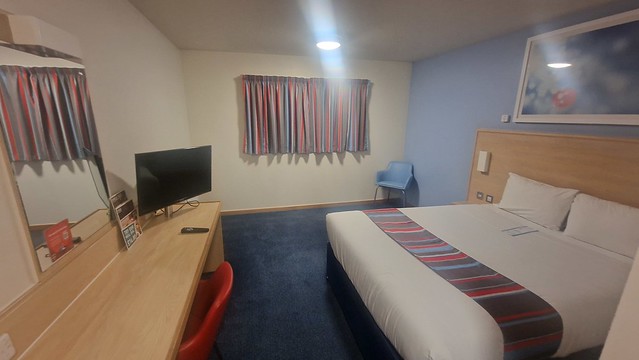
    Slightly blurry, but Liam once again drove me to Hatfield to stay at the Travelodge overnight before my onward journey. It’s always handy to get gossip fitted in on these journeys and it is quite handy getting a chauffeur driven ride straight to the hotel. Nothing much to report here about the Travelodge, the room was clean and there were no noise issues internally or externally. It seems a reliable hotel, I suspect I might be staying here a reasonable amount.

    20240916_100909

    The view of Hatfield. I’m not sure that even my two loyal blog readers need to see a view of Hatfield out of a hotel window, but yet here we are.

    20240916_121305

    As my flight was later on in the day, I popped to Harpsfield Hall to have several hot drinks for £1.56. Things looked problematic at first as the team member thought that the card machines were down but she said I could try, but I’d likely need to go and find cash. I wasn’t going to go and find cash, but I didn’t mention that and I was preparing to just move straight to Luton. However, to her surprise and considerable delight, the card payment went through and I went through a few hot chocolates. It reminded me that I really should restore the emergency £5 note to my wallet that I rarely remember to replace following the very occasional occurrence that I’ve had to use cash. It’s usually to get chips, but there are few places now which don’t take cards.

    20240916_103608

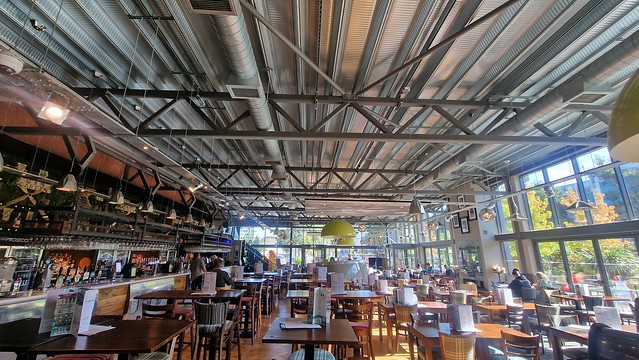
    It’s quite metallic to say the least. I’ve visited here before, but I appear not to have ever written anything about it. I will use the history that Wetherspoons provide:

    “The original Harpsfield Hall stood nearby and was approached by a long driveway, across open fields. It seems to have been built in the early 19th century, when it replaced a larger, older house of the same name, described as ‘a commodious residence with pleasure grounds’. The later hall was demolished in the 1930s to make way for the main runway of the new Hatfield Aerodrome. This pub stands at the corner of the old aerodrome site.”

    This part of Hatfield is all quite modern, the old village is known as Bishop’s Hatfield, but the bulk is part of the post-war New Town programme.

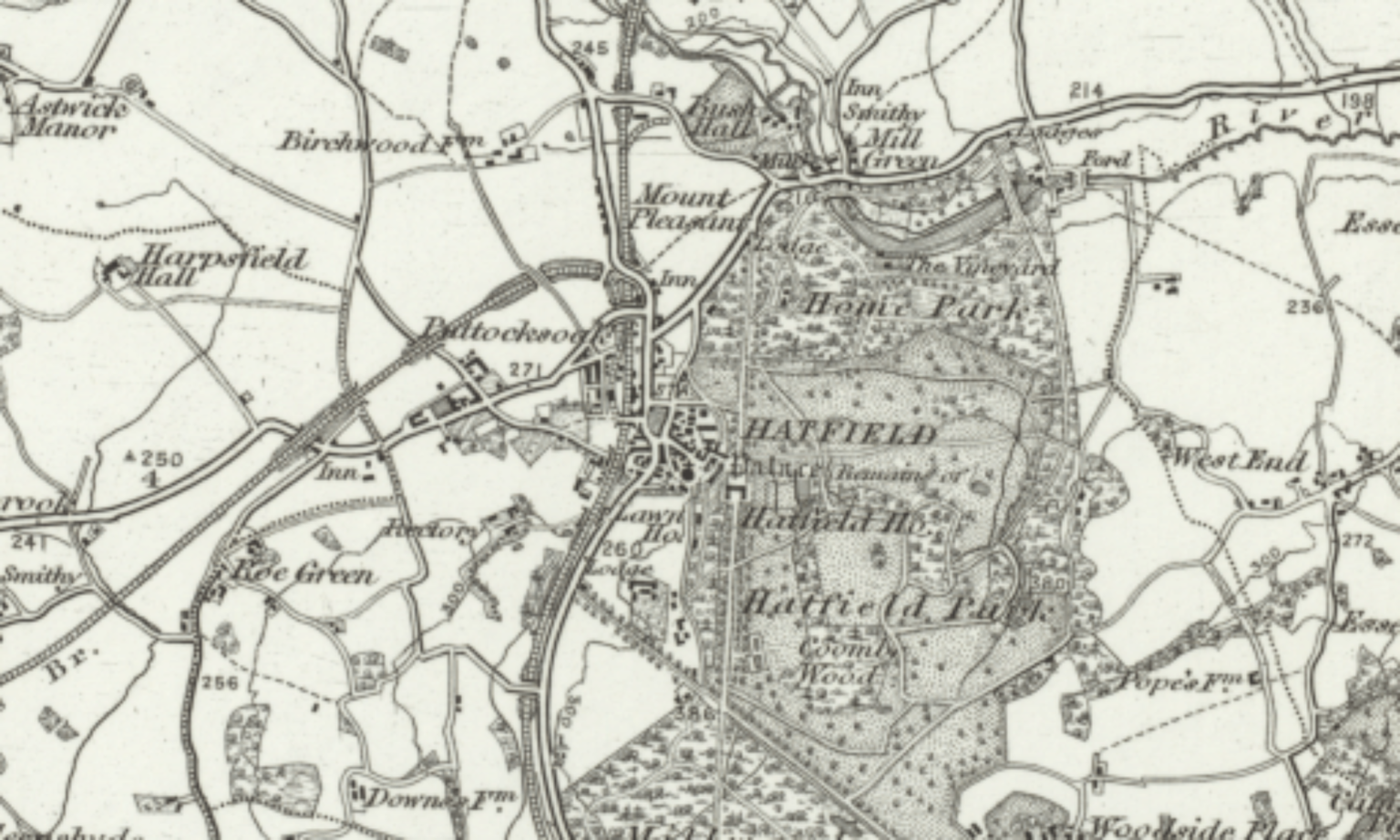
    Clicking on this map will make it larger and shows the difference between the 1860s and today (copyright of image to the right is the Open Streetmap project). The cursor on the left hand map is where the JD Wetherspoon outlet is today.

    20240916_114149

    Given the aerodrome link, there’s an aircraft related theme to the pub and it also has Boeing 747 engine cowlings which have been turned into booths. I’ll find my old photos as I sat in one of those before, all very decadent.

    20240916_114921

    Whilst I was at the pub, a customer demanded that BBC News was turned off and GB News was turned on. I was privately a little unimpressed when the team member agreed. It would never occur to me to be so annoyed at the news channel that I’d go and get it changed to make a political point. Each to their own I suppose.

    20240916_122601

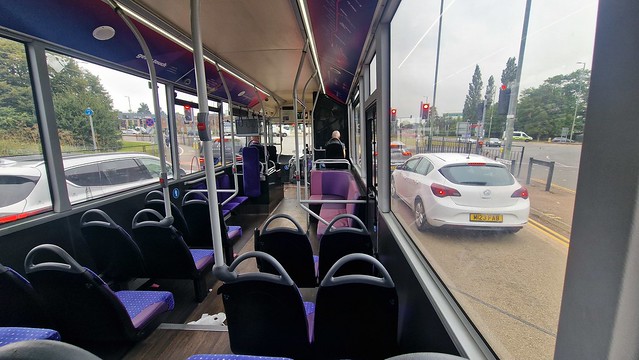
    Off to the 610 bus to Luton, a bargain £2 but it turned up 25 minutes late. I’m not sure that it’s the most reliable of bus services but I’m forgiving when I’m not in a rush and the service is cheap.

    20240916_124743

    And off we go, passing the Galleria in Hatfield. As an aside, this is the exact point where the Hatfield and St Albans Railway used to run.

    20240916_134827

    Safely in Luton, I went to the town centre this time and I’m always interested in these sort of ghost remains of buildings. I’ll have to come back to this one another time though.

    20240916_153100

    Full of originality, I went to JD Wetherspoon for food and drink. This is primarily as I wanted to sit in a quiet venue and get on with typing away on my laptop, with the chain being particularly good at providing an environment where this is achievable. Again, I’ve visited before and I’ll use the chain’s history:

    “In the late 19th century, the Crown & Anchor Brewery stood on the site of this Wetherspoon pub, a short walk from the site of Luton’s first brewery. Founded by Thomas Burr, in 1780, it stood next to his family home, known as The White House.”

    20240916_141224

    The meal and drink cost just over £6 thanks to the Luton Wetherspoons being in the lowest price band that the chain has. And I was able to look at some books whilst I was there. Cheap, cheerful and reliable. This is one of the Wetherspoons which seems to have a queueing system, something of a throwback to Covid, which always seems slightly odd. I paid using the app, but I’m yet to get used to queues in pubs, although there is an innate fairness about them that I like.

    20240916_155354

    Walking to the railway station, I passed by a Vauxhall Factory, the home of the Vauxhall Vivaro. There are around 1,500 workers here so it remains an important employer for the area.

    20240916_155624

    And then by the printing works of the Daily Star. There used to be a large sign for the Daily Express and the Sunday Express, but either they’ve fallen off or they’re no longer printed here.

    20240916_161218

    Here we are again, the delights of London Luton Airport. I was just five hours early for my flight, which I thought was reasonable. Excitement was certainly growing, it meant that I was returning to Poland for the first time in over a year.

  • Belgrade Trip – Dragonfly Bus 610 from Hatfield to Luton

    Belgrade Trip – Dragonfly Bus 610 from Hatfield to Luton

    20240909_092048

    It was easier than I expected to get from Hatfield to Luton, it’s a short walk from the Travelodge to the Galleria and the bus stop is just opposite the front of the shopping centre. Some sensible urban planning.

    20240909_092854

    As usual, I got to the bus stop 25 minutes early for my bus. Fortunately, the previous 610 bus was delayed by 20 minutes and so I was able to board the bus after just a couple of minutes of standing at the bus stop. Sometimes the bus Gods smile nicely…. The cost for this journey was just £2, many thanks to the bus cap which I still think is one of the best policies that the last Government managed to think of. The current Government are refusing to extend the cap, which otherwise runs out at the end of 2024, but it would be a serious blow for public transport if they fail to do so. I checked what the bus fare would have been before the price cap and back in 2019 I would have had to pay £9 to use the service.

    This whole arrangement meant that I was in Luton around 60 minutes after setting off from Hatfield. My entertainment was boosted by two separate passengers asking the bus driver if she knew that her bus was late. It transpired that she did realise that the bus was late, but it was nice of the passengers to check.

  • Belgrade Trip – Journey to Travelodge

    Belgrade Trip – Journey to Travelodge

    20240909_001525

    Woooo, a little adventure this week as I’m going to Belgrade which is my first visit to Serbia. I had a little issue that I had to work out how to get to Luton Airport for my flight, but where there’s a will, there’s a Liam and his car. He kindly picked me up just before midnight to take me to the delights of Hatfield. I had established that I could get from Hatfield to Luton Airport relatively easily, although I didn’t realise at the time how easily, and the Travelodge was only £30 for the night. It’s not the easiest hotel to find the entrance to, but I was dropped off in good time. The staff seemed startled at someone trying to get in, but the check-in process was quick and easy. The room is the old style Travelodge lay-out, but it was clean and entirely functional. For the money, it was really rather good and was suitably convenient.

    20240909_001551

    Liam patiently waited outside to check that I had managed to check-in. This is the confirmation photo that he wanted before he could safely drive off without me messaging him 20 minutes later saying I’ve had a crisis.

    20240909_090729

    The room was very cold and I think that’s the state of the art temperature control on the left. I like very cold rooms, but I suspect some guests might not have been surprised and delighted by the arrangement. If only all hotel rooms were chilled like this one then I’d be very pleased.

    20240909_091028

    It was all very peaceful inside, although there are a fair few number of reviews complaining about both internal and external noise. I noted a customer review which reads:

    “Horrific. Stayed in room 226, all I could hear all night was the banging from the loud music coming from a restaurant across the road. Went to reception and told them and they said they have had lots of complaints because of it but nothing has been done to resolve it. I literally ended up sleeping in the bath till half 2 in the morning when the music stopped. Worse nights sleep I’ve ever had.”

    I’m really not sure that sleeping in a bath was ever going to work as a plan, but there we go…. I quite like the buzz of external noise, but another customer noted:

    “There was a man asleep in the disabled toilet after drinking to much. The area around it was terrible. There was rubbish everywhere, bed linen that someone had thrown out of bedroom window was just left.”

    Sounds an entertaining evening…..

    “Awful ! Truly horrendous.

    We started to worry when we tried to park behind the hotel – men openly selling drugs , drug paraphernalia on the floor .

    Reception staff lovely but the hotel have an agreement with the local council . Apparently their residents are “well behaved” but on finding one hotel guest on the floor of the corridor so drunk or drugged he could not get up . With another lady guest hanging out the hotel corridor window smoking drugs we decided that due to feeling unsafe we would leave .

    The bottles of urine outside the front of the hotel were just disgusting. The hotel surroundings are full of groups of men hanging around . We felt really uncomfortable.

    The hotel have refunded my two nights but I am still out of pocket for the two hotels we had to find as we did not stay in Hatfield Central .

    I would not like anyone to feel how we did , this in my opinion is not a hotel for a lone female .

    I have since found out that another business stopped using this hotel as female staff felt so uncomfortable

    Avoid!”

    They sound like a satisfied customer.

    20240909_091137

    It is an odd design though, as there’s an open car park under the building and it’s probably quite a protected area for someone some poor sod who sleeps rough to stay dry. There’s a JD Wetherspoon pub about three doors down, one I’ve visited before and I can’t say that I thought I’d be back in Hatfield any time soon.

    But, lovely as the stay was, I had to work out to get from Hatfield to Luton Airport….

  • Wednesday – Sagardi Restaurant, Mikkeller, the Dundee Arms and Lee Valley YHA (Part 2)

    Wednesday – Sagardi Restaurant, Mikkeller, the Dundee Arms and Lee Valley YHA (Part 2)

    Continuing on from part one.

    20220817_163942

    I arrived at Sagardi restaurant in Shoreditch just a little damp from the rain, even though it’s only a four minute walk from Goose Island. I had £50 to spend thanks to The Fork, otherwise I’m fairly sure I wouldn’t have thought to come here and it’s a bit out of my price range anyway. The welcome was immediate and I was offered a choice of seats, but I thought it best to dry off at the rear of the venue and I’m sure they were pleased with that. They didn’t want upmarket and decadent customers entering to see damp patrons sitting near to the door.

    20220817_164219

    Starting with still water and a pint of Txapeldun from Whym, which I didn’t even attempt to pronounce. It was a perfectly acceptable Spanish pale ale which was well kept, although it’s fair to say that this really is a restaurant which focuses on wine. The beer wasn’t much more than the water and it cost £6.50, which was perhaps the only element that seemed even vaguely keenly priced.

    20220817_164426

    My rather blurry photo of the restaurant’s interior. Not ideal, but it’ll have to do. Handily, they sat me next to a power outlet which was useful in charging my phone back up which I had managed to discharge by spending about an hour staring at it. The interior design is functional and not too over to the top, but there has been some effort made with some decorative features around the place such as the coat hangers in the shape of horses’ heads.

    20220817_164429

    And the wine collection. I’d have rather it was an extensive craft beer collection, but there we go. I accept what they had was in keeping with the theme of the restaurant.

    20220817_164829

    An anchovy and olive concoction that was brought over as some sort of amuse bouche. This was delicious, strong and clean flavours.

    20220817_170038

    I raved on about tomato bread when I went to Barcelona (indeed, I think Bev got fed up with me raving on about it) and I think I ate about six loaves of it at one restaurant. The version here was less interesting, there was no depth of flavour, the bread was too thick for my liking and it didn’t take me back to Barcelona in any shape or form.

    20220817_170211

    The pan-fried codfish in the style of Zapiain cider house, although of what relevance that last bit is I have no idea as there was no taste to the sauce. I probably should have gone for something more exotic off the menu (I had been tempted by the octopus, but it’s served in so many different ways I’m never sure how it’ll turn up), but the cod had an odd texture which only just seemed cooked. There was some texture from the garlic, but no flavours of note and it all felt rather basic and uninspiring. Not that I had paid for it, but if I had, I would have been disappointed given that this dish was priced at £22.

    Just on the presentation, it’s neat, but it’s quite minimal on the middle of that plate. I accept that the Spanish style might be to serve a variety of items on different plates, but nonetheless, it does look a bit barren there. A few vegetable elements, and I don’t write that lightly, would have enhanced this a little.

    20220817_170335

    The side of Sagardi style potato wedges, which meant that I had effectively ordered fish and chips, was rather more generous in the portion size. They were cooked fine, although heavily salted, and this was really the pinnacle of the meal for me, which probably isn’t much of an advertisement for the restaurant. It mentions on the menu that it’s “grandma’s home cooking”, but I’m wondering exactly whose grandmother they’re referring to.

    20220817_173608

    There’s a butcher’s shop inside the restaurant, as part of the theme, but there were people standing in front of it and so I thought better of taking a photo, but it’s visible here through the glass windows. Overall, I left feeling uninspired and I could see why it was nearly empty inside, and they’re perhaps reliant on link-ups from companies such as The Fork. The service was polite, but the food was mediocre at best, although judging from the reviews, perhaps I didn’t order the right menu items to get the best experience.

    20220817_181526

    TFL has a two-tier pricing system which has ridiculous differences between on-peak and off-peak fares. Off-peak is between 09:30 and 16:00 and from 19:00, which means that it’s cheaper to sit in a pub and get a drink whilst waiting for 19:00. So, that’s what I did, popping to Mikkeller at Hackney Road.

    20220817_174114

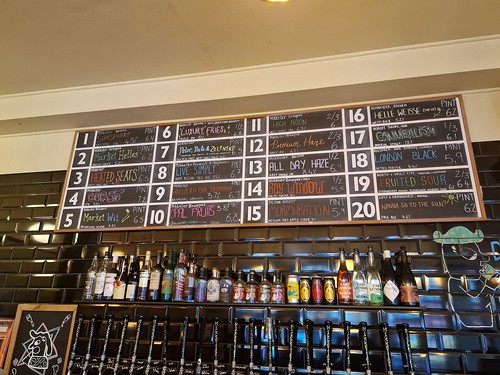
    Twenty different beers, with the usual decent range of different beer styles and they had one from Adroit Theory which looked interesting.

    20220817_174250

    I don’t like the third glasses that Mikkeller use, they’re too prone to spilling, but the triple IPA brewed by them, Luxury Fries, was decadent and delicious. As an aside, I’m pleased that I know what they mean by being dry hopped now (effectively adding them later on in the brewing process), it gives me confidence than in fifteen years or so I’ll have a decent understanding of brewing. The bar isn’t the largest and it got reasonably busy, but I had a seat by the window looking out over to the church opposite.

    20220817_182408

    I didn’t go in the Royal Oak on Columbia Road, but I liked the external architecture of the pub, with some of the interior fittings surviving as well.

    20220817_190717

    A quick visit to the Dundee Arms to wait the final thirty minutes before the cheaper fares. The pub has been trading since the later part of the eighteenth century, so that’s some heritage tied up in the property.

    20220817_184620

    There’s a slightly divergent mixture of historic building, modern on-trend elements and darkness, although I still quite liked the whole arrangement. Service was friendly and immediate, the surroundings clean and comfortable. It feels something of a locals’ pub, although I mean that in the positive sense and not as a hint that I thought a riot might break out at some point.

    20220817_184636

    I have no idea about the artworks in the background, but the beer was better than I had anticipated, the Sicilian Harvest from the Five Points Brewing Company who are just down the road in Hackney. I’ve somehow not been to their taproom yet, but it looks appealing.

    20220817_191224

    Now able to tap in at the reduced rate, I was safely at Cambridge Heath station, first opened back in May 1872 and now part of the London Overground.

    20220817_191218

    At the back is a Greater Anglia train flying through, but I don’t think that the mainline trains stop here anymore.

    20220817_195600

    And I was heading to the end of the Overground line, at Cheshunt, which is where this photo was taken whilst I was waiting to cross over. The railway station here dates to 1846, but more interestingly perhaps is that nearby is where the Cheshunt Railway opened in 1825, known as the first monorail to open anywhere in the world. There’s a little bit more about this at https://www.hertsmemories.org.uk/content/herts-history/topics/transport/railways/cheshunt_railway_1825, but this makes Cheshunt one of the more important locations in the world in terms of the development of the railway in the early nineteenth century.

    20220817_195919

    I was heading here, to the YHA London Lee Valley which I’ve stayed at before. I choose to come here as although it’s miles from London, it was by far the cheapest accommodation option that I could find. It takes just over thirty minutes from London Liverpool Street making it more accessible than its geographical location might suggest. Friendly staff as ever and they have a range of food and drink to buy at reception, although it’s more expensive than at some pubs which I’ve always thought is slightly odd. I think they’re more thinking of a captive market than the price point of the people staying there.

    20220817_200306

    This YHA works on the lodges concept.

    20220817_200350

    There’s a communal kitchen in each lodge, although I had already eaten an adequate (at best) meal and so didn’t need to use anything here.

    20220817_200434

    And the private en-suite room for £40, which is very good value for London at the moment, as even the cheapest Travelodge room was twice that. Indeed, it would have been the same price for an extra person, if they want to climb up to the top of the bunk bed arrangement.

    20220817_200438

    It’s not going to win any design awards, but it was clean and comfortable.

    20220817_200446

    And, thanks to this, lovely and cool.

    There was some external noise from over-excited youngsters (which I define as anyone under 30), but it had stopped by midnight and so I wasn’t too bothered, bearing in mind it is a YHA. Although, to be honest, the average age at a lot of YHAs is older than I am, which is marginally over 32. It all meant that after several weeks in Norwich, I was at least staying somewhere different.

  • Books about Hertfordshire

    Books about Hertfordshire

    BOOKS ABOUT HERTFORDSHIRE

    The Origins of Hertfordshire by Tom Williamson is a large 270 page book which covers the history of the county from late prehistoric times to the thirteenth century. There’s lots of topographical history of the county, a subject not always well covered by books looking at this period of the county’s history. Primarily text based, as the period covered inevitably means that there is limited documentary evidence, there are though a number of maps. The book’s ISBN is 9781905313952.
    The Buildings of England – Hertfordshire book is the Bible of building archaeology in England, initially edited by the astute Nikolaus Pevsner, with research support from Bridget Cherry. The book has been recently updated by James Bettley and is 720 pages full of tightly written text about the buildings of Hertfordshire, in tremendous detail. There are many perambulations around the county’s towns, covering the main buildings of note. Pevsner’s quite cutting remarks about some buildings have remained in the book and there are some initial chapters about the general history of the county. The book’s ISBN is 9780300223903.
    The Watford to St. Albans Branch by SC Jenkins is part of the Locomotion Papers from the Oakwood Press. It’s a 90 page book which has an in-depth history of the line, with plenty of photos of stations, engines and also numerous older timetables and maps. There’s a great deal of clarity to the writing and plenty of history, despite this being a relatively short branch line. The book’s ISBN is 0853613990.
    Branch Lines Around Hertford and Hatfield to Broxbourne, St. Albans and Buntingford by Vic Mitchell and Keith Smith was published by Middleton Press in 2009. There are around 100 pages in the book, with Middleton being one of the prolific publishers of titles about the railway network. This title covers the evolution of the electrified branch line to Hertford East, along with the country branch to Buntingford. There’s not a substantial amount of supporting text, but the photos are interesting to look at, especially given how much has changed over the decades. There are also two pages of timetables, from the 1860s to the 1950s. The book’s ISBN is 9781906008581.
    The Origins of Hatfield Street Names compiled by Frank J Cox is a 16 page book which details how all of the streets in the town of Hatfield acquired their names. The book was published by Hatfield This Century, now the Hatfield Local History Society. The reasons for the name of Fiddle Bridge Lane are intriguing, it’s likely linked to the story of a merry fiddler from the medieval period.
    Hertfordshire Churches and Other Places of Worship by Jeffery W Whitelaw is 140 pages long and is something of a basic introduction to the historic religious buildings in the county. The book starts with a history of the local parish, with a chapter on the Cathedral and Abbey Church of St. Alban, with the book having an introduction by the Bishop. There’s then a section of post-conquest churches and monasteries up to the Reformation, then a chapter which covers the post-Reformation period. The next two chapters cover what to look for inside a church, then what to look for outside a church, along with a glossary of terms and then a gazetteer of the county’s churches. The book’s ISBN is 0948353856.

    Hertfordshire Buses by John Law is a 96 page book published by Amberley which has tens of photos of older coaches from the 1930s to today. Between the 1930s and the 1960s the buses were operated by London Transport, before being handed to the National Bus Company in 1969. Bus deregulation in the 1980s led by Margaret Thatcher saw it split into numerous smaller companies. There’s plenty of supporting text under each photo and it’s a well-written title. The book’s ISBN is 9781445669717.

    Hatfield and Its People – Part 5 : Roads and Railways was published in 1960 and was written by members of the Hatfield Branch of the Workers’ Educational Association.  It’s a comprehensive 32 page book about primarily the evolution of the road system and the railways.

    Hatfield and Its People – Part 8 : Schools was published in 1962 and was written by members of the Hatfield Branch of the Workers’ Educational Association. It’s a short 32 page book which is nearly entirely about the Countess Anne foundation. The initial text of the book apologises about the omission about most other schools in the area, although they are very briefly listed. Unfortunately, the title of the book is perhaps a little misleading given how it is so focused on one institution, but it does cover this subject with some clarity.

    Hatfield and Its People – Part 11A : Families and Trades was published in 1964 and was written by members of the Hatfield Branch of the Workers’ Educational Association. It’s a 46 page book is inevitably a little niche given the broad subject being covered, which is the story of Hatfield’s trade and business families.
    NO IMAGE
    A Walk Around Old Hatfield by Gladys Brown is a short pamphlet which acts as an introduction to the town’s history. The author notes that there’s little new to long-term residents of Hatfield, but it is a useful history for those wanting to walk around and discover the important heritage elements. Brown was a former teacher and also a founder member of Hatfield This Century (later known as Hatfield Local History Society).

    Portrait of Hertfordshire by Brian J Bailey is 210 pages long and was originally published in 1978 by Robert Hale. It’s a conversational book in tone which makes it very readable, with the introduction noting that it has more village greens than any other county, and it was noted in the epilogue how important agriculture remained to the people of Hertfordshire. The author noted that he hoped that didn’t change, otherwise “the next chapter in the county’s story may well be the way to oblivion”.
    NO IMAGE
    Glebe Cottages Hatfield by Joy Emerton is a short pamphlet published by Frank J Cox for Hatfield Local History Society. It tells the story of the first 100 years of Glebe Cottages, from 1892 until 1992, including the names of the block residents and several photos.

    A Caring County? Social Welfare in Hertfordshire from 1600 edited by Steven King and Gillian Gear. This 350 page book was published the University of Hertfordshire Press and as an academic rigour to it, but it’s still a readable book and an intriguing question asked throughout is how has Hertfordshire dealt with the social needs of its residents over the centuries? The authors conclude that in many ways that the county has proved to be caring and nimble in its dealings with those needing assistance. The book’s ISBN is 9781909291126.

    Archaeology in Hertfordshire Recent Research – A Festschrift for Tony Rook edited by Kris Lockyear is a large 350 page book which covers the recent research that has taken place regarding the archaeological history of the county. The author Kris Lockyear is a senior lecturer at the Institute of Archaeology at UCL and the director of the Welwyn Archaeological Society. The reference to Tony Rook is because he was the founder of the Welwyn Archaeological Society and is very much a niche book, but essential reading though for those wanting a broad understanding of the different investigations which have taken place. The book’s ISBN is 9781909291423.

    Hertfordshire Soldiers of the Great War by Paul Johnson and Dan Hill is 280 pages long and is written by two military historians. Always well researched and with immense detail, there’s a chapter covering each year of the war, along with an extra section on the 1920s and another on the Home Front. There are numerous illustrations throughout, with this being a comprehensive introduction to what soldiers from the county faced during the First World War. The book’s ISBN is 1473893933.

    A Pilgrimage in Hertfordshire by HM Alderman was originally published in 1931 as a perambulation around the county, covering many of the landmarks in Hertfordshire. There are plenty of pen drawings of various historic locations and the book was republished in the 1990s to make it more accessible. The republished book’s ISBN is 1871199336.

    Biplanes to Rockets – 48 Years in Aviation by Ben French is a book about the recollections of a De Havilland Ground Engineer. French worked for the company between January 1935 and October 1983 and the book was originally written for his family, but then was published so that a wider audience can understand more about not just his own career, but also the heritage and history of the company. The book’s ISBN is 9781526205384.
  • Towns in Hertfordshire

    Towns in Hertfordshire

    Some of the larger settlements in Hertfordshire and a brief history of each.


    Borehamwood

    Borehamwood is a town in Hertfordshire, England. It has a history that dates back to the medieval period, and its name is thought to derive from the “boreham wood” that was once located there.

    In the 19th and early 20th centuries, Borehamwood was a small rural village. However, with the growth of London, the town underwent significant development in the 20th century, particularly during the interwar period, and became a suburban town. The film and television industries also established themselves in the town, with Elstree Studios located in Borehamwood.

    Today, Borehamwood is a vibrant and bustling town with a diverse community, good transport links, and a variety of shops, restaurants, and other amenities. Despite its suburban character, it still retains some green spaces, including a number of parks and nature reserves, which provide a peaceful escape from the hustle and bustle of the town.

    Bushey

    Bushey is a town located in the county of Hertfordshire, England. The town has a history that dates back to the medieval period, with records of its existence going back to the 11th century. During the medieval period, Bushey was a small agricultural village, with its primary industry being farming.

    In the 19th and 20th centuries, Bushey underwent significant growth and development, becoming a suburban town with a thriving community and several industries. The town was particularly known for its hat-making industry, which was one of the largest in the country at the time.

    Today, Bushey is a vibrant and dynamic town with a diverse community, good transport links, and a variety of shops, restaurants, and other amenities. Despite its suburban character, it still retains some green spaces, including parks and nature reserves, which provide a peaceful escape from the hustle and bustle of the town.

    Cheshunt

    Cheshunt is a town in the Broxbourne borough of Hertfordshire, England, located on the River Lea. Its history dates back to the Roman period, when it was known as Cestrehunt, and was a major settlement along the Roman road that linked London to Colchester. During the Norman conquest, Cheshunt was mentioned in the Domesday Book of 1086 and was granted to the Bishop of London.

    In the Middle Ages, Cheshunt was a market town and became an important centre for agriculture and brickmaking in the 19th century. The town was connected to London by the railway in 1840, leading to further growth and development. During World War II, Cheshunt suffered significant damage from German bombing, but was rebuilt after the war.

    In the mid-20th century, Cheshunt saw significant growth with the arrival of major companies, such as Tesco and Sony, setting up their headquarters in the town. This led to an influx of residents and a expansion of the town’s residential and commercial areas. Today, Cheshunt is a suburban town with a mix of residential, commercial, and industrial areas and is known for its parks, lakes, and sports facilities.

    Harpenden

    Harpenden is a town in the St Albans district of Hertfordshire, England. It has a long history, with evidence of human habitation dating back to the Neolithic period. In the Middle Ages, Harpenden was a small agricultural village and remained so until the late 19th century, when it began to grow as a commuter town for London. The arrival of the railway in 1868 and the development of the town’s infrastructure led to a significant increase in population.

    In the early 20th century, Harpenden continued to grow as a popular residential area and became a hub for the surrounding rural communities. The town saw a significant expansion in the interwar period, with the development of many new homes and the construction of several new schools and community facilities.

    Today, Harpenden is a thriving town with a population of over 30,000. It is known for its historic architecture, parks and open spaces, and its high-quality shopping and dining options. The town is also home to several sporting clubs, a golf club, and a theatre, and is a popular destination for tourists and visitors.

    Hatfield

    Hatfield is a town in Hertfordshire, England, with a history dating back to the Roman period. The town was mentioned in the Domesday Book of 1086 and was the site of a royal palace in the Middle Ages, which was used by several monarchs, including King Henry VIII. In the 16th century, the palace was demolished and replaced by Hatfield House, which remains an important landmark in the town today.

    During the Industrial Revolution, Hatfield grew as a centre for industry and transportation, with the arrival of the railway in the 19th century. The town was also home to several major aircraft and defence companies, including De Havilland and British Aerospace, which played a major role in the development of the aviation industry.

    In the 20th century, Hatfield saw significant growth and development, with the construction of many new homes and the expansion of the town’s commercial and industrial areas. Today, Hatfield is a thriving suburban town with a mix of residential, commercial, and industrial areas, and is known for its parks, lakes, and sports facilities. The town is also home to the University of Hertfordshire, which was established in the mid-20th century and has grown to become one of the largest universities in the UK.

    Hemel Hempstead

    Hemel Hempstead is a town in Hertfordshire, England. It has a long history, with evidence of human habitation dating back to the Roman period. The town was mentioned in the Domesday Book of 1086 and was a small agricultural village for much of its history.

    During the Industrial Revolution, Hemel Hempstead began to grow as a centre for industry and transportation, with the arrival of the railway in the 19th century. The town was also home to several major paper mills and printing works, which helped to drive its economic growth.

    In the mid-20th century, Hemel Hempstead underwent significant expansion as a result of the government’s New Towns program, which aimed to alleviate overcrowding in London and other major cities. The town was designated as a New Town in 1947 and saw rapid growth, with the construction of many new homes, schools, and community facilities.

    Today, Hemel Hempstead is a thriving suburban town with a population of over 90,000. It is known for its parks, lakes, and sports facilities, and is a popular destination for tourists and visitors. The town is also home to several large employers, including Marlowes Shopping Centre, which is one of the largest shopping centres in the UK.

    Hertford

    Hertford is the county town of Hertfordshire, England and has a long history, with evidence of human habitation dating back to the Roman period. The town was mentioned in the Domesday Book of 1086 and was a market town and an important centre for agriculture in the Middle Ages.

    In the 16th and 17th centuries, Hertford was a centre for the wool trade and became known for its production of cloth and hats. The town was also a centre for the brewing industry, with several breweries established in the 17th and 18th centuries.

    In the 19th century, Hertford saw significant growth as a result of the arrival of the railway and the expansion of the town’s infrastructure. This led to the development of new homes, schools, and community facilities, as well as a growth in industry and commerce.

    Today, Hertford is a thriving town with a population of over 26,000. It is known for its historic architecture, parks and open spaces, and its high-quality shopping and dining options. The town is also a popular destination for tourists and visitors, and is home to several sporting clubs, a theatre, and several museums and galleries.

    Hoddesdon

    Hoddesdon is a town in the Broxbourne borough of Hertfordshire, England. It has a long history, with evidence of human habitation dating back to the Roman period. In the Middle Ages, Hoddesdon was a small agricultural village and remained so until the late 19th century, when it began to grow as a result of the expansion of the railway network.

    In the early 20th century, Hoddesdon continued to grow as a popular residential area for workers in London, and saw the development of several new homes and community facilities. During World War II, the town was badly affected by bombing, with many homes and businesses damaged or destroyed.

    After the war, Hoddesdon underwent significant redevelopment, with the construction of many new homes and the expansion of the town’s commercial and industrial areas. Today, Hoddesdon is a thriving town with a population of over 20,000. It is known for its parks, lakes, and sports facilities, and is a popular destination for tourists and visitors. The town is also home to several large employers, including pharmaceutical and medical technology companies.

    Letchworth

    Letchworth is a town in Hertfordshire, England. It is one of the first garden cities in the world and was founded in 1903 as a response to the growing problems of overcrowding and poor living conditions in urban areas. The garden city movement aimed to create a new type of urban settlement, one that was based on the principles of town planning and incorporated large areas of green space and parks.

    Letchworth was designed as a planned town, with a grid-like street layout and a mix of residential, commercial, and industrial areas. The town was also designed to be self-sufficient, with its own water and sewage systems, electricity generation facilities, and parks and open spaces. In the years following its founding, Letchworth grew rapidly, attracting residents from London and other urban areas. The town was also an important centre for industry, with several major companies setting up operations there.

    Today, Letchworth is a thriving town with a population of over 35,000. It is known for its parks and open spaces, and its distinctive architecture, which combines elements of Arts and Crafts style with Art Deco.

    Rickmansworth

    Rickmansworth is a town in the Three Rivers district of Hertfordshire, England. It has a long history, with evidence of human habitation dating back to the Roman period. In the Middle Ages, Rickmansworth was a small agricultural village and remained so until the late 19th century, when it began to grow as a result of the expansion of the railway network.

    In the early 20th century, Rickmansworth continued to grow as a popular residential area for workers in London, and saw the development of several new homes and community facilities. During World War II, the town was badly affected by bombing, with many homes and businesses damaged or destroyed.

    After the war, Rickmansworth underwent significant redevelopment, with the construction of many new homes and the expansion of the town’s commercial and industrial areas. Today, Rickmansworth is a thriving town with a population of over 15,000. It is known for its parks, lakes, and sports facilities, and is a popular destination for tourists and visitors. The town is also home to several large employers, including pharmaceutical and medical technology companies.

    St Albans

    St Albans is a city in Hertfordshire, England with a rich and diverse history. The city was originally called Verulamium and was a major Roman settlement and a centre of commerce and industry in the Roman province of Britannia. After the fall of the Roman Empire, Verulamium declined, but the town remained an important centre for agriculture and trade in the Middle Ages.

    In the 16th and 17th centuries, St Albans became a centre for the cloth trade and was known for its production of fine cloth. The city was also an important centre for religion and was the site of several significant events in English church history, including the trial of St Alban, England’s first Christian martyr, and the birth of the English Reformation.

    In the 19th and 20th centuries, St Albans grew rapidly as a result of the expansion of the railway network and the growth of London, and became a popular residential area for workers in the capital. Today, St Albans is a thriving city with a population of over 140,000. It is known for its rich history and cultural heritage, its parks and open spaces, and its high-quality shopping and dining options. The city is also home to several museums, theatres, and other cultural attractions, and is a popular destination for tourists and visitors.

    Stevenage

    Stevenage is a town in Hertfordshire, England. It is one of the country’s first new towns and was established in the mid-20th century as part of the UK government’s response to the growing problems of overcrowding and poor living conditions in urban areas.

    The concept of the new town was to create a planned community with a mix of residential, commercial, and industrial areas, and to provide high-quality housing and public facilities for residents. Stevenage was designed as a self-contained town, with its own schools, shops, and public transport, and with plenty of green spaces and parks. In the years following its establishment, Stevenage grew rapidly, attracting residents from London and other urban areas. The town was also an important centre for industry, with several major companies setting up operations there.

    Today, Stevenage is a thriving town with a population of over 85,000. It is known for its parks and open spaces, and its distinctive architecture, which combines elements of modernist and brutalist design.

    Tring

    Tring is a small market town in Hertfordshire, England, with a long and fascinating history. Archaeological evidence suggests that the area has been inhabited for thousands of years, and there are several historic sites in and around the town, including an Iron Age hill fort and a Roman settlement.

    In the Middle Ages, Tring was a small agricultural village and was known for its wool trade. During the Tudor period, the town grew and prospered, and several fine buildings were constructed, including Tring Manor, which still stands today.

    In the 19th and 20th centuries, Tring continued to grow and expand, and became a popular residential area for workers in London. The town was also a centre for industry, with several major companies setting up operations there.

    Today, Tring is a thriving market town with a population of over 11,000. It is known for its historic buildings, its parks and open spaces, and its high-quality shopping and dining options.

    Watford

    Watford is a large town in Hertfordshire, England with a rich and diverse history. Archaeological evidence suggests that the area has been inhabited for thousands of years, and there are several historic sites in and around the town, including an Iron Age hill fort and a Roman settlement.

    In the Middle Ages, Watford was a small agricultural village and remained so until the 19th century, when it began to grow as a result of the expansion of the railway network. In the late 19th and early 20th centuries, Watford became a popular residential area for workers in London, and saw the development of several new homes and community facilities.

    During the 20th century, Watford continued to grow and expand, and became a major centre for industry and commerce. The town was home to several large companies, including printing and publishing firms, and was an important centre for the manufacture of paper, textiles, and other products.

    Ware

    Ware is a market town in Hertfordshire, England with a history that dates back to the Roman period. The town grew around a Roman settlement, which was established in the 1st century AD and became an important centre for trade and commerce.

    In the Middle Ages, Ware became a prosperous market town and was known for its wool trade. During the Tudor period, the town grew and prospered, and several fine buildings were constructed, including several historic inns and taverns.

    In the 19th and 20th centuries, Ware continued to grow and expand, and became a popular residential area for workers in London. The town was also a centre for industry, with several major companies setting up operations there.