Category: Two Julians

  • Norwich – Cat and Fiddle (Two Julians)

    Norwich – Cat and Fiddle (Two Julians)

    20250607_215337

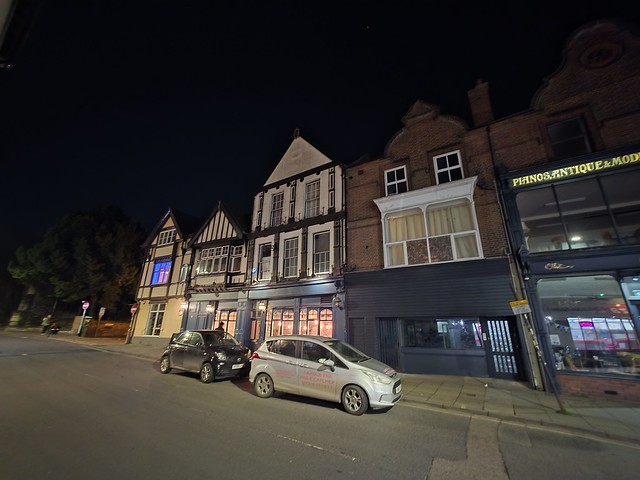
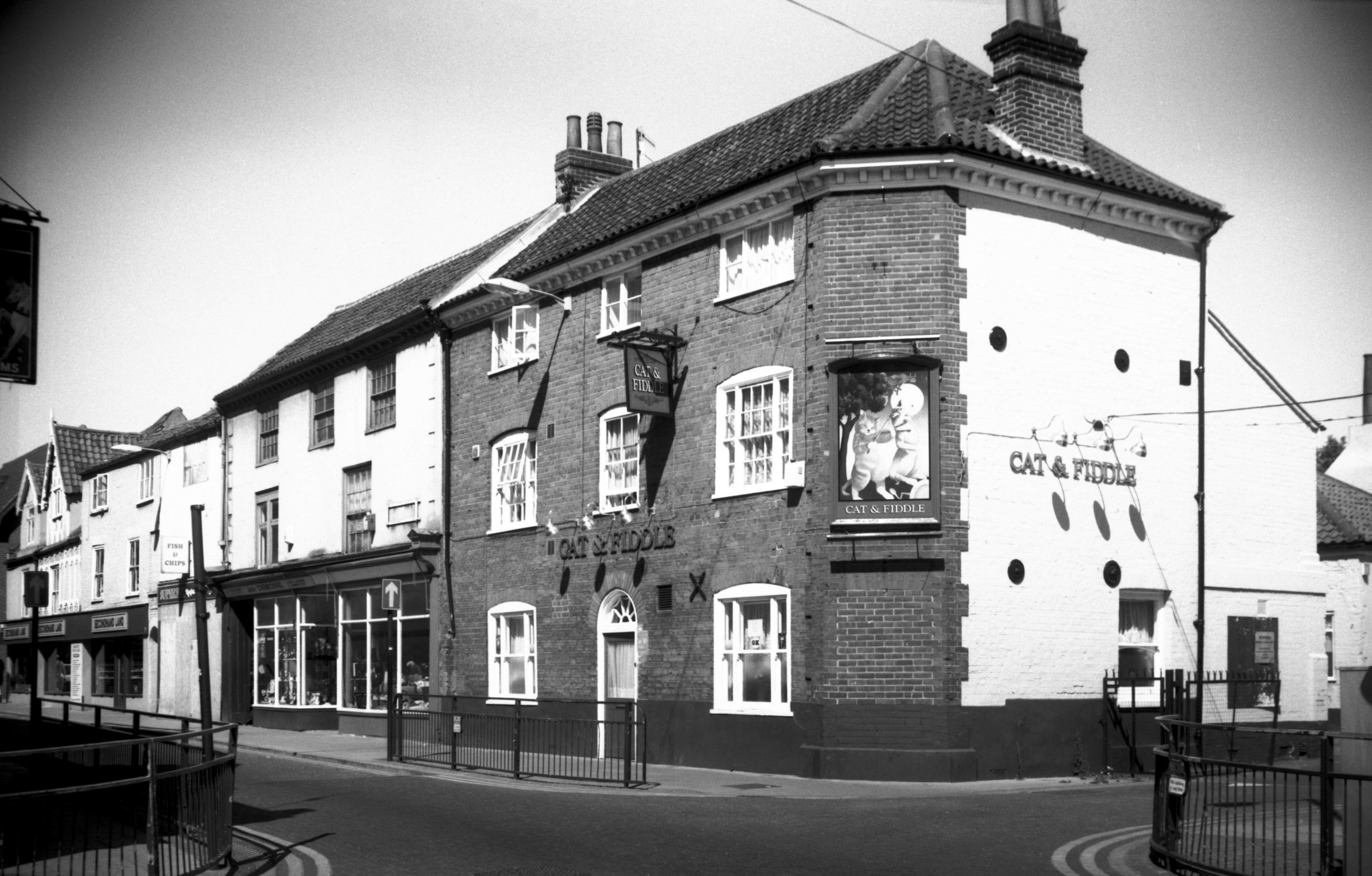
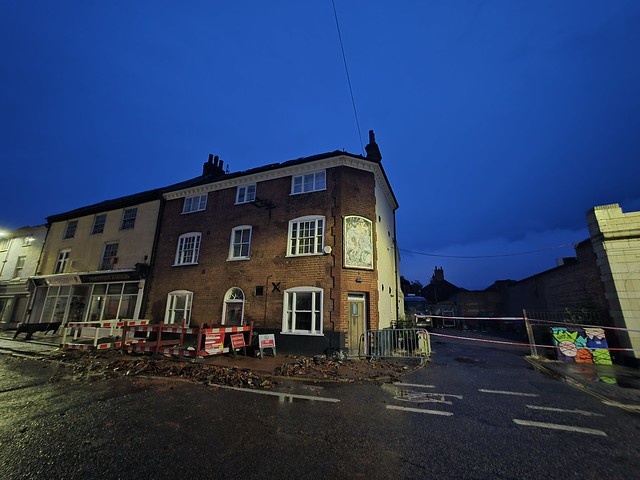
    The scene at the Cat & Fiddle last week after a fire, caused by a cannabis farm getting a little over-heated on the top floor, caused significant damage to the former pub which had closed in 2011. It had been a pub since 1760 and, a little ironically perhaps, a few years after closing it found itself in the craft beer quarter along with the Malt & Mardle, the Artichoke, the Leopard, the Plasterers and the King’s Head. George Plunkett has a photo of the pub as it looked in 1997.

    In terms of the pub name, there was a letter in 1902 sent to the media regarding the pub’s name.

    “THE CAT AND FIDDLE.

    Sir,—In “The History of Signboards,” by Larwood and Hotter, the following account is given: ” . . . The only connection between the animal and the instrument being that the strings are made from the cat’s entrails, and that a small fiddle is called a kit and a small cat a kitten. Besides, they have been united from time immemorial in the nursery rhyme,

    Heigh diddle diddle,
    The cat and the fiddle.

    Amongst other explanations offered is the one that it may have originated with the sign of a certain Caton Fidèle, a staunch Protestant in the reign of Queen Mary, and only have been changed into the cat and fiddle by corruption; but, if so, it must have lost its original appellation very soon, for as early as 1589 we find, ‘Henry Carr, Signe of the Catte and Fidle, in the Old Chaunge.’ Formerly there was a ‘Cat and Fiddle’ at Norwich, the cat being represented playing upon a fiddle, and a number of mice dancing round her.”

    —Yours, etc., J. C. BURLEIGH.
    13, Plynlimmon-terrace, West-hill,
    Hastings, Nov. 30.”

    Well, there are some views on the history and it must be noted that the pub had a rather impressive sign, still visible in my photo at the top. There have historically been four pubs with the name Cat & Fiddle in Norwich (although nearly nothing is known about two of them), including one on Botolph Street which lasted until 1867, but the Cat & Fiddle Yard lasted until 1967. This map from the 1880s shows the confusion here that there must have been and indeed still us in trying to identify which pub is which when they’re referred to in the media.

    Towards the bottom centre-left is the Cat & Fiddle Yard, although the pub here had closed a few years before. The pub on Magdalen Street is visible towards the centre-top of the map, with the Phoenix Brewery visible located opposite. Anyway, back to the Cat & Fiddle on Magdalen Street which is what I should be focusing on here.

    The building doesn’t look it from the exterior, but it was likely built as a residential property in the early eighteenth century and was then used as a pub from around 1760. The rear range of the pub is older though, perhaps as early as 1600.  Until the early twentieth century the pub was often referred to as the Cat & Fiddle Inn, because accommodation was available on the two upper floors. In the early nineteenth century, the pub advertised itself as a postal house, meaning that they kept horses that could be rented out, which transpired to be the forerunner of Post Offices. The pub was also the location for the annual meeting of the Taverham Association for Prosecuting Felons in the early 1830s and that sounds like an interesting little arrangement.

    In 1859, there was an auction in the pub for the Phoenix Brewery which was located pretty much over the road, although the brewers didn’t own the pub itself. The brewery continued to trade for some time, before the building became the Phoenix Shoe Factory and was then knocked down when they decided to build Anglia Square.  In 1886, the pub was something of a hub for the Conservative Party at an election with numerous posters up, something the other Julian would no doubt be thrilled about. There were numerous allegations of treating voters and the whole matter came to the attention of the courts.

    The pub landlord between 1882 and 1900 was James Alfred Morris, with his son, Leonard James Morris, taking over and announcing in the local press that the pub was under new management. The advert adds:

    “The Cat & Fiddle Inn, livery and bait stables, with ample accommodation for horses and traps, wagonettes and brakes. Traps of every description available for hire, special attention given to all orders for cabs and weddings.”

    Alfred Morris was though summoned to court for driving a horse and cab on St. Benedict’s in May 1904 without using a light, for which he was fined 2s 6d and warned never to do it again. The pub does appear in the media as something of a taxi company, including doing the transport for the Whippet and Terrier Coursing Club when it met out at the Blue Boar in Sprowston. In the 1930s, the pub was used as the headquarters of the Norwich Excelsior Cage Bird Society and earlier in the century, it was the home of the Piscatorial Society (I had to look that up, it’s a thing for fishermen). In 1932, George William Penny of Blackpool, using the pub as his home address, attempted to hold a fair on the street which would include a cake walk and music, but the magistrates were having none of it as the previous time bits of coconut ended up in someone’s garden and the local headteacher was most upset at the whole arrangement with kids running amok.

    There’s a problem today in many hotels where tradespeople leave their van outside whilst they stay overnight, only to find that their tools have been pinched when they get back to go to work. There seems to have been an equivalent in 1912, when it was reported in the Cromer & North Norfolk Post that the warehouse of R Clarke who was the Hickling Carrier based at the pub, found that he had been broken into. He lost linen drapery, handkerchiefs, stockings and a firkin of butter. I was quite intrigued by butter being stored in the firkin, but this is a separate term for a small container of butter rather than my thought that they were using firkins of beer to shove butter in. That did sound like a lot of butter.

    For most of its history, the Cat & Fiddle was owned by Steward & Co or later on Stewart & Patterson, before it was all purchased by Watney Mann. There were once numerous rooms internally, including a snug, but in 1983 these were all ripped out to create one large open space and a bar at the centre. I recall Julian telling me before that this arrangement was required by the magistrates, keen to ensure that the person behind the bar could see all of the premises from where they were standing. Convenient most certainly, but it must have significantly altered the character of the pub. It seems that at this time they changed the door from the corner of the building to something more central, along with some covering up of the fireplaces.

    In 1997, the pub received national attention when Roger James Foster died of injuries which he received whilst in the pub. The pub landlord was arrested and charged with his murder along with a customer, but as they were found not guilty due to insufficient evidence I won’t name them. In the years after that, Tager Inns took the building over and I’ve noted before what happened to this company. In short, they built themselves up as an operator and they were then purchased by London Inn Group, who got themselves into trouble soon afterwards and went bust in some spectacular fashion with the administrators struggling to even work out what pubs they owned. Sub-optimal really.

    Julian has likely visited many times as he’s spent a lot of his many years in pubs, but I visited it just once with my friend Ross, likely nearly around twenty years ago now. I recall that it had something of a reputation for being a vibrant venue and we were offered drugs, but that sort of thing is wasted on me, unless someone comes up with a load of Mullermilch and then I’m the buyer, although that isn’t really a drug and I’m not sure that a flavoured milk based drink from central Europe is usually pushed and touted around Norwich pubs. In June 2011, the pub shut its doors for the final time, by then the building was in need of substantial repair internally and the reputation really wasn’t the best.

    Anyway, I digress. This was a sad loss as a pub, not least because of how the area has since improved and had it stayed open there would have been an opportunity for more custom when the new residential properties open at whatever replaces Anglia Square. I imagine that if it was still trading, this might have become something of a craft beer bar, all rather on-trend. I assume that they will be rebuilding the structure soon enough, but I can’t imagine that it will have a pub on the ground floor again, although I think it’d be rather nice if they did.
  • Norwich – Ship (Two Julians)

    Norwich – Ship (Two Julians)

    20210309_125522

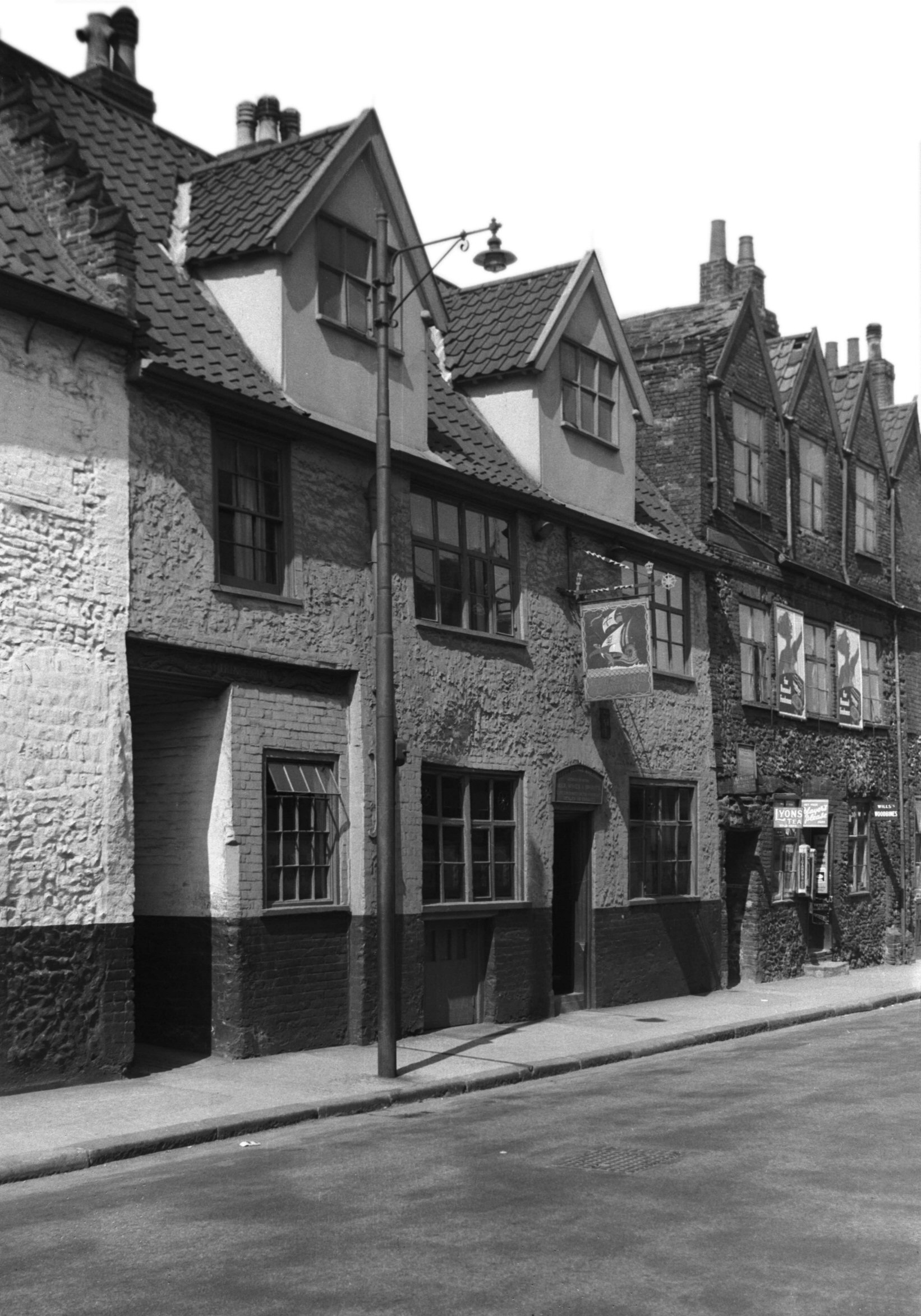
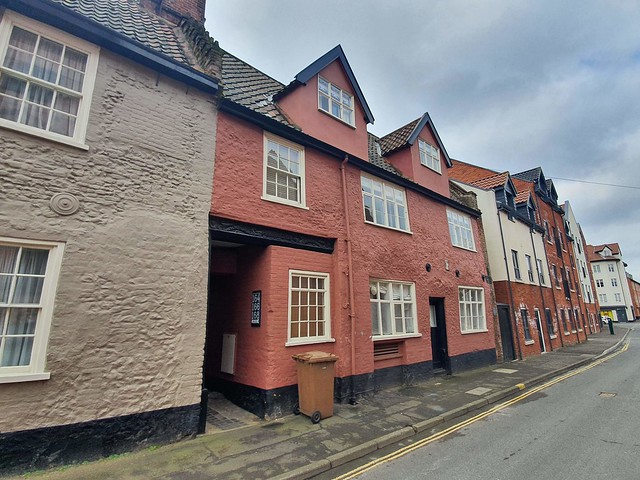
    This is a slightly different visit to those I usually write up, it’s a pub on King Street that unfortunately closed all the way back in 1969. It was known as the Ship, or the Ship Inn, and it is the building in the photo which is painted red. This means that I haven’t visited it, although Julian probably has in his younger days. Firstly, it’s useful to have a look at the photo that George Plunkett took of the pub in 1939 from a very similar position to mine. The main door of the pub is in the centre of the photo and the former cellar hatch is underneath the window just to the left of the door.

    The building was a licensed premises from at least 1760 and it was acquired by Youngs, Crawshay & Youngs in the nineteenth century and their branded pub sign is visible in George’s photo. The company was then bought by Bullards and then that was in turn acquired by Watney Mann. After closing its doors on 26 May 1969, it was then purchased by Norwich City Council who in the following years turned it into two residential properties. The ownership by Youngs, Crawshay & Youngs was rather handy as their brewery, the Crown Brewery, was located nearby on the other side of the road, so the beer didn’t have far to go.

    The brewery advertised in the Eastern Daily Press in September 1889 that a boozer was available (fortunately, the newspaper didn’t actually keep calling every pub that in the nineteenth century) opposite the Crown Brewery and this was taken on by James Catchpole and he ran it until he died in 1898 and his wife then carrying on operating it for another five years. There was a large auction in the pub in October 1889 which included 150 lots of “useful furniture” and if that wasn’t a sale on behalf of someone else, the recently deceased landlord Walter Blyth must have liked his chairs, tables and headboards.

    20210309_125545

    Ship Yard is located behind the pub and I won’t give any prizes for those who work out how it got its name. This is the entrance to Big Ship Yard and there’s an entrance to what was Little Ship Yard on the right hand side of the pub.

    Here’s a map from the 1880s which might make things a little clearer.

    20210309_125549

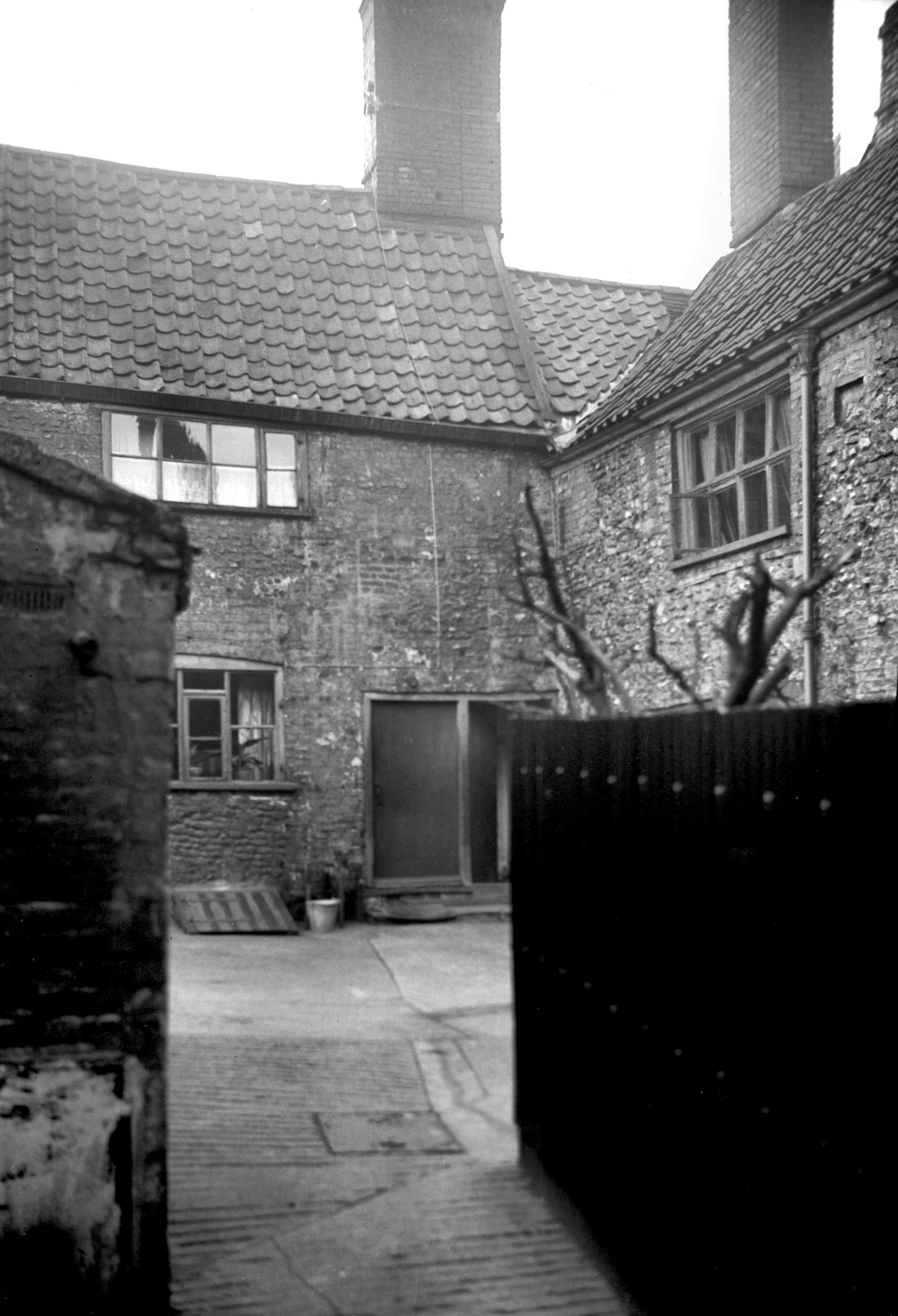
    The rear of Ship Yard and the buildings down here were demolished around 1970 and rebuilt to provide more modern accommodation. George Plunkett took a photo down here in 1938 and I suspect it might be the only one surviving of this courtyard.

    20210309_125534

    Quoting the great George Plunkett, he noted that “The yard to its south has at some time been partly built over, so that while formerly wide enough for the passage of carts it will now accommodate only pedestrians. The finely carved lintel above bears a design of foliage together with the rather contradictory inscription “Princes In”; it is believed that this was brought here at some time from the famous inn of that name, first mentioned in 1391, which once stood in St George Tombland parish on the north side of Princes St.” This feels a logical argument to me, meaning that this lintel could date back to the late medieval period or Tudor period with a bit of imagination.

    20210309_125701

    That’s the former main door to the pub and I rather like that those timber surrounds to the door are original. The building dates back to around the seventeenth century and was constructed from flint rubble and topped with a pantile roof. The casement windows, the ones either side of the door, are thought to date to when the building was constructed, although the sash windows are later.

    20210309_124856

    During the period after lockdown, Jonathan and I went on an expedition to look for all the parish boundary markers in Norwich. I need to return to the posts I’ve made about these and fix the broken images, but then Jonathan and I can start completing our project.

    The loss of this pub is a huge shame and I don’t say that about absolutely everywhere, although Julian often has a crack at that line of argument. There are no pubs remaining on the stretch of King Street and imagine the heritage of this building if it was still a licensed premises, I suspect that it would be something of destination real ale venue given the history. The building was listed in 1954 and it was that which perhaps meant that the city council decided against demolishing it and instead repurposed it, so at least it has survived in some form.

  • Norwich – Hop Rocket (Two Julians)

    Norwich – Hop Rocket (Two Julians)

    20250212_220924

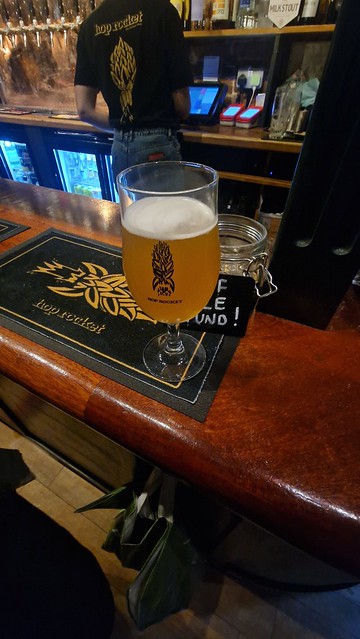
    Starting with an apology that Julian and I visited the Hop Rocket in February, so it’s both taken me time to write about this visit and it also means that the photos were taken in the dying days of my last phone so the quality is sub-optimal. Anyway, the Hop Rocket is relatively new in this building on Unthank Road which was previously briefly Oliver’s Cocktails, before that it was the Amnesty Bookshop and going back further it was a bakery and cafe so it’s been a little of a chameleon of a venue. I’ve also got nothing against trendy and expensive food venues, although I’m unlikely to visit them, but it’s a delight to see this becoming a pub and indeed something of a decent one.

    20250212_220040

    When we were in the York, Tom had mentioned that the venue was holding its first birthday party, so it seemed an opportune time to visit as I know what Julian is like when there’s free cake.

    20250212_215556

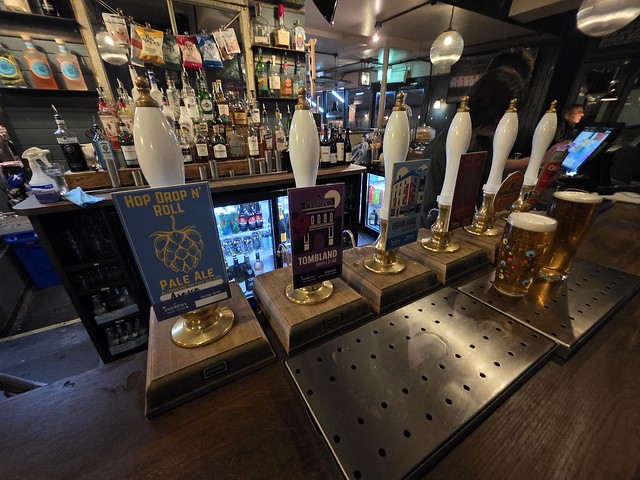
    The beer choice was solid, a pretty even mix of cask and keg, with a number of local breweries and some national delights. It was a well curated beer list with numerous tempting options, all feeling rather on-trend, but there is also plenty of additional choice in the beer fridges.

    20250212_220922

    Behind the bar and there was an upbeat vibe to the venue, although it likely helped that they were celebrating their birthday. It was busy, but the service was efficient and polite, with the team member being knowledgeable about the beer range. The interior is cosy and there’s also a small outside drinking area.

    20250212_220128

    I went for the 11th Birthday Cake Celebration (Mango, Pineapple, Coconut & Lime Ice Cream Cake with Vanilla Pastry Sour) from Amundsen Brewery, which was a beautiful little number. Lime and coconut elements, this was smooth, decadent and juicy, although Amundsen does frequently surprise and delight me.

    20250212_221110

    And we did leave clutching our birthday goodie bags.

    I’m not sure that the venue refers to itself as a micropub, not least as it’s not a small venue, but it does have that sort of ambience. It’s well reviewed on-line (although there’s a bizarre review from a customer who let their dog urinate in the pub twice and seems perplexed that this wasn’t considered ideal, but my two loyal blog readers can read the full version on Google Reviews) and attracts a varied crowd, but it has a strong contingent of younger drinkers (as in early 20s, not a load of 12 year olds). They don’t do food beyond basic bar snacks, but they do let customers bring their own in and they’re pet friendly. I very much liked this venue, it’s a bit of a hike for me to get there, but I’m sure that I’ll meander again there soon. All really rather lovely and this feels like the independent pub, which I think is owned by the same people as run the Brewery Tap, that I hope lots of people support.

  • Norwich – Strangers Tavern (Two Julians)

    Norwich – Strangers Tavern (Two Julians)

    20250327_223837

    Next on our perambulation a couple of weeks ago was Stranger’s Tavern which has somewhat of a complex history to unpick. Firstly, Julian found the railings outside the pub a handy place to lock his bike up and to also keep an eye on it when we were seated inside. Once that faffing about was done and I watched the police doing something next door with a food delivery driver, we were ready to enter.

    The story starts with the Three Pigeons pub which was located opposite where the pub today is now located. The current location is under the ‘HAR’ of Charing in the above map. This has been a pub from the mid eighteenth century located where Westwick Street and St. Benedict’s Street met, but the building was demolished for road improvement works in the 1890s. In 1869, there were allegations of election bribery taking place at the pub although the investigators only found evidence of intoxication of voters. I sometimes wonder whether this (the intoxication, not necessarily the bribery) should be encouraged again to see if voters make more sensible decisions after a couple of beers.

    This map, from around 1900, shows where the pub was moved to. Morgans Brewery operated the venue until the 1940s, then it became owned by Tollemache & Cobbold. In 1977, the pub was renamed the Hog in Armour and that’s how I remember it over twenty years ago when my friend James and I played pool upstairs. That’s now been turned into a cocktail bar which is separately branded today, but I digress. It was renamed the Mash Tun in 2014 and then the Strangers Tavern in 2019. I quite like the Three Pigeons name myself, but there we go.

    An advert from 1881 and there are a couple of interesting things there, including the bagatelle table (the fore-runner of today’s bar billiards), but also the annual bread, cheese and celery supper. I’m not bothered about the celery, but the rest of the supper sounds amazing.

    Incidentally, in 1930, the local press reported:

    “Mr. Lindley, at the Three Pigeons, near Charing Cross, has a hog, which is allowed to be the largest ever seen in this city (Norwich). Its dimensions are 9 feet in length, 5 feet high, 9 feet round the body, and the neck measures 4 feet 4 inches round; his weight is computed to exceed 50 stone.”

    50 stone?!?! Handy for the later name of the Hog in Armour though.

    20250327_220846

    The bar was entirely devoid of customers when we entered, but it was contemporary and clean in its design.

    20250327_220803

    I had expected something rather more generic, but I think it’s fair to say that both Julian and I were surprised and delighted. There was a broad range of craft beers and the team member behind the bar was knowledgeable, engaging and enthusiastic. Well, I say we were both delighted, but they don’t serve real ale (those two lines that look like cask are actually cider) so Julian could have been more delighted, but at least the craft options were intriguing.

    20250327_220622

    The keg selection which is a little hard to make here unfortunately, but there were some beers from breweries that I hadn’t been aware of and it’s always good to see beer from Brew York.

    20250327_220945

    I opted for the Ben & Terry’s Peanut Buttercup from Bianca Road Brew Co, a London brewery who were new to me. Lots of peanut butter, smooth and rich, this was nearly quite a decadent beer. Julian went for a beer from the same brewery, the Hay-Z which is a pale ale and it was a fresh and fragrant little number.

    The team member said that the bar was doing well, although it’s always seemed a bit empty when I’ve gone by, but it’s possible that they get a decent crowd in during weekend events. They don’t seem to serve food other than bar snacks, so it’s a primarily wet-led venue. I actually really liked the pub, it offered beers that were a little different, the service was friendly, the team member who served us was knowledgeable about beer and I felt welcome during the visit. All really rather lovely and I think that they deserve to be busier.

    Finally, for anyone who wants to see what the Hog in Armour looked like in the 1980s, jump to 12 minutes in of this Tales of the Unexpected video. Also note the appearance of Clive Swift, later better known for his role in Keeping Up Appearances.

  • Norwich – Rumsey Wells (Two Julians)

    Norwich – Rumsey Wells (Two Julians)

    20250327_220107

    This was the third pub on the latest perambulation around Norwich that Julian and I undertook last week as a service for the people of Norfolk and Suffolk (and indeed beyond) as we continue our attempts to straddle the Waveney. I confess we haven’t done much straddling lately, but never write us off as we are brave enough to return to Suffolk for brief periods at a time.

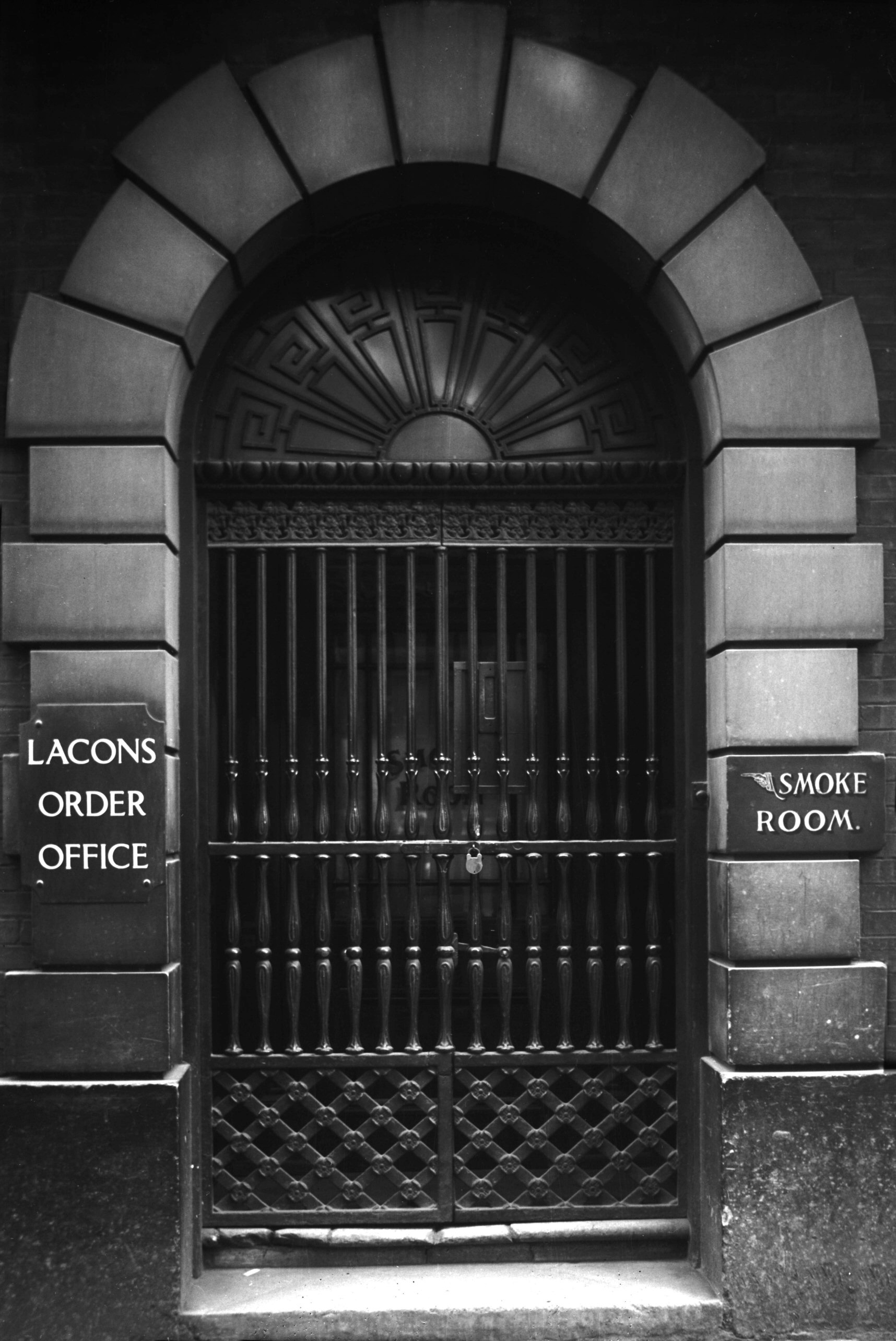
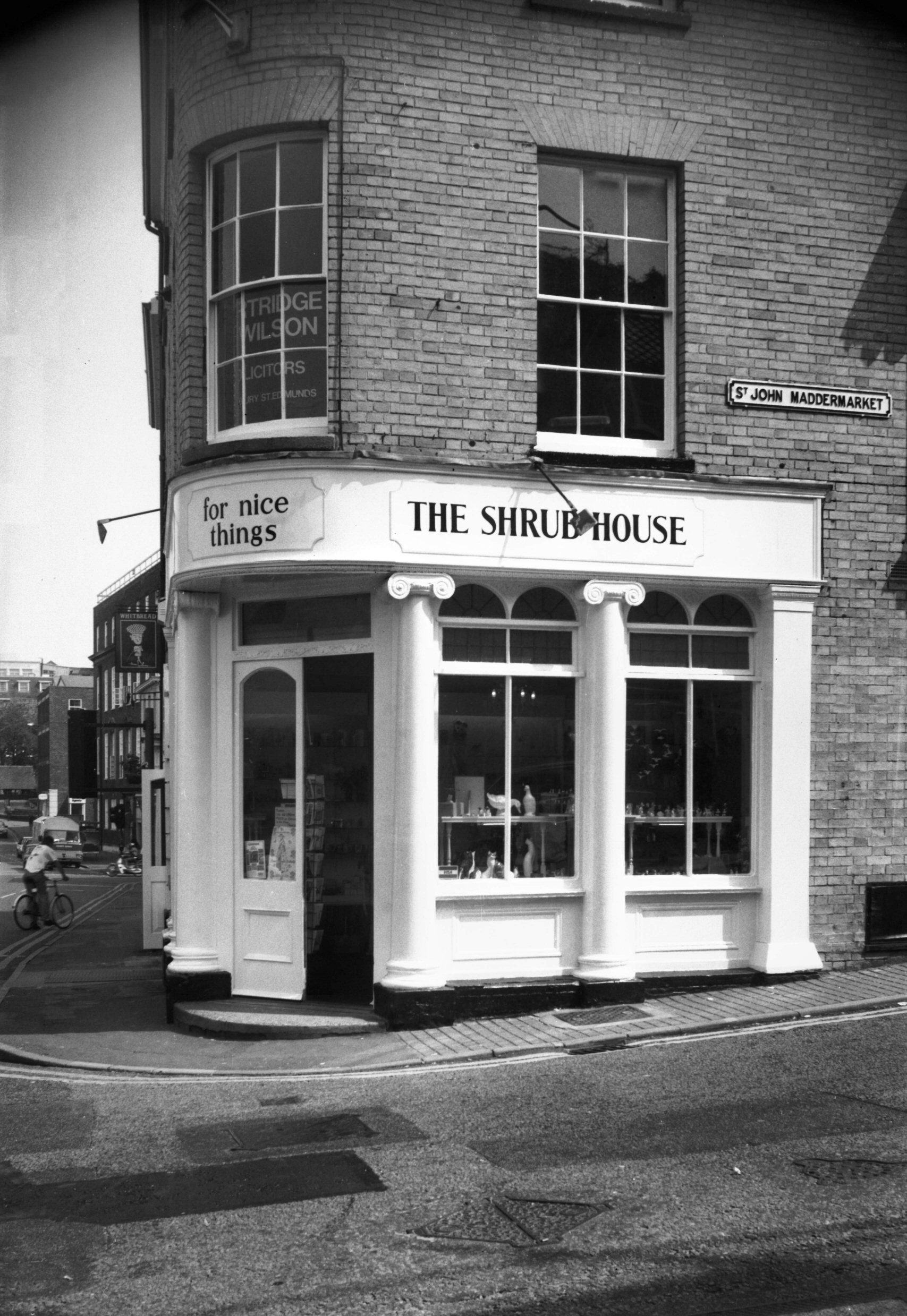
    I have digressed though. The history of the pub is complex, although it has transpired that Julian once again remembered its recent past correctly (he hasn’t entirely lost it just yet), and effectively the pub was originally the building on the right. It then lost that bit on the corner which is now a shop, but which was the main bar, but then gained the relatively large building in the middle which was a hat outfitters. George Plunkett has a rather lovely photo of the front door from 1938. There’s also a photo in his archive from 1989 which shows what is now a separate shop, but the old name remained it appears for the new shop.

    The historic pub bit of the building had opened as a wine and spirits shop, operated by Ward & Fisher (later Ward & Seaman), in the early 1820s and in 1829 the owners offered the lease for sale and noted the substantial cellars and premises that the wine merchants were operating from. The building became a pub in the later Victorian period which was known as the Shrub House and it was taken over by Lacons in 1896. In the 1970s, the corner section was lost to become a shop and the pub closed in 1979 for a few years. In 1984 it opened in its expanded form and was renamed the Blueberries and then became known as the Rumsey Wells between 1985 and 1989. It was then renamed again (I wish they’d stop doing this to pubs as it always sounds like they’ve having some identity crisis) to St. Andrew’s Tavern, but reverted once again to the Rumsey Wells in 2008. Hopefully they’ll just leave it like this now.

    20250327_220042

    The new bit of the pub. This is the former shop area which was historically run by Herbert Rumsey Wells (1877-1937) and he was rewarded by having the pub name after him. He was by all accounts something of an eccentric hatter and his family business dated back to the early nineteenth century. Visible in the above photo, this was the Wells & Son hat shop that became part of the pub in 1984. Between 1984 and 1989, the pub was run by Colin Keatley, who went on to do great things at the Fat Cat. Back to Rumsey Wells, I mentioned that he was eccentric as I got that impression from the obituary put in the local newspaper in December 1937:

    “Norwich has lost a picturesque personality by the death at his home in St. Andrew’s Street, on Wednesday, of Mr. Herbert Rumsey Wells. He was 60 years of age. With his “doggy” cap, large Inverness cape, snuffbox, and sometimes a monocle, he must have been known to many thousands of his fellow-citizens, and he was almost as well known in most of the big cities and towns of the British Isles. It was his boast that he was the most expensive cap maker in the world. He travelled the country on behalf of his firm from Land’s End to John o’Groat’s and it certainly could be said that he was his own walking advertisement.”

    You’ve got to have some confidence to say that you’re the most expensive in the world…..

    20250327_212454

    The pub today is operated by Adnams, which might be obvious when looking at the beer options. The service from the team member was efficient and polite, although it’s a little difficult here as they have a split bar and I know from past experience that it’s hard for them to see who is waiting next. Everything seemed well managed, although there were some uncovered sausage rolls that were looking a bit lost and vulnerable at the end of the bar, like pastry orphans awaiting adoption. For the truly forensic photo inspectors, they can spot them in the earlier photo, assuming they have the time and, frankly, the inclination for such detailed sausage roll scrutiny.

    20250327_212623

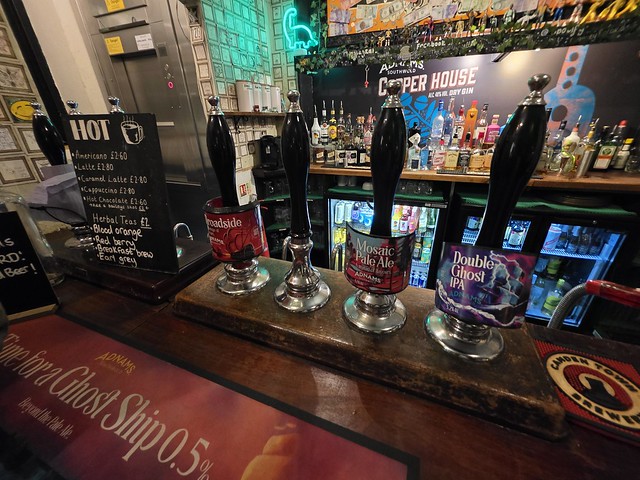
    The old bit of the pub is visible behind the glass. The beer inside the glass is the Double Ghost IPA from Adnams, not a beer that I’ve heard of before, but it was rather lovely with a malty, slight toffee flavour which was balanced and smooth. The beer was well-kept and served in an appropriate branded glass, not something that’s essential but I do try and mention it positively.

    The food offer here is Pieminister (which I keep calling Pieminster in error) and they had a selection of pies available at prices that weren’t unreasonable. It’s an interesting food franchise, it keeps an option open for customers, without having the huge kitchen and salary costs of a larger operation.

    The venue is a rather agreeable one, although it’s not one that I visit at all regularly. The pricing was somewhere around average and the pub was clean and organised, with a slightly studenty vibe going on. I didn’t visit them on this occasion, but they have a little courtyard area available and I think there’s a basement bar which is in operation when it gets busier. Anyway, the pub had some interesting beer choices and a quirky building history, so all rather lovely.

  • Norwich – Cinema City Bar (Two Julians)

    Norwich – Cinema City Bar (Two Julians)

    20250327_212131

    Julian suggested for the second evening visit of the night that we should visit the Cinema City bar. Now, this was a decent idea, but it’s such a complex building that there’s quite a lot of history to uncover. Julian has had some significant involvement here over the years, but I’ll let him tell those stories over a pint…. It’s an historic building which opened as a cinema in April 1978 and it was remodelled between 2004 and 2007 to add more screens. George Plunkett took a photo from around this location in 1936 and it looks relatively unchanged from the exterior. Here’s one of the frontage of the building from the same time period, showing what is now the entrance to Cinema City.

    20250327_212104

    The courtyard of the building. So, as I understand, Cinema City is formed of two buildings:

    (i) Suckling House – This is the core medieval part of the building which faces onto St Andrews Street. It’s a Grade I listed merchant’s house with origins dating back to the early 14th century (around the 1320s). It’s named after the Suckling family (Robert Suckling was Mayor of Norwich) who owned it in the 16th century and it stopped being used as a residence around 1915, today being the restaurant and bar area of the cinema.

    (ii) Stuart Hall – This hall was added to the east side of Suckling House. It was part of a restoration project funded by Ethel Mary and Helen Caroline Colman (of the Colman’s Mustard family) in 1923. They gifted the restored Suckling House and the newly added Stuart Hall (designed by local architect Edward Boardman) to the City of Norwich in 1925 for public and educational use. Stuart Hall was equipped with cinema projection facilities from early on and this is the area of the building where the cinema screens are located.

    Two medieval doorways survive in Suckling House and it was originally constructed as a hall house. Julian correctly remembered the building was descheduled in 1997, but it remains protected and is known as one of the city’s most historic buildings. It has obviously required some clever and innovative thinking to ensure that the building could be modified to become a cinema and remain in usage, but to also ensure that it remained suitably protected.

    20250327_212050

    The dining room area. I didn’t go in here as I didn’t want to disturb the sole table of diners. The building was partly demolished by the construction of a tramway, although not as much as the building opposite, but the listed building record mentions that some of it was restored back again. I am going to copy the building survey here as I think it’s a definitive record and offers a more detailed background than I can offer:

    “The Great Hall of Suckling House is generally agreed to be 14th century, although opinions about the precise date vary. The original entrance to the hall would have been through one of the two doors which face one another at the western end of the hall. This would have led into a screens passage which, on the western side led to service rooms in vaulted bays, and to the east into the open hall. The screen was probably timber, and no trace remains. The area where the cinema foyer is today was originally part of the Little Parlour, and fragments of the wall survive in the north and south walls. In the south wall at first floor level a medieval door still exists, and may represent the original entrance to the Solar from an external stair.

    The ground floor of the western range would have served as the service wing. Three vaulted bays survive, with evidence for another in the panelled room. This latter bay has fragmentary remains of vault webbing and is thought to have been the buttery, with the larder to the south, and further south were kitchens. There is much speculation about whether the service wing is earlier or later than the hall. The awkward junction between the original southern door and the vaults suggest that the two buildings cannot be contemporary. The layout of the hall follows the typical Norwich format of having the principal living rooms separated from the street by service rooms.

    Early in the 16th century a long covered passageway was added to the north of the hall, leading out from the screens passage towards the counting house. This had open sides with oak posts and decorated spandrels, one with the Grocers’ Arms and another with the arms of St Andrew. The inventory of Robert Suckling (1589) has allowed a conjectural plan of the building to be drawn up. In the 17th century the building begins to be broken up. In 1608 the buildings were divided into northern and southern sections and sold separately. The wine merchant Philip Rose who bought Suckling House from 1819 is believed to be responsible for the insertion of a cellar in the Great Hall by raising the floor. Wine merchants continued to use the building until 1914. In the 17th century the western range was refaced . The Great Gate that once stood just south of the Counting House was blocked off and incorporated into a house of six bays which appears Georgian, but is in fact just refaced.”

    20250327_212035

    A rather lovely window which has some seating located within it. There’s some stained glass at the top of the window, although it’s hard to make out from this photo.

    20250327_211301

    For reference, this is the pizza menu. The pricing is a little punchy, but it’s in quite a decadent building which is generally frequented by, let’s be realistic, a relatively middle-class audience.

    20250327_211252

    The main menu.

    20250327_210637

    That’s some ceiling arrangement.

    20250327_210629

    Spot the smoke alarm in the rafters which it feels must be entirely sub-optimal to have to change.

    20250327_210625

    The bar area and it’s perhaps a little cluttered, but they are trying to sell snacks to cinema goers, so I understand that. The service was friendly, personable and efficient, so the vibe was welcoming.

    20250327_210505

    And finally the beer, which was pretty much the only option and there’s no cask available at all. The beer is the Mosaic Pale Ale from Adnams, but this is the keg version which was light and hoppy, but a little too cold and I think it’s simply better in cask form.

    This venue is one that is probably over-looked by many drinkers in the city and I have to confess that it has never occurred to me to come here. But that’s what you get for being friends with Julian, an encyclopaedia knowledge of every watering hole in Norwich. It’s a little pricey and the beer selection is limited, but the surroundings are historic and on that basis alone, it’s worth a visit.

  • Norwich – St. Andrew’s Brewhouse (Two Julians)

    Norwich – St. Andrew’s Brewhouse (Two Julians)

    20250327_210301

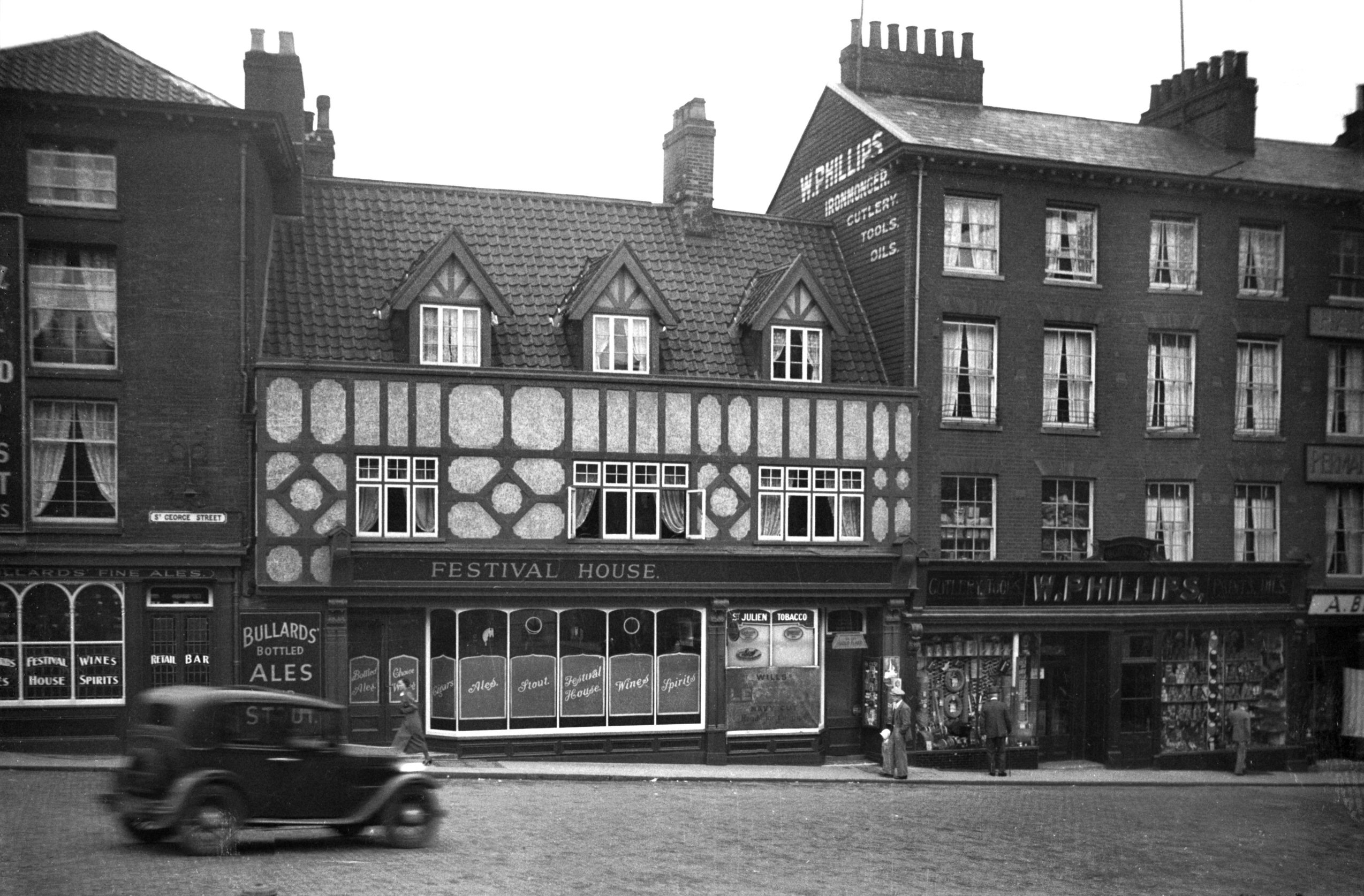
    Located on St. George’s Street, this is the exterior of St. Andrew’s Brewhouse which opened as the Festival House in 1899 when it was a Bullards pub (George Plunkett has a photo which he took in 1936 of the exterior). It was briefly known as the Grocer’s Ghost in 1992, then briefly as Franco’s the following year, before reverting to its original name. In 2001, it was reopened as the Irish bar Delaney’s after a substantial renovation, before being renovated once again and opening under its current name in 2015.

    John Hostler, a local labourer of no fixed residence, was intoxicated inside the pub and had his drink removed from him in 1908, so he threatened to put in the windows. He managed to do this, causing nearly £5 damage to the large plate glass window at the pub. In his defence to the court, he said that he fell and “my knee accidentally went through the glass”, but unsurprisingly this wasn’t believed and he was sentenced to six weeks hard labour. Perhaps as an attempt to get some of their money back, the next year they were flogging tickets to see the King go by, offering “splendid uninterrupted view of the procession, with tickets from 2s 6d”.

    It was reported in the local press on 22 May 1909 that the new landlord of just two weeks, Joseph Samuel Paston, had been found dead in the pub. I’ll repost the entire article as it’s quite intriguing:

    “The Norwich City Coroner (Mr. R. W. Ladell) conducted an inquiry on Monday morning into the sad circumstances attending the death of Joseph Samuel Paston, aged 55, landlord of the Festival House public-house, St. Andrew’s, who was found dead in bed at 10.30 last Saturday morning, having evidently died from gas poisoning. Mr. P. L’Estrange was present, representing Messrs. Bullard, Ltd.—The widow, Alice Mary Paston, who is living at 43, Gertrude Road., said her husband was a retired Sergt. Major of the 3rd Dragoon Guards, and until quite recently was landlord of the Golden Star public-house, Duke-st. During the past two years his health had not been very satisfactory, and on several occasions he had received medical treatment. They had only lived at Gertrude-rd. a fortnight, during which time he applied for an appointment as caretaker, but he was unsuccessful, and in consequence he had taken over the licence of the Festival House.

    As her husband had been in the Festival House only a fortnight, their furniture had not yet been removed from Gertrude Road. The deceased had slept at the house, and witness and her little boy had slept at Gertrude Road., witness sending her husband’s meals down to him. On Friday afternoon last the deceased became somewhat queer, and he went to bed unusually early. On Saturday morning witness carried on the business of the house, and about half-past ten, thinking her husband had had a long rest, she went to his room to tell him to get up. On going into the room she found it full of gas fumes. She immediately opened a window, and on going to the bed found her husband quite dead. He had apparently passed away in his sleep. Witness was of opinion that in turning off the gas, which was immediately above the bed, he accidentally turned it on again. Her husband had been extremely happy since he had been in that house.— A son, Wm. Thomas Paston aged 12, said he last saw his father alive on Friday afternoon, when he was very queer. He corroborated the other facts of his mother’s evidence.—Detective-Sergt. Goldsmith spoke to examining the premises on Saturday evening. He thought the gas was turned on in an accidental way as the deceased was taking his arm from the burner.—A verdict of “Accidental Death” by suffocation was returned, the jury expressing their deep sorrow with Mrs. Paston in her bereavement.—Mr. L’Estrange said the deceased was a most trustworthy man.”

    20250327_202923

    The interior of the pub and it’s all rather large in size, with a lower seated area which has a restaurant and numerous floors above which are usually reserved for private parties. They have also been used as a nightclub in the past and it has gone under numerous incarnations, including as Sams Rock Nite Club. I think that sounds just a little raucous for me. It was also named Samantha’s, which I assume is the same Sam, claiming to be the only rock club in Norfolk with its resident DJ, Gary Lee. When I get my little group about pub history going, I suspect that there will be a lot of memories from people about this pub and club.

    20250327_202642

    The beer selection is mostly, but not entirely, from their own brewery set-up. I think the server was new, but he was friendly enough, with the pub feeling generally all rather clean and tidy.

    20250327_202934

    The beer I went for was half a pint of the Anglo Saxon Amber from St. Andrew’s Brewhouse. Its flavour seemed to be playing a rather successful game of hide-and-seek if I’m being entirely honest, and it’s hard not to be as I merrily score every beer I have on Untappd. A thin and quite watery brew which was rather sub-optimal, it had the charming simplicity of something your mate might proudly offer from his garden shed brewery – you praise the effort, admire the bottle and hope he doesn’t notice you didn’t quite finish it. Julian had the Oaks from Barsham Brewery and was more pleased, noting it was a nice, standard bitter. The prices are slightly higher than average for beer, but not by much, so it’s all relatively affordable.

    20250327_210247

    Flights are available….. I’ve had numerous beers from the brewery and I’ll just limit myself to saying that I haven’t ever been surprised or delighted. Well, I’ve been surprised, but not in the positive sense, as I had a Tombland Porter in December 2021 and it was hard to even get through it and I had the Grocer’s Ghost Pale Ale on the same night and discovered that it was even worse. However, others might get on better with beers from the brewery, each to their own.

    I mainly remember this as Delaney’s, a vibrant and quite loud Irish bar, which Julian reminded me used to have elevated wooden seating by the window which allowed for watching over the bar. Julian also reminded me of how he once helpfully used to sit watching the bar for trouble-makers many years ago, he’s always offered that helpful service to landlords and landladies. Back to the pub, I’ve rated the food here higher than the drink over the years, but the service has always been polite and helpful. It’s located opposite where Norwich Beer Festival is held every October (other than last year when the Halls were out of commission, hopefully not something which will happen again this year) and there’s external seating which is agreeable for people watching. It’s a popular venue and so it’s clearly doing quite a lot right, so that’s all rather lovely.

  • Norwich – Chambers Cocktail Company (Two Julians)

    Norwich – Chambers Cocktail Company (Two Julians)

    20250314_212428

    This was the seventh pub on our perambulation around Norwich, the former Lawyer pub on Wensum Street. I would note that this was the end of the formal part of our endeavours (we are very precise with our study days) and we then went to the White Lion and Artichoke who are both due a separate write-up on another day. As they often are, https://norfolkpubs.co.uk/ have been very useful at trying to unpick the history of this venue and its previous names:

    1831 – 1972 : The Grapes
    1972 – 1977 : Silver Dollar
    1977 – 1980? : Silver Jubilee
    1980 – 1996 : The Lawyer
    1996 – 2004 : The Fugitive and Firkin
    2004 – 2018 : The Lawyer
    2018 – 2025 : Chambers Cocktail Company

    If it were my choice, which I accept that it isn’t, I think I’d rather they’d stuck with their historic name of the Grapes, but more in a moment about why it felt appropriate to get rid of that. The building interior has been quite knocked about internally over the decades, but it’s known to have had an alcohol licence from the early 1830s and perhaps earlier than that. I have no idea what possessed them to change the name to the Silver Dollar, it sounds like some Las Vegas casino and I’m not sure that Wensum Street has ever really been about that. The building owners are a little different to many pubs in the city, it was effectively what would now be called free trade until 1932 when it became owned by Backs and then it was taken over by Henekeys in 1952 before returning to free trade. Then it was purchased by Ind Coope and it became owned by the De’ath family in 2004 when the Lawyer name was restored.

    I’m having unusual problems with the history of this pub as it’s hardly appearing in any historic records other than as a wine vaults, a wine wholesaler or wine merchants, so I’m wondering if this really was ever much of a pub and it was more of a place where wine was sold. That would fit the name of the pub and it’s unusual lack of a brewery owner, along with the rather obvious fact that it isn’t shown as a pub on any Victorian maps. Backs and Henekeys were also wine merchants, so I don’t think that they had many drinkers of beer in here until the 1970s. I’m sure many other pub experts could have told me all that, but I’m merrily defining the history of this building as being heavily based around wine with beer being a recent addition to proceedings.

    20250314_210146

    There was a member of door staff, but he proffered a friendly welcome and the atmosphere was rather quieter than the Wetherspoons over the road that we’d just come from. There’s no real ale, but there’s the beer board and I tried to order the Foghorn from Brewpoint, but they had sold out. The service was friendly and immediate, with customers being served in turn. Incidentally, the lack of real ale is a relatively new thing, in 1987 the ‘Best Pubs of Great Britain’ book reported that they had four beers which included Adnams Bitter, Courage Best Bitter and two guests.

    20250314_210358

    For the second time in the evening I went for the Alpacalypse from Salt Brewery, which was still light and hoppy, being rather pleasant. Incidentally, that’s not the bubbles from the keg beer, it’s because the glass is just a little dirty (or has some soap residue or similar) and the bubbles are sticking to the side.

    20250314_210552

    Oooh, craft beer. There’s no food offered here, but this drinks list is extensive.

    20250314_210608

    I fear that the venue and I have rather different definitions of craft beer. And although that might sound snobbish, the majority of pubs along Wensum Street and Magdalen Street have a better range of craft beers than here, so it seems a little strange to me that they are defining themselves in this way. Incidentally though, their prices are towards the middle of the scale and aren’t over-priced, so there’s a positive.

    20250314_210716

    The bar which I think I can say was frequented by a rather different audience to that of the Glass House which is opposite, but that perhaps fits in with the historic situation of it primarily selling wine rather than beer. The bar looks quite old and traditional, but it’s actually a modern reproduction which was installed here in the 1980s. It was clean and comfortable, the music was at an appropriate level and the vibe felt informal and welcoming.

    The venue is focused on cocktails, although there are some clues to that from their name, and there’s an extensive list of those. The cocktail I like would be something I think I would call the Emperor’s Single Tear of Golden Ambrosia which is a craft beer served with nothing else other than a theatrical flourish, I don’t need multiple ingredients in my ideal drink. Anyway, I digress. I’m not the venue’s target demographic here as I assume they’re going for a refined audience that wants to have a more decadent experience rather than someone that is seeking craft beer or real ale served alongside some Wotsits. However, it’s evident that their model is working as they’ve been trading for seven years and it seemed reasonably busy when we were there, so they’re doing well to keep the pub going.

  • Norwich – Glass House (Two Julians)

    Norwich – Glass House (Two Julians)

    20250314_210058

    The sixth pub in our perambulation around Norwich was the JD Wetherspoon operated Glass House. I didn’t really need to take more photos of here as I likely have several hundred from over the years. The pub isn’t listed in the Good Beer Guide, but I suspect it wasn’t far away given how many pubs from this chain that are listed. I will note that I like this pub, I’ve been coming here for over two decades and it’s generally always been excellent with very few exceptions that I can think of.

    The pub opened in 2001 and I’ll borrow their history of the venue:

    “Numbers 11–13 Wensum Street were previously in use as small shops and The Glass House Restaurant, the latter recalling the glass company which had been on this site for several decades. The Glass House owes its name to both the glass company which had been on this site for several decades and Norwich’s long history with glass. The Norwich School of glass makers was a mediaeval Norwich-based community of stained glass markers, mostly active between the mid-14th century and the English Reformation, when much of the glass was destroyed as part of the general injunction against stained glass, shrines, roods, statues and bells. The school’s generally light and uncomplicated style has stylised methods of depicting floors and countryside, including motifs resembling ears of barley, seaweed, chequers or pebbles. In common with other church craftsmen, the glass painters used a characteristic border design which resembled a holly leaf wrapped around a rod, as seen at the top of the pub fronts ionic pillars.”

    Julian remembers the restaurant and the shops that were based here, but that’s before my time. Credit, once again, to JD Wetherspoon for making an effort to display information about the history of the building and the area. Thank goodness for George Plunkett in general and his archive has a wonderful photo of the building from 1938.

    20250314_201011

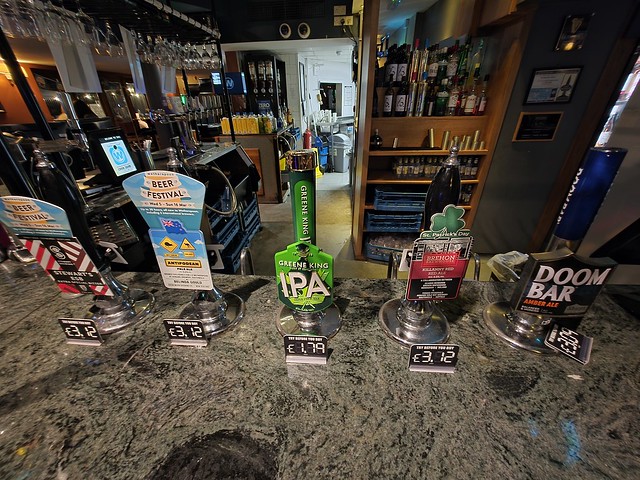
    The real ale options, including a couple from the chain’s real ale festival that is taking place at the moment. The pricing is towards the lower end of the scale for drinks, rivalled only really by Craft Union pubs in terms of national brands. The beer selection is broadly excellent, there are cask ales, craft cans and a couple of interesting keg options.

    20250314_201631

    My quick snack of three chicken based items for £7.49, which seemed a marvellous idea as we hadn’t yet eaten on our walking expedition. The food was served promptly, it was reasonably priced and it met my expectations in terms of the taste, temperature and presentation. The food prices have been sneaking up for some time and this pub is one of the more expensive in the chain. Julian marched through his scampi and curry sauce with some satisfaction.

    The beer is the Killanny Red Ale from Brehon Brewhouse Brewery which was well-kept and had some interesting toffee and caramel flavours going on. I ordered the drink at the bar and I didn’t have to wait for long to be served and they were dealing with customers in turn. The layout of the pub is odd because of its history, there are three segments to the bar and I think the staff prefer serving from the middle but I like ordering at the large section as that’s where their real ales are. There are some historic elements to the venue, including the ability to peer through a little window in the main room upstairs down towards the area where we were sitting, it all adds to the quirkiness of the pub.

    I have always been impressed (as I don’t get out much) that big data can produce some very similar results and nearly every JD Wetherspoon ends up with a rating of between 3.8 and 4.1 on Google Reviews, with this one being at the top of that scale. It is fair to say that I ponder these things for too long perhaps. As it’s a Wetherspoons, I consider it fair game to go through the reviews and merrily repost some.

    “Waited at the bar for ages to be served. Then a gentleman came to the bar and got served straight away. Made a comment about it and got a load of mouth from a bloke behind the bar! If you served your customers in a responsible amount of time you wouldn’t get any comments. Very rude and unprofessional.”

    I love reviews like this as I want to know what the “comment” was, I bet it wasn’t what could be defined as helpful….

    “Awful experience here would not recommend staff were incredibly rude and un-welcoming on arrival. Told the manager we were upset and he told us we wouldnt be getting served anymore because his staff felt ‘uncomfortable’ after we had Confronted them on their rudeness. Which we found bizarre. Disgusting hospitality”

    After we had “confronted them”, I mean, I can’t imagine what has happened there.

    “If i knew that in this pub you have to behave like in a church, i would never go there, the employee who kept shushing us because we were laughing too loud, refused to buy us the next round of beer, he was very rude (he had long bangs combed to the side ) honestly if you want to go there in a group of friends, learn sign language because you will be asked to leave. Waste of time .”

    Good, I bet they were being too loud.

    “Door supervisor was a clown, warned us he’d kick us out for laughing.”

    Marvellous.

    “If I could give it 0 stars I would. Bar staff served our group of 6 two drinks, and decided we’d had too many because we were laughing a lot. Very poor form, would not recommend if you want to stay for more than 1 drink. Idiots running the whole gaff”

    And another win for the pub’s peace and quiet. There’s always a Greene King pub if people want to have a laugh.

    “We got chucked out as a group of people at 21.30 on 9.03.19 ,just because one of us was a little alibriated, we were then ALL tarred with the same brush ,some of us had only just arrived,…..there was a man on the sidelines ,so drunk shouting his head off he was allowed to stay…. Sorry don’t understsnd……we all moved on and had a very nice evening ..”

    Bloody alibriated customers.

    “Can’t believe this place doesn’t allow well behaved dogs ..better behaved than some humans.. I understand not allowed in the pub but surely outside …”

    I see a lot of reviews like this and I’m not sure whether each pub is meant to employ someone who judges what is a well behaved dog and what is a bloody nuisance. I can say that there are quite a lot of annoying dogs in pubs which I suspect the owners think is either cute, tolerable or acceptable.

    “Have to pay on phone app upstairs , will not take cash ? Even though they advertise ” table service ” if you want to pay cash , you have to down stairs where they will take cash . ( Not upstairs ???? )”

    Slightly aspirational in a Wetherspoons to expect to pay cash at the table, but there we go.

    All told, I was happy with this visit and once again, JD Wetherspoon proved to be a reliable operator. They are sometimes rather too maligned in my view, but each to their own of course. As for Julian and I, we will continue to monitor their standards by visiting at off-peak times on a regular basis.

  • Norwich – Compleat Angler (Two Julians)

    Norwich – Compleat Angler (Two Julians)

    20250314_195609

    The fifth pub on our perambulation is the Greene King operated Compleat Angler, located near to Norwich’s main (well, only) railway station.

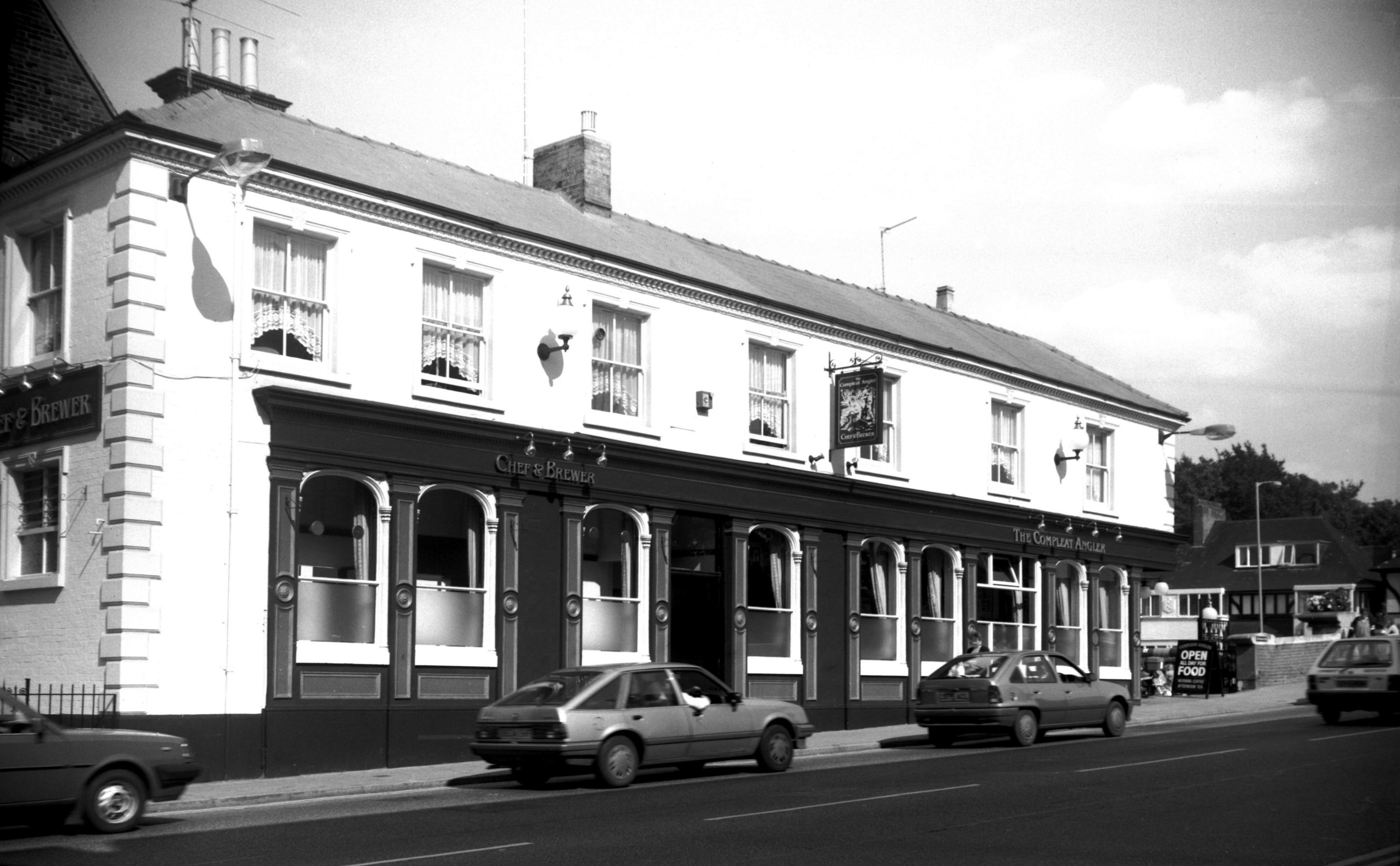
    The building has a complex history, it was built in around the 1840s and was opened as the Norfolk Railway House, but had other names such as the Toll House. It was renamed to be the Compleat Angler in 1974, although it had a brief spell as the Windsors between 1984 and 1988. The pub was originally a Bullards pub and they advertised in the local press in 1853 for someone to take over the lease of the pub. Later on, the venue was taken over by Anglia Taverns before becoming part of Chef & Brewer (George Plunkett took a photo of the building in 1988 when it was a Chef & Brewer pub). Then the years of pubco rapid expansion came and it was taken over by Scottish & Newcastle, then the Spirit Group, then Punch Taverns and then Greene King saw an opportunity to punish the locals and they took over in around 2018.

    The landlord in the 1870s was a man called Robert Rix and he also owned property, something that is known as he was summoned to court for failure to manage a well on his property in Canterbury Place in St. Benedict’s, but he “undertook to remedy the evil” which is handy…. Incidentally, I don’t specifically know why the pub name was chosen, but it relates to a book written by Izaak Walton in 1653. In the post-war period, a portion of the pub was known as the ‘Blue Room’ when it appeared to be more of a club arrangement.

    Here it is in the mid-1880s, although very much surrounded by the distillery and vinegar works. Around two years after this map was published, they replaced the 1844 lattice iron arch bridge which had been built to access the railway station with a new and more substantial structure. This new bridge, which is still there today, is 16 metres long and 15 metres wide and it was constructed in the station yard of Norwich Railway Station and then they rolled it onto the foundations of the older bridge. I’ve been told that the downstairs pub cellar has some evidence of an older structure which faced the road, but I’ve never been down there to have a look.

    20250314_193909

    The entire bar is clean and tidy, although it’s perhaps a little formulaic and lacking in any authentic heritage. This isn’t helped by the numerous massive refurbishments that take place here every few years, although they’ve never really brought the downstairs into full usage and it was closed when we visited. For several years this pub was used as the pub for away football fans, but it reverted to being a pub that home fans could use instead from around 2019.

    20250314_193937

    The food menu and there are a range of traditional pub meals available. In all fairness to the venue, the food reviews seem generally quite positive, so they’re clearly doing something right. However, a customer recently posted a photo of a saucer sized plate of chips:

    “Should be ashamed of themselves. Ordered “House seasoned” fries which cost £3.50. Received at most 10 normal fries with a dusting of salt. If you’re going to charge £3.50 for frozen fries at least give a decent amount.”

    I’m with the customer here having seen the photo, but the pub stood firm in their response:

    “Hello sorry that you weren’t happy with your visit today we unfortunately have a spec that we have to follow with weights of our products will raise this with our head office.”

    The team members here all seemed friendly and helpful, although it’s hard to engage about beer as they don’t really have anything to engage about. I suppose they could chat away about the nearby JD Wetherspoon outlet which sells Greene King IPA and Greene King Abbot, but also has seven guest beers. Anyway, I mustn’t sneer, beer is for the many and not the few. Although I’d personally prefer the many had more choices, I won’t go on and on about it….

    20250314_193121

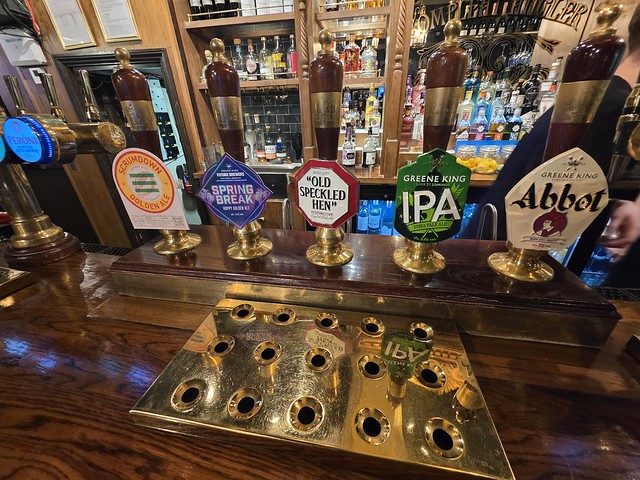
    OK, I might go on about it for a bit longer. Here is the beer choice and I can’t help feeling that the reason Greene King doesn’t offer a guest beer here is because no-one would drink any of the stuff that they brew themselves. Mind you, I’ve always been a bit cynical and Julian does nothing to discourage that. There’s nothing here of any great interest (to me anyway), it’s poorly curated in terms of different beer styles and the prices were towards the higher end of the scale. Other than for a few generic national brands, their ‘craft beer’ selection is stuff they brew themselves and is frankly about as desirable as Christmas in the middle of March. I remember when they did offer guest beers here, but this appears to be a thing of a past judging from the Untappd check-ins over recent months.

    20250314_193423

    I decided that the beer that might be the one I would dislike the least would be the Spring Break from Greene King. It’s arguably a pointless beer (by arguably, I mean I’ll argue that), but I’ll give them that it’s a well-kept pointless beer although it was devoid really of any flavour or depth of taste. It saddens me that some great small brewers are struggling whilst Greene King occupies a beautiful building and sells this.

    There are a couple of negative reviews that the venue doesn’t have a disabled toilet and their defence is that as they’re a listed building they’re not allowed to make the changes. I’m puzzled about this, they’re not a traditionally listed building so they don’t have a Grade I or Grade II listing, but they do indeed have a local city listing. Given that their toilets are at one end of the building which is level and would enable disabled access, is it really the case that the council has refused a planning permission change to make some changes to these toilets? Historic England is generally very favourable to greater disability access in fully listed buildings, so this seems like a situation that the Compleat Anger are being treated a little unfairly if the council are indeed blocking disabled toilets.

    I can’t help thinking what a wonderful pub this could be if Greene King sold it to another operator, although that might be being unkind. Having noted that, Jay Rayner has inspired me to have some semblance of honesty, so there we go. In terms of the positives, it has a prime site, it’s large in size and there are rather lovely river views from their terrace area, but I can’t forget their lack of guest ales and that all of the five beers they have on cask are rated towards the lower end of the scale on Untappd. Anyway, the team members were friendly, the pub was clean, the beer was well-kept and the surroundings were comfortable, but it’s not really a pub that is aimed at me as I like beer. I don’t think that Julian will mind me saying that it’s not really a pub that will be high on his repeat list, but I think in his eyes every pub is aimed at him if I’m being honest.