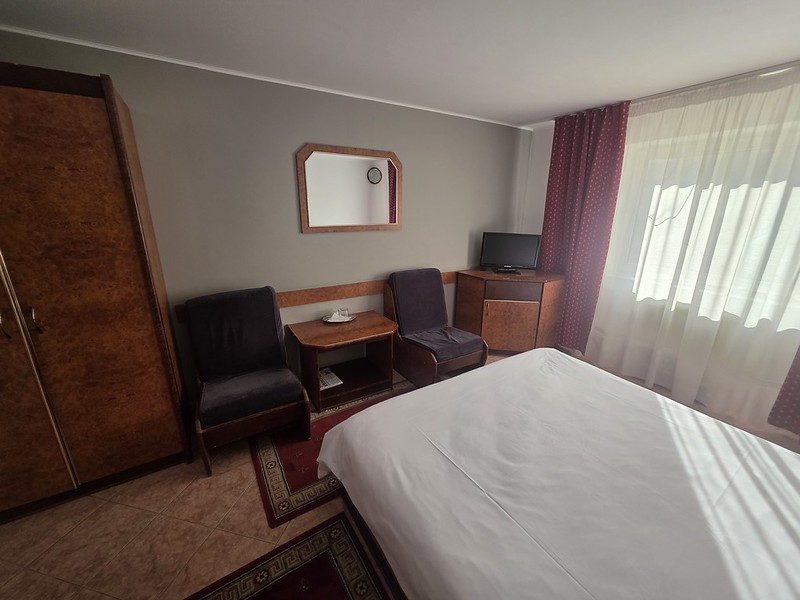
I had spent my first two nights in Timișoara at the Ibis hotel, but I decided to switch to a more thrifty option on my final night as I was leaving it at 02:30 to get a taxi to the hotel. The staff member at the reception desk was friendly and it all felt an efficiently run operation.
This is some retro look, I really rather liked it, although it’s likely looked like this for around three decades. Chunky wooden furniture which I imagine would be a right faff to remove, but it’s all got a certain style and I’ve glad that it’s still here
The room was clean, tidy, warm and in a period of its own. However, for the money, which was just over £20 a night including the hotels.com discount, it represented excellent value for money. The bathroom was basic, but functional, with no noise issues either internally or externally.
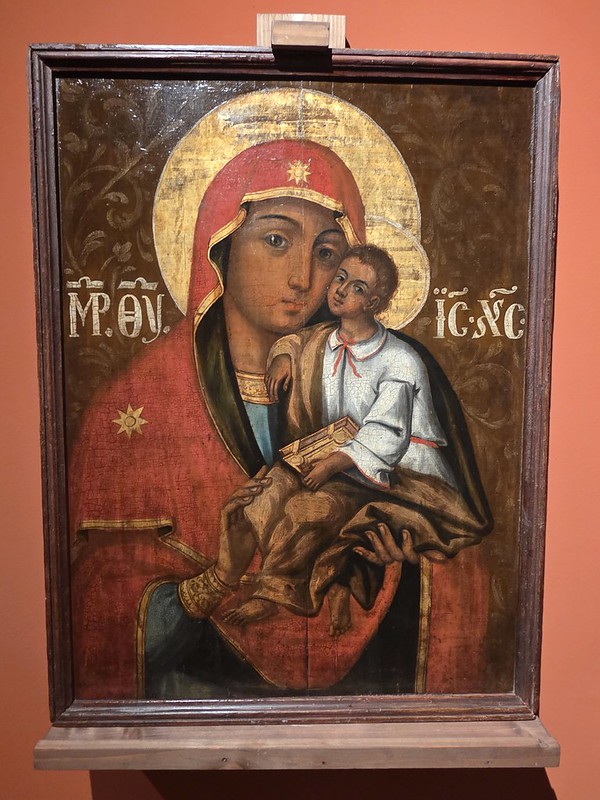
There isn’t any medieval art at the Timișoara Art Museum, but there is a collection of primarily eighteenth century pieces of religious art on display.
This artwork is by Stefan Tenecki, painted with oils directly onto wood. It was originally on display at the wooden church in Hodoș, Timiș County, which was originally constructed in the late eighteenth century.
The church was pretty much falling down by the early 1970s, despite a renovation in the 1920s, and it was moved to Timișoara. This is one of the pieces, dating from around the 1760s, which was moved to the museum.
This style of painting Jesus with an almost adult like face is a Byzantine thing which I think looks quite odd, but it must have suited the church at the time. And I rather like that this artwork was being looked at a rural church over 250 years ago.
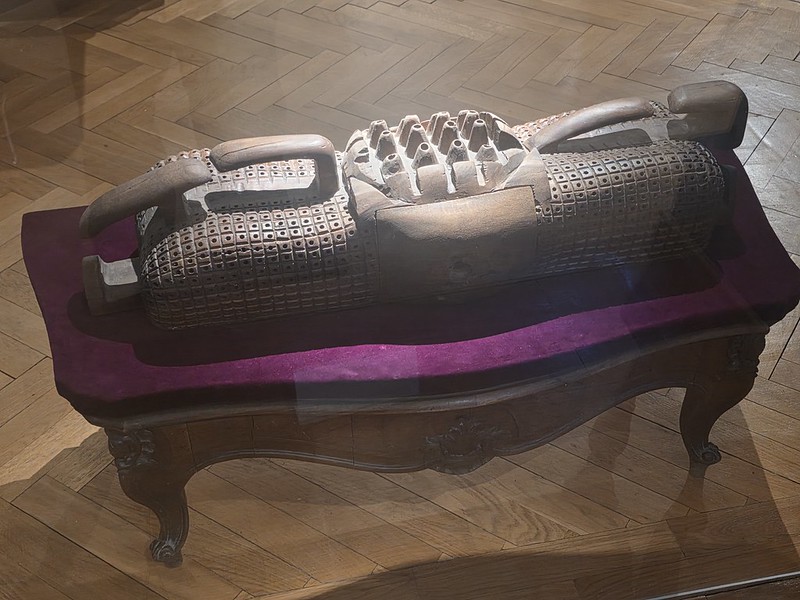
I have no idea what this at the Museum of Art actually is.
Google Gemini suggested that it’s either a Mukoku slit drum or a Chokwe slit drum, where as ChatGPT goes for a communal grinding stool with spikes or a palm oil extraction press component.
All very creative, but I’m not convinced. Answers on a postcard…
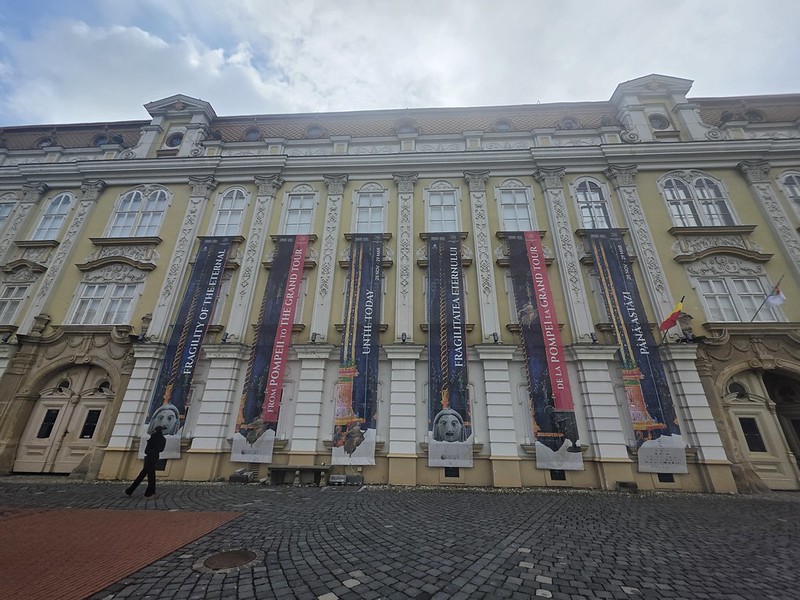
This artwork is by József Ferenczy (1866-1925), an artist who moved to Timișoara in 1901 when it was part of the Austro-Hungarian empire. This was the golden age of the city, grand new buildings were being constructed and it was very much a cultural hub. Ferenczy also brought up his children in the city and it’s also where he died in 1925.
The gallery names the sitter in the artwork as Stefan Bognia, but I can’t find out anything about him, but I assume he has some military role from his appearance. But it’s the theme of this being very much the golden age of the city that appealed to me, the grandeur that is now faded (but is being restored) was very much in evidence back then.
Whoever the man was, this is how AI thinks he would look today in modern clothing.
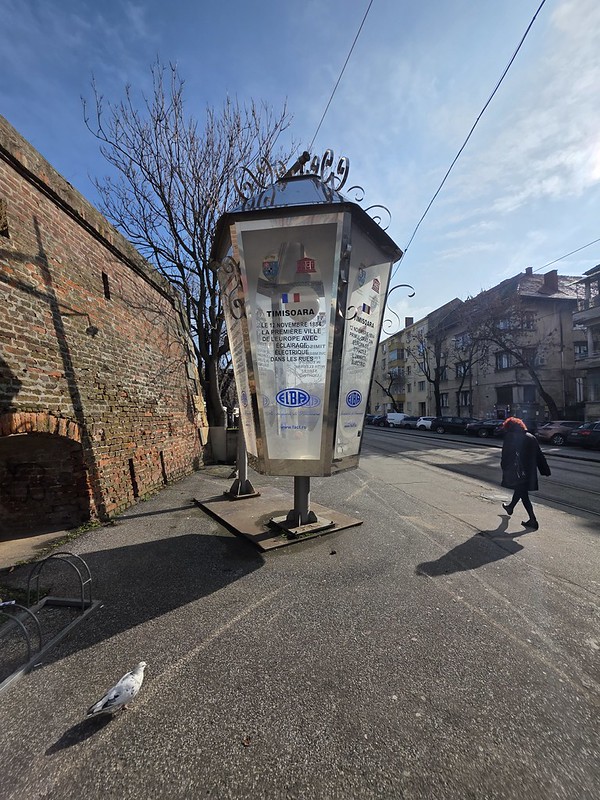
Timișoara are quite proud that they were the first city in Europe with electric street lighting when it was introduced on 12 November 1884. There were over 700 street lamps, so it was all something of an effort.
It’s perhaps in some need of cleaning, but it’s a nice little commemoration of their forward thinking. The reality is slightly more complex though, as it often is, as the city’s gas lighting contract was coming to an end and the company wanted a lot more money. The city wasn’t prepared to sign, but the infrastructure was owned by the gas company and so Timișoara could have been plunged into action if they hadn’t acted…..
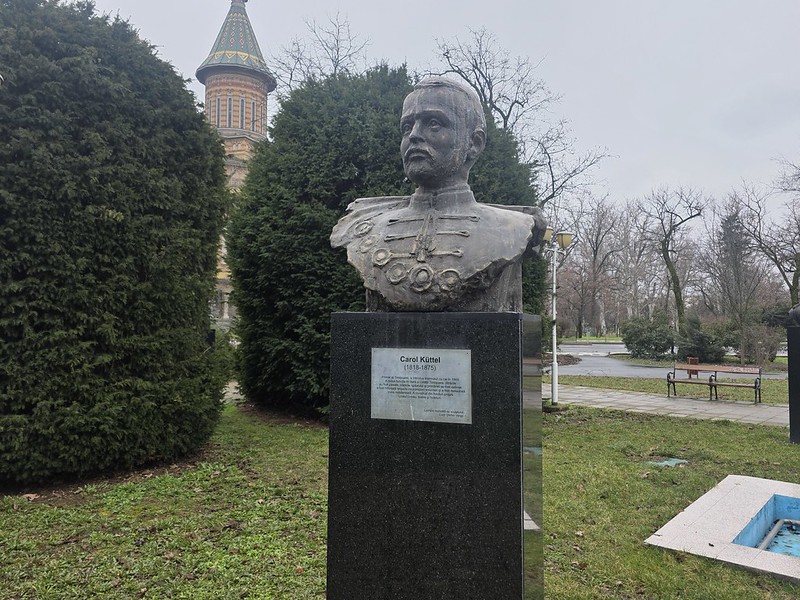
Although with the limitation of history is told by the winners, I like seeing that statues and sculptures there are in a city. It’s always intriguing to see whose memory they want to be remembered. I wonder if Nicolae Ceaușescu ever thought that his statues would stand proud across Romania, or whether he was aware of the inevitably that they would be pulled down.
Anyway, I digress. This is Carol Küttel (1818–1875), often referred to as Karl or Károly, who was a pivotal figure in the urban development of Timișoara, serving as the city’s mayor during two distinct terms from 1859 to 1861 and again from 1867 to 1872. A jurist by training, Küttel is widely celebrated for his role in modernising the city’s infrastructure, most notably for initiating the establishment of the horse-drawn tram system in 1869, making Timișoara one of the first cities in the world to adopt this form of public transport. His administration was also instrumental in the decision to construct the city’s theatre, a move that furthered Timișoara’s reputation as a “Little Vienna” and a cultural hub within the Austro-Hungarian Empire.
This statue of him was unveiled in 1999, but I’m quite focused on his horse-drawn tram escapades. Although this was the first city in what is now Romania to get them, they were only just ahead of the Romanian city of Arad, which isn’t far away at all. It was one of the earliest in the world to have trams and I like the innovators who must have been very much ahead of the game here. And, the city still has trams, unlike those places which got in early and then got rid of them far too early.
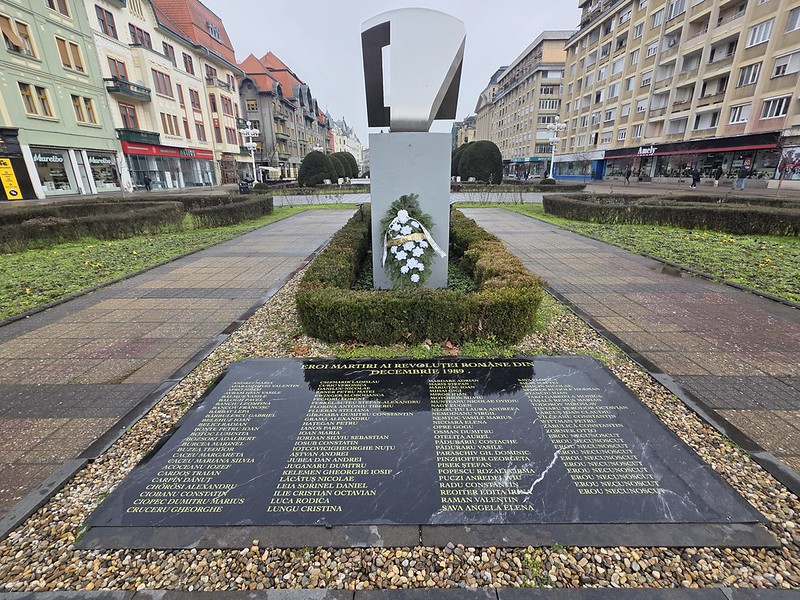
With the city’s cathedral in the background, this is the Crucifixion monument, designed by Paul Neagu.
In front of the monument are names of those who died in the 1989 Romanian Revolution. The revolution began in Timișoara and the city is still very much defined by that today, it is not something that is kept a secret and they seem very proud at being at the forefront of change. And, to stand up to Nicolae Ceaușescu much have taken some considerable bravery and courage.
The Timișoara Orthodox Metropolitan Cathedral, something of a soaring landmark at the edge of Victory Square, stands as one of the most iconic symbols of the city and the wider Banat region. Built between 1936 and 1941, the cathedral was designed by architect Ioan Traianescu in a distinctive Neo-Moldavian style that harmoniously blends Byzantine, Ottoman and late Renaissance elements. Its silhouette is defined by eleven towers, the central spire reaching an impressive height of 90.5 metres, making it one of the tallest religious structures in Romania. The exterior is notable for its vibrant polychrome facades, featuring intricate brickwork in shades of red and orange, complemented by glazed ceramic roof tiles that form traditional Romanian mosaic patterns. Because the cathedral was constructed on marshy ground, it rests upon a massive concrete slab supported by over 1,000 reinforced concrete pillars driven 20 metres deep into the soil.
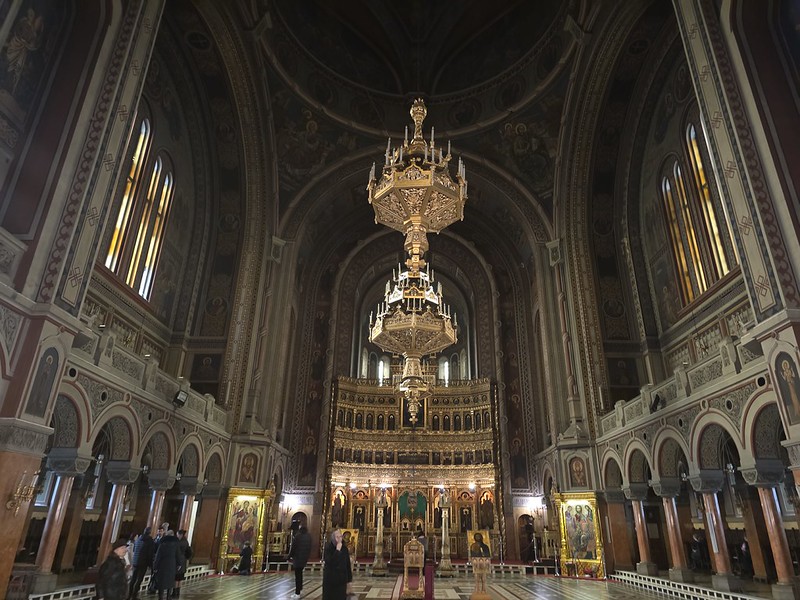
I decided to only take one photograph as this was a place of worship and I was evidently the only tourist, not that anyone looked at me or said anything. This is a deeply impressive cathedral, not because of its decoration or design, but because there was something else going on. There were acts of devotion all around me, but there were also people sitting in the seats to the side reading and thinking, this was a place for true reflection.
The interior of the cathedral is clearly grand, designed to accommodate up to 5,000 worshippers within its expansive, cross-shaped plan, although I’d suggest that this would be somewhat packed. The walls are adorned with elaborate frescoes by the renowned painter Anastase Demian, though the completion of these works was significantly delayed by the onset of the Second World War. The iconostasis is magnificent and was carved and gilded in 22-carat gold by the sculptor Ștefan Gajo. There’s a link between the building and the 1989 Romanian revolution, but more of that in another post.
I accept that the frontage of Bereta’s taproom isn’t the most decadent and awe-inspiring, it’s not the Grand Canyon of entrances, but I’ve been looking forward to visiting here.
The beer selection and there are some decadent little numbers on here.
If I understand correctly, customers can order food into the taproom, but they don’t offer their own food options other than for these crisps.
It was quiet, but it was clean, comfortable and interesting. The team member serving was friendly and helpful, it had an inviting and relaxing vibe to it.
Bereta Brewing emerged from the burgeoning homebrewing scene of Timișoara in 2014, when founders Adrian Biebel and Silviu Dumitru turned a shared hobby into one of Romania’s most influential craft beer projects. Initially operating as cuckoo brewers, utilising the spare capacity of established facilities, the duo quickly gained a reputation for their uncompromising focus on modern, hop-forward styles such as New England IPAs and experimental stouts. Their trajectory changed significantly in 2018 with the opening of their own dedicated brewery in Giarmata, just outside the city, which allowed them to increase production and refine their technical processes. And, this taproom in Timișoara opened last year to expand their reach a little further.
Can decoration.
This is the ‘Ai Pi lei from Bereta, a piney and punchy beer, hop forward with a bit of citrus.
I was just going to go for Bereta beers, but they had a Funky Fluid beer and so that gets prioritisation. The best brewery in Europe can’t be overlooked. This is the Yule Cherry and although I know it’s February, I went for it anyway. Lots of cherries, only very slightly tart, all very reliable from this great Polish brewery.
And finally, I went for Billie’s Special 2025 from Bereta, which was boozy, rich, packed with cherries, it was sweet with chocolate notes and very definitely decadent.
They’ve also got some fridges in a separate room with numerous delights, including a couple of Funky Fluid. I bought a couple of Bereta beers to take away, I’ll report back….. Anyway, this was a rather lovely visit and it’s good to see the taproom of this fine brewery and I’m sure that I’ll be back.
It’s slightly hidden away, but this is the very well reviewed Indian Bistro which is located in the cellar of this grand building. The restaurant is known for making an effort to import ingredients from India and apparently reservations are usually needed at weekends.
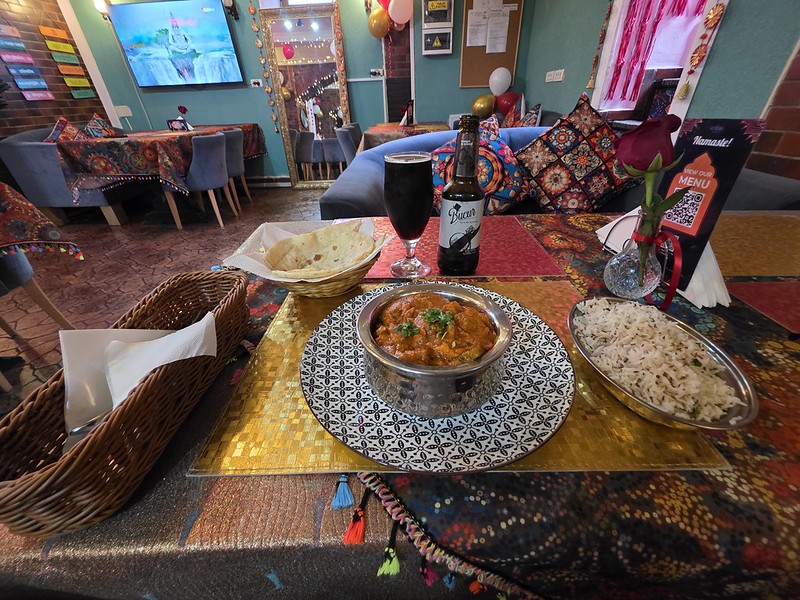
It’s certainly atmospheric with its bright colours and internal decor choices. I’m not a huge fan of sofas for dining purposes, but the tables have a choice of more traditional seating on one side which I opted for rather than going for some ‘choose your own adventure’ arrangement where I would be sitting too low or high for the table. The venue doesn’t have printed menus (or I didn’t see any), but instead uses a QR code for diners to have a look at the food and drink options.
The server spoke English which was rather helpful for ordering purposes and she was friendly and personable. I had read in advance that there was a scale of spice for each dish that was between one, no spice, and five, lots of spice. I opted to go for five, as I’ve been in this situation many times in Europe and the high spice option doesn’t quite meet my hopes. She did look slightly surprised which was initially something of minor concern to me.
That’s the chicken kadai, one of my go to options at the moment, served alongside cumin rice (jeera) and a chapati. All beautifully presented, it looked appetising and appealing, with the portion size being entirely reasonable.
Back to the spice level, this really was ramped up, which surprised and delighted me. Holding no prisoners in terms of the spice, the sauce was flavourful and interesting, with the chicken being tender. The rice was well cooked and the chapati was slightly nutty and complemented the curry arrangement well.
The beer here is the Bucur Bruna, a dark beer with tastes of caramel, coffee and malt. They had quite a choice of beers, not just the riveting excitement of Cobra and Kingfisher which is the limit of many Indian restaurants in the UK.
All really rather lovely, the prices were low by UK standards (around £12 for everything) and the quality was high. This was really rather good and I have positive memories now of a restaurant that isn’t frightened of using spice in food.