Category: Random Posts

  • Dictionary of the Vulgar Tongue – Day 235

    Dictionary of the Vulgar Tongue – Day 235

    The Dictionary of the Vulgar Tongue was first published at the end of the eighteenth century, and given that the current health crisis is giving too much time to read books, I thought I’d pick a daily word from it until I got bored….

    Oil of Stirrup

    The definition of this phrase is more sinister than it might initially appear, with Grose noting that it’s “a dose the cobler gives his wife whenever she is obstropulous”. The word ‘cobler’ is just another, now archaic, spelling of cobbler, or a shoemaker, hence the stirrup reference as that was one of their tools. The word ‘obstreperous’ is lovely in itself, but it means unruly or difficult. So, effectively, this is another phrase for wife beating, although it seems to have come into usage only briefly during the late eighteenth century and had pretty much disappeared again by the early nineteenth century.

  • London – Kensington and Chelsea (Borough of) – EasyGroup

    London – Kensington and Chelsea (Borough of) – EasyGroup

    And another random post….

    The branding from easyGroup is nearly always quite vibrant and they haven’t held back at their London offices in Kensington. I like that their branding is so recognisable, quite an achievement. As an irrelevant aside, I try and avoid anything from easyGroup since they started getting involved with practices such as those mentioned at https://www.pinsentmasons.com/out-law/news/hard-cheese-for-stelios-in-easypizza-case. But each to their own….

  • Dictionary of the Vulgar Tongue – Day 234

    Dictionary of the Vulgar Tongue – Day 234

    The Dictionary of the Vulgar Tongue was first published at the end of the eighteenth century, and given that the current health crisis is giving too much time to read books, I thought I’d pick a daily word from it until I got bored….

    Oil of Barley

    I like this rather lovely little phrase, defined by Grose simply as “strong beer”. The first bit of the phrase, the ‘oil of’ was commonly used in the seventeenth and eighteenth centuries to describe many things, with the barley reference dating to at least as early as the seventeenth century.

    The phrase lingered on in usage until relatively recently, where it sadly finally seems to have gone out of the vernacular.

  • Dictionary of the Vulgar Tongue – Day 233

    Dictionary of the Vulgar Tongue – Day 233

    The Dictionary of the Vulgar Tongue was first published at the end of the eighteenth century, and given that the current health crisis is giving too much time to read books, I thought I’d pick a daily word from it until I got bored….

    Odd-Come-Shortlys

    This is another one of Grose’s definitions that I can’t add much to, but I like the phrase. He defines it as “I’ll do it one of these odd-come-shortly’s; I will do it some time or another”. The first known author to use this phrase was Jonathan Swift in the early eighteenth century, with its meaning just evolving from being one of those odd days which may come shortly where there will be time to do something.

  • Dictionary of the Vulgar Tongue – Day 232

    Dictionary of the Vulgar Tongue – Day 232

    The Dictionary of the Vulgar Tongue was first published at the end of the eighteenth century, and given that the current health crisis is giving too much time to read books, I thought I’d pick a daily word from it until I got bored….

    Oaths

    This is a snapshot of the period, defined by Grose as “the favourite oaths of the thieves of the present day are, ‘God strike me blind!’, ‘I wish my bloody eyes may drop if it is not true!’ ‘So help me God!’ and ‘Bloody end to me’”. The word usage here for ‘oaths’ is an older meaning, which is that meaning a swear word, whereas now it just tends to mean a solemn promise.

    Since the word isn’t used so much in the swearing manner, it has fallen in usage over the last two centuries.

  • Dictionary of the Vulgar Tongue – Day 231

    Dictionary of the Vulgar Tongue – Day 231

    The Dictionary of the Vulgar Tongue was first published at the end of the eighteenth century, and given that the current health crisis is giving too much time to read books, I thought I’d pick a daily word from it until I got bored….

    Nyp, or Nip

    And back to alcohol with this definition, “a half pint, a nip of ale: whence the nipperkin, a small vessel”. As someone who usually drinks half pints (decent craft beer or real ale should ideally have enough taste or flavour to ensure that’s enough to be getting on with, preferably before trying a different one) this is relevant to me as well. Although, today (and my friend Nathan who is more of a beer expert – with a special focus on irrelevant stuff – will likely know) a nip is probably better defined in terms of spirits, or with beer, as a third of a pint.

    Back the nipperkin which Grose mentioned in this definition, Wikipedia says this:

    “The nipperkin is a unit of measurement of volume, equal to one-half of a quarter-gill, one-eighth of a gill, or one thirty-second of an English pint. In other estimations, one nip (an abbreviation that originated in 1796) is either one-third of a pint, or any amount less than or equal to half a pint. A nipperkin is also one-eighth of a pint of beer or any other liquor.”

    Firstly, Wikipedia is wrong (who would have thought….) as the nipperkin dates to at least the early seventeenth century, although it wasn’t in common usage until the early eighteenth century (that 1796 reference is likely to Grose’s book). Secondly, imperial measures really are a bloody nightmare…..

    The word is likely from the German verb ‘nippen’, meaning to sip, with some dictionaries suggesting that the word ‘nipperkin’ entered the English language before the word ‘nip’. I’m not convinced about that…. Either way, it’s clear that the word nip (or nyp) has meant entirely different amounts of liquid over the years. As an experiment, I’d suggest that if someone tried to order a nip at a beer festival, they’d probably be given a taster. At a bar, they might get confused looks, but I doubt they’d get a third of a pint or even half a pint….

  • Dictionary of the Vulgar Tongue – Day 230

    Dictionary of the Vulgar Tongue – Day 230

    The Dictionary of the Vulgar Tongue was first published at the end of the eighteenth century, and given that the current health crisis is giving too much time to read books, I thought I’d pick a daily word from it until I got bored….

    Numms

    This is a practical idea, with the word being defined by Grose as “a sham collar, to be worn over a dirty shirt”. The etymology of the word is unknown, although it was in use from at least the late eighteenth century.

  • Who Said It First in Parliament?

    Who Said It First in Parliament?

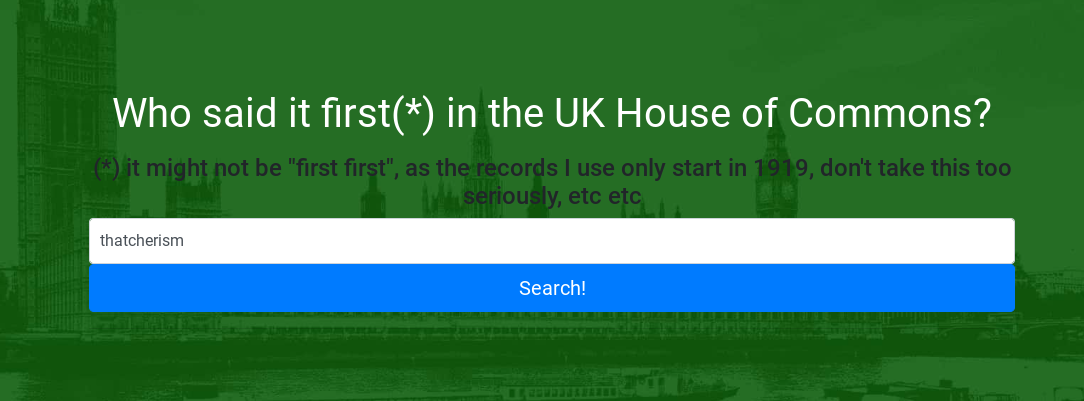
    I like this web-site, you can type in a word and it mentions when it was first used in the House of Commons.

    http://parli-n-grams.puntofisso.net/hansard.php

    It currently still only has data from 1919 onwards, but it’s still intriguing. In the above image, apparently the first time that the word Thatcherism was used was in 1978.

  • Dictionary of the Vulgar Tongue – Day 229

    Dictionary of the Vulgar Tongue – Day 229

    The Dictionary of the Vulgar Tongue was first published at the end of the eighteenth century, and given that the current health crisis is giving too much time to read books, I thought I’d pick a daily word from it until I got bored….

    Numbscull

    This is a word still in use, although more commonly spelled numbskull today, defined by Grose as “a stupid fellow”. The word has been in use since at least the late seventeenth century, a combination of the word ‘numb’ meaning deprived of sensation and ‘skull’ as in, well, skull (OK, word origin here isn’t hard for anyone to work out).

    This interested me from Ngram (clicking on the image makes it larger), the usage of the words numbskull, numskull, numbscull and numscull over the last couple of centuries. What’s likely is that the next generation will spell this word as numskull, that ‘b’ perhaps being permanently lost.

  • Dictionary of the Vulgar Tongue – Day 228

    Dictionary of the Vulgar Tongue – Day 228

    The Dictionary of the Vulgar Tongue was first published at the end of the eighteenth century, and given that the current health crisis is giving too much time to read books, I thought I’d pick a daily word from it until I got bored….

    Numbers

    If nothing else, this definition from Grose shows that politics in the late eighteenth century isn’t perhaps much different to politics today in terms of Ministers not answering questions…. The definition of this word is “to consult the book of numbers: a term used in the House of Commons, when, instead of answering or confuting a pressing argument, the minister calls for a division, ie, puts the matter to the vote.”