Category: Books

  • BOOK REVIEW : Travel Writing 2.0 (Third Edition) by Tim Leffel

    BOOK REVIEW : Travel Writing 2.0 (Third Edition) by Tim Leffel


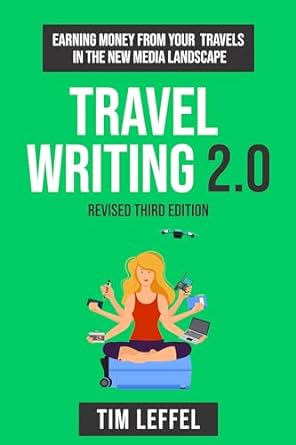
    This is another in my occasional series of book review posts and they might be appearing here more as I’ve just realised you can’t leave reviews on Amazon unless you spend £30 per year on other products. I admire their attempts to make reviews genuine, but it feels a little sub-optimal as I rarely buy anything from Amazon. Anyway, this book is by the travel writer Tim Leffel and I’ve followed him via his newsletters for some years. This is a slightly elongated version of the review that I would have posted on Amazon if I had met their new requirements.

    The present book aside, the best title that I’ve read on travel writing over recent years has been How to be a Travel Writer by Don George. That book perhaps needs a new version in a similar way to this update from Leffel given the ever shifting sands of the topic. The nature of travel writing has changed over recent years, but there are sections in this book on both traditional earnings as a travel writer and digital opportunities for a travel writer. Leffel notes that “the rise of one type of media does not mean the automatic fall of another” and I think that’s a solid way of thinking.

    Travel writing books many years ago would focus on writing articles for magazines and newspapers, as well as how to write guidebooks. Writing guidebooks is a challenging and time-consuming occupation and the comment that “you barely have time to write full sentences before moving on to the requisite restaurant listings and museum hours” is evident from any Lonely Planet or Rough Guide book. Leffel’s comment that many young travellers use their phone to source material and don’t go near guidebooks seems accurate as I can’t recall the last time I saw anyone in Europe or the United States under the age of around 40 looking at them. The market will continue to evolve, certainly the way in which travellers source their curated information on an area.

    The key element here, which I think is standard advice from all travel writers I’ve noted over the years, is to have a diverse portfolio of different income streams. Without that there will be inevitable highs and lows which make cash flow planning nigh on impossible without another way of earning money. The book is a useful exercise for those who are wondering what potential there is from entering the travel writing market, but the positive element is that there are low barriers to entry for anyone who wants to.

    In terms of writing style, the author stresses the importance of always being curious, noting:

    “If you are a closed-minded, dogmatic person who only gets news from one source, doesn’t have a passport, and never reads quality fiction, you are going to be a lousy travel writer.”

    I don’t claim to be a travel writer, although I have done some of it in numerous different ways over the years, but I’d agree that poor writing is often apparent. The author writes that some skills are innate and some are learned, but travel writing is certainly something that needs curiosity, practice and a lot of reading. Finding a tone of voice is inevitably important and Leffel preaches the need “to be authentic” in writing.

    All authors should perhaps consider getting their own blog, but this book suggests that it isn’t for everyone and it does potentially take up a lot of time. For some writers, the time and energy won’t be justified, but for others it is a useful marketing tool. I started this blog to primarily remember where I’d been, which I accept isn’t necessarily the inspirational back story some might like, but between my two loyal readers and myself I’ve been able to get numerous paid projects because of it. The pros and cons of having a blog are examined by Leffel, it’s certainly something to consider.

    There’s also practical advice relating to search engine optimisation, social media and networking. There’s also advice on things to definitely not do if new to the trade, alongside the importance of having a good work ethic. Most importantly, Leffel notes that it’s important to develop a thick skin for the inevitable rejections that will come. The advice on travelling in a frugal manner is also wise, I’ve managed to do that for years and I’ve always thought that this makes travel more authentic rather than taking away from the experience. When British Airways paid for me to travel in First and Club World I always had very different stories to tell than when in World Traveller, with most of my interactions during my five weeks in the United States last year being on public transport. There’s nearly always an angle, but the engagement with others plays a big part in telling any story.

    The author addresses very early on in the book the matter of income potential. Realism is important here, as most travel writers don’t earn that much from their profession, although there are some who do very well indeed. But, this is partly because some are hobbyists or just writing part-time, writing because they enjoy travelling and find that it makes their trips more affordable. For those who want to get into travel writing, this is certainly a good first book to read, particularly in conjunction with Don George’s book.

    You can buy the book by clicking on the Amazon image at the top of this post or directly at https://travelwriting2.com/get-the-book/.
  • Dictionary of the Vulgar Tongue – Day 302, 303 and 304

    Dictionary of the Vulgar Tongue – Day 302, 303 and 304

    Scull Thatcher

    One of the slightly more jovial definitions in Grose’s book, this means “a peruke maker”, with a peruke being a wig.

    As an aside, the word peruke itself has rather fallen out of usage over time. Specifically, a peruke wig is the one worn by barristers and judges in British courts, although at the time of Grose they were quite a common fashion accessory amongst the well-to-do. I’m not sure that this was a much used phrase though, it doesn’t appear to have been used often in print.

    Scum

    I thought it was interesting that this definition is an old one, not anything more recent, and it’s “the riff-raff, tag-rag, and bob-tail, or lowest order of people.” In its other meaning of the dirty layer on liquid, it’s from the Germanic word ‘Schaúm’, which still means ‘foam’ in English.

    Sea Lawyer

    It’s a long time since I’ve heard this phrase, which Grose defines as “a shark”. I know it more in the sense of it being an argumentative person, but it also means a sailor who refuses to follow an order, although that usage seems to be more from the late nineteenth century. It’s a quirky little phrase though, I like the idea of being able to refer to someone as a sea lawyer without them realising its full meaning….


    Any excuse for me to roll out Ngram….. However, it shows the phrase is sadly fading out of usage.

  • Dictionary of the Vulgar Tongue – Day 299, 300 and 301

    Dictionary of the Vulgar Tongue – Day 299, 300 and 301

    Scald Miserables

    Grose’s dictionary refers to this as “a set of mock masons, who in 1744 made a ludicrous procession in ridicule of the Freemasons”.

    © The Trustees of the British Museum

    As this print from 1742 shows, this procession had been going on for a few years and it took place just outside of the boundaries of the City of London. I can’t imagine that the Freemasons were much impressed by this little show, but there were many even at this time who treated the organisation with some disrespect.

    Schism Shop

    On the subject of disrespect, those involved with the dissenting religions in the eighteenth century were often vilified by those who couldn’t believe anyone couldn’t accept everything that the Church of England said was true. The dictionary definition of this is “a dissenting meeting house”, whether that be Quakers, Baptists, Congregationalists or Unitarians, to name just a few. There’s something quite charming though in the abusive term, I like to think that some of the groups would have adopted it almost as a badge of pride. Looking at newspaper archives, the dictionary was ahead of its time, as the term was relatively rare at the end of the eighteenth century, but it became much more commonly used towards the end of the nineteenth century before it died out during the early twentieth century.

    Scourers

    There’s a myth that there used to be a lot more respect for the law in centuries gone by, but there were plenty of robberies in churches in the nineteenth century and no shortage of anti-social behaviour in the eighteenth and nineteenth centuries. That is also evident from this dictionary definition, namely “Riotous bucks, who amuse themselves with breaking windows, beating the watch, and assaulting every person they meet: called scouring the streets”. Crime as a whole was also high in the eighteenth century, partly through increased poverty but also through a greater opportunity given the newly wealthy classes. Much as I like city living, I think the rural life was probably safer and more peaceful back in the late eighteenth century when Grose wrote his book.

  • Dictionary of the Vulgar Tongue – Day 296, 297 and 298

    Dictionary of the Vulgar Tongue – Day 296, 297 and 298

    During lockdown, I started on my riveting (ahem) series of posts from the Dictionary of the Vulgar Tongue. I was getting quite near to the end of the book, but then I managed to stop in February 2021 (having got to Rum Bubber), but now this is another project I want to see completed.

    Saint Geoffrey’s Day

    The dictionary defines this as “Never, there being no saint of that name: tomorrow-come-never, when two Sundays come together”. Arguably, there is a St Geoffrey, also known as St Godfrey, although that’s a slightly moot point here. This phrase was in use in the late eighteenth century, perhaps slightly into the early nineteenth century, and is another sad loss to the language. I think it’s got a nicer and more humorous edge to it than “a month of Sundays” which is the modern equivalent.

    Sandwich

    There’s very little interest to this definition itself, which is “Ham, dried tongue, or some other salted meat, cut thin and put between two slices of bread and butter: said to be a favourite morsel with the Earl of Sandwich”, other than the timing. This book was published in the late eighteenth century, so this would have been quite an on-trend word at the time that was just coming into popular usage.

    This image is from Google Ngram and shows how frequently the word has been used in books. It slightly surprises me just how relatively rare the word was until the beginning of the twentieth century.

    Scab

    One word that I personally don’t like is the word ‘scab’ when applied to those who don’t take part in a strike, and I’ve read that some in the trade union movement find it an unfortunate word which exists more as a quirk of history. That is reinforced by this definition, which is “a worthless man or woman”, which seems to have first been used to describe non-strikers in the United States in the early nineteenth century. Google Ngram shows that it has been falling in usage over recent decades and I can imagine that it might be a word that eventually slides away in terms of its strike meaning.

  • Good Beer Guide 2022

    Good Beer Guide 2022

    The Good Beer Guide 2022 edition is now out and the CAMRA app has been updated, so I can see which of my favourite pubs have made a reappearance. My delight is mostly reserved to see that the brilliant Hop and Vine is back in, although I’d have refused to have acknowledged that the book even existed if it hadn’t….. (I admit to copying much of this text from last year, but I did check the Hop & Vine first!)

    Here’s the list of Good Beer Guide pubs that I’ve visited….

    Anyway, the new copy is available at https://amzn.to/3269OCx:

  • Dictionary of the Vulgar Tongue – Day 293, 294 and 295

    Dictionary of the Vulgar Tongue – Day 293, 294 and 295

    The Dictionary of the Vulgar Tongue was first published at the end of the eighteenth century, and given that the current health crisis is giving too much time to read books, I thought I’d pick a daily word from it until I got bored…. And to catch up after getting behind with these posts, and because I’m getting towards the end of the book, I’m doing three days at once now. How lovely….


    Rot Gut

    I like the drinking definitions that Grose comes up with, this one is “small beer; called beer-a-bumble – will burst one’s guts before it will make one tumble”. The phrase has been used since at least the late sixteenth century and initially was made with reference to beer, but it later evolved into also meaning wine, whisky and anything vaguely alcoholic. The phrase was also used during the Prohibition period in the United States, where it’s fair to say that the standards of alcoholic drinks fell somewhat.

    The Google Ngram of how “rotgut” and “rot gut” have been used over the last century, having become more commonly used in recent decades.


    Round Robin

    This is another phrase that I hadn’t realised had such a long etymological heritage, being defined by Grose as “a mode of signing remonstrances practised by sailors on board the king’s ships, wherein their names are written in a circle, so that it cannot be discovered who first signed it, or was, in other words, the ringleader”.

    The phrase was in use from as early as the middle of the sixteenth century, but the word origins are lost. There’s a theory, which seems to be the most common, that it derives from the French “ruban rond”, when petitions were allegedly signed on a round ribbon. That suggestion doesn’t seem to be very likely to me and it’s also the wrong way round. There is though an interesting blog post about an example of one of these round robins from 1760.

    A newspaper article from 1730 about an example of a round robin in use, not entirely successfully on this occasion. There’s a reference to a round piece of paper and I wonder whether the origin of this phrase is just ’round’ because it’s a petition that needs to be presented in that way to give anonymity and ‘robin’ as that’s sort of the shape of the bird.

    Today, the phrase is more commonly used with regards to sports tournaments and Christmas cards……


    Rum Bubber

    And back to the licensed trade, Grose defined this as “a dexterous fellow at stealing silver tankards from inns and taverns”. Customers stealing glasses from pubs can by annoying today for the management, although at least they aren’t as expensive to replace as silver tankards. The word ‘bubber’ is from the seventeenth century and originally meant a drinking bowl and which evolved into a word used to describe anyone who stole plate. This is also one of the definitions that Grose has just lifted out of Nathan Bailey’s “Universal Etymological English Dictionary” which was published in 1721.

  • Dictionary of the Vulgar Tongue – Day 290, 291 and 292

    Dictionary of the Vulgar Tongue – Day 290, 291 and 292

    The Dictionary of the Vulgar Tongue was first published at the end of the eighteenth century, and given that the current health crisis is giving too much time to read books, I thought I’d pick a daily word from it until I got bored…. And to catch up after getting behind with these posts, and because I’m getting towards the end of the book, I’m doing three days at once now. How lovely….

    Rigmarole

    This is defined by Grose as “roundabout, nonsensical. He told a long rigmarole story”, and it was a phrase that would have been new at the time as its earliest recorded usage is from the middle of the eighteenth century. Oxford Languages Dictionary gives an explanation of the origins of the word, which is “apparently an alteration of ragman roll, originally denoting a legal document recording a list of offences.

    Google Ngram helpfully charts the popularity of the word over the last couple of centuries, it’s perhaps a strange word that has persisted in usage as it’s not necessarily easy to spell. In around 1880, the alternative spelling of rigamarole comes into usage, which remains relatively common today.


    Roast and Boiled

    Back to the military with this definition, which Grose gives as “a nick name for the Life Guards, who are mostly substantial house-keepers; and eat daily of roast and boiled”. The Life Guards are a regiment in the British Army and their heritage goes back to the middle of the seventeenth century. This web-site has details of other nicknames that the regiment managed to acquire, which included The Bangers, Lumpers, The Cheesemongers, The Fly-slicers, The Piccadilly Butchers, The Ticky Tins, The Tin Bellies and The Patent Safeties. That’s quite an impressive list of nicknames that they’ve secured for themselves….


    Romeville

    A short and concise definition here, simply given as “London, cant”, with cant meaning the criminal community. This sounds all rather exotic, but there’s an alternative version from the eighteenth century which is “Rumville”, although ‘Rum’ here means good. Although there are different spellings, the meaning was the same, which was the canting community felt that London was a city of great opportunity to them. The word fell out of usage in around the 1850s, although New York then took on the same nickname. I think I quite like the idea of London being referred to as ‘Rumville’ though…..

  • Dictionary of the Vulgar Tongue – Day 287, 288 and 289

    Dictionary of the Vulgar Tongue – Day 287, 288 and 289

    The Dictionary of the Vulgar Tongue was first published at the end of the eighteenth century, and given that the current health crisis is giving too much time to read books, I thought I’d pick a daily word from it until I got bored…. And to catch up after getting behind with these posts, and because I’m getting towards the end of the book, I’m doing three days at once now. How lovely….


    Reverence

    I feel that I can add nearly nothing to this definition from Grose:

    “An ancient custom, which obliges any person easing himself near the highway or footpath, on the word Reverence being given him by a passenger, to take off his hat with his teeth, and without moving from his station to throw it over his head, by which it frequently falls into the excrement; this was considered as a punishment for the breach of delicacy. A person refusing to obey this law, might be pushed backwards. Hence, perhaps, the term Sir-Reverence.”

    The ‘Sir-Reverence’ lingered on in the English language, meant as an apology in advance for what someone was about to do or say. That’s all that needs writing here….


    Rhino

    Nice and simple definition this time, especially given Grose’s meanderings with the above, simply meaning “money” and it was used by the canting, or criminal, fraternity. This word has been used since the early sixteenth century as a slang for money and no-one is quite sure where it originated from. It might be that rhino horn was expensive, it might be that rhino was seen as an bulky and expensive thing (and the rhino would have been a relatively new concept for westerners at the time) or it could be from the Greek meaning of the word rhinoceros, which is “relating to the nose” as someone paying through the nose (another old phrase). And Green’s Dictionary of Slang adds another possibility to the mix, which is “clipping of SE sovereign; the term moved f. Und. to general slang, in mid-19th century”. So, in short, no-one knows, and this meaning of the word became archaic in around the late nineteenth century.


    Riff Raff

    I use this phrase from time to time (I won’t name the friends I have in mind), defined by Grose as “low vulgar persons, mob, tag-rag and bob-tail” and it hasn’t much changed its meaning since the dictionary was published in the late eighteenth century. The phrase is from the late fifteenth century, it’s a corruption of the old French “rif et raf” meaning “one and all”, so there’s some heritage to this.

    Although there’s a long history to this phrase, it’s only recently that it has become more commonly used. I suspect that some of this is related to the Rocky Horror (Picture) Show from the 1970s onwards, where Riff Raff is one of the characters.

  • Dictionary of the Vulgar Tongue – Day 284, 285 and 286

    Dictionary of the Vulgar Tongue – Day 284, 285 and 286

    The Dictionary of the Vulgar Tongue was first published at the end of the eighteenth century, and given that the current health crisis is giving too much time to read books, I thought I’d pick a daily word from it until I got bored…. And to catch up after getting behind with these posts, and because I’m getting towards the end of the book, I’m doing three days at once now. How lovely….


    Red Lattice

    One of Grose’s more concise definitions, simply “a public house”. This phrase was in usage from the sixteenth century until around the mid nineteenth century and it’s a descriptive term, as many pubs used to have red latticework at their frontage. There are no pubs today with this as their name, although Greens Dictionary of Slang notes that there was one at Butcher’s Row, located off of the Strand in London.

    Google Ngram shows how the phrase fell out of usage, likely perhaps as pubs stopped have such red latticework and it all became less relevant.


    Red Letter Day

    Grose refers to this as “a saint’s day or holiday, marked in the calendars with red letters. Red letter men: Roman Catholics: from their observation of the saint days marked in red letters”. Although this practice has been happening since Roman times, the common usage has likely evolved from the late medieval religious manuscripts, with the phrase being used since at least the seventeenth century. The Wikipedia page on this subject also has a list of the days of the year when judges of the English High Court wear their scarlet robes, a concept that I hadn’t been aware of.

    Despite a company being founded recently with the same name which got some media publicity for various reasons, Google Ngram suggests that the phrase was much more commonly used in the early twentieth century.


    Remember Parson Melham

    It’d be remiss of me not to mention something that Grose writes about Norfolk and his definition is “drink about: a Norfolk phrase”. Not that I can add much to it or establish who Parson Melham was, although ‘drink about’ just means to be rather drunk. A letter was written to the Illustrated London News in February 1857 asking for the origins of Grose’s definition, but it doesn’t seem that anyone was able to respond. Whoever this Parson Melham was though, he sounds an interesting character.

  • Dictionary of the Vulgar Tongue – Day 281, 282 and 283

    Dictionary of the Vulgar Tongue – Day 281, 282 and 283

    The Dictionary of the Vulgar Tongue was first published at the end of the eighteenth century, and given that the current health crisis is giving too much time to read books, I thought I’d pick a daily word from it until I got bored…. And to catch up after getting behind with these posts, and because I’m getting towards the end of the book, I’m doing three days at once now. How lovely….


    Ralph Spooner

    Annoyingly, I can’t find out anything more about this, simply defined by Grose as “a fool”. I’m not convinced that this phrase was much in usage, and he likely just took it from Nathan Bailey’s 1736 canting dictionary. The word ‘spoon’ was used in the eighteenth and nineteenth centuries to describe someone as a fool, although I’m not sure what they had against Ralph….


    Rank

    This is defined by Grose as “stinking, rammish, ill-flavoured; also strong, great. A rank knave; a rank coward: perhaps the latter may allude to an ill savour caused by fear”. On the second part of that definition, the phrase “rank coward” is still in usage, but its original meaning of being a stinking coward is perhaps forgotten.

    Back to the main part of the definition, what might be the most interesting element of this is that the word remains in use today. I suspect that at least a few people hearing a younger person use the phrase “that’s rank” might query their use of English, but it has had this meaning of something disgusting since around the late seventeenth century.

    It’s derived from the old English word ‘ranc’, meaning something strong or powerful. That changed over time to something that was strong and unpleasant, with the alternate spelling ‘ranck’ being more common for a period.


    Reader Merchants

    And here we perhaps verge into some slight anti-semitism, this being defined as “pickpockets, chiefly young Jews, who play about the Bank to steal the pocket-books of persons who have just received their dividends there”. A pocket-book is a wallet, and a reader was also another word for a wallet, hence the origin of the phrase. There was another similar phrase at the time, ‘reader hunter’, which meant the same thing.