Category: Railways

  • Railway Times – National Importance of Railways (1837)

    Railway Times – National Importance of Railways (1837)

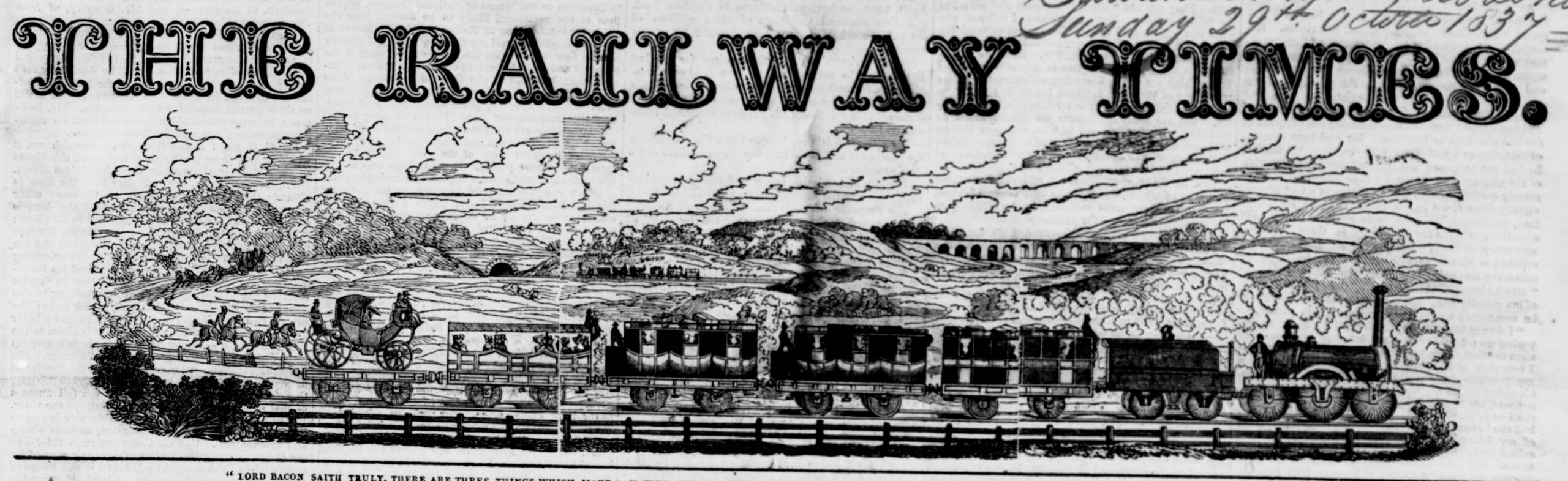
    Back to the Railway Times (I like to mix things up on this ‘riveting’ blog….) and this is an article that they’ve republished from the Wilts and Gloucestershire Standard of November 1837.

    I rather like that it summarises the debate of this exciting new form of transport which was still not winning everyone over. The article title was “The Importance of the Railways” and they still referred to the rail project as a “great experiment” which isn’t an unreasonable summary of the arrangement at the time.

    As an aside, I like the use of the word “ebriety”, which I rarely see used now, it just means drunk although the word sobriety has continued in use. And there’s another interesting use of the word “characterizing” with a ‘z’ which was the frequently used spelling of the time before we’ve diverged off to prioritise our ‘s’ usage….

    Most of all, it captures a snapshot of British life at the time, changing quickly and just as the population is getting used to the industrial revolution. It’s not just us today who live in interesting times.

    “We beg to direct the attention of our readers to the subject of Railroads, as one destined, ere long, to produce a considerable revolution in the internal economy of this country. Some months ago the public mind was in such a ferment on this subject, and John Bull was so running riot, as he is wont to do on any matter affording scope for speculation, that the attempt to get at any sound notions, or information that could be depended upon, seemed hopeless. Now that this ebriety seems to have produced a complete lethargy, there is a chance of obtaining facts that may be relied on, and of arriving at just deductions from them.

    This has become a subject of great national importance, as regards the commercial and manufacturing interests of the country. We have, hitherto, maintained a preference in the foreign markets by the comparative excellence and cheapness of our manufactures. It must be borne in mind that carriage, both of the raw material, and of the manufactured article, is, in many cases, a very important item in the cost of the latter, and that if we allow foreign countries to get the start of us, in modes of conveyance which very materially diminish expense, we shall give them a very serious advantage. It is not perhaps generally known what is going on in this way on the continents of Europe and America. In France, the following lines have been undertaken, some by the government and others by public companies: From Paris to Havre, by Rouen, 55 leagues; from Paris to Calais, 53 leagues; from Paris to Lisle, 53 leagues; from Paris to Lyons and Marseilles, 219 leagues; from Paris to Strasburg, 116 leagues; and from Paris to Bordeaux, 154 leagues. These communications are again carrying on from the Belgian frontier, as appears by the report of M. Nothcomb, the minister of public works, wherein it is stated that the Government has taken in hand an extent of 115 leagues; that the works were commenced in March, 1834, and have continued in progress, and that three sections are already open to the public. These traverse the country from the borders of France to those of Prussia. The Prussian government has fixed a line with various branches from the Belgian Railways by Aix-la-Chapelle to Cologne. In America there are upwards of 1500 miles of Railways completed, and 3000 miles reported to be in various stages of progress.

    It is difficult to foresee the effect these wondrous means of communication will produce upon the value of property within their influence, upon the conveyance of commodities in different districts; on the localities of markets, and the modes of dealing, and even on the habits and manners of the people, by the great extension of intercourse which will necessarily result.

    Though we are at present hardly justified in characterizing this bold and novel mode of conveyance, otherwise than as a great experiment, sufficient has been practically achieved, in particular cases, to render it morally certain that Railways will very soon entirely supersede the existing means of travelling, on all the great thoroughfares of the kingdom. It has been clearly established in practice, that, on a well-appointed Railroad, passengers can be conveyed in one-third of the time at two-thirds of the cost, with greater punctuality, with infinitely greater safety, and with much less fatigue than by the best appointed coaches now in use, excellent as they have become.

    The general establishment of Railways, therefore, throughout the kingdom, is as certain as the return of the seasons. In this great commercial and manufacturing country, in which 9-10ths of the population are busily occupied a great proportion of the 24 hours, economy of time is of more consequence than economy of money; and the public will never submit to any system of transit, while another can be devised at once saving of time and money. Experience has shown us, that if coaches between two places, say 100 miles distant, have performed the journey in 12 hours, and a new coach starts and performs the same journey in eleven hours, the former must quicken their speed, or they will be driven off the road. The same result happens, if one coach conveys passengers for a few shillings less fare than those previously established. It having been demonstrated that the means exist of conveying passengers the 100 miles in four hours, at two-thirds of the cost, and with much less bodily fatigue, no man can doubt that the public will yield them.

    Railways are so expensive in their construction, that they cannot be multiplied like ordinary roads. Their course and position, therefore, become a matter of the deepest interest to all persons of property, or who are engaged in trade, commerce, or manufacture, as there can be no question, but that the districts traversed by these lines, or in close communication with them, will derive advantages which will greatly enhance the value of property, as compared with that which is more remote. We entertain no doubt that, ere long, in advertisements for the sale of property, the advantage most prominently put forth will be, that it is within a certain distance of this or that Railway. It behoves, therefore, all those interested in any particular district, to bear an eye in time to this subject, and not allow their more foresighted neighbours to steal a march upon them.”

  • Railway Times – London to Birmingham Line Reaches Tring

    Railway Times – London to Birmingham Line Reaches Tring

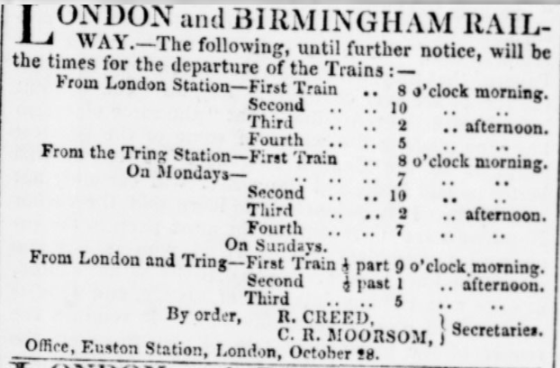
    As I’m still reading through the Railway Times (I’ve reached the second issue now), this is from November 1837 and the London & Birmingham Railway has now managed to reach Tring. Although the railway station wasn’t built that near to Tring, the excited local population funded part of a new road to make it more accessible to residents.

    They reached Tring on 16 October 1837 and it would be on 17 September 1838 that the full line between London Euston and Birmingham was opened. The glorious station and the Euston Arch were constructed in 1837, but the disaster that was the nationalised British Rail pulled it all down in the 1960s. But, that’s a different story.

    Reading the Railway Times it’s evident just how exciting the advent of the new rail era actually was, the country was opening up and there were all manner of opportunities ahead. I was going to note that I’ve never been to Tring, but I’ve remembered that we walked through it when walking the Ridgeway a few years ago.

  • Railway Times – Red Rover Stagecoach

    Railway Times – Red Rover Stagecoach

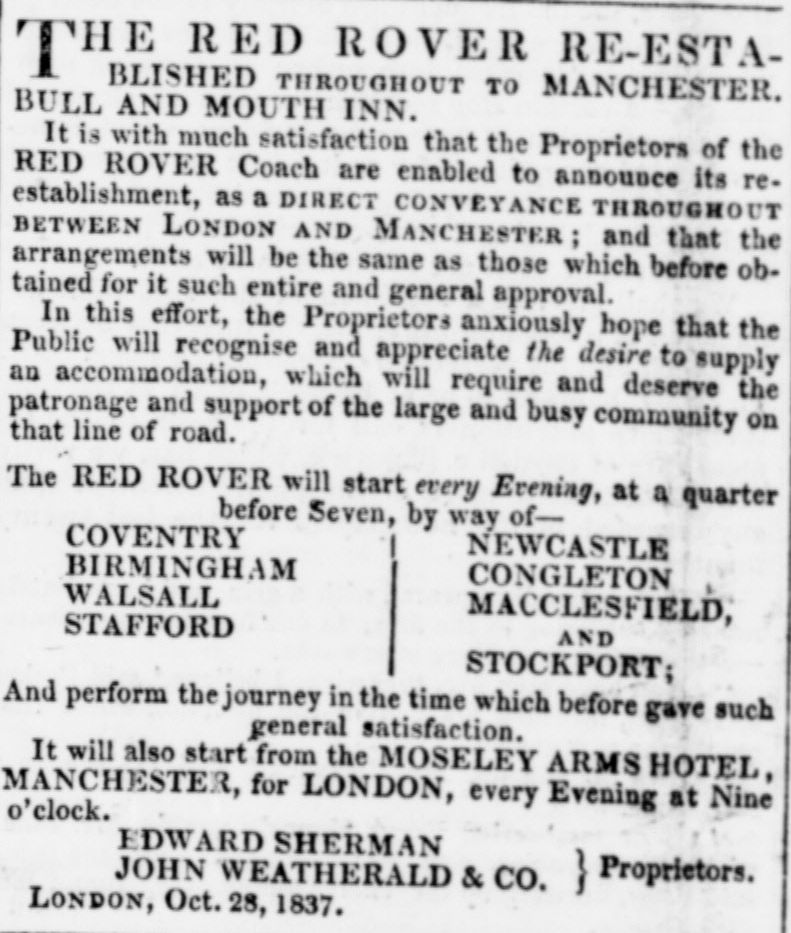
    This advert in the Railway Times in 1837 is the turning point for long-distance transportation in the country. The Red Rover stagecoach route from London to Manchester was being re-established, but the sands of time weren’t in the favour of the service. The Red Rover service had been quite decadent, the drivers were well-paid and wore smart red hats and they were fined if their service was delayed (making them slightly less well-paid).

    This stagecoach website mentions:

    “LONDON – MANCHESTER. ‘THE RED ROVER’
    London (Bull & Mouth, St Martins-le-Grand), Barnet, St Albans, Dunstable, Fenny Stratford, Stony Stratford, Towcester, Daventry, Coventry, Birmingham, Lichfield, Rugeley, Stafford, Stone, Newcastle-under- Lyme, Congleton, Wilmslow, Manchester
    – Distance 187 miles. Journey time 20 hours
    – Depart London at 8.30amManchester at 8.00am
    – 4 seats inside, 8 outside
    – Operator E Sherman & Co Numbers 3448, 3493″

    On 17 September 1838, the rail service between London and Birmingham opened and the service between Manchester and Birmingham had already opened in 1837. The stagecoach services didn’t last much after this, most of the London services had ceased by the early 1840s.

  • Railway Times – 1837 Plans for Line Between England and Scotland

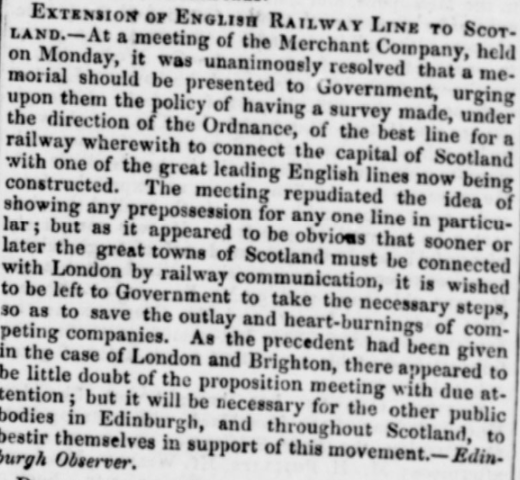
    Railway Times – 1837 Plans for Line Between England and Scotland

    Since I’m now obsessed with this new archive, something that I hadn’t given much thought about is how in 1837 they were starting to wonder how they were going to connect England and Scotland by rail.

    The businesses in Scotland were quite exercised by this, the opportunity for new trading opportunities started to become available and the initial thought was that this was all so complex and expensive that there would only be one line needed.

    The very first comprehensive rail link between the English and Scottish networks wasn’t created until 1846 by the North British Railway, which opened its line from Edinburgh down to Berwick-upon-Tweed. This route connected the Scottish capital to the burgeoning English railway system, although it was not a continuous track journey into London initially, as it involved two “water breaks” which were crossings of the River Tweed at Berwick and the River Tyne at Newcastle, which necessitated road or ferry transfers. Only later, when bridges were built, did passengers finally get to stay comfortably aboard without the indignity of a ferry detour. It also transpired that the North British Railway made more of their money from transporting minerals around the place than they did from their passenger services.

    A fully continuous, uninterrupted railway line between the two capitals for the first time came shortly after with the opening of the Caledonian Railway’s (and they were the big rivals of North British Railway with absolutely no love lost there at all) main line between Glasgow and Carlisle on 15 February 1848, which then linked to the English London and North Western Railway, finally establishing a complete, high-speed rail route between Glasgow and London.

  • Random – Railway Times

    Random – Railway Times

    I accept that this might not be very interesting to either of my two loyal readers, but I am very excited to discover that the British Newspaper Archive have just put on 3,295 issues of the Railway Times starting from 1837. The aim of their new journal was to focus on many railway related stories, but they also took a view that they should comment and report on wider news matters.

    Expect a wave of quite ‘riveting’ posts of things that I find that are interesting….

  • Bratislava to Vienna – Rail Journey

    Bratislava to Vienna – Rail Journey

    20250628_134022

    The journey between Bratislava and Vienna is relatively easy, it’s a train that runs every hour which doesn’t require a prior reservation and there’s only one class of ticket available. There are delays at the moment electrifying the line in central Bratislava, so that meant that I had to take the REX6 train from Bratislava Petrzalka station.

    20250628_134105

    The whole thing did seem a little dated and as if it was last restored in the 1980s, but it was clean and the signage was clear. I purchased a single ticket from the ticket office and managed to somehow get a return ticket (maybe they just wanted me back), but that has worked out well. They could ideally use some ticket machines though to smooth this element out.

    20250628_134403

    Mine was the 15:16 train.

    20250628_134132

    My train was departing from Platform 1 and I realised that it arrived early, so I thought I’d go and have a look at it.

    20250628_134847

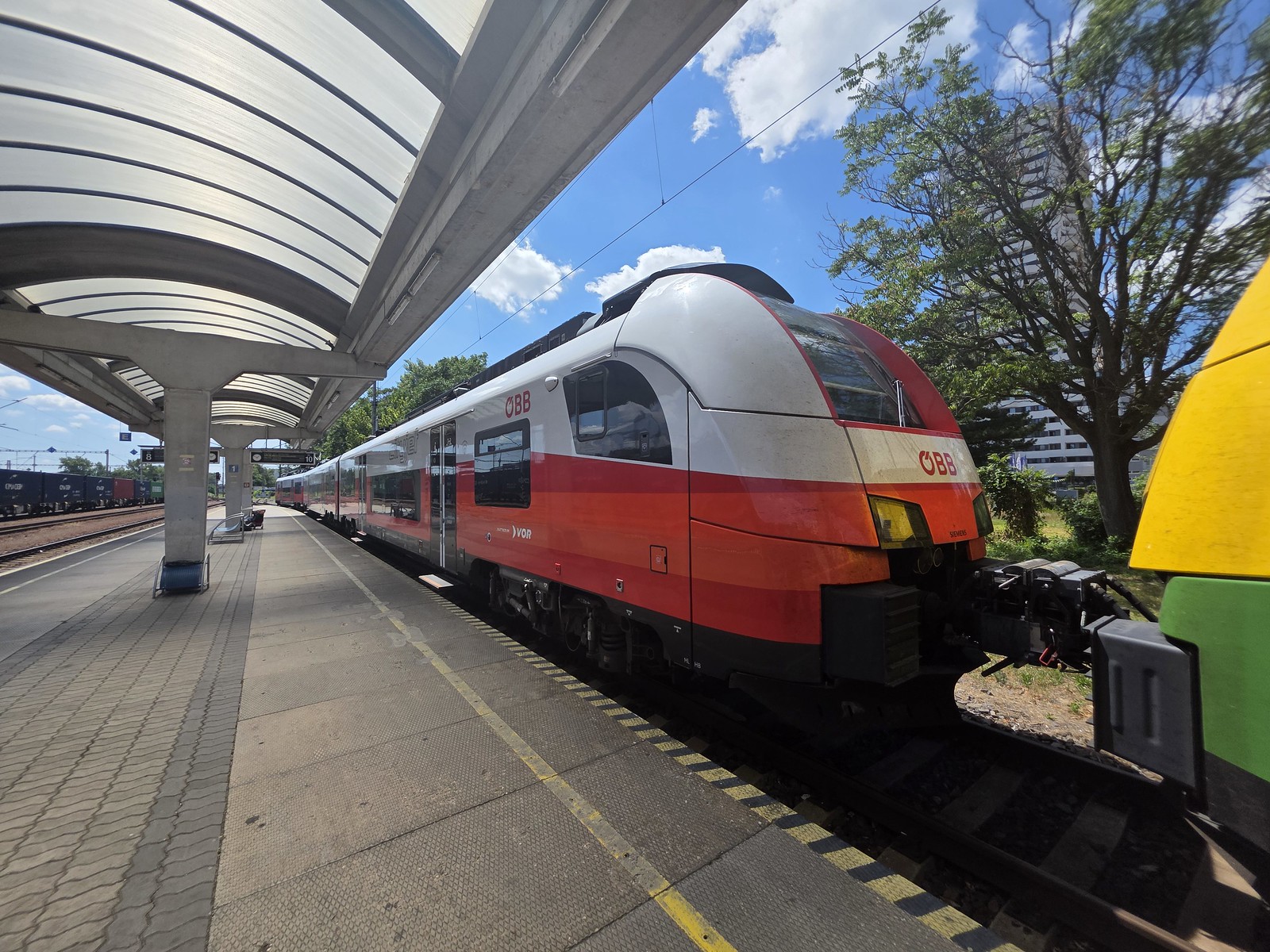
    In a typical European compromise, half the train is Slovakian and the other half in Austrian. This is the Slovakian bit.

    20250628_134947

    And here’s the Austrian bit.

    20250628_135017

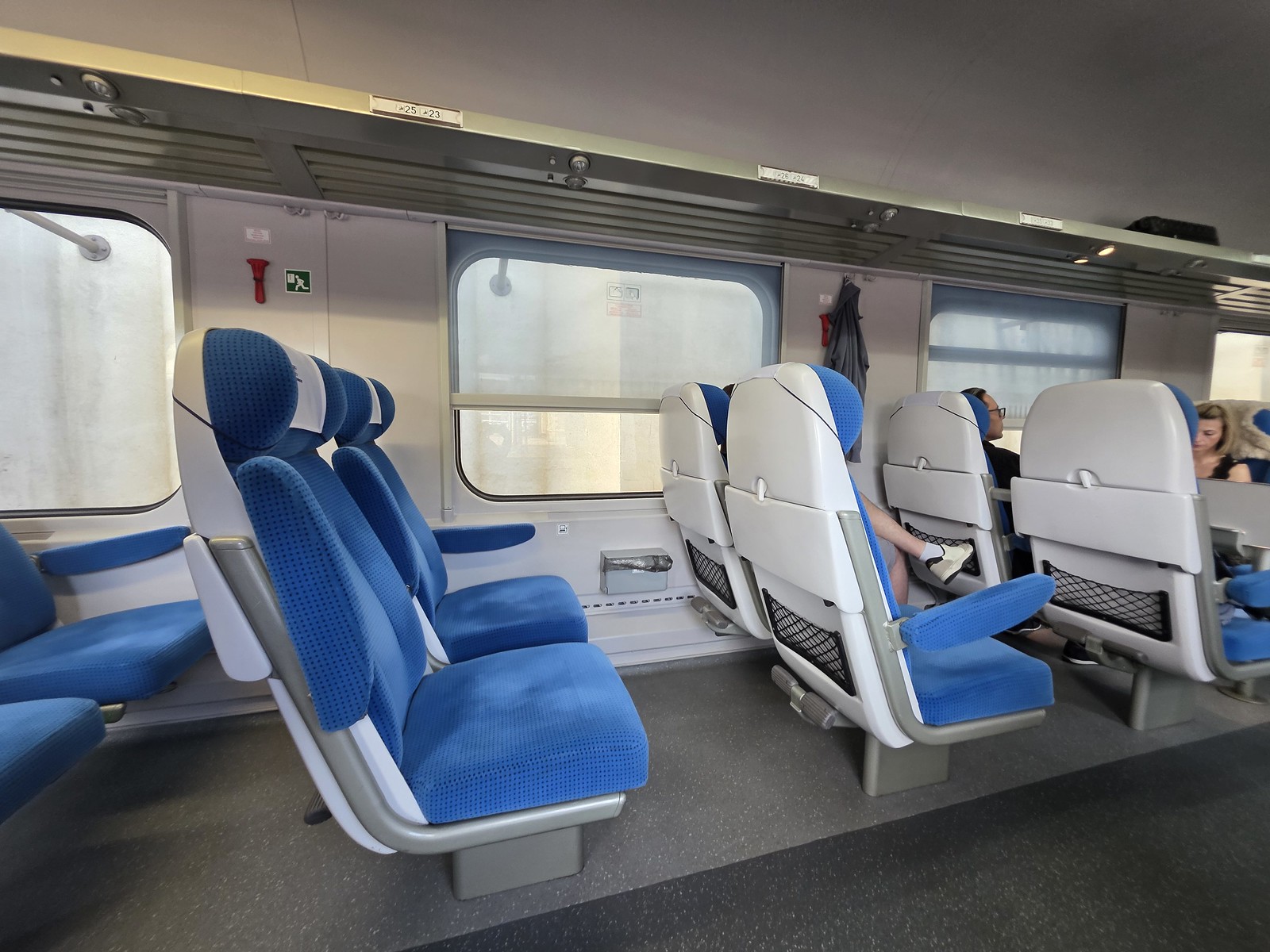
    The Austrian half had no tables, no power points and no air conditioning. It was also noticeably dirtier than the Slovakian half, but that must have been bad luck as I can’t imagine they have different cleaning teams (or maybe they do….).

    20250628_135327

    Which meant that I went to sit in the Slovakian half. There’s nothing decadent about either half of the train, neither have First class and neither have catering.

    20250628_135523

    I’m not convinced that this is the best place to put the power outlet, but there we go.

    20250628_152402

    Safely into Vienna’s main station on time. It was a smooth journey, costing just under £10 and taking just over an hour. There are no ticket barriers, but my ticket was checked en route and the staff member seemed friendly and personable, with the whole arrangement feeling organised with announcements in Slovakian, German and English. Crossing borders has never been so easy…..

  • Gdansk to Warsaw Rail Journey – PKP Intercity

    Gdansk to Warsaw Rail Journey – PKP Intercity

    20250619_142730

    I’ve done this rail journey before, but since I was enthused by my trip on Lithuanian trains last week, I thought I’d compare and contrast how the Poles do it. There are two main types of Intercity service in Poland, I went on the cheaper one of the two as I can’t afford to be too decadent, but that is relevant to bear in mind. The two are the Express Intercity Premium (EIP) using Pendolino trains and the more standard Intercity. I started from the rather glorious Gdańsk Główny railway station which has recently gone under a major overhaul. It was built in the early 1900s and has that glorious Neo-Renaissance look, all a bit Prussian with a touch of Hanseatic drama, like it’s trying to impress its then German parents.

    20250619_142833

    The main hall has been faffed about with quite a lot, but it remains an impressive structure and numerous people were taking photos of the interior. Obviously including me.

    20250619_142846

    They’ve put a lot of seating into the railway station and plenty of power points, although these departure boards weren’t working.

    20250619_142944

    The tracks and the city’s coach station is nearly visible in the background. Integrated transport and all that, all very positive, especially as the trams and city buses sweep past the front of the station.

    20250619_143005

    The restoration work doesn’t seem to be complete as two of the large halls are empty and the track is still fenced off at this point. I’m not quite sure what the plans are, but they’ll likely involve some more shops and eating options as there aren’t a great deal in this station as opposed to somewhere like Krakow’s main railway station.

    20250619_143112

    One of the empty grand rooms. There isn’t a luxurious first class lounge here as there was in Vilnius, or at least, not one that I could use.

    20250619_144341

    Also not working, but the yellow posters with all the train times were up, so that’s all that I needed.

    20250619_144404

    And I found a working departure board, my train was the 15:57 to Łódź. They like to advertise the platform numbers in advance in Poland, unlike the UK where they like to keep it a secret (unless you use the third party app which tells you).

    20250619_144714

    I like this system of giving a platform number, a track number and then a sector. Numbering on quite a lot of UK railway stations is confusing, somewhere like Cambridge is a case in point.

    And since I’ve gone down that rabbit warren, here’s a map courtesy of Greater Anglia. Platform 1 is the same as platform 4 and the same as platform 4a, but 2 and 3 are up to the left and 4 and 5 to the right. Then platforms 7 and 8 are over the footbridge. The Polish system would be much better here, you’d have Platform 1 as everything from 1 to 6 (which are then individually numbered) and Platform 2 as both 7 and 8. They’d then be split into sectors.

    20250619_144838

    Waiting on the platform, there’s lots of seating around.

    20250619_155613

    Boarding in coach 10 which it stated during the ticket purchasing process would be at the front of the train, so I knew roughly where to stand.

    20250619_155725

    The seats are 2*1, with every set of seats (whether a couple or individual) having its own power outlet and bin. It was all clean and tidy, not least because there were bins everywhere, it was all a delightfully neat setup that gave off strong “organised European” energy.

    20250619_155727

    Settled in for the journey and Poland is another of those countries where the seat reservations just work. I witter on about this, but on nearly every UK train where people are forced to get reservations there are arguments, often quite bad arguments. Many people ignore the seat reservations and there is tension when they’ve asked to move after they’ve settled in. In Poland, everyone sits where they’re supposed to sit. Many UK rail companies have given up with seat reservations entirely, not least Greater Anglia, but they might as well all give up if they’re not going to actually make them reliable. As an aside, as a top tip, I never sit in my reserved seat in the UK, I find the carriage which has no reservations (usually marked on certain third party apps) and sit there, it’s usually nearly empty as other people are trying to sit near their reserved seat.

    20250619_161603

    Crossing the river at Tczew, which I visited in 2022 because I wanted to see the bridge. We also went past the impressive Malbork Castle although no photos of that as it was on the other side.

    20250619_182301

    I had opted for the single seat and it was all sufficiently spacious with plenty of leg room. There was a small victory that my fluent Polish (mainly counting from 1 to 100 so I know when they call out the order number at fast food locations and also knowing the word for Wednesday) seemed to fool the guard that I was Polish. Well, that’s my story and I’m sticking to it.

    20250619_190555

    And safely into Warszawa Centralna railway station which I’ve written about many times, this photo is of the train whilst I was on the travelator thing. I then discovered it was a Public Holiday (Corpus Christi) and the supermarket I planned to go to was shut. But I went to a Żabka convenience store instead and nearly broke the self-service scanner trying to buy a pistachio mullermilch.

    This first class rail journey was around £17, which seems reasonable value to me. UK rail trips of the distance can be this price, but you can routinely get £17 fares on the Polish rail system for this journey even booking on the same day, which don’t require you to book three weeks in advance and go via their equivalent of Crewe (I’m not sure where that would be actually, maybe Kutno) with six split tickets. I do like the Polish network, it wasn’t quite as decadent as the train that took me from Vilnius to Kaunas, but it was still a very positive experience. Also, people on Polish trains don’t seem to feel the need to play music loudly from their phones or put their feet on seats…..

  • London – Turn Up Rail Fares in East Anglia in 2008

    London – Turn Up Rail Fares in East Anglia in 2008

    I’ve just found this old scan when clearing down my Evernote archive and I vaguely remember these prices when One Anglia ran the rail network in the East Anglia region. These are back from 2008, just before One Anglia was rebranded and this was when they were trying to make the walk-up fares seem affordable. It was still of course much cheaper at the time to book tickets in advance, although I note that the prices for accompanied kids has soared since then.

  • Warsaw to Ciechanów Train – PKP

    Warsaw to Ciechanów Train – PKP

    20250408_103444

    For reasons unknown to me, the hotel prices in Warsaw were excessively high which is unusual, so I thought I’d spent a night in Ciechanów as it’s only one hour away by train. I started from Warszawa Centralna, which I’ve written about numerous times before.

    20250408_095200

    Mine was the 11:00 to Kołobrzeg, which cost the equivalent of £6 despite booking in on the morning of the journey. I’ve also noted many times before that I love these yellow sheets of paper, they’re clear and informative.

    20250408_103448

    There we go, platform 2.

    20250408_104404

    Down the escalator.

    20250408_104454

    The UK have these screens, but they rarely work correctly in terms of getting you to stand in the right place for the carriage you’re booked into. This one worked perfectly for me.

    20250408_104956

    There we go and the train started in Łódź, it reminds me that I want to go there again soon.

    20250408_110024

    They still have corridor trains, although much of the seating is more as it is in the UK. The seats are comfortable, they come with double arm-rests so each person has one each (not that there was anyone else in my cabin thing) and power points.

    20250408_120020

    And arriving on time….

    20250408_120026

    The train departing off to northern Poland.

    20250409_092426

    And the new and shiny railway station.

  • Little Gifts from Network Rail

    Little Gifts from Network Rail

    Interrupting my riveting series of posts about concrete, thank you to Network Rail for these   🙂    I shall carry them both about and the bug thing might well appear in a few photos until I get bored of it or its head falls off.