
Category: Quincy

  • Quincy – Hancock Cemetery (Ebenezer Hayden)

    Quincy – Hancock Cemetery (Ebenezer Hayden)

    Back to my visit to the Hancock Cemetery in Quincy.

    This is the grave of Ebenezer Hayden, who was the son of John and Susanna, and he was born in 1645 and died on 13 February 1717. Colonial American history doesn’t get much older than this and Ebenezer married Anna and had three children, Ebenezer jr (born 13 April 1679), Ruth (born 19 November 1681) and William (birthdate unknown, but he married Sarah Hobart on 26 December 1726). Hayden was made a freeman in Boston on 15 May 1690, but lived most of his life in Braintree (which was effectively the same place as Quincy then).

    Hayden fought in the Suffolk Troop during King Philip’s War, also known as the First Indian War, which was a conflict lasting from 1675 until 1678. It was fought between the native Americans and the colonists, and although the numbers on each side were about even, the native Americans suffered greater losses. That time in the military meant that Hayden is now seen as a veteran of the US Army, hence the circular marker by his grave.

    I do wonder what these seventeenth-century colonists would make of the Braintree and Boston areas today……

  • Quincy – Hancock Cemetery (William Tompson)

    This is the earliest headstone in the Hancock Cemetery, dating back to 1666. William Tompson was a puritan and was also the first Minister in Quincy, apparently known for his “intellect and zeal”. Tompson was born in 1597 in Lancashire, England, and was educated at Oxford University. He came to New England in 1636 and was the Minister in Quincy from September 1639 until his death in 1666.

    Tompson’s son, Benjamin Tompson, is known as the first American poet and he was born in Braintree (which was later divided into two areas, one of which is Quincy) in July 1642 and he was educated at Harvard College. He died in April 1714 at the age of 71 and is buried in Roxbury, just to the south of Boston.

  • Quincy – Hancock Cemetery

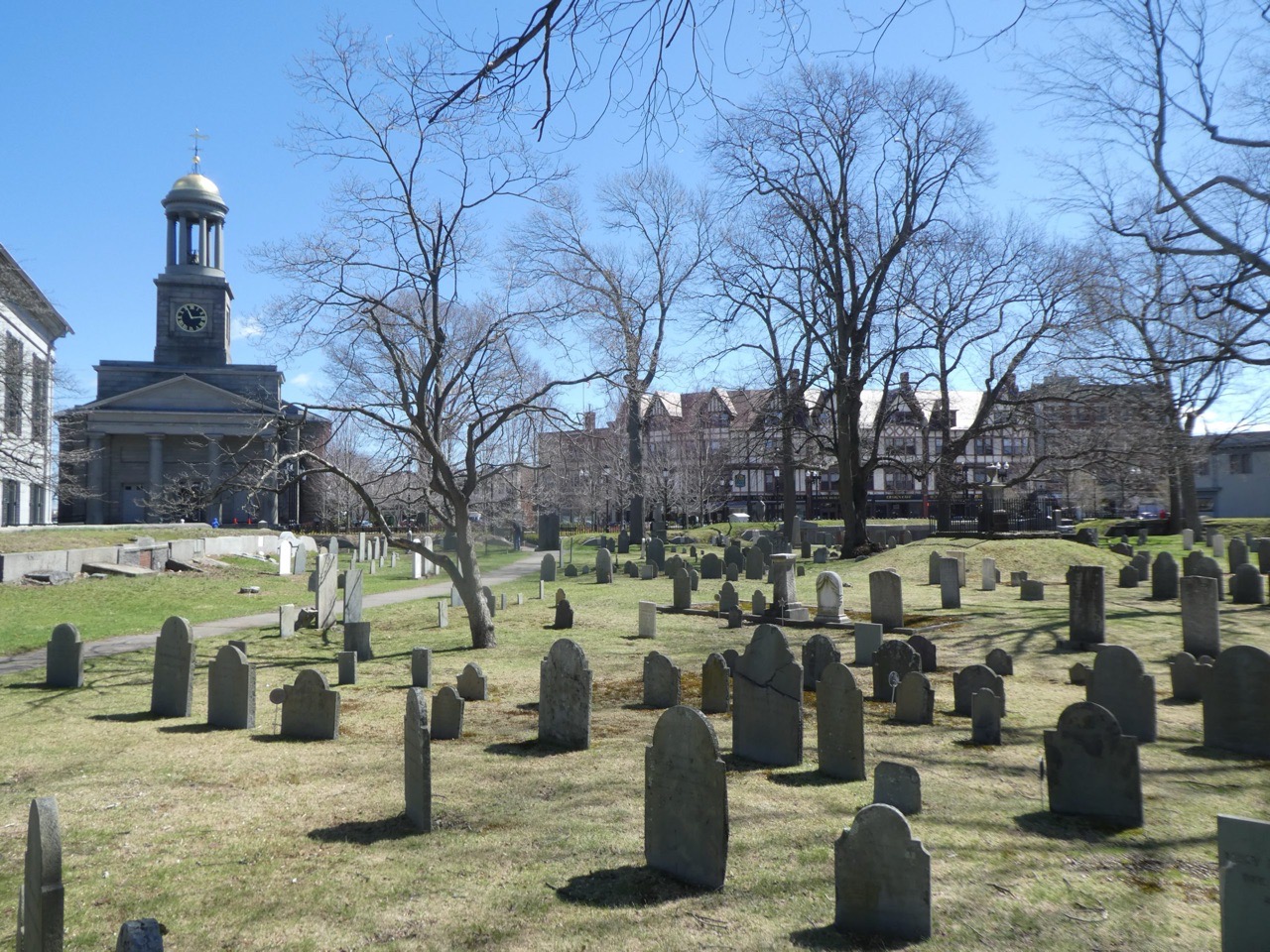
    Hancock Cemetery is located in the centre of Quincy and the first burial here was in around 1640. The former Presidents John Adams and John Quincy Adams were also buried here, although they were later moved over the road to the United First Parish Church.


    Some photos of the cemetery, which is in a good state of repair. There were little markers on many of the graves which indicated if the person had died in the revolutionary wars and I took several photos of what I considered to be interesting graves (which I’ll post about separately in due course).

    Many of the burials here were of Puritans and they often didn’t want grave markers, so there are many more people buried here than it might appear from the number of gravestones. The cemetery remained in use until 1854 when Mount Wollaston cemetery was opened.

  • Quincy – United First Parish Church

    This is the fourth church to have been built either on this site or nearby, with this building dating to 1828. I was fortunate that it has only just re-opened this week, so I was able to get a guided tour of the church.

    The interior of the church with everything being mostly original, including the pews, although the organ dates to the early twentieth century. The church uses granite donated by John Adams and it was designed in the Greek revival style.

    Visitors to the church are allowed to sit in the Adams Pew. There were two of us on the tour and the other person didn’t want to sit in the pew. But I did. So I did.

    There’s a little plaque marking that this was the pew used by the Adams.

    Interesting pulpit arrangement.

    A model of the earlier building. The lump of the wood in the corner is important as it’s an original part of the church in the model, it’s one of the supports in the tower.

    This weather vane is from the second church and it was moved to the third church. Someone pinched it, but it was reclaimed, although not before it had been used as target practice.

    However, it is in the crypt that the pride of the church is held, it’s the body of the second President of the United States and the first Vice-President of the United States, John Adams.

    As if having the remains of one President isn’t enough, the church has two. The other is John Quincy Adams, the sixth President of the United States. There’s only one other President who is buried in a church, which is Woodrow Wilson who has been laid to rest in Washington National Cathedral.

    There’s an optional charge for the tour of $5, which I paid as I thought that it was all just fascinating. The tour lasted for around 35 minutes and the crypt was kept until the end, and was a highlight. There’s another quirk of history, as both John Adams and Thomas Jefferson (the third President of the United States) died on 4 July 1826, exactly 50 years after the signing of the Declaration of Independence.