Category: Poland

  • Warsaw – Warsaw Pontiseum

    Warsaw – Warsaw Pontiseum

    20250402_144201

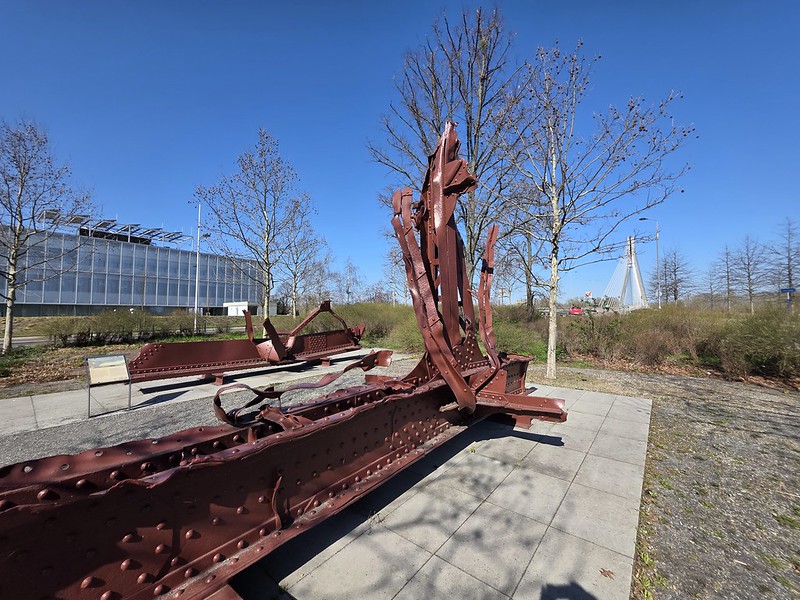
    It’s something of a grand title for these bits of bridge that are on display near the Vistula, but they do have an important heritage. It’s commemorating all of the bits of bridge that have been discovered at the bottom of the river since the Warsaw Uprising in 1944. They were lifted out of the river after seventy years by the Road and Bridge Research Institute in Warsaw. The name comes from ‘Ponte’, which is the Latin for bridge, and, well, ‘Museum’. I suspect my cleverer readers would have worked that latter part out themselves though. This little arrangement of bridge parts opened in 2014 and it’s stayed here near the river since then.

    Warsaw’s bridges were systematically targeted and destroyed, first by retreating Russian forces on August 5, 1915, and later by German troops during the Warsaw Uprising on 13 September 1944. So, it’s time for a table:

    Bridge Name Construction Dates Key Historical Notes
    Kierbedzia Bridge 1859–1864 First permanent steel bridge in Warsaw; Destroyed WWI (1915) & WWII (1944)
    Poniatowski Bridge 1904–1914 Destroyed WWI (1915) & WWII (1944); Rebuilt multiple times
    Bridge under the Citadel 1873–1875 Located near present-day Gdański Bridge; Destroyed WWI (1915) & WWII (1944)

    20250402_144016

    This is Kierbedzia Bridge, the first permanent steel bridge in Warsaw which was constructed between 1859 and 1864. It was designed by Stanisław Kierbedź and was a six-span steel riveted truss structure of the American type, vital for the city’s expansion and economic life. Its history mirrored Warsaw’s fortunes, being destroyed first by retreating Russian forces in the First World War (5 August 1915) and then by German forces in the Second World War (13 September 1944).

    20250402_144051

    This is Poniatowski Bridge which was built between 1904 and 1914. This was also destroyed during both the First and Second World Wars, in 1915 and then also on 13 September 1944. It must have annoyed the civil engineers who had built the thing, it stood for just one year before the Russians destroyed it. The replacement bridge opened in 1925, so that one managed to last nineteen years before it was destroyed.

    20250402_144120

    This is the Bridge under the Citadel which was a railway bridge constructed between 1873 and 1875, located on the site of what later became Gdański Bridge. Once again, this was destroyed in 1915 and 1944.

    These lumps of twisted steel are quite powerful, showing the determination to get them built to aid the country’s economy and then seeing them destroyed for defensive reasons in both World Wars. Fortunately, the replacements since the Second World War have fared somewhat better.

  • Warsaw – Metro System : A1 Kabaty (Visiting Every Station)

    Warsaw – Metro System : A1 Kabaty (Visiting Every Station)

    20250409_144202

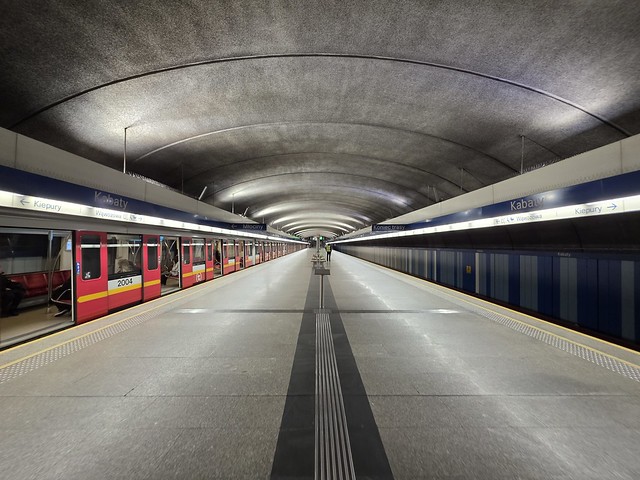
    Next on my little mission to visit the area around every metro station on the Warsaw network was Kabaty which is at the southern end of the M1 line. The physical commencement of the M1 line was officially marked by the driving of the first steel pile for the tunnel support structure in the Ursynów district on 15 April 1983 and this station opened on 7 April 1995, one of the first ones to open on the network.

    20250409_142532

    As a separate note, there’s excellent signage across Warsaw.

    20250409_143042

    This stone commemorates the life of Andrzej Ciołek of Żelechów (c. 1380 – c. 1448), a Polish Knight and Statesman. Rather notably, in 1404, he undertook a pilgrimage to Santiago de Compostela in Spain, reflecting his devoutness and I can imagine that it felt a long way from home at the time.

    20250409_142626

    It’s rather residential, which does limit me a little bit in this riveting post. A lot of this was empty fields when the metro station was first constructed, so there’s not a huge amount of history immediately visible around this metro station.

    20250409_143243

    Some sculptures in Park Przy Bażantarni. The name of the park translates to ‘By the Pheasantry’ referring to the historical royal pheasantry (Bażantarnia) that once stood nearby during the eighteenth century when the area was part of royal hunting grounds.

    20250409_143337

    A decorative bridge in the park.

    20250409_143418

    The Church of Blessed Władysław of Gielniów (Kościół Błogosławionego Władysława z Gielniowa), dedicated to a fifteenth century Polish Franciscan friar, preacher and poet known for his deep piety and role in promoting vernacular Polish religious hymns. He is one of Poland’s national patrons and the church has something of a modern design.

    20250409_144304

    Inside the station which is quite industrial and the architectural identity, like the other stations on the initial M1 segment, was shaped during the 1983-1985 design phase led by Metroprojekt, with Jasna Strzałkowska-Ryszka as the lead designer. It’s notable incidentally that there are no advertising hoardings all along the station which is somewhat different to many other countries around the world, the initial intention was to deliver an uncluttered public space.

  • Warsaw – Metro System : A8 Wierzbno (Visiting Every Station)

    Warsaw – Metro System : A8 Wierzbno (Visiting Every Station)

    20250420_110353

    Next on my side quest to visit every station on the Warsaw metro system is Wierzbno on the M1 line.

    20250420_110425

    The station is on the first stretch of the line that opened on the network on Friday 7 April 1995 and it’s a heavily residential area. The station took its name from the local area and the etymology of ‘Wierzbno’ itself traces back to the Polish word ‘wierzba’ meaning willow tree. While the initial Ursynów sections often utilised the cut-and-cover method, the segment running through Mokotów, including the area beneath Aleja Niepodległości where Wierzbno is located, predominantly employed underground tunnelling techniques, often carried out by experienced miners. The construction took nine years in total from when they started, but Poland had gone through some rather seismic political changes during this time.

    20250420_111102

    Translated, this sign says:

    “Ksawerów Street – Originally the name of the estate of Ksawery Pułowski (a landowner, collector and philanthropist), established in the mid-19th century near Królikarnia, which was also his property. Over time, the name became the name of the street.”

    20250420_111105

    And the street itself.

    20250420_111543

    Nearby is Park Granat which takes its name from Grupa Artyleryjska „Granat”, or the “Granat” Artillery Group which was a military unit of the Polish Home Army during the Second World War.

    20250420_111610

    As a general comment, the city has a lot of beautiful parks.

    20250420_113645

    There’s a memorial to the Granat unit in the park which specifically highlights the unit’s courageous fight during the Warsaw Uprising in the Mokotów district, which lasted from 1 August to 27 September 1944. The group fought significant battles in this area, suffering heavy casualties (around 230 killed out of 520 who participated). Some of the bravest of the brave.

    20250420_113935

    In this voyage of discovery, I didn’t realise that there was a sculpture park nearby, Park Rzeźby w Królikarni. It’s operated by the National Museum in Warsaw and they have sculptures of various ages located in this eighteenth century garden.

    20250420_114129

    This marble sculpture dates from 1985 and is ‘The Kiss’ by Maria Papa Rostkowska (née Baranowska, 1923–2008). During the war, she was active in the Polish resistance and she participated in the Warsaw Uprising of 1944 (as a messenger for the People’s Army) and along with her first husband Ludwik Rostkowski she helped rescue Jews from the Warsaw Ghetto. For her wartime bravery, she was awarded the Order of Virtuti Militari, Poland’s highest military decoration.

    20250420_114139

    This bronze sculpture dates from 2017 and is ‘Flor Diente’ by Xawery Wolski (1960-). The information panel notes that the work intentionally refers to the shape of a seed, tooth or flower bud, representing the unshakeable continuity of nature.

    20250420_114211

    A memorial to the Home Army.

    20250420_114259

    This concrete sculpture dates from 1935 and is ‘Wild Boar’ by Stanisław Komaszewski (1906-1945). He studied at the Academy of Fine Arts in Warsaw and exhibited internationally, but his career was brought to a premature end due to the Second World War and much of his artwork was destroyed during the conflict. He fought in the Warsaw Uprising and was arrested and then imprisoned in Dachau concentration camp and from there he was transferred to the Natzweiler-Struthof subcamp in Mannheim-Sandhofen, Germany, where prisoners were subjected to forced labour under brutal conditions at the Daimler-Benz factory. He died there on 24 January 1945 at the age of just 38.

    20250420_114635

    This granite sculpture dates from 1887 and is ‘Dog’ by Edouard-Léon Perrault (1828-1888). It was acquired by the museum just after the end of the Second World War and either this, or a copy, was displayed at the Salon in Paris in 1887.

    20250420_114558

    The palace here was destroyed during the Second World War, but was reconstructed and in 1965 it opened as a museum dedicated to Xawery Dunikowski.

    20250420_114839

    View from the rear of the palace.

    20250420_114824

    The back of the palace, it’s very English country house and when the gardens were laid out originally that was their intention.

    20250420_123924

    This granite sculpture dates from 1974 and is ‘Horizons’ by Magdalena Więcek (1924-2008). Born in Katowice, she studied painting and sculpture after the end of the Second World War, first at the State Higher School of Visual Arts in Sopot (1945-1949) and then at the Academy of Fine Arts in Warsaw (1949-1952) where she studied under Franciszek Strynkiewicz. Her early works in the 1950s were created during the Socialist Realist period and included figurative sculptures like Górnicy (Miners) and Matka (Mother). The information panel notes that an important aspect of perceiving the sculpture is how it changes along with the movement of the observer.

    20250420_124129

    An old bridge which leads to the palace.

    20250420_124345

    The old external wall of the palace.

    20250420_125118

    Back into the network.

    20250420_125133

    The interior and this is one of stations that was built as a civilian shelter in case some sort of global war broke out. That proved expensive and was dropped from later sections of metro building.

    20250420_125215

    The station map.

    20250420_125247

    It’s not the most decorative, but it’s functional.

    20250420_125206

    The station sign.

  • Warsaw – Beer and Bones Craft Beer Bar

    Warsaw – Beer and Bones Craft Beer Bar

    20250418_201813

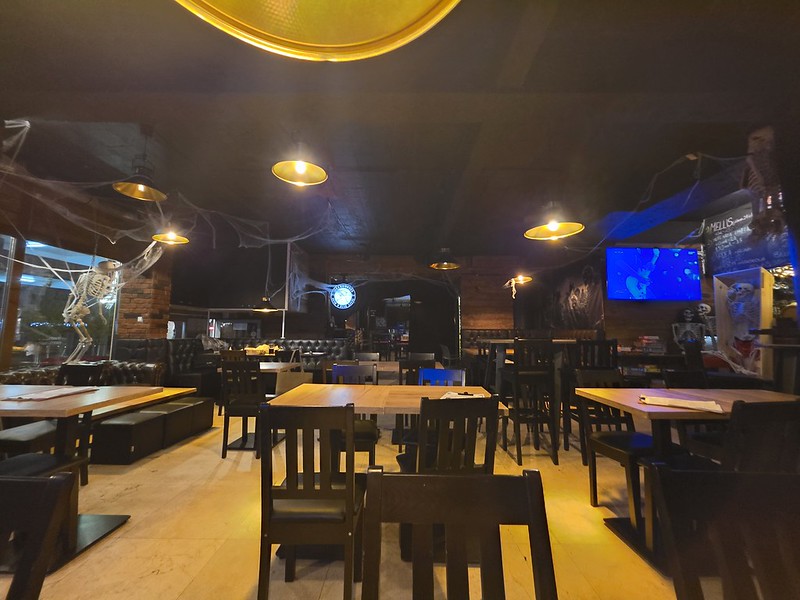
    Easter has caused some surprise and delight to the tram schedules in Warsaw and at times it feels like the logic is just to let the driver go wherever they fancy. However, after some faffing about whilst it poured down with rain, I managed to get to my intended destination of Beer and Bones whilst only being slightly damp.

    20250418_210059

    I wondered how busy it would be on a Friday night over Easter weekend, but there’s the answer.

    20250418_210056

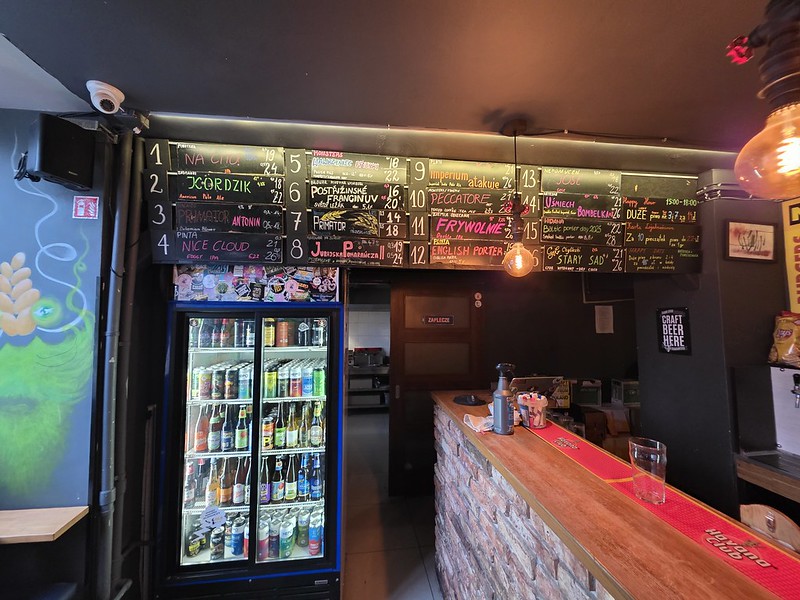
    The bar area and although the beer list isn’t clearly visible here, they put it on-line at https://beer-bones.ontap.pl/ for anyone who wants to peruse it. The service was friendly, immediate and welcoming, with the team members being knowledgeable about the beer offering.

    20250418_210908

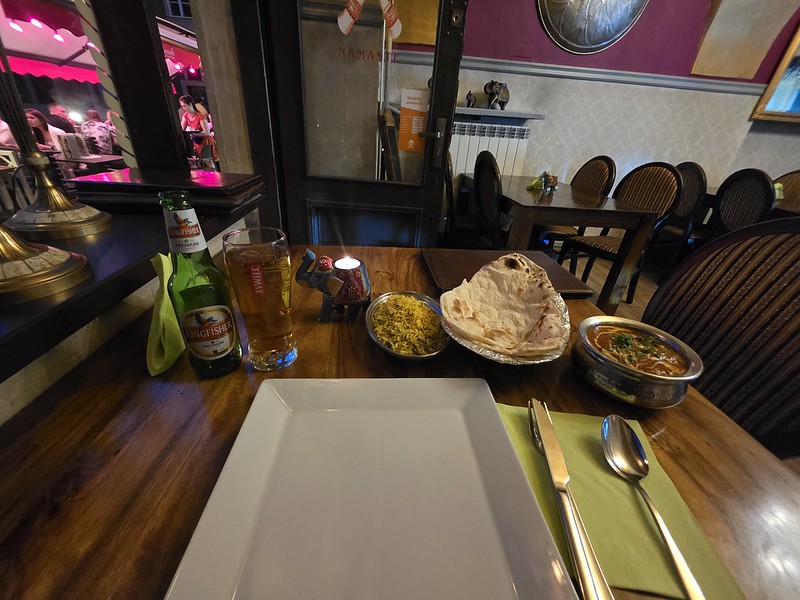
    I went for the chorizo burger with fries and it was better presented than this photo suggests. They didn’t bring cutlery, but who needs such devices anyway as a primal approach is just easier. The burger, as is usual in Poland, was cooked medium to be pink in the middle and it was juicy and the slices of chorizo added some extra flavour. I think I would have rather they cooked some sizzling chorizo up rather than using slices, but the taste was there. The chips were firm on the exterior and fluffy on the interior, with a heap of jalapenos to add to the mix. Really all rather delightful.

    The beer is the Sir Nick from Piwoteka and it’s cheesecake pastry stout. I thought that it was more like chocolate milk, but it was creamy and reasonably rich. The end taste was a little sweet and the flavours could have been a little more punchy.

    It’s a very decent bar and it’s located literally next door to Hopito, so a mini bar crawl isn’t exactly difficult. The welcome was friendly, the food was excellent, the beer selection was well curated and the pricing was moderate for the centre of Poland’s capital. All really rather lovely and it did get slightly busier during the hour or so I was in there. I’d add that the journey back was much smoother and the tram went in the same direction as I had anticipated it would.

  • Warsaw – Warsaw Ghetto (Leszno Street and Żelazna Street)

    Warsaw – Warsaw Ghetto (Leszno Street and Żelazna Street)

    20250419_112511

    I’ve tracked a lot of the Warsaw ghetto wall, but I can’t remember seeing this specific signage before and as the sign says, this is where the Leszno Street entrance to the ghetto was located. The Warsaw Ghetto was established by by the Nazis following German occupation and the area was formally sealed on 16 November 16 1940. There were initially 350,000 Jews walled into the ghetto, but that number soon increased to 460,000 as deportees from other areas arrived in the city.

    20250419_112509

    These maps are located in numerous places across the city, over-laying the location of the ghetto onto the current street plan. Leszno Street was one of the major pre-war streets enclosed within the initial ghetto boundaries established in November 1940. When the ghetto was effectively split into two sections (the “Small Ghetto” south of Chłodna Street and the “Large Ghetto” to the north) following boundary adjustments in late 1941 and early 1942, notably the exclusion of a section west of Żelazna Street between Leszno and Grzybowska Streets, Leszno Street remained a key east-west axis within the Large Ghetto.

    The incredible web-site at https://getto.pl/en gives a clear indication of what is happening here.

    20250419_112545

    What the area looks like today, with the line of the ghetto wall visible on the pavement of Żelazna Street.

    20250419_112527

    There’s the line of the former ghetto.

    20250419_112518

    The crossing today and, as ever, it’s very hard to try and envision what this area looked like in the early 1940s.

  • Warsaw – Potential Arson at the Wooden Bell Tower at the Cathedral of Our Lady of Victory

    Warsaw – Potential Arson at the Wooden Bell Tower at the Cathedral of Our Lady of Victory

    20250419_110209

    I frequently go on about the quality of life in Warsaw, the low crime, the low level of anti-social behaviour, the strong policing, the low litter and all manner of other positive attributes about the city. However, one of the historic buildings in Warsaw was lost a few days ago and arson has yet to be ruled out from the investigation.

    20250419_110306

    This bell tower is located next to the Cathedral of Our Lady of Victory and the wooden construction dated to around 1817. For reasons relating to German and Russian occupation, there’s not a huge amount that is old in Warsaw, so the loss of this is highly sub-optimal. It took fire fighters around two hours to put out and they have been able to save around 25% of the wooden structure and the bells in their steel frame also held up.

    20250419_110300

    The two bells, one of which dated to 1772, did quite well not to fall down and so it seems that they can be repaired and there is some excellent documentation of the structure from a few years ago. I don’t know the official titles, but the heritage people have already been on site to work out how to fix the situation. Knowing Poland, it’ll be fixed the next time that I go by and I rather hope that it transpires not to be arson.

    20250419_110310

    And a couple of graves located near to the bell tower.

  • Wizz Air (London Luton to Warsaw Chopin)

    Wizz Air (London Luton to Warsaw Chopin)

    20250417_141629

    I usually don’t write anything about the flights I take, but a change is as good as a rest and all that. I’m not sure that Luton Airport has really mastered the art of returning flights efficiently, but the security process is now quite efficient. I have to confess to pure idiocy during security when I managed to leave my belt on during the security scan. I blame the confusion on their policy of leaving liquids and laptops in the bag which throws my system. The member of security staff was though not deterred and, thankfully, my brief masterclass in how not to do security seemed to escape wider notice, preserving my fragile dignity in aviation matters.

    They announced the gate quite early, an hour before the flight, the delights of Gate 32 beckoned. Having endured the boarding methodologies back in my BA days, which often resembled a polite but ultimately confusing game of human Tetris, Wizz Air’s approach felt refreshingly straightforward. Every passenger knows, or should know, where to go from signage and they didn’t take long to board everyone. Admittedly, that leads to a lot of waiting on the stairs in the airport terminal to board, but at least it feels efficient although it’s less ideal for people who prefer to have a little sit down rather than balance themselves and their luggage on steps.

    20250417_143213

    The aircraft was ready and for the sake of completion, the registration is 9H-wNE, the same aircraft I went from Gdansk to London Luton on a few months ago. It’s hard not to make that sound quite geekish, but as a reminder, for my two loyal blog readers who can’t remember, it’s an Airbus A321 which was delivered to Wizz Air in March 2024. Feel free to use that aviation nugget of information at your next dinner party, instant social success guaranteed…..

    20250417_144703

    I’ve had a long series of good fortune from the seating Gods where I’ve been aisle or window seats, but that luck had run out for this flight when I was randomly given a middle seat. I always vaguely hope that one of the passengers doesn’t turn up, but they both did. Both were Polish, the one by the aisle fell asleep for most of the flight and the other managed to consume several Polish beers and then needed me to wake up the aisle guy from his hibernation for obvious reasons. I’m not sure that they entirely managed to follow my rule of letting the middle seat passenger have the arm rests, but since that’s a rule I’ve created it’s one that’s hard to enforce. Fortunately, this isn’t a long flight and two hours later we were landing into Warsaw.

    The crew on the flight were well presented, engaging and efficient, although that’s the normality for Wizz Air flights I’ve found. Announcements from the pilots were in Polish with a shorter English version following soon after and the safety briefing was completely in a way that the CAA would be pleased by.

    The delights of Warsaw always excite me, so I didn’t even mind that it was a bus that took us to border control. Most passengers on the flight were Polish or had EU passports, so the queue for my passport to be stamped was relatively short. The border agent was friendly and for this visit didn’t require a detailed explanation of my life before letting me into Poland. The flight is with my Multi Pass, which I’m still moderately obsessed with, so it cost just £8.99. Armrest battles aside, Wizz Air delivered the goods once again as far as I was concerned.

  • Warsaw – Reason Behind Hotel Bristol Name

    Warsaw – Reason Behind Hotel Bristol Name

    20250417_204633

    This is an aside, just because it loops back to a post I wrote a few days ago about Frederick Hervey, the 4th Earl of Bristol (1730–1803). This rather decadent hotel in Warsaw was constructed between 1899 and 1901 on the site of the former Tarnowski Palace, opening to the public on 19 November 1901. Unusually for central Warsaw, some of the structure remained standing after the Second World War as the Germans had been using it themselves, meaning that it could be re-opened relatively quickly at the end of the conflict. It was taken over by Orbis, who today are known for running all Accor hotels in Poland amongst numerous other things, with plans to demolish it in the 1970s fortunately disregarded. It’s now part of the Marriott chain, but I rather like the link to Ickworth House with the hotel name, which has remained unchanged since 1901.

  • Warsaw – Metro System : C4 Bemowo (Visiting Every Station)

    Warsaw – Metro System : C4 Bemowo (Visiting Every Station)

    20250418_113542

    Next on my expedition to visit every metro station in Warsaw was Bemowo, at the western end of the M2 line. Construction of the station started in 2019 and it opened for passenger usage on 30 June 2022, with the station name being simply the name of the district that it’s located in, although during planning it was named after the street it’s on, ‘Powstańców Śląskich’. It’s a residential area of the city and something of a transportation hub, so the extension out here seems rather sensible.

    20250418_113630

    The Church of the Roman Catholic Parish of St. Luke the Evangelist which was constructed in 2001, with the parish having been established in December 1992 by Cardinal Józef Glemp. The first Holy Mass had been celebrated on May 31, 1990, at the site of the future church.

    20250418_113657

    It might have my initials, but I can’t imagine me starting a construction company on the grounds I’m not keen on changing light bulbs.

    20250418_113822

    The sculpture of General Józef Zachariasz Bem (1794–1850) who was a Polish military leader and national hero of both Poland and Hungary. He began his career in the Napoleonic Wars and rose to prominence during the 1830–1831 November Uprising in Poland, where he earned a reputation as a skilled artillery commander. Later, he played a key role in the Hungarian Revolution of 1848, leading forces in Transylvania to several significant victories against Austrian and Russian troops. His leadership, courage and tactical brilliance made him something of a beloved figure in both nations given how much he had surprised and delighted the populations. Following the collapse of the revolutions, Bem sought refuge in the Ottoman Empire, where he converted to Islam and continued his military career under the name Murad Pasha. He died in exile in Aleppo in 1850, although his remains were later brought back to Poland. Despite his exile, Bem’s legacy endured as he is remembered as a symbol of cross-national solidarity and the shared fight for independence, with statues and memorials honouring him in both Poland and Hungary.

    20250418_114802

    Looks a bit industrial. This was on my way to look at the nearby Górczewska Park.

    20250418_115328

    This text reads “SÁNDOR PETŐFI 1823 – 1849, Outstanding Hungarian poet Adjutant to Gen. J. Bem, Fell for freedom”. Unless my two loyal blog readers have already forgotten from two paragraphs ago, they already know about General Bem. Sándor Petőfi was a legendary Hungarian poet, revolutionary and something of a national hero. He is widely regarded as Hungary’s national poet and was one of the key figures of the Hungarian Revolution of 1848. Petőfi’s poetry, full of passionate calls for liberty and national pride, inspired revolutionary fervour among Hungarians. His most famous poem, “Nemzeti dal” (“National Song”), played a central role in igniting the revolution.

    20250418_115354

    The park’s amphitheatre which was opened in 2008 and which can seat up to 1,000 spectators. From 2009, it was named the Michael Jackson Amphitheatre, which didn’t delight everyone and they took the name away in 2019 as it became too controversial. It was originally given this name because he did some sort of musical event at the nearby airport, Warsaw-Babice Airport.

    20250418_115503

    Some trees and a park seems a sensible place to put them.

    20250418_115506

    A hill in the park with a playground on it.

    20250418_121325

    It started raining so I thought that I’d better get back.

    20250418_121546

    Going down the steps.

    20250418_121609

    The station design which seems less decadent than they could have made it given that it’s a new station and the ones before looked, well, more jazzy. The plan was to use weathering steel, or Corten Steel, as apparently this rustiness looks interesting. I’m not entirely convinced, but there we go.

    20250418_121623

    The ever useful metro map. The task of constructing the C4 Bemowo station, along with the preceding C5 Ulrychów station and connecting tunnels, was awarded to a consortium comprising the Turkish company Gülermak Ağır Sanayi İnşaat ve Taahhüt A.Ş. as the leader, and the Italian company Astaldi S.p.A., both of whom had experience in building other bits of the network in the city. While the station box itself was constructed using the cut-and-cover method, typical for Warsaw Metro stations, the connecting tunnels were bored using Tunnel Boring Machines (TBMs), which were named “Krystyna” and “Elisabetta”.

  • Warsaw – View of the City from 1850

    Warsaw – View of the City from 1850

    Slightly randomly, as is the central theme of this blog, I rather liked this view of Warsaw from around 1850 as I hadn’t seen it before. Created by Adam Pilinsky, it’s from the Praga side (or east bank) of the city looking into the central area that is now known as the Old Town.